AI News
The AI Chip Rush Is Creating a Second Market for Inference Software
DeepSeek chip plans, ZML inference tools, and AI chip supply pressure show that the hardware rush is spawning a software market around it.
Read Article →
DeepSeek chip plans, ZML inference tools, and AI chip supply pressure show that the hardware rush is spawning a software market around it.
Coverage of AI agents, identity security, MCP profiles, and enterprise governance shows that autonomy now depends on identity infrastructure.
Meta’s AI image tools and photo access questions show that privacy is turning into a product constraint rather than a policy add-on.

Reports that OpenAI will publicly release GPT 5.6 after a government-requested delay show that model access is now a policy lever.
GitLab, enterprise readiness surveys, and workflow-first adoption signals show that enterprise AI is moving from experimentation to proof.

Meta’s admission that AI agents are progressing more slowly than expected, combined with its storage and cloud restructuring, shows how hard it is to turn capex into product leverage.

Anthropic’s Teresa Carlson hire, government code-auditing work, and recent trust controversies point to a bigger move: public sector channels are becoming a key AI distribution layer.

DeepSeek’s reported chip project and the latest Nvidia weakness point to a compute market that is starting to reward control, efficiency, and financing discipline over raw scale.

Google’s latest AI data-use controversy and chatbot security reports show that consent, defaults, and safe failure are now as important as model quality.

Beijing’s reported move to curb overseas access to China’s top AI models reveals that model distribution, not just model quality, is becoming the real power center.
UN warnings about killer robots, child protection, and inclusive AI show governance is moving from speeches to institutions.
Leaked financial talk, IPO speculation, and token-payment scrutiny are turning OpenAI into a capital-markets story.
A Treasury warning, market skepticism, and leverage concerns are making the AI bubble debate harder to dismiss.
Reports that Nvidia’s next-generation Kyber rack slipped to 2028 suggest the AI bottleneck is now physical, not conceptual.
Anthropic’s reported 20-year Kentucky lease with TeraWulf turns AI demand into a power, land, and financing story.
Agentic AI is creating identity and access risk faster than enterprise security teams can normalize it.
OpenAI’s GPT-5.6 release limits point to a model market where access rules matter as much as benchmark scores.
Palantir and Nvidia’s government AI push shows sovereign infrastructure is becoming the premium AI market.
Amazon’s custom chip push and AI-spending financing turn AWS into a capital-intensive hardware and infrastructure play.
Meta’s WhatsApp and Messenger agent rollout, plus token-based pricing, pushes social messaging into metered AI commerce.
Voters increasingly ask chatbots and AI systems for political guidance, raising new questions about trust, bias, and election integrity.
OpenAI’s reported proposal to hand the Trump administration a 5% stake turns AI oversight into a question of ownership, leverage, and public power.
Nvidia’s compute-at-scale push and revenue-share experiments show that AI infrastructure is becoming a financing market, not just a chip market.
Meta’s admission that AI agents are progressing more slowly than expected is a useful reminder that autonomy is harder to ship than to demo.

Anthropic’s push to tighten Claude Code access for Chinese users turns a coding tool into a live test of export control, trust, and AI geopolitics.
Amazon’s push toward in-house AI chips for devices signals a broader move toward edge AI, cheaper inference, and more control over the hardware stack.
Meta’s Muse Spark push suggests the company is trying to rebuild its AI story around coding, agents, and a tighter model stack.

Google’s Gmail Live beta points to a future where the inbox behaves like a conversational workspace instead of a static message list.
Cloudflare’s new crawl controls turn AI content access into a billing and permission problem for publishers.
Anthropic’s move into drug discovery reframes AI for science as workflow infrastructure, not a one-off research demo.
Ars Technica’s reporting on Google’s 2025 power use shows why AI infrastructure is colliding with utilities, siting, and carbon goals.
Bloomberg’s report that Meta may sell AI computing power suggests internal infrastructure is becoming a product category, not just a cost base.
Nvidia’s startup compute program suggests the infrastructure vendor wants upside in addition to silicon sales, changing the economics of AI company formation.
Microsoft’s $2.5 billion Frontier Company push with 6,000 employees suggests AI transformation is becoming a managed service, not a DIY software purchase.
Reported talks over a 5% U.S. government stake suggest OpenAI is now negotiating for political room to operate, not just model quality.
New reporting on AI privacy shows the next fight is not about vague warnings but about whether device, browser, and platform defaults can keep people from leaking themselves to AI systems.
Cisco’s move to put AI agents in front of 90,000 employees is a sign that enterprise AI is shifting from optional copilots to managed internal labor.
The latest wave of Chinese model progress suggests the frontier is less about one universal benchmark leader and more about a fast-moving, price-sensitive contest across ecosystems.
Meta’s reported move to commercialize excess AI compute suggests the boundary between internal infrastructure and external cloud product is getting much thinner.
The Bank for International Settlements warning about AI investment excess is a reminder that the next AI shock may show up in credit, valuations, and balance sheets before it shows up in the product.
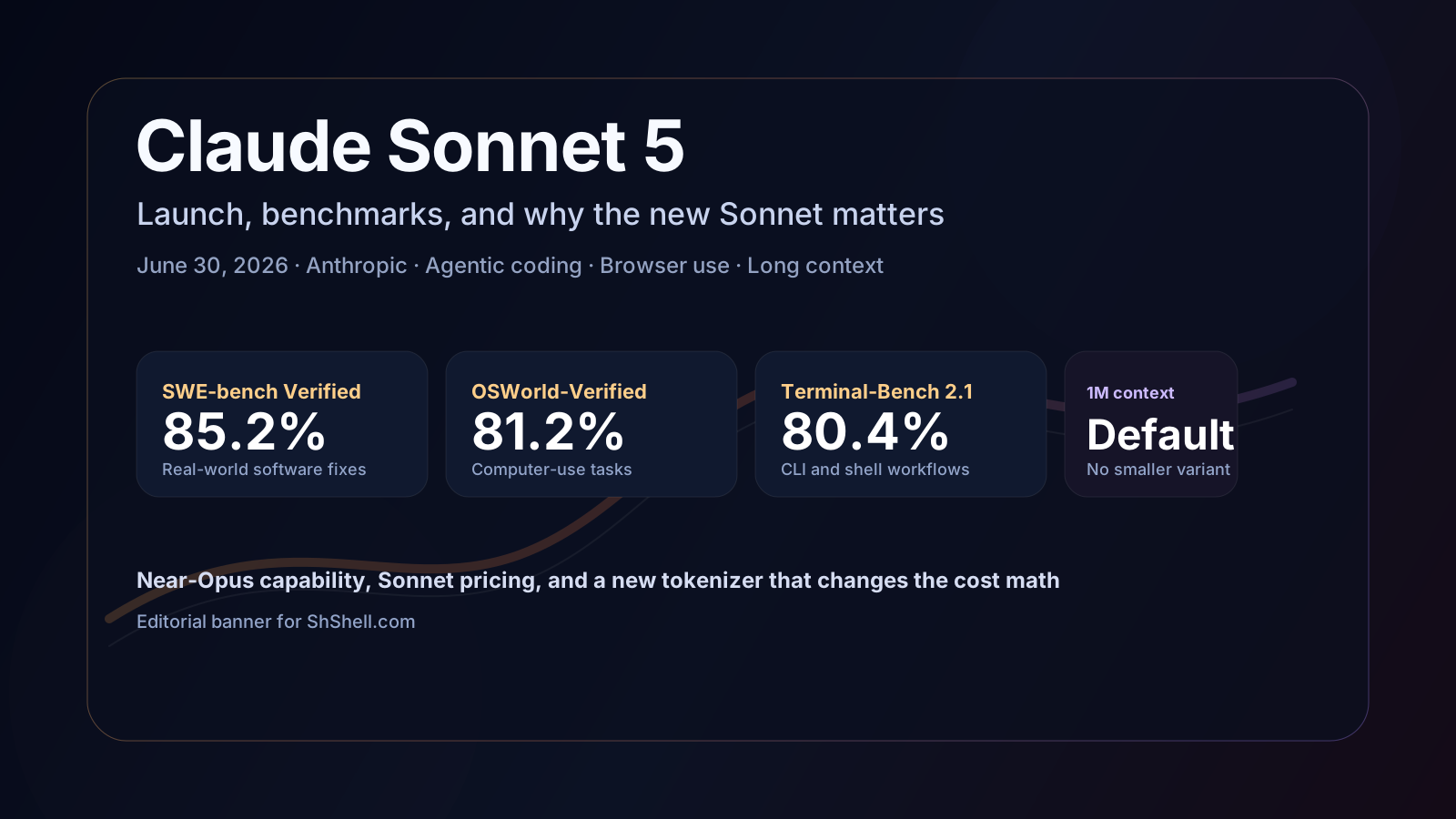
Anthropic's June 30 launch of Claude Sonnet 5 pairs a 1M-token context window and new defaults with benchmark gains that matter for coding and agents.

The AI market no longer behaves like one category. Consumer assistants, enterprise copilots, regulated vertical tools, and sovereign stacks now buy on different rules.

Access tiers, rate limits, regional rollouts, and human review are no longer back-office details. They are now part of how AI products reach users and earn trust.

The enterprise AI buyer no longer wants only a correct answer. The buyer wants evidence: citations, traces, approvals, and a defensible path from source to output.

The most valuable AI products are moving beyond raw model quality and toward systems that learn from every click, correction, approval, and failure.

AI assistants are learning to remember people, projects, and preferences across sessions, but that same memory becomes risky the moment personal convenience meets enterprise policy.

Anthropic’s cyber-threat analysis suggests attackers are using AI deeper in the kill chain than older frameworks assume, exposing a gap between observed behavior and what MITRE ATT&CK can fully describe.

Copilot Cowork's GA release points to a larger shift: Microsoft is turning Copilot into a usage-priced task runner with plugins, Work IQ context, and always-on agent behavior.

Google is wiring Gemini directly into Google Business Profile and Business notebooks, pushing the product beyond chat and toward a practical operating layer for small businesses.

Google's new DiffusionGemma release is less about beating every benchmark and more about proving that speed, editability, and inference efficiency can justify a different model architecture.