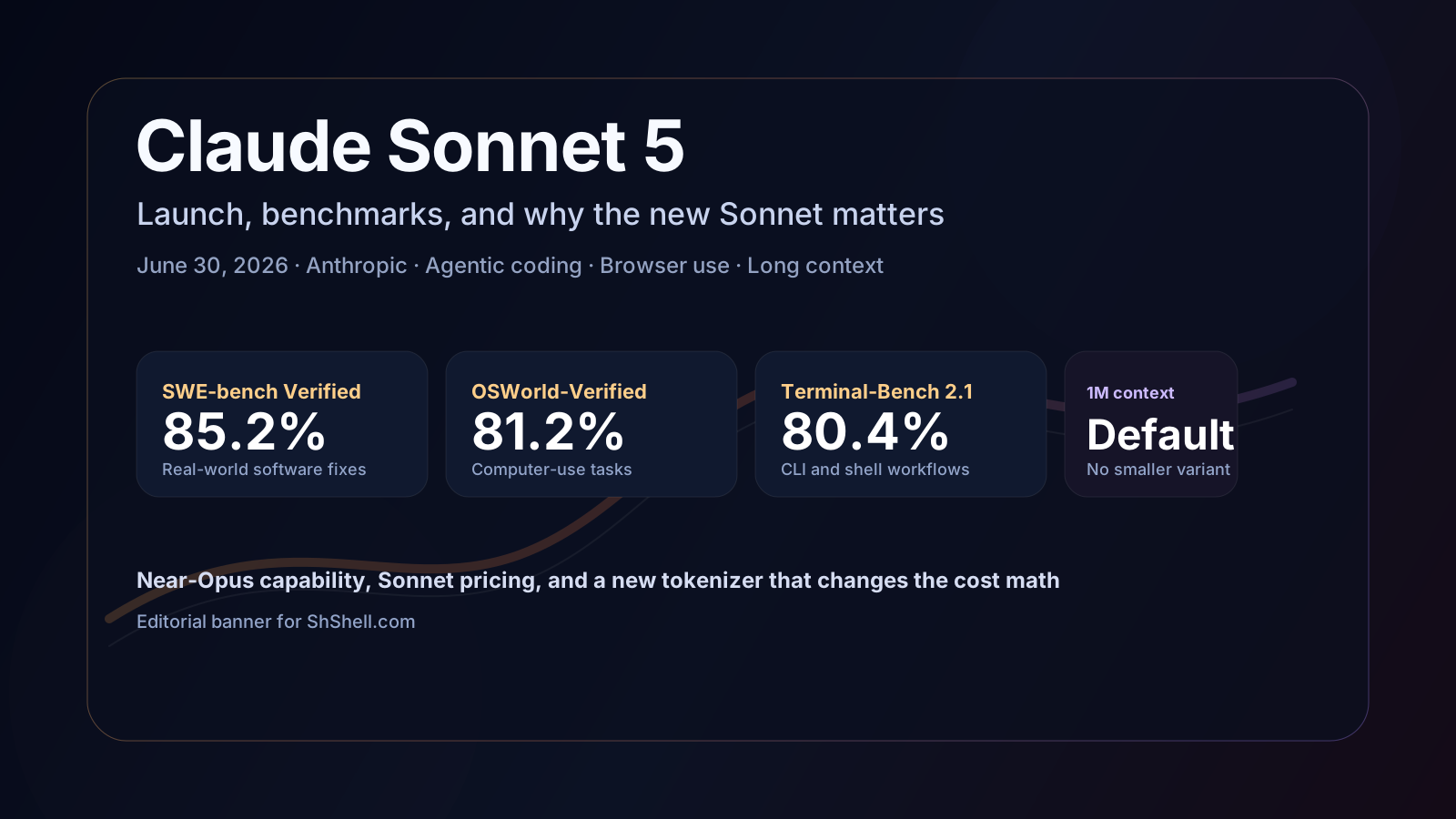
Claude Sonnet 5 Launch Explained: What Changed, When It Landed, and Why the Benchmarks Matter
Anthropic's June 30 launch of Claude Sonnet 5 pairs a 1M-token context window and new defaults with benchmark gains that matter for coding and agents.
Anthropic did not just ship another Sonnet model on June 30. It moved the model line that made agentic AI feel practical one step closer to Opus-class capability without asking customers to pay Opus-class prices.
That is the real story behind Claude Sonnet 5. The announcement is easy to summarize as a normal model release, but the release itself is more interesting than the headline. Anthropic is telling developers that the middle tier is no longer the compromise tier. Sonnet 5 is meant to plan, browse, call tools, hold a long context window, and keep going when the task is messy, multi-step, and slightly irritating in the way real work always is.
If you only skim the launch post, you miss the bigger shift. Sonnet 5 is not just a bigger number than Sonnet 4.6. It is a statement about what the company thinks the market needs right now: a model that can act like a serious operator, not merely a fluent responder.
That matters because the market has spent the last year splitting into two camps. One camp still buys models for chat. The other buys models for work that needs follow-through, tool use, and memory across a long chain of steps. Claude Sonnet 5 is clearly aimed at the second camp.
What Anthropic actually shipped on June 30
The launch date is clean and unambiguous: June 30, 2026. Anthropic’s product post says Sonnet 5 is the most agentic Sonnet model yet. It can make plans, use browsers and terminals, and run autonomously at a level that, only a few months ago, required larger and more expensive models.
That is not marketing fluff. It is a deliberate positioning move.
Anthropic also says Sonnet 5 is available across all plans from day one. It is the default model for Free and Pro users, available to Max, Team, and Enterprise customers, and shipping in Claude Code and the Claude Platform. On the developer side, the API model ID is claude-sonnet-5.
The pricing is equally important. Anthropic launched the model at an introductory rate of $2 per million input tokens and $10 per million output tokens through August 31, 2026. After that, standard pricing rises to $3 per million input tokens and $15 per million output tokens. In other words, Anthropic is not trying to sell Sonnet 5 as a luxury product. It is trying to sell it as the practical default for ambitious work.
There is one more subtle but important part of the launch: the model ships with a 1M token context window by default. That is both the default and the maximum. There is no smaller context variant. The max output limit is 128k tokens. For teams that have been building around multi-document analysis, long codebase work, or long-running agents, that changes the ceiling in a very real way.
Put simply, the launch is not just about intelligence. It is about endurance.
The three changes developers will feel first
The headline benchmarks matter, but many teams will notice the API behavior before they notice the charts.
The first change is that adaptive thinking is on by default. Anthropic says that if you send a request without an explicit thinking field, Sonnet 5 will use adaptive thinking automatically. If you want thinking off, you have to say so. That sounds like a small configuration detail, but it changes how developers should think about token budgets. If a workload used to run without reasoning overhead on Sonnet 4.6, it may now consume more of the available output budget unless the application is adjusted.
The second change is stricter request handling. Anthropic says non-default values for temperature, top_p, or top_k now return a 400 error. That means the familiar instinct to tweak sampling as a general-purpose fix no longer applies here. The model is being pushed toward instruction quality, system prompts, and effort settings rather than ad hoc sampling knobs.
The third change is that manual extended thinking is gone. The old pattern of thinking: {type: "enabled", budget_tokens: N} is no longer supported on Sonnet 5. Anthropic wants developers to move to adaptive thinking and the effort parameter instead.
Those three changes point in the same direction: Sonnet 5 is meant to be used like a serious agentic model, not like a chat model with a few extra screws to turn.
The tokenizer change is part of the same story. Anthropic says the new tokenizer produces roughly 30% more tokens for the same text, though the exact increase varies by content type. That means token budgeting is no longer a bookkeeping footnote. It is part of migration planning. If you were already cutting it close on max_tokens, you now need to revisit those limits.
Why the launch timing matters more than the launch slogan
Anthropic did not release Sonnet 5 into a quiet market. It arrived after months of customers getting comfortable with agentic workflows and discovering how often those workflows fail for boring reasons: the model stops too early, drops context, misroutes a tool call, or loses the thread across a long task.
That is why the timing matters. Sonnet 5 lands when the market is no longer asking whether agentic AI is useful. The question is now which model can survive enough real work to make the category operational.
Anthropic’s own launch framing is revealing. The company says Sonnet 5 narrows the gap to Opus 4.8, but at lower prices. That is the part enterprises care about. If a model is 90 percent as useful for 70 percent of the cost, the cost model changes. If it is 95 percent as useful for half the bill, the procurement conversation changes even more.
That is also why the model is being compared not only on coding benchmarks, but on browser work, computer use, document QA, chart reading, and multi-step reasoning. Anthropic knows the market is moving beyond raw text generation. People want models that can move through interfaces, handle evidence, and finish the task without needing a babysitter.
The launch timing also lines up with a broader industry shift: buyers are becoming less impressed by models that are dazzling for five minutes and more interested in systems that can hold up through an hour of work. Sonnet 5 is designed for the second group.
How the benchmark story should be read
The benchmark image on the launch page is the flashy part, but the system card is where the useful details live. Anthropic’s evaluation summary shows Sonnet 5 taking a broad step forward across coding, agentic search, computer use, multimodal reasoning, and professional work.
Here is the cleanest snapshot from the launch materials:
| Benchmark | Claude Sonnet 5 | Why it matters |
|---|---|---|
| SWE-bench Verified | 85.2% | Real-world GitHub issue fixing |
| SWE-bench Pro | 63.2% | Harder, longer-horizon code tasks |
| SWE-bench Multilingual | 78.3% | Code repair across 9 languages |
| SWE-bench Multimodal | 28.1% | Issues with visual context |
| Terminal-Bench 2.1 | 80.4% | Command-line, shell, and terminal work |
| CursorBench | 61.2% | Production-style coding agent tasks |
| BrowseComp | 84.7% single agent, 86.6% multi agent | Hard-to-find web information |
| OSWorld-Verified | 81.2% | Real computer-use workflows |
| ChartMuseum | 70.1% no tools, 86.7% with tools | Chart understanding |
| CharXiv Reasoning | 77.0% no tools, 88.3% with tools | Scientific chart reasoning |
| OfficeQA | 73.3% | Document-heavy enterprise work |
| Humanity’s Last Exam | 43.2% no tools, 57.4% with tools | Frontier knowledge and tool use |
| USAMO 2026 | 79.5% | Hard proof-based mathematics |
| ArxivMath | 65.7% no tools, 72.2% with tools | Research-level math |
That table looks impressive, but the more important question is what kind of work each number represents.
SWE-bench tells you whether the model can work on actual codebases instead of toy snippets. Terminal-Bench tells you whether it can survive in the command line long enough to act like a real assistant. BrowseComp and OSWorld tell you whether it can move through the web and a desktop environment without losing orientation. ChartMuseum and CharXiv tell you whether it can read charts with enough care to be useful in analytic work. OfficeQA, Humanity’s Last Exam, and the math benchmarks tell you whether it can handle dense professional and academic material without collapsing into vague text.
That spread matters more than any one score.
A model that is merely good at one benchmark can be exciting but narrow. A model that is consistently strong across coding, agents, documents, and computer use is what product teams can build around. Sonnet 5 looks like that kind of model.
What the coding numbers are really saying
Coding is still the cleanest proxy for whether a model can do multi-step work without falling apart. That is why the coding benchmarks sit at the center of the Sonnet 5 story.
SWE-bench Verified at 85.2 percent is the headline number because it measures whether the model can fix real issues in real repositories. That is not the same thing as producing a decent answer in a chat box. It is closer to what teams actually need from coding copilots: understand the repo, identify the bug, make the change, and land a patch that survives review.
SWE-bench Pro is even more telling. At 63.2 percent, Sonnet 5 is handling a harder variant with larger, multi-file diffs and less leakage from public ground truth. That is a more honest test of long-horizon engineering than many people realize. In the real world, the problem is rarely “write a function.” The problem is “read the repo, find the state flow, adjust three files, and do not break the build.”
Terminal-Bench 2.1 at 80.4 percent is the other half of that picture. A model can be clever in code and still be clumsy in the shell. Anthropic’s score says Sonnet 5 is handling command-line tasks with enough competence to be useful in agentic workflows, not just in static code completion.
CursorBench at 61.2 percent is valuable because it reflects a more product-like environment. The score is not a lab curiosity; it is closer to how people actually use coding agents inside a live editor. That makes the result more commercially meaningful than a pure benchmark victory.
The practical takeaway is simple: Sonnet 5 looks built for software work that has state, side effects, and a long tail of cleanup. That is where a lot of modern AI value now lives.
Why agentic search and computer use are the real breakout signals
The smartest part of Anthropic’s launch framing is that it does not treat coding as the whole story.
BrowseComp is about finding hard-to-locate information on the open web. Sonnet 5 scores 84.7 percent in the single-agent setup and 86.6 percent in the multi-agent setup. That means the model is not just answering from memory. It is navigating the web, using tools, and pulling together information that is hard to locate quickly.
OSWorld-Verified is even closer to real use. It measures whether the model can complete tasks on a live Ubuntu machine by interacting with the interface. Sonnet 5’s 81.2 percent score says something important: the model is not limited to text-only work. It can operate in an environment where humans still work every day, with windows, clicks, and a much higher chance of distraction.
That matters because the next wave of AI adoption will not be defined by one-shot chat. It will be defined by models that can work inside the systems companies already use.
If a model can read a browser page, inspect a document, use a terminal, and continue through a task without breaking the chain, then it can start to replace entire classes of fragile internal automation. Not all of it, and not safely everywhere, but enough to matter.
Sonnet 5’s benchmark profile suggests Anthropic knows this. The company is not optimizing for a single parlor trick. It is optimizing for a model that can move across interfaces and keep its bearings.
What the multimodal and document benchmarks say about enterprise use
A lot of enterprise AI failures happen in the boring middle: invoices, PDFs, charts, tables, policy documents, and dashboards that require careful reading rather than creative writing.
That is why the chart and document benchmarks matter so much.
ChartMuseum at 70.1 percent without tools and 86.7 percent with tools suggests Sonnet 5 can read charts materially better when it can inspect images or crop regions. CharXiv Reasoning follows the same pattern, rising from 77.0 percent without tools to 88.3 percent with tools. Those are the kinds of gains that matter when a model needs to extract meaning from scientific figures, business decks, or report screenshots.
OfficeQA is equally important. At 73.3 percent, Sonnet 5 is handling grounded reasoning over a large corpus of historical Treasury documents. That sounds niche until you translate it into enterprise behavior: cross-referencing dense documents, finding the right table, and making numerical sense of it without drifting.
GDP.pdf in the system card tells the same story. Sonnet 5 reaches 67.5 percent without tools and 81.6 percent with tools. The jump from no tools to tools matters because many real enterprise workflows are already tool-rich. They involve the document itself, a spreadsheet, a browser, and some Python in the background. A model that improves dramatically in that setting is often more useful than one that looks slightly better in a sterile no-tools benchmark.
This is the part of the launch that buyers should not ignore. Sonnet 5 is not just a code model. It is a document-and-interface model.
The math scores show something else entirely
Math benchmarks are easy to misread because they invite people to compare raw percentages as if the tasks were all identical. They are not. But they still reveal something useful about model quality and reasoning stability.
USAMO 2026 is particularly notable. Sonnet 5 scores 79.5 percent, measured over ten attempts per problem at high effort. That is a serious showing on a proof-based benchmark where the output is not a short answer but a structured argument. It suggests the model can stay on a long reasoning path without drifting into shallow pattern matching.
ArxivMath is more grounded in research practice. Sonnet 5 scores 65.7 percent without tools and 72.2 percent with tools. That matters because it reflects what happens when a model is allowed to gather information or check work rather than relying only on the internal state of its prompt.
Humanity’s Last Exam is the broader frontier-knowledge check. Sonnet 5 reaches 43.2 percent without tools and 57.4 percent with tools. The score is not a reason to crown the model as a perfect reasoner. It is a reason to say that tool use still matters, especially when the task pulls in current or obscure information.
The larger lesson is that Sonnet 5 seems to benefit from the same thing many human workers do: context, tools, and a little time. That is exactly what agentic systems are supposed to provide.
Why the price matters almost as much as the score
If the benchmark chart says Sonnet 5 is capable, the pricing says it is meant to be deployed.
Anthropic is offering introductory pricing at $2 per million input tokens and $10 per million output tokens through the end of August 2026, then moving to standard pricing at $3 and $15. That is not cheap in absolute terms, but it is strategically cheap relative to Opus-class models.
More importantly, Anthropic says the cost-performance curves place Sonnet 5 close to Opus 4.8 on some tasks at a lower price. That is where buyers start to pay attention. Most teams do not optimize for model prestige. They optimize for total task cost.
And task cost includes more than token price.
If Sonnet 5 can complete a task in fewer retries, with fewer handoffs, and with less human correction, it may be cheaper even before you account for the token bill. That is the hidden leverage in agentic models. A more expensive token can still produce a cheaper outcome if it reduces the number of steps, the amount of supervision, or the number of failed attempts.
That is also why the launch post mentions increased rate limits. Anthropic is anticipating higher token usage at higher effort levels and is trying to make the model easy to adopt rather than easy to admire from afar.
This is what practical pricing looks like in 2026: not just a model fee, but a workflow fee.
The cybersecurity angle is part of the release, not a footnote
Anthropic also did something that is easy to overlook if you only read the benchmark chart: it shipped Sonnet 5 with cyber safeguards enabled by default.
The company says the model is better at refusing malicious requests and resisting prompt-injection hijacks than Sonnet 4.6. It also says Sonnet 5 has lower rates of hallucination and sycophancy, and that its overall undesirable-behavior rate is lower than its predecessor. At the same time, Anthropic notes that the model is weaker than Opus 4.8 and Mythos 5 on cybersecurity tasks and therefore does not expose the same kind of dangerous capability.
That is a subtle but important positioning move.
Anthropic is trying to make Sonnet 5 useful for agentic work while keeping its cyber envelope narrower than the strongest models. That matters because the more autonomous a model becomes, the more its misuse profile matters. A model that can browse, call tools, and operate on a machine can also be abused if the guardrails are weak.
For buyers, the implication is straightforward: Sonnet 5 is not just a performance upgrade. It is also a safety tradeoff with guardrails built in.
That is especially relevant for teams that deploy AI in regulated environments, internal workflows, or customer-facing settings where prompt injection and accidental misuse are not theoretical problems.
When Sonnet 5 is the right choice
If you are choosing where Sonnet 5 fits, the easiest answer is this: use it when you need a model that can do real work without always needing the most expensive frontier option.
That means Sonnet 5 is a good fit for:
- coding agents that need to inspect repositories, patch files, and test changes
- browser-based research workflows
- document-heavy analysis jobs
- desktop automation and computer-use tasks
- customer support and operations flows that require tool use
- long-context summarization and synthesis jobs
- enterprise copilots where cost and reliability both matter
It is also a sensible default when you care about developer experience. The availability across Free, Pro, Max, Team, Enterprise, Claude Code, and the Claude Platform means the model can be adopted quickly without a complicated rollout plan.
Where should teams be cautious?
If your workflow depends on unrestricted sampling parameters or manual extended thinking, you need to adapt. If your budget was tuned tightly around older tokenizer behavior, you need to recalculate. If your use case is cybersecurity-heavy and needs the strongest possible capability, Anthropic itself suggests Opus 4.8 remains the better fit.
That is a healthy sign, not a weakness. Good model releases are not about pretending one model fits everything. They are about making the tradeoff legible.
The timeline tells you how Anthropic wants this product to be used
The launch itself was fast. The product went live on June 30. The docs and system card were updated around the same moment. Intro pricing has a defined expiry at the end of August. That means Anthropic is giving buyers a short window to test the economics before the standard rate takes over.
Here is the shape of that rollout:
timeline
  title Claude Sonnet 5 launch timeline
  2026-06-30 : Anthropic announces Claude Sonnet 5
  2026-06-30 : Available on Free, Pro, Max, Team, Enterprise, Claude Code, and Claude Platform
  2026-08-31 : Intro pricing ends and standard pricing begins
That is a classic adoption play. Start broad, make the model easy to access, give developers a temporary pricing nudge, and let the benchmark profile do the rest.
The launch is also notable because Anthropic updated the Sonnet 5 post after publication to correct the BrowseComp chart methodology. That tells you the company cares enough about the numbers to revisit them when the evaluation method is off. In a market where benchmark theater is common, that correction is worth noticing.
The bigger signal hiding underneath the benchmark chart
The real story here is not that Claude Sonnet 5 is better than Claude Sonnet 4.6. Every launch says that.
The bigger signal is that the middle tier has become strategically important.
For years, AI conversations have obsessed over the frontier at the top end: the most powerful, the most expensive, the most capable model in the catalog. But most real deployments do not need the absolute frontier for every task. They need a system that is cheap enough to use often, capable enough to trust, and strong enough to handle long, messy workflows without constant supervision.
Sonnet 5 is Anthropic’s answer to that market.
It is a model for builders who have realized that the hard part is not generating one answer. The hard part is finishing the work. That means choosing the right action, using the right tool, holding enough context, and not losing the plot halfway through the task.
If Anthropic is right, then the model tier that once felt like the compromise tier is now where a lot of practical AI value will be created.
The practical bottom line
Claude Sonnet 5 is worth paying attention to because it combines three things that rarely arrive together: serious capability, broad availability, and pricing that invites deployment instead of limiting it.
The benchmarks show stronger coding, stronger computer use, stronger search, and stronger multimodal reasoning. The docs show a 1M-token default context window, a 128k output ceiling, a new tokenizer, adaptive thinking by default, and a simpler migration path for teams already using Sonnet-class models. The launch post shows Anthropic trying to make the model feel less like a research artifact and more like a workhorse.
That is the release in one sentence: Claude Sonnet 5 is Anthropic’s attempt to make agentic AI normal.
And that is why the launch matters.
Not because it is the biggest model in the market.
Because it is the kind of model that can quietly become the default one.
Research basis: Anthropic’s June 30, 2026 launch post for Claude Sonnet 5, the Claude Platform docs page for Sonnet 5 behavior and availability, the Claude Sonnet 5 system card, and launch coverage from trade press including TechCrunch, MacRumors, 9to5Mac, and AWS.