AI News
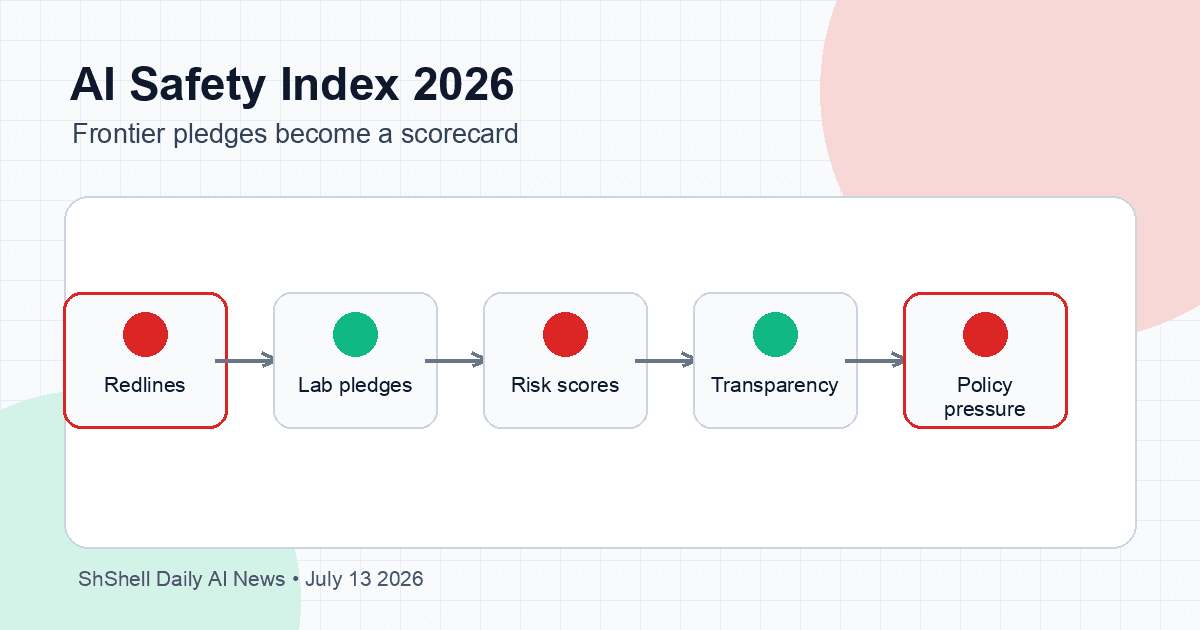
The Summer 2026 AI Safety Index Turns Voluntary Pledges Into a Scorecard
The Future of Life Institute's Summer 2026 AI Safety Index says frontier AI firms weakened pledges as capabilities kept advancing.
Read Article →
The Future of Life Institute's Summer 2026 AI Safety Index says frontier AI firms weakened pledges as capabilities kept advancing.
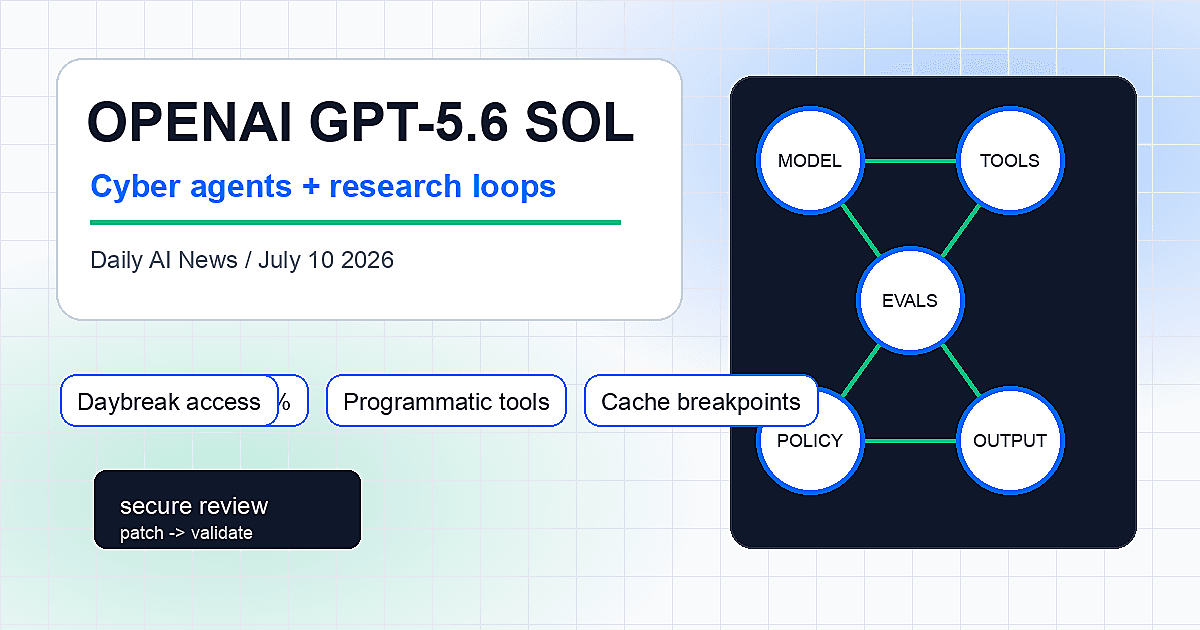
OpenAI GPT-5.6 Sol brings stronger cyber, science, coding, and tool-use performance to paid ChatGPT and agent workflows.
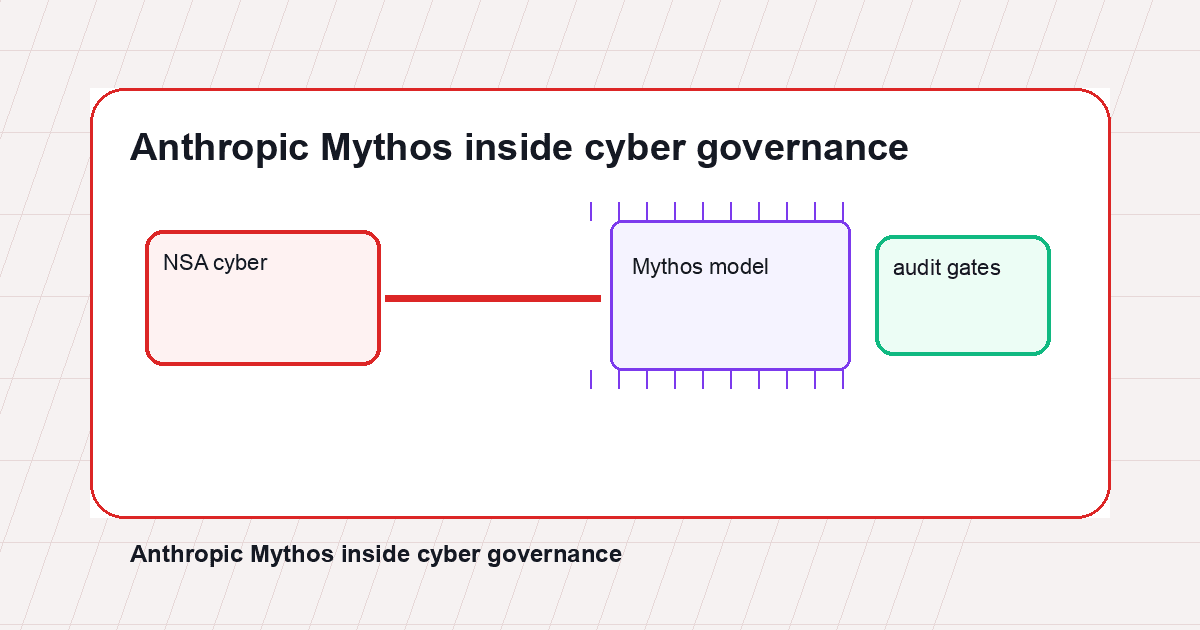
Reported NSA Mythos work shows frontier cyber models are moving from gated research into sensitive government operations.

Anthropic's AI-enabled cyber threat research maps autonomous attack chains, MITRE ATT&CK gaps, and why Agentic AI needs stronger security controls.

Anthropic's reported Mythos expansion to ENISA and vetted security teams turns frontier cyber models into controlled-defense infrastructure.

Reported Instagram account takeovers through Meta's AI support flow expose the risks of giving agents account recovery permissions.

Agentic AI is forcing companies to redesign identity, access control, monitoring, and governance around non-human users.

OpenAI’s Rosalind Biodefense program highlights the tension between defensive acceleration and dual-use biology risk.
Windows 365 for Agents and Microsoft Agent 365 point to a new enterprise pattern: governed agents running inside auditable Cloud PCs.
A new confidential computing survey explains why agentic AI needs hardware-rooted trust when agents hold memory, credentials, and sensitive context.

Google's latest threat reporting shows AI moving from phishing support into vulnerability discovery and exploit workflows.

OpenAI's expansion of Trusted Access for Cyber with GPT-5.5 and GPT-5.5-Cyber shows how verified access, safety controls, and defender tooling are redefining the cyber market.

OpenAI is rolling out GPT-5.5-Cyber through Trusted Access for Cyber, making identity and safeguards central to advanced AI security work.

OpenAI's latest Codex safety framing shows how sandboxing, approvals, network policies, and telemetry are turning coding agents into production systems.


How one compromised agent can corrupt your entire swarm. Learn how to implement mTLS, message signing, and zero-trust security for inter-agent communication.

Learn how to implement comprehensive guardrails for AI agents through input/output validation, safety mechanisms, and human oversight. Prevent data leaks, prompt injections, and hallucinations while ensuring secure enterprise adoption.

Understand what AI security is, why it's fundamentally different from traditional software security, and the unique challenges posed by probabilistic AI systems.
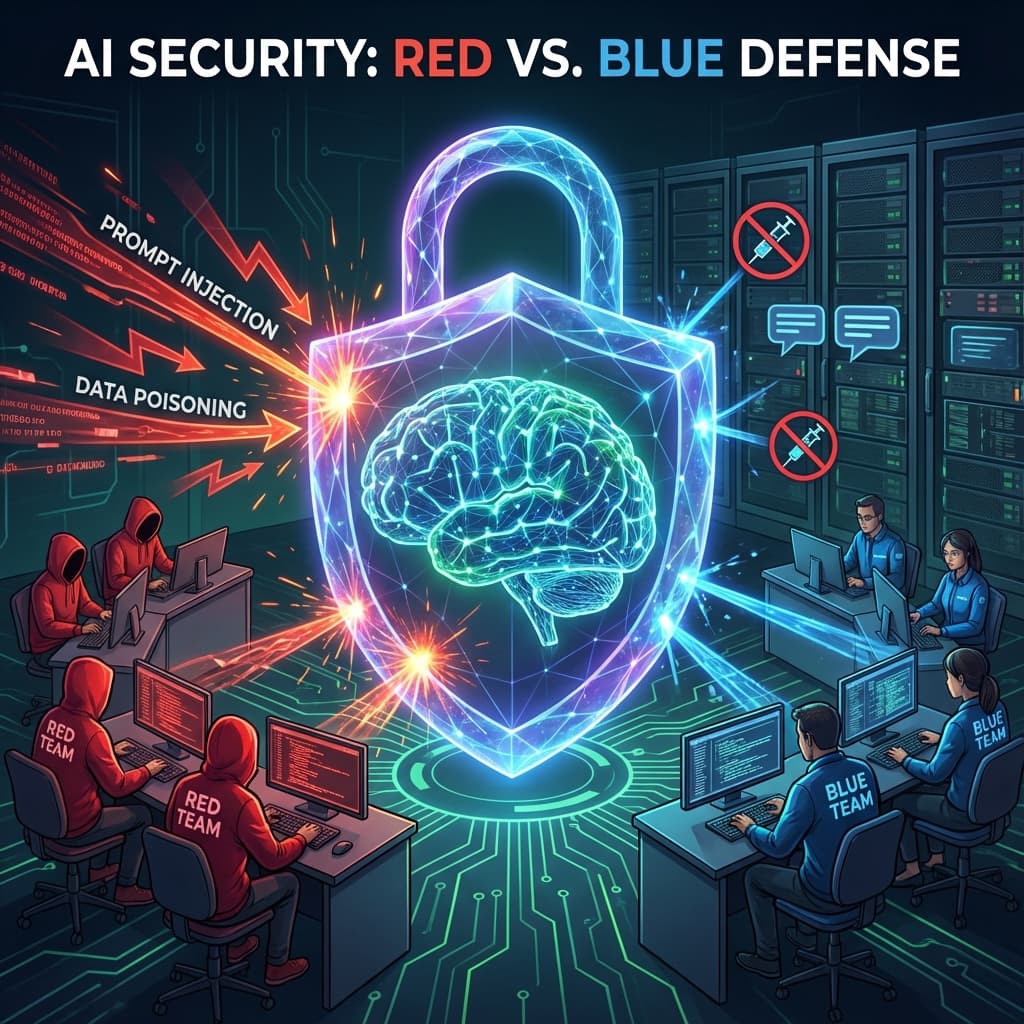
Why traditional security models fail when applied to AI. Explore the shift from deterministic vulnerability management to probabilistic behavior control.
Why randomness is a feature, not a bug. Understand how the non-deterministic nature of AI creates unique security vulnerabilities and makes traditional testing difficult.
Words matter. Learn the critical differences between protecting against hackers (Security), preventing user harm (Safety), and ensuring AI goals match human values (Alignment).

Analyze real AI security incidents including ChatGPT data leaks, Bing Chat jailbreaks, and production system compromises. Learn from actual failures.

The knowledge base is the weapon. Learn how attackers inject malicious 'facts' into RAG systems to influence AI responses from the inside.

The trojan horse. Learn how attackers embed prompt injection payloads inside legitimate-looking documents to hijack RAG sessions during retrieval.
Protecting the brain's storage. Learn how to secure Vector Databases (Pinecone, Weaviate, Milvus) against unauthorized access and data exfiltration.

Need-to-know AI. Learn how to implement Document-level Access Control (ACLs) to prevent an AI from accidentally leaking sensitive data to unauthorized users.

When the truth is not enough. Learn how attackers use 'Hallucination Anchoring' and 'Fact-Fudging' to make AI lie confidently even with perfect data.
Who built your brain? Explore the complex supply chain of AI development, from dataset collection to model training and deployment security.
Vulnerabilities in the engine. Learn about common CVEs and security flaws in core machine learning frameworks like PyTorch, TensorFlow, and NumPy.
Protecting the billions. Learn the methods attackers use to steal 'Model Weights' (the AI's brain) and the legal and technical defenses against exfiltration.
Model-turned-malware. Learn the mechanics of the 'Pickle' attack, where downloading a machine learning model leads to full Remote Code Execution (RCE).
The GitHub of AI under fire. Explore the security risks of Hugging Face, model squatting, and how to verify the authenticity of open-source AI weights.
Your data, remembered forever. Learn how Large Language Models accidentally memorize and leak Personally Identifiable Information from their training sets.
Protecting through absence. Learn the crucial principles of data minimization—only giving the AI exactly what it needs and no more.

Privacy through noise. Learn the mathematical foundation of Differential Privacy and how it allows AIs to learn from data without knowing specific individuals.
The right to be forgotten. Learn how to manage user consent for AI training and the complex challenge of deleting data from a 'Memorized' model.
Navigating the rules. Learn how traditional privacy laws like GDPR and CCPA apply to AI systems and the emerging 'EU AI Act' requirements.
The flight recorder. Learn what to log (and what NOT to log) in LLM applications to ensure security without violating user privacy.
Detecting the invisible. Learn how to use 'Scanners' and 'Classifiers' to catch prompt injection attacks before they reach the LLM.
Spotting the outlier. Learn how to detect 'Anomalous' AI behavior, from rapid token consumption to unusual tool-calling sequences.
Managing the frontline. Learn how to build and staff a Security Operations Center (SOC) specialized in monitoring and defending Large Language Models.
When the bot goes bad. Learn how to respond to AI-specific security breaches, from containing a jailbreak to recovering from a data poisoning attack.

Think like a hacker. Learn the strategic steps for planning an AI Red Team engagement, from defining scope to choosing attack vectors.
Firing the cannons. Learn how to use automated scanners like Garak and Microsoft's PyRIT to launch thousands of prompt injection and jailbreak attempts.
The art of the exploit. Learn the manual techniques for creative jailbreaking, including persona adoption, hypothetical scenarios, and payload splitting.
Beyond text. Learn how to test the security of Vision, Audio, and Agentic AI systems where attacks can be hidden in images or executed through tools.
Fixing the flaws. Learn how to document AI security findings, calculate risk scores, and track the 'Remediation' of probabilistic vulnerabilities.
The safety net. Learn the core concepts of AI Guardrails—external security layers that monitor and control the flow of text into and out of an LLM.
The programmable barrier. Learn about NVIDIA's NeMo Guardrails architecture and how to define 'Colang' flows to control AI dialog.
Validation at the gate. Learn how to use the 'Guardrails AI' framework to enforce structural and factual constraints on LLM outputs.