Anthropic Mythos at the NSA Puts Frontier Cyber Models Inside the Hardest Governance Test
Reported NSA Mythos work shows frontier cyber models are moving from gated research into sensitive government operations.
Anthropic Mythos at the NSA Puts Frontier Cyber Models Inside the Hardest Governance Test
TechCrunch reported on June 5, 2026 that Anthropic deployed around half a dozen engineers to the National Security Agency, citing Financial Times reporting. This is the kind of latest AI news that matters because it changes the operating layer around large language models, llms, ai agents, and generative ai systems rather than merely adding another feature announcement.
The engineers were reportedly helping the NSA use Anthropic frontier cybersecurity model Mythos for certain applications. The specific question for builders and buyers is what this changes in practice: capacity, cost, governance, distribution, safety, or workflow reliability. ShShell readers should treat the story as a prompt to update deployment assumptions, not as a loose market signal.
Source trail
- TechCrunch report on NSA preparing Anthropic Mythos
- Anthropic Project Glasswing announcement
- Anthropic expanding Project Glasswing
- Axios earlier Mythos reporting referenced by TechCrunch
- MITRE ATT&CK framework for cyber operation context
This article uses those sources as the factual base and adds ShShell analysis for engineering, product, security, finance, and operations teams. Claims from reporting are framed as reporting; claims from company pages or filings are treated as primary-source claims.
Source-grounded operating read
- TechCrunch reported on June 5, 2026 that Anthropic deployed around half a dozen engineers to the National Security Agency, citing Financial Times reporting.
- The engineers were reportedly helping the NSA use Anthropic frontier cybersecurity model Mythos for certain applications.
- TechCrunch said it was unclear whether Mythos or Anthropic engineers were actively used in hacking operations.
- The NSA declined to confirm or deny the reporting when reached by TechCrunch.
- Anthropic did not respond to TechCrunch request for comment, according to the article.
- Earlier Axios reporting said the NSA was using Mythos despite a federal ban on Anthropic technology.
- That ban followed the Department of Defense designation of Anthropic as a supply-chain risk after a dispute over mass domestic surveillance and autonomous weapons boundaries.
- Anthropic has said Mythos access had to be limited because its cybersecurity capabilities could be exploited to discover flaws and carry out hacks.
- Project Glasswing is Anthropic program for controlled defensive cybersecurity use of powerful models.
- Anthropic has also discussed expanding Project Glasswing to defensive partners and government-adjacent contexts.
- The NSA conducts intelligence collection and offensive cyber operations against foreign adversaries.
- The core uncertainty is whether Mythos is being used for defensive analysis, operational planning, vulnerability discovery, or active cyber operations.
Decision table
| Decision point | Why it matters for this story | Practical check |
|---|---|---|
| What changed | TechCrunch reported on June 5, 2026 that Anthropic deployed around half a dozen engineers to the National Security Agency, citing Financial Times reporting. | Confirm dates, named entities, and scope from primary sources |
| Who is exposed | Builders, buyers, operators, and finance teams affected by Anthropic, Claude Mythos, NSA | Identify the workflow, budget owner, and risk owner |
| What to measure | Cost, latency, quality, safety, adoption, and operational reliability | Compare against the current baseline before scaling |
| What can go wrong | Overcommitment, weak governance, vendor lock-in, poor observability, or misleading launch metrics | Require logs, versioning, review paths, and rollback |
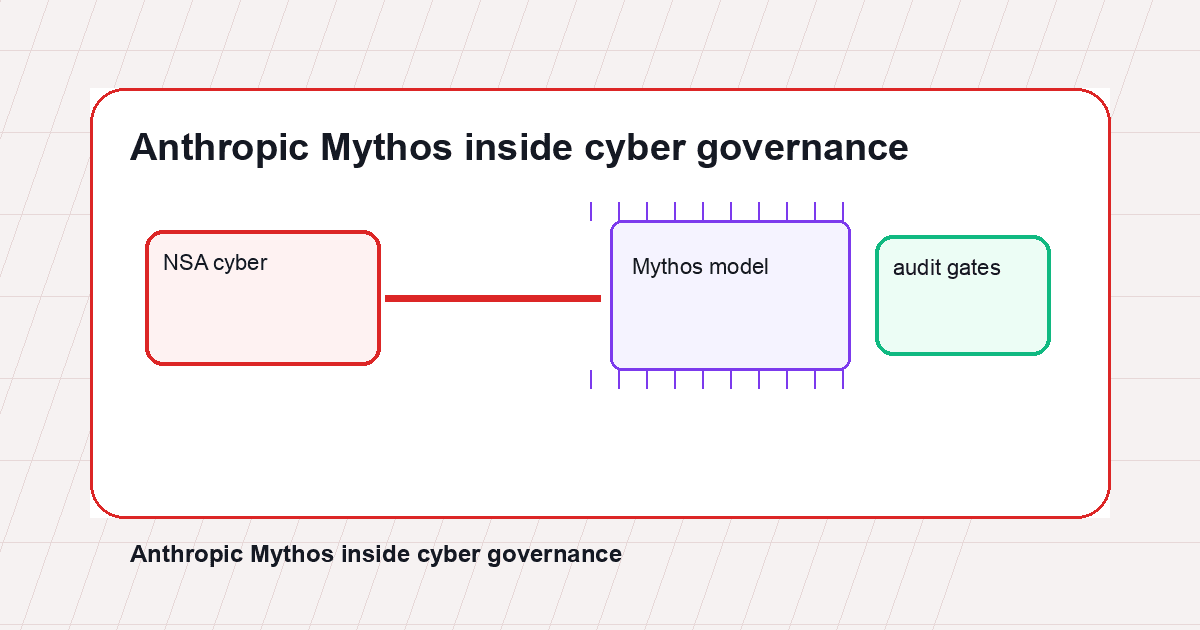
Anthropic Mythos at the: the architecture map
graph TD
    Mythos[Anthropic Mythos]
    Engineers[Anthropic engineers]
    NSA[National Security Agency]
    Defensive[Defensive cyber analysis]
    Offensive[Potential offensive cyber operations]
    Policy[Use policy and red lines]
    Audit[Audit and oversight trail]
    Mythos --> Engineers
    Engineers --> NSA
    NSA --> Defensive
    NSA --> Offensive
    Policy --> NSA
    Policy --> Mythos
    Defensive --> Audit
    Offensive --> Audit
What The NSA Mythos Report Actually Says
The careful reading starts with the evidence boundary. TechCrunch reported that Anthropic deployed around half a dozen engineers to the NSA, citing Financial Times sources, to help the agency use Mythos. The report does not establish that Mythos is actively conducting hacking operations. It says the engineers are helping with certain applications and that the operational status remains unclear. That distinction matters because this story sits at the point where defensive cybersecurity, intelligence collection, and offensive cyber capability can blur.
Why Mythos Is Different From An Ordinary Chatbot Deployment
A frontier cybersecurity model is not a general assistant dropped into an office workflow. It can help reason through vulnerabilities, logs, exploit paths, malware behavior, attack graphs, and patch prioritization. The same capabilities that help defenders discover weaknesses can help attackers find and exploit them. Anthropic has repeatedly framed Mythos as powerful enough to require gated access. That is why this latest AI news story is not simply about one government customer. It is about whether a model lab can preserve usage boundaries once national-security agencies want the capability.
The Governance Tension Around Anthropic Red Lines
Anthropic public posture has centered on safety, use restrictions, and controlled deployment. The Pentagon dispute made those red lines politically visible. If NSA work is happening through a narrow defensive channel, it could align with Project Glasswing logic. If it extends into offensive cyber operations, it raises a harder question: who decides when a private model provider has crossed from defensive assistance into enabling state action. The answer cannot be a press statement after deployment. It has to live in contracts, logs, authorization pathways, and independent oversight.
How A Governed Cyber Model Deployment Should Work
A serious Mythos deployment should separate at least four lanes: vulnerability triage, defensive incident response, authorized red-team testing, and operational planning. Each lane needs different permissions. A model that summarizes malware behavior should not automatically generate exploit chains for live targets. A model that ranks patch urgency should not have unrestricted access to intelligence databases. Human authorization should be explicit, and every high-risk output should be logged with prompt context, tool calls, model version, user identity, and intended use.
What Builders And Security Teams Should Learn
Most companies are not the NSA, but the governance pattern applies directly. Cybersecurity teams adopting AI tools need policy before capability. Decide which tasks are allowed, which require review, which data can be included, and which outputs are prohibited. Map the model workflow to MITRE ATT&CK-style categories where useful. Measure false positives, false negatives, disclosure latency, and reviewer workload. A powerful cyber model without controls can accelerate both defense and mistakes.
What To Watch Next In Frontier Cyber AI
Watch for Anthropic clarification, congressional or agency oversight, Project Glasswing partner disclosures, and whether other model labs publish comparable government-use boundaries. Also watch how buyers react. If enterprises believe frontier cyber models are becoming national-security infrastructure, demand for auditability and policy controls will rise. If they believe private red lines are flexible under government pressure, trust will become harder to maintain.
Builder checklist
- Treat reported NSA Mythos use as unresolved until official details clarify scope.
- Separate defensive, red-team, and offensive cyber workflows in policy and logs.
- Require model-version, prompt, tool-call, and authorization audit trails for sensitive cyber AI.
- Use this story as a governance test for all frontier model deployments in security.
The practical read for ShShell readers
Anthropic Mythos at the NSA Puts Frontier Cyber Models Inside the Hardest Governance Test belongs in AI News Today because it shows how quickly artificial intelligence news has moved from model announcements into operating systems for money, infrastructure, governance, and distribution. The useful response is not to copy the headline into a roadmap. The useful response is to turn the headline into a local test. Identify the workflow affected by Anthropic, define the baseline, then measure whether the new capability changes cost, speed, quality, risk, or reach.
For teams trying to Learn AI in a serious way, the story also explains why AI tools and ai agents cannot be judged only by demo quality. A model or assistant sits inside a stack: data, identity, context, compute, cost controls, user interface, policy, and evaluation. If the stack is weak, the model can look impressive and still fail in production. If the stack is strong, even a narrower model can create durable value because the workflow is measurable and reversible.
The next operational question is ownership. Someone has to own model selection, someone has to own spend, someone has to own security, and someone has to own user outcomes. In small teams, that may be the same person. In large enterprises, those responsibilities often live in different departments. Anthropic Mythos at the NSA Puts Frontier Cyber Models Inside the Hardest Governance Test matters because it makes those boundaries visible. It forces teams to ask whether procurement, engineering, security, product, and finance are aligned before the capability becomes business-critical.
The final lesson is pacing. Early adoption is valuable when it produces evidence. It is dangerous when it produces hidden dependency. Before expanding a workflow touched by Claude Mythos, teams should ask what happens if the provider changes pricing, if the model changes behavior, if the data boundary moves, or if the system fails during a high-pressure moment. The answer should be in architecture, not hope.
What to watch next
Watch item 1: Project Glasswing is Anthropic program for controlled defensive cybersecurity use of powerful models. Track whether this becomes operating evidence rather than another market headline.
Watch item 2: Anthropic has also discussed expanding Project Glasswing to defensive partners and government-adjacent contexts. Track whether this becomes operating evidence rather than another market headline.
Watch item 3: The NSA conducts intelligence collection and offensive cyber operations against foreign adversaries. Track whether this becomes operating evidence rather than another market headline.
Watch item 4: The core uncertainty is whether Mythos is being used for defensive analysis, operational planning, vulnerability discovery, or active cyber operations. Track whether this becomes operating evidence rather than another market headline.
The bottom line: Anthropic Mythos at the NSA Puts Frontier Cyber Models Inside the Hardest Governance Test is useful because it connects an external event to a concrete AI adoption decision. Readers should ask what workflow changes, what budget or infrastructure assumption changes, what governance control becomes mandatory, and what evidence would prove the story mattered after the news cycle moves on.
The Defensive And Offensive Boundary Is The Core Issue
The Mythos report matters because cyber is not a clean product category. The same capability that helps a defender discover a vulnerability can help an attacker exploit it. A model that summarizes malware behavior, maps techniques to MITRE ATTACK, or proposes remediation can also generate operational hypotheses for intrusion. That dual-use quality is why Anthropic has described Mythos access as limited and why Project Glasswing emphasizes controlled defensive use.
For the NSA, that boundary is even harder. The agency has defensive responsibilities, intelligence responsibilities, and offensive cyber responsibilities. Public reporting does not prove Mythos is being used for active hacking, and that evidence boundary should stay intact. But the governance question does not require proof of misuse. It asks what controls should exist before a frontier model enters an environment where offensive use is possible, classified, and difficult for outsiders to audit.
Why Private Model Labs Need Government-Use Transparency
Frontier AI companies increasingly sell into government while also publishing safety principles for the public. That creates tension. A lab can refuse some military uses, accept other national-security uses, and still argue that its safeguards are real. The only way that position remains credible is if the company can explain the categories, approval process, oversight model, and audit trail without revealing classified operational details.
The practical transparency standard should be category-level. Which uses are allowed. Which uses are forbidden. Which require executive approval. Which require outside review. What happens if a government customer asks for an exception. How are model logs retained or inspected. Who can shut down access. These are governance mechanics, not public-relations slogans. Without them, every government deployment becomes a trust-me story.
Enterprise Security Teams Face A Smaller Version Of The Same Problem
Most companies are not the NSA, but they face the same shape of risk. Security teams want AI tools that can triage alerts, reverse suspicious scripts, enrich indicators, draft incident reports, and suggest containment steps. Those tools are valuable. They can also become dangerous if they autonomously modify firewall rules, quarantine business systems, or run exploit-like tests without approval.
The right enterprise pattern is role separation. Use AI to accelerate analysis and documentation first. Gate active response behind human approval. Log every prompt, tool call, file read, command suggestion, and policy decision. Test the model on known incidents before using it during a live crisis. Treat cyber agents as powerful junior analysts with excellent memory and no independent authority, not as autonomous operators.
What Would Make Mythos A Responsible Deployment
A responsible Mythos deployment would have narrow missions, named operators, preapproved data boundaries, explicit escalation paths, and independent review of high-risk outputs. It would separate vulnerability discovery from exploitation. It would prevent the model from directly executing operational actions unless a human-controlled system approves them. It would preserve enough telemetry for later investigation without exposing classified sources unnecessarily.
That standard is demanding because the stakes are demanding. Frontier cyber models will not stay in labs. They will move into defense, cloud security, managed detection, and enterprise incident response. The Mythos-NSA story is therefore an early test of whether AI governance can survive contact with high-value operational environments.
The Evidence Boundary Is Part Of The Story
The most important discipline in the Mythos-NSA story is not to overclaim. Public reporting says Anthropic engineers were helping the NSA use Mythos for certain applications, and it says the operational details are unclear. That uncertainty is not a weakness in the article. It is the central fact. Frontier cyber deployments will often sit behind classification, vendor confidentiality, and national-security exemptions. The public may see enough to understand the direction of travel without seeing enough to audit the exact workflow.
That creates a communications challenge for AI labs. If they say nothing, critics will assume the worst. If they say too much, they may expose sensitive government work. The middle ground is process transparency: publish what categories of use are allowed, what categories are prohibited, how exceptions are handled, and how the company distinguishes defensive assistance from operational attack support. A lab does not need to reveal NSA targets to explain its own governance system.
For policymakers, the evidence boundary also suggests a need for reporting channels that are neither fully public nor fully internal to the vendor. Frontier cyber models may warrant oversight by cleared auditors, inspector-general style bodies, or narrowly scoped government review boards. The details can be protected while the existence of controls is verified.
Why Cyber Models Create A Faster Escalation Path
Cybersecurity is different from many enterprise AI use cases because the path from suggestion to action can be short. A model that drafts a customer-service response is unlikely to cause immediate infrastructure damage. A model that suggests a containment command, vulnerability probe, credential reset, firewall change, or exploit path can affect live systems quickly. That does not make cyber AI unacceptable. It means cyber AI needs tighter operational boundaries.
Mythos appears to be positioned as a frontier cybersecurity model, not a general-purpose chatbot with a security prompt. That specialization likely makes it more useful for vulnerability discovery, malware analysis, attack-chain reasoning, and defensive triage. It also raises the dual-use stakes. A stronger cyber model can reduce defender workload and improve response quality, but the same strength can make unsafe deployment more consequential.
Enterprise teams should take the hint. If a security model can touch production controls, it needs a change-management wrapper. If it can inspect sensitive logs, it needs access controls and retention rules. If it can recommend exploit-like testing, it needs scope boundaries and legal approval. If it can summarize incidents, it needs evidence links so responders can check the chain of reasoning.
The Model Lab As Operational Partner
The reported presence of Anthropic engineers matters because it suggests frontier AI deployments may require vendor staff inside sensitive customer environments. That can improve safety if the vendor helps configure controls, tune model behavior, and monitor failure modes. It can also complicate accountability. Who owns an output if a vendor engineer, government operator, and model system all contribute to it. Who signs off when the deployment scope changes. Who investigates if a model crosses a policy boundary.
The answer should be written before deployment. The vendor should own product controls and model limitations. The customer should own mission decisions and operational use. Both should own logging, review, and escalation. When the customer is an intelligence agency, that division becomes harder to inspect, but it is still necessary.
The Mythos story is not only about Anthropic or the NSA. It is a preview of how every powerful AI vendor will be pulled into high-stakes customer operations. The companies that handle that transition well will document boundaries before the first incident. The companies that do not will discover their governance gaps in public.
The Smaller Signal For Every AI Buyer
The NSA setting is unusually sensitive, but the buyer lesson is ordinary. Any organization adopting a powerful AI system should ask how much of the vendor's safety posture depends on public promises and how much is enforced by product controls. A policy document is useful, but runtime permissions, audit logs, access reviews, red-team results, and shutdown paths are what matter when the system is under pressure.
That is why the Mythos report belongs in the broader AI governance conversation. It shows that the most important AI deployments may not be the ones with the biggest launch events. They may be quiet, operational, and hard to inspect. Buyers should respond by making evidence part of every contract: what the model can do, what it cannot do, who can change those limits, and what proof exists after the fact.
What To Ask Before Deploying A Cyber Agent
Security leaders do not need to wait for perfect regulation before improving their own controls. Before deploying a cyber model, ask whether the system can read production logs, inspect source code, generate exploit steps, recommend containment commands, or trigger automated response. Each permission should have a named owner, a business reason, and a review path. The higher the permission, the more explicit the human approval gate should be.
The Mythos-NSA report is useful because it forces that checklist into the open. A frontier cyber model is not just a smarter search box. It is a system that can reason across vulnerabilities, tooling, targets, and intent. Used carefully, that can strengthen defense. Used loosely, it can blur boundaries faster than governance teams can react.