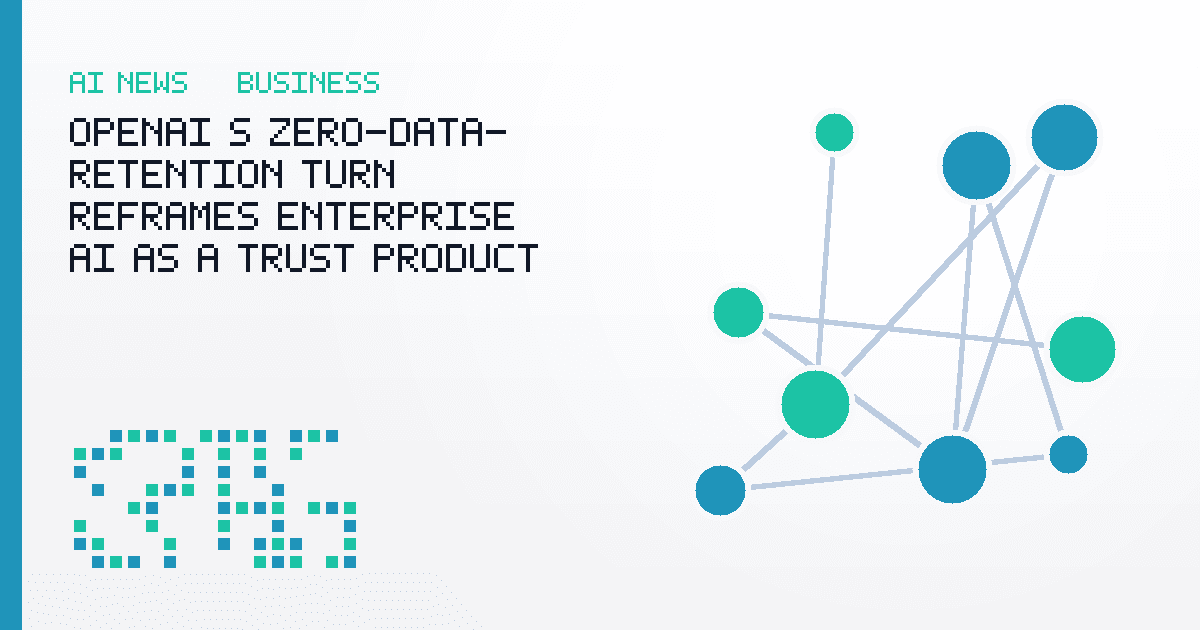
OpenAI's Zero-Data-Retention Turn Reframes Enterprise AI as a Trust Product
OpenAI's zero-data-retention option shows enterprise buyers now judge AI on data handling, audit risk, and residency as much as model quality.
37 articles

OpenAI's zero-data-retention option shows enterprise buyers now judge AI on data handling, audit risk, and residency as much as model quality.
IBM\u2019s warning that AI is squeezing software budgets captures a new enterprise reality: companies are paying for AI twice, once in new tools and again in the systems they have to replace.
Anthropic’s Teresa Carlson hire, government code-auditing work, and recent trust controversies point to a bigger move: public sector channels are becoming a key AI distribution layer.
Microsoft’s $2.5 billion Frontier Company push with 6,000 employees suggests AI transformation is becoming a managed service, not a DIY software purchase.
Reported talks over a 5% U.S. government stake suggest OpenAI is now negotiating for political room to operate, not just model quality.
The AI market no longer behaves like one category. Consumer assistants, enterprise copilots, regulated vertical tools, and sovereign stacks now buy on different rules.
The enterprise AI buyer no longer wants only a correct answer. The buyer wants evidence: citations, traces, approvals, and a defensible path from source to output.
Google is wiring Gemini directly into Google Business Profile and Business notebooks, pushing the product beyond chat and toward a practical operating layer for small businesses.
Huntington Bank’s AWS redaction project is a rare AI story with a concrete business outcome: privacy work that used to take years now takes months.
NVIDIA and AWS are optimizing AI where it now matters most: inference latency, vector search, and the messy work of getting models into production.

Claims that the U.S. government froze Anthropic’s most advanced models do not hold up; the real story is how export controls and sanctions shape access to frontier AI.

Odyssey’s $310 million Series B at a $1.45 billion valuation, with Amazon, AMD Ventures, and GV in the mix, says strategic capital still wants exposure to the AI video and simulation stack.

Leaked Q1 2026 figures reportedly show OpenAI at $5.7 billion in revenue and $3.7 billion in operating costs, a reminder that hypergrowth in AI still comes with a heavy compute bill.

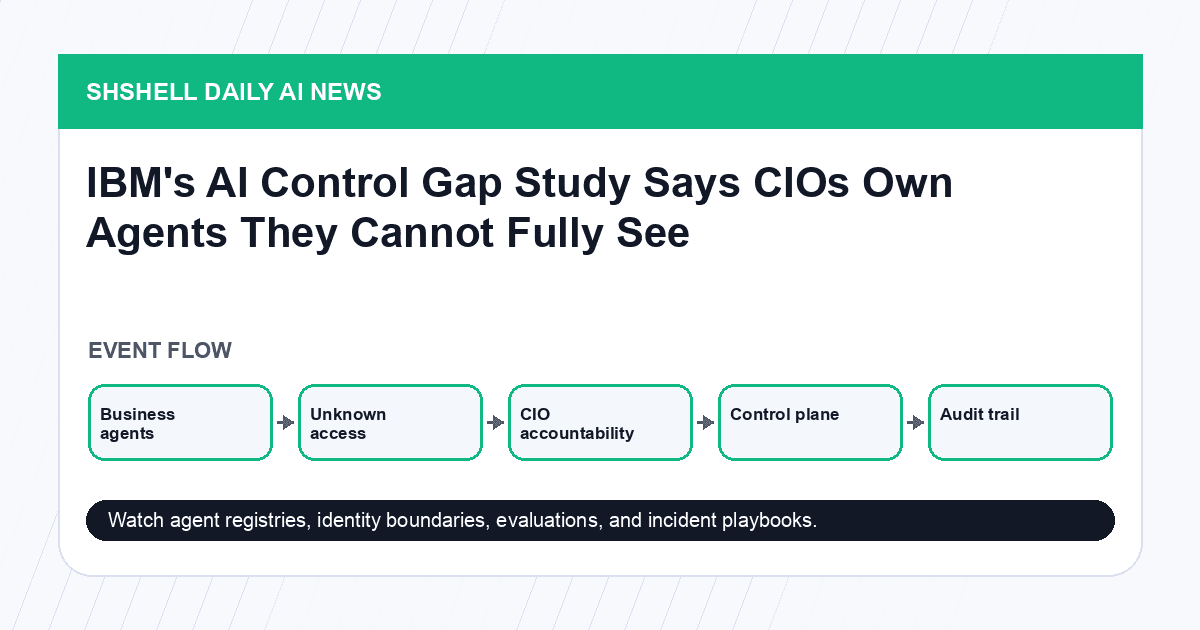
IBM says CIOs and CTOs face an AI control gap as autonomous deployments outpace governance and visibility.

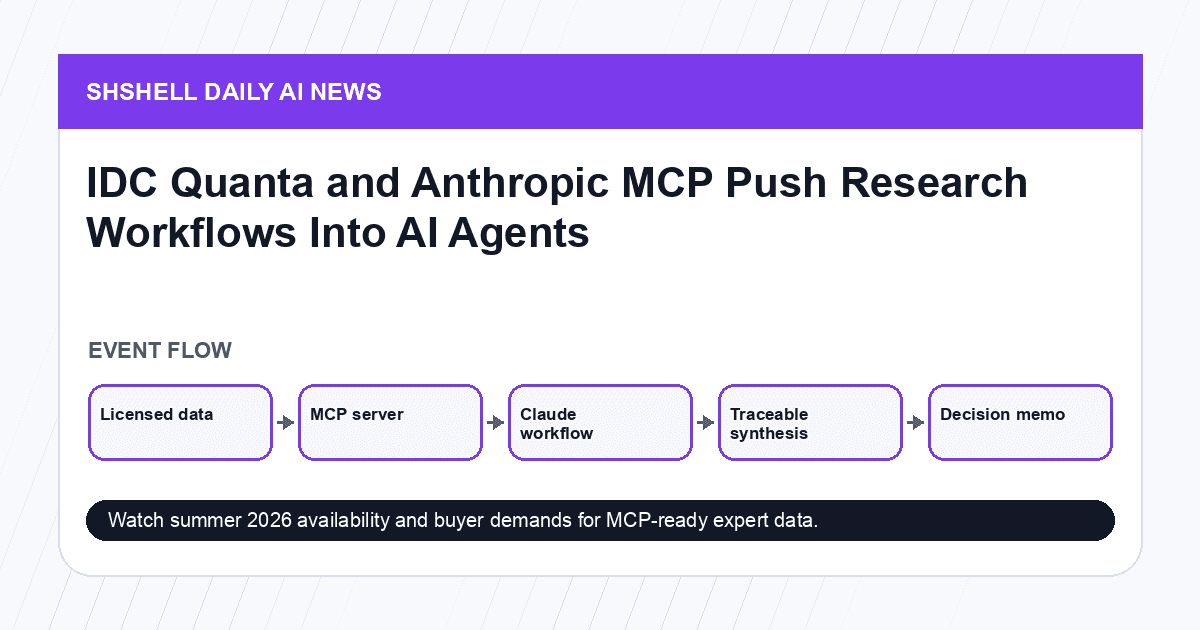
IDC Quanta uses Anthropic MCP-style workflows to embed trusted market intelligence inside enterprise AI tools.

Microsoft Build 2026 put agentic AI, Microsoft IQ, GitHub Copilot, and multi-agent security at the center of enterprise AI news today.

Windows 365 for Agents and Microsoft Agent 365 point to a new enterprise pattern: governed agents running inside auditable Cloud PCs.

OpenAI's Gartner recognition for Codex signals that enterprise coding agents are becoming a governed software buying category.

Anthropic is reportedly approaching its first operating profit, making enterprise Claude demand a test case for AI business economics.

OpenAI and Dell are bringing Codex closer to hybrid and on-prem enterprise environments where sensitive code and workflows live.

Anthropic and KPMG are turning Claude into client-delivery infrastructure across audit, tax, legal, advisory, and private equity work.

Anthropic is reportedly weighing funding at a valuation above USD 900B, exposing the capital demands behind enterprise AI growth.

Ramp's AI Index shows Anthropic edging past OpenAI in paid business adoption, signaling a shift in enterprise AI demand.

Anthropic's financial services agent push shows banks want AI inside controlled workflows, not just chat windows.

EU officials are exploring AI Act simplification as companies warn that complex rules could slow adoption without improving trust.

Microsoft Agent 365 pushes enterprises toward inventory, identity, and policy controls for AI agents across clouds.

Anthropic introduced finance and insurance agent templates for Claude, showing how frontier labs are packaging AI for regulated workflows.

Google's April AI updates connect Gemini Enterprise agents, Gemma 4, chips, Vids, Colab, and Deep Research into one stack.

OpenAI is reportedly building a multibillion-dollar enterprise AI deployment vehicle with private-equity backers.

Microsoft is framing AI adoption around four modes of human-agent work: author, editor, director, and orchestrator.

Google Cloud and Merck’s $1.75B partnership signals the end of AI experimentation and the beginning of a trillion-dollar agentic industrial revolution.

Forbes 2026 AI 50 signals a tectonic shift: enterprise AI winners now compete on independence, sovereignty, and ROI—not raw model scale.

Microsoft's new 'Copilot Cowork' shifts AI from a passive assistant to an active digital teammate, capable of orchestrating complex file-based workflows across the M365 ecosystem.

OpenAI has released GPT-5.4, featuring an unprecedented 1-million-token context window and a new reasoning kernel optimized for long-running autonomous workflows.

By the end of 2026, 40% of enterprise applications will feature task-specific AI agents, marking the transition from generative assistance to autonomous digital colleagues.

Separate the AI noise from the real wins. This guide debunks the biggest overhyped claims of 2026 while showcasing the 'boring but real' applications of AI that teams are actually shipping and scaling.
Data privacy is the #1 hurdle for enterprise AI. Learn how to architect a production-grade Role-Based RAG system that ensures users only see what they are authorized to access, from ingestion to real-time retrieval.