IDC Quanta and Anthropic MCP Push Research Workflows Into AI Agents
IDC Quanta uses Anthropic MCP-style workflows to embed trusted market intelligence inside enterprise AI tools.
IDC Quanta and Anthropic MCP Push Research Workflows Into AI Agents
Market research is being pulled out of static portals and pushed into the same agentic workflows that now run enterprise work.
IDC introduced IDC Quanta at Directions 2026 and described an AI-powered technology intelligence layer, with an Anthropic collaboration to bring IDC intelligence into Claude workflows through Model Context Protocol servers and plugins. That makes it a useful Artificial Intelligence News story because it is not just another model leaderboard item. It changes how a real organization wants AI systems, AI tools, or AI agents to be evaluated, governed, purchased, or operated. For readers tracking latest AI news, the signal is the operational layer around generative AI: who gets access, which workflow changes, what data becomes available, what risk moves to the buyer, and what evidence can be checked after the announcement.
This article uses IDC Quanta announcement, Anthropic MCP documentation, Model Context Protocol as the factual trail and adds ShShell analysis for builders, buyers, researchers, operators, and learners. Company claims are treated as claims unless the source provides documentation, dates, figures, product mechanics, or named operational constraints. The goal is to help readers understand what changed, how it works, why it matters now, and what to watch next without turning the story into generic large language models commentary.
Source Trail
What Happened on the AI News Today Timeline
IDC introduced IDC Quanta at Directions 2026 and described an AI-powered technology intelligence layer, with an Anthropic collaboration to bring IDC intelligence into Claude workflows through Model Context Protocol servers and plugins. The timing matters because the AI market is now flooded with launches that sound similar from a distance: agents, copilots, research assistants, AI search layers, governance dashboards, and automation platforms. The useful editorial question is whether this specific event changes a workflow enough for users to behave differently tomorrow.
For this story, the change is concrete. IDC Quanta is positioned as embedded intelligence: entitlement-based access to proprietary research, data, and methodology appears inside email, collaboration, and AI-native environments. The MCP approach lets agents discover, retrieve, synthesize, and structure trusted research without sending users back to a portal. That detail matters more than the branding because it tells readers where the system sits in the stack. A launch that touches data access, permissions, evaluation, logging, or workflow execution deserves more scrutiny than a launch that only promises smarter answers.
The other important detail is the affected audience. The affected readers are CIOs, analyst-relations teams, sourcing leaders, enterprise architects, consultants, and AI builders who depend on traceable market intelligence rather than generic web summaries. Those groups do not evaluate AI only by asking whether the answer is impressive. They ask whether the system can be trusted inside a process with budgets, records, privacy duties, service promises, or compliance reviews.
The Mechanism Behind the Announcement
IDC Quanta is positioned as embedded intelligence: entitlement-based access to proprietary research, data, and methodology appears inside email, collaboration, and AI-native environments. The MCP approach lets agents discover, retrieve, synthesize, and structure trusted research without sending users back to a portal. Put more simply, the story is about a control surface. The strongest AI systems in 2026 are no longer judged only by model quality. They are judged by the surrounding mechanism that decides what the model can see, what it can do, who approved the action, which evidence supports the output, and how the organization can inspect the result later.
That is why this story fits the broader shift toward Agentic AI. Agents are not only chat windows. They are loops that observe a state, choose an action, call tools, update records, and decide whether to continue. The moment a system can do that, the mechanism becomes as important as the model. A weak mechanism turns a capable model into an unreliable operator. A strong mechanism can make even a narrower model useful because the workflow is scoped, measured, and reversible.
For builders, the first practical test is integration depth. If the system depends on copying output from a chatbot into another product, it remains a productivity helper. If it can authenticate, retrieve context, act inside a bounded workflow, and create an audit trail, it becomes infrastructure. The difference is not semantic. It changes who owns deployment, who signs off on risk, and how teams measure whether the system improved work or merely shifted effort around.
Why This Matters for Buyers and Builders Right Now
This is Latest AI News material because it shows where AI search is heading. The next competitive layer is not only a better chatbot answer; it is a governed connector between licensed expert data and agents that can perform research tasks. This is where Latest AI News becomes practical. The AI industry has enough demos. What teams need now is evidence about production behavior. Does the system reduce cycle time without hiding errors? Does it improve quality for junior staff without creating review overload for senior staff? Does it save tokens, labor hours, or support escalations after the cost of monitoring is included?
The answer depends on the buyer's operating model. A startup can sometimes accept a lightweight review loop because the blast radius is small and the same people build, approve, and use the tool. A regulated enterprise needs stronger separation: identity, approval thresholds, logs, evaluation suites, incident response, and procurement language. A public-sector or education buyer may need an additional evidence layer showing that the system is equitable, explainable, and resilient under adversarial or unusual inputs.
The wider implication for Learn AI readers is that prompt engineering alone is no longer the core skill. Prompting still matters, but durable value increasingly comes from workflow design: choosing sources, defining tool permissions, specifying failure conditions, creating evaluation sets, measuring cost per successful task, and building a clear human escalation path.
Operating Map
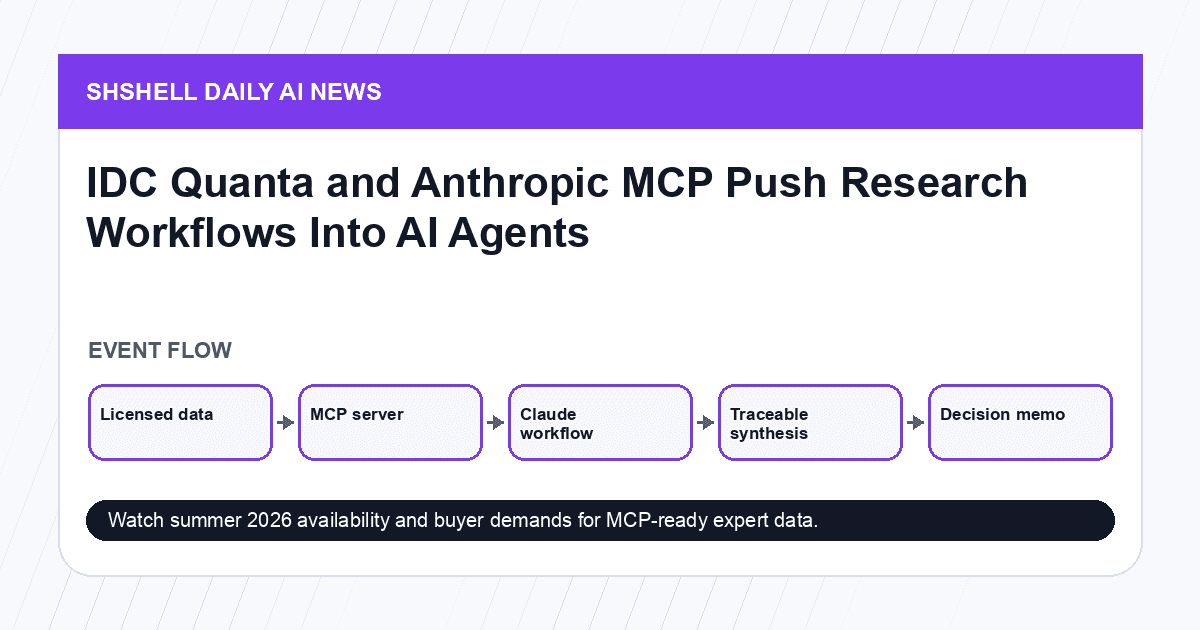
flowchart LR
    N0["Licensed IDC data"]
    N1["MCP server"]
    N2["Claude workflow"]
    N3["Traceable synthesis"]
    N4["Decision memo"]
    N5["Procurement action"]
    N0 --> N1
    N1 --> N2
    N2 --> N3
    N3 --> N4
    N4 --> N5
The map is intentionally narrow. It follows the specific story rather than drawing a universal AI pipeline. That matters because diagrams become misleading when they hide the real control points. In this case, the important question is how the event moves from announcement to workflow outcome. The path contains at least one handoff where governance can fail: data can be too broad, permissions can be too loose, outputs can lose provenance, costs can become invisible, or humans can approve actions they do not understand.
Decision Table for Teams Evaluating the News
| Reader question | What the source says | What to verify |
|---|---|---|
| Old workflow | Search portal, download report, summarize manually | Slow and hard to audit |
| New workflow | Agent retrieves entitled IDC intelligence | Fast but needs traceability |
| Control point | MCP permissions and entitlements | Generic web scraping |
| Buyer test | Citations, source lineage, usage rights | Polished answer with weak provenance |
The table is a quick buyer checklist, not a scorecard. A strong answer in one row does not cancel out a weak answer in another. For example, excellent data access does not solve weak publication review. A clean agent identity does not prove the reasoning quality is good. Low token cost does not matter if the system creates expensive follow-up work. The value comes from reading the rows together and asking where the specific deployment will break.
What Could Go Wrong
The model depends on source traceability, entitlement enforcement, retrieval quality, and whether analysts can preserve nuance when research gets compressed into agent outputs. Those caveats are not reasons to ignore the announcement. They are the reasons to test it carefully. AI systems fail differently from traditional software. They can produce an answer that looks polished but rests on weak source selection. They can execute the right task against the wrong record. They can overfit to easy examples. They can silently escalate costs. They can make a risky action look ordinary because the interface compresses uncertainty into a confident paragraph.
The most common failure pattern is not a dramatic system crash. It is a slow mismatch between responsibility and visibility. A business team adopts a tool because it solves a painful workflow. IT inherits accountability after the system is already useful. Security tries to retrofit controls. Finance discovers recurring costs after usage spreads. Legal asks for logs that were never captured. By then, the organization is not deciding whether to adopt AI. It is deciding whether to unwind a dependency.
Another risk is measurement theater. Teams may create dashboards that count prompts, tokens, conversations, or tasks completed without measuring task quality. A bad AI agent can create more completed tasks and worse outcomes. A research collaboration can produce more papers and still leave the most important causal question unanswered. A CRM automation can reduce manual entry while weakening client communication if exceptions are missed.
What Builders Should Do Next
Builders should start with a narrow workflow and write down the failure conditions before connecting the AI system to real data or real actions. The question is not only what the model should do. The question is what the system must refuse, pause, escalate, or log. That list should be concrete: unavailable source, conflicting records, missing authorization, low confidence, sensitive data boundary, unexpected cost spike, or a user request outside the approved task.
Second, create an evaluation set that resembles actual work. For ai search, include stale sources, conflicting sources, paywalled material, and ambiguous names. For AI agents, include tool failures, partial permissions, duplicate records, and tasks that require human judgment. For economic research, include identification problems and privacy boundaries. For advice workflows, include client exceptions and records that should not be automatically changed.
Third, assign ownership by layer. Product owners should own the workflow goal. Platform teams should own runtime reliability. Security should own identity and access boundaries. Legal or compliance should own retention, disclosure, and review obligations. Finance should own unit economics. Without that split, AI deployment becomes a shared enthusiasm with unclear accountability.
The Implementation Questions Hidden Inside the Headline
The first hidden question is whether the announcement changes data movement. In this story, the answer is yes because the workflow depends on controlled access to specific records, research signals, operational traces, or CRM events rather than an open-ended chat with public web knowledge. That distinction is important for ai search and agentic systems. Retrieval from a trusted source can improve usefulness, but it also creates new obligations: entitlement checks, retention rules, source freshness, and a way to prove which source shaped the answer.
The second hidden question is whether the system has an action boundary. Many products call themselves agents because they can plan or summarize. The more meaningful threshold is execution. Can the system create a follow-up task, update a record, request a document, call a business API, schedule work, or trigger a review path? If it can, the deployment needs policies that are written like operational rules, not like marketing principles. A team should be able to say which actions are automatic, which actions need confirmation, which actions are blocked, and which actions must be routed to a named human role.
The third hidden question is whether the evidence survives compression. AI interfaces often compress messy context into a clean answer. That is useful, but it can hide uncertainty. A good implementation keeps the evidence attached. For research workflows, that means citations, methods, sample limits, and publication review status. For observability workflows, it means traces, tool calls, prompts, model versions, and evaluation outcomes. For CRM workflows, it means source messages, linked documents, record diffs, and the reason a human was asked to review.
How to Evaluate the Claim Without Waiting for Perfect Benchmarks
Teams do not need a universal benchmark to start testing this story. They need a representative task set. A representative set should include normal cases, edge cases, adversarial cases, and boring administrative cases. The boring cases matter because many AI tools look good on dramatic examples and fail on the routine work that actually determines return on investment.
For IDC Quanta and Anthropic MCP Push Research Workflows Into AI Agents, a practical evaluation would track at least five measures. Accuracy asks whether the output is factually and procedurally correct. Coverage asks whether the system handled the full task rather than the easiest portion. Latency asks whether the workflow became faster after review time is included. Cost asks whether token, subscription, platform, and human review costs remain acceptable. Recoverability asks whether a bad result can be detected, explained, and rolled back without starting an internal investigation from scratch.
The best test is a shadow deployment. Let the AI system run beside the existing process for a limited period, but do not let it take final action without human review. Compare its output to the team's normal work. Count not only the wins but also the review burden. If the tool saves ten minutes of drafting and creates fifteen minutes of verification, it has not improved the workflow. If it saves time but weakens records, it may create delayed risk rather than immediate value.
What This Means for Prompt Engineering and AI Training
Prompt engineering remains useful, but this story shows why prompts are only one layer. The stronger skill is operational prompt design: writing instructions that reference approved sources, define stop conditions, demand uncertainty disclosure, and map model output to a workflow that someone can inspect. A prompt that gets a beautiful answer is not enough. A prompt that gets a useful answer with the right evidence, the right limits, and the right escalation behavior is more valuable.
AI training also changes. Teams should train employees to ask where the information came from, what the model was allowed to do, what it was not allowed to do, and what evidence would change the answer. That is different from teaching people to use clever prompt templates. It is closer to teaching applied judgment. Users need to know when an AI answer is a draft, when it is an operational recommendation, and when it is a record-changing action that requires accountability.
For builders of ai courses or internal enablement programs, this is a useful case study. The curriculum should include source evaluation, workflow mapping, security basics, cost awareness, and failure review. A learner who can explain the system boundary will make better use of generative ai than a learner who only knows how to ask for a polished summary.
The Market Signal Beneath the Product Signal
The broader market signal is that AI competition is moving into specialized trust layers. Frontier models still matter, but the winning product in a given workflow may be the one with better evidence handling, better governance, better integration, or better economics. That creates room for companies that are not frontier labs. A research provider can compete by making proprietary intelligence agent-ready. An observability vendor can compete by making reasoning traces useful. A CRM vendor can compete by automating narrow workflows with clear records. A cloud provider can compete by turning agents into managed infrastructure.
This is also why buyers should avoid treating all AI announcements as equivalent. A model release, an RFP, an agent framework, a governance study, and a vertical workflow agent each create different forms of value. The right question is not whether the announcement is exciting. The right question is what scarce resource it changes: expertise, time, data access, coordination, compute, trust, or compliance capacity.
In this case, the scarce resource is not raw text generation. The scarce resource is reliable execution under constraints. That is the theme connecting much of the latest AI news in 2026. Organizations have access to powerful models. They now need ways to make those models behave predictably enough for repeated work.
A Practical Rollout Plan for Cautious Teams
A cautious rollout should begin with inventory. List the data sources, tools, records, permissions, and users involved in the workflow. Then identify which part of the work is judgment-heavy and which part is repetitive. Automate the repetitive part first. Keep judgment-heavy decisions visible to humans until the evaluation evidence is strong.
Next, define the approval ladder. Low-risk actions can be logged and executed automatically. Medium-risk actions can require confirmation from the task owner. High-risk actions should require a specialist review. Prohibited actions should be blocked at the system level, not merely discouraged in a policy document. This ladder is especially important for AI agents because they can make multi-step progress before a human notices that the task has drifted.
Finally, create a review cadence. During the first month, inspect failures weekly. After the workflow stabilizes, inspect sampled decisions, cost anomalies, and user complaints. Keep a changelog of prompt updates, model updates, connector changes, and policy changes. Many AI failures are introduced by seemingly small changes in context windows, retrieval ranking, tool permissions, or model behavior. A changelog makes those changes debuggable.
What Learners Should Take From This Story
For readers using ShShell to Learn AI, the lesson is that modern AI work is becoming multidisciplinary. The person who understands only prompts will miss the system. The person who understands only compliance will miss the capability. The person who understands only model benchmarks will miss adoption friction. The useful operator can connect all three: model behavior, workflow mechanics, and organizational risk.
This is especially true for large language models and llms used as agents. A prompt can ask for a plan, but a production agent needs a source policy, an action policy, a memory policy, a cost policy, and an escalation policy. That does not make AI less powerful. It makes it more real. The most valuable deployments will be the ones that turn impressive intelligence into repeatable work without hiding uncertainty.
What to Watch Next
Watch the expected summer 2026 availability, Claude workflow integrations, and whether buyers ask vendors to expose authoritative datasets through MCP rather than ordinary PDFs. Those next signals will reveal whether the announcement becomes durable infrastructure or fades into the pile of AI tools that made sense in a demo but struggled in production. The early signs to track are specific: named customer usage, published evaluation methods, traceable outputs, security documentation, cost transparency, incident handling, and evidence that users changed a real process rather than simply tried a new interface.
The broader market lesson is clear. AI News today is less about whether artificial intelligence can generate fluent text. It can. The more important question is whether organizations can surround that capability with evidence, controls, and workflows strong enough for real work. This story is one more data point in that shift from model spectacle to operational accountability.