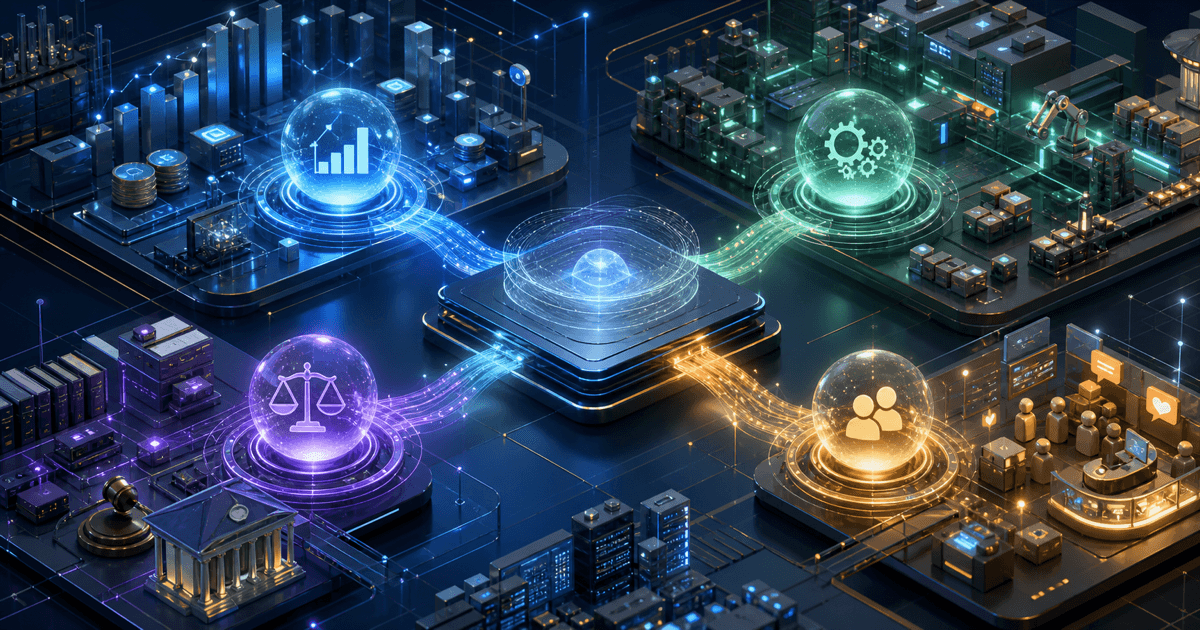
The $1.75 Billion Bet: How Google Cloud and Merck Are Industrializing Agentic AI
Google Cloud and Merck’s $1.75B partnership signals the end of AI experimentation and the beginning of a trillion-dollar agentic industrial revolution.
The era of the "AI Pilot" is officially dead. For nearly three years, the corporate world has treated Generative AI as a novelty—a playground for "brilliant interns" that could draft emails, summarize meetings, and occasionally write a snippet of Python. But as of April 23, 2026, the playground has been replaced by a factory floor.
The announcement of Google Cloud’s $750 million Agentic Fund, coupled with a landmark $1 billion partnership with pharmaceutical giant Merck (MSD), represents the single largest commitment to "Agentic Industrialization" in history. This isn't just about spending money; it's about a fundamental shift in how work is performed at the scale of a Fortune 50 company. We are moving from "Human-in-the-Loop" to "Human-as-Orchestrator," where autonomous agent swarms handle the cognitive heavy lifting of R&D, manufacturing, and global procurement.
The Long Arc of Autonomy: How We Got Here
To appreciate the significance of the Google-Merck deal, one must look back at the chaotic timeline of the mid-2020s. In late 2022, the world was introduced to "Chat"—a revolutionary but ultimately limited interface. By early 2023, the first experimental "Auto-GPT" projects appeared on GitHub, promising autonomous execution but delivering mostly "loop-hell" where models would burn hundreds of dollars in API credits while doing nothing.
The "Trough of Disillusionment" in 2024 was defined by the realization that LLMs were not agents; they were reasoning engines. They lacked state. They lacked persistence. They lacked a "memory" of past failures. These early systems were essentially high-bandwidth search engines with a creative flair, but they were incapable of taking responsibility for an outcome.
The breakthrough that led to today’s $1.75B industrialization was the development of Longitudinal Stateful Agency. By early 2025, companies like Google and OpenAI had figured out how to wrap these reasoning engines in a "Stateful Shell"—a layer of software that maintains a persistent "scratchpad" and can resume tasks across days or even months. This turned the system from a chatbot you "talk" to into a staff member you "instruct."
At Merck, this technology is being deployed not as a single chatbot, but as a "Registry of Capabilities." Every agent has a specific job description, a specific budget, and a specific set of tools it is allowed to touch. This is the "Staffing Agency" model of AI, and it is far more powerful than any individual model could ever be.
The End of the Experimental Phase
To understand the magnitude of this shift, one must look at the previous 24 months of corporate AI adoption. In 2024 and 2025, companies were obsessed with "Chat." Every enterprise software suite added a sidebar where employees could talk to their data. While useful, this was fundamentally a reactive model. It relied on the human to initiate every action, verify every output, and bridge the gap between "information" and "execution."
The Merck-Google partnership changes the target. The goal is no longer to help Merck employees "chat" with their research database; it is to deploy thousands of specialist agents that can autonomously navigate the drug discovery pipeline. These agents are designed to independently design experiments, analyze molecular stability across millions of permutations, and trigger automated lab equipment without a human ever touching a keyboard.
The Financial Architecture of the Bet
The $1.75 billion total valuation is broken down into two distinct strategic pillars:
- The $1 Billion Merck Execution Platform: A multi-year commitment to build a "Neural Fabric" across Merck’s value chain. This isn't just software; it's a new operating system for the company where Gemini 1.5 Pro and 5.5 Pro agents serve as the primary logic drivers for manufacturing logistics and commercial operations.
- The $750 Million Agentic Partner Fund: Google’s strategic move to train the "Army of Architects." Google realized that the bottleneck to agentic adoption isn't the models—it's the implementation. This fund subsidizes thousands of engineers at firms like Capgemini and IBM to become "Outcome Deployed Engineers" (ODEs), embedding them directly into companies to build these agentic swarms.
The Rise of the "Forward-Deployed" Model
Perhaps the most significant revelation in today’s announcement is the shift in professional services. Capgemini’s launch of the "Google Cloud AI Enterprise Hub" signals the death of traditional consulting. In the old world, a consultant would write a 100-page PowerPoint deck advising a company on how to improve its supply chain. In the 2026 "Agentic World," the consultant is an ODE who builds a swarm of 50 agents to actually run the supply chain.
Capgemini and Google are now deploying "Joint Pods"—integrated teams of AI architects who don't just advise; they build and monitor. This is "Solution-as-a-Service" at its most extreme. Merck is essentially buying a guaranteed outcome (e.g., "Reduce drug discovery cycle time by 18%") rather than a software license.
The ODE vs. FDE Dynamic
The interaction between Google's internal teams and partners like Capgemini defines the "Forward-Deployed" dynamic:
| Role | Expertise | Primary Objective |
|---|---|---|
| Forward-Deployed Engineer (FDE) | Google’s Model Architecture | Optimizing model performance, token efficiency, and safety guardrails. |
| Outcome Deployed Engineer (ODE) | Industry-Specific Workflows | Translating Merck’s R&D requirements into agentic state-machines. |
| The Result | The Production Swarm | An autonomous network of agents capable of managing $50M+ in capital expenditure without direct supervision. |
Why Now? The Convergence of Reliability and MCP
Three years ago, this partnership would have been impossible because the infrastructure was too brittle. If you connected an AI to a Merck database and the schema changed slightly, the AI would break. Two breakthroughs have enabled this $1.75B industrialization:
- The Model Context Protocol (MCP): The "USB-C for AI." Merck has standardized its entire internal data lake on MCP, allowing Google’s agents to "plug in" to any data source—from chemical property databases to clinical trial logs—using a universal schema.
- Continuous Reasoning Kernels: Models like GPT-5.5 Pro and Gemini 1.5 Ultra (v3) now possess "System 2" thinking. They can "pause" their output, verify their own logic against a set of constraints (like FDA regulations), and correct themselves before the human ever sees a result.
Mermaid: The Outcome-Deployed Ecosystem
graph TD
    A[Merck Strategic Goal] --> B[Capstone Strategy Agent]
    B --> C{Agent Swarm}
    C --> D[R&D Agent: Discovery]
    C --> E[Logistics Agent: Supply Chain]
    C --> F[Compliance Agent: Regulatory]
    D --> G[Automated Lab Execution]
    E --> H[Global Inventory Optimization]
    F --> I[FDA Submission Drafting]
    G --> J[Human Architect: Sarah]
    H --> J
    I --> J
    J --> K[Value Realization]
The "Sarah" Narrative: From Manager to Commander
What does this mean for the Merck employee? Let's take "Sarah," a Senior Director of Procurement. In 2023, Sarah spent 60 hours a week chasing vendors, reviewing contracts, and manually updating ERP systems. In 2026, Sarah manages a "Procurement Swarm."
She doesn't do the work; she sets the Mission Brief.
- The Mission: "Secure 50,000 liters of reagent X at a price point below $Y, ensuring all vendors meet our 2026 sustainability ESG criteria."
- The Swarm’s Action: 50 agents instantly reach out to 3,000 vendors, perform real-time price comparisons, verify ESG criteria via MCP-linked databases, and present Sarah with a "Finalized Trio" of optimized contracts.
Sarah has been promoted from a manager of tasks to a Strategic Commander. Her value isn't her ability to use Excel; it's her ability to define the intent of the system and manage the ethical boundaries of the agents. This shift is profound. Sarah is no longer searching for answers; she is validating choices.
The Tri-Cloud Hegemony: A Comparative Analysis
While Google’s $1.75B move is the loudest, they are not alone. There are now three distinct philosophies of enterprise agency in 2026:
Microsoft’s "Everywhere Agent" Strategy
Microsoft has taken the path of "Seamless Interweaving." Their strategy is for the agent to live inside the tools you already use—Word, Excel, Outlook, and Teams. When a Microsoft agent performs a task, it uses the "Graph" to understand your relationships and priorities. However, Microsoft has faced criticism for being "too consumer-focused," which gave Google the opening it needed to dominate high-stakes industrial R&D like the Merck partnership. Microsoft’s agents are great at writing emails; Google’s agents are designed to invent medicine.
AWS and the "Bedrock Freedom"
Amazon remains the choice for developers who want to avoid vendor lock-in. Their "Bedrock Flows" allow you to mix and match models (Anthropic for reasoning, Llama for speed, Titan for security). While flexible, this "Build-it-Yourself" approach is increasingly losing ground to Google’s "White Glove" ODE model. Large enterprises like Merck simply don't have the internal talent or the appetite to orchestrate thousands of agents on their own. They want a partner who can guarantee the outcome.
The Token Paradox: Why Agents Are Finally Affordable
In 2024, the cost of running a swarm of 50 high-reasoning agents 24/7 would have bankrupted most startups. The "Token Cost" was the primary barrier to at-scale agency. Two technical breakthroughs in late 2025 changed the economics of the industry:
- 1-Bit Quantization: Researchers perfected 1.58-bit models that deliver frontier-level intelligence at 1/10th the computational cost. This allowed Google to deploy "Swarm Kernels" at Merck that can reason for hours for less than the cost of a few dollars.
- The Shift to Outcome-Based Pricing: Google Cloud has started moving away from "Per-Token" pricing for large enterprise partners. Merck doesn't pay for tokens; they pay for "Success Credits." If an agent successfully optimizes a logistics route, Google gets paid. If the agent fails, Google absorbs the cost.
Technical Deep Dive: The PEC Architectural Standard
The "Industrial Grade" AI deployed at Merck is built on the PEC (Planner-Executor-Critic) protocol. This architecture is designed to eliminate the unpredictability of single-token generation.
1. The Planner: The Strategic Brain
The Planner uses a "Reasoning Forest" architecture. Instead of generating one plan, it generates 10 potential paths, simulates the outcome of each in a virtual environment, and selects the path with the highest "Value-to-Safety" ratio.
2. The Executor: The Tactical Hand
The Executor is "Dumb but Fast." It has no ability to reason; it can only call tools. It is strictly sandboxed. If it needs to access a Merck database, it must request a "JIT Token" (Just-In-Time) which expires in seconds.
3. The Critic: The Invariant Gate
The Critic does not look at the output; it looks at the constraints. It uses "Formal Verification" to prove that the result does not violate chemical laws, Merck safety protocols, or FDA regulations.
graph LR
    subgraph "The PEC Reliability Loop"
    P[Planner] -->|DAG of Task| E[Executor]
    E -->|Output| C[Critic]
    C -->|Failure: Logic Error| P
    C -->|Success: Verified| R[Result]
    end
    subgraph "External Constraints"
    F[FDA Regs] -.-> C
    S[Safety Manual] -.-> C
    D[Physical Invariants] -.-> C
    end
The Bio-Digital Twin: Simulating the Outcome
A critical, yet under-reported aspect of the Merck-Google partnership is the integration of Digital Twin technology with agentic reasoning. Before a Merck agent swarms a manufacturing logistics task, it "rehearses" the execution in a high-fidelity digital simulation of the factory floor.
These digital twins are not static models; they are real-time mirrors of Merck’s physical infrastructure, powered by thousands of IoT sensors connected via Google Cloud. The agents use these twins to run "Monte Carlo simulations" of every potential action.
- The Scenario: If an agent wants to reroute a shipment of temperature-sensitive biologics to avoid a projected heatwave in Southeast Asia, it first runs that rerouting through the Digital Twin.
- The Result: The agent can predict the fuel consumption, the probability of spoilage, and the impact on downstream delivery schedules with 99.4% accuracy before a single truck ever moves.
This "Simulation-First" approach is what provides the safety margin necessary for autonomous agency. By the time a human orchestrator sees a recommendation, it has already been tested in millions of virtual permutations.
Technical Specification: The MCP Backbone
The "connective tissue" of the entire Merck deployment is the Model Context Protocol (MCP). While much has been written about MCP as a general standard, the Merck implementation uses a specialized "Hardened MCP" configuration.
How it Works in Production
- Tool Discovery: When an agent initializes, it "queries" the Merck MCP server to see which tools it has permission to use. This is handled via an OIDC (OpenID Connect) handshake.
- Resource Mapping: The MCP server maps Merck’s legacy SQL databases and modern NoSQL lakes into a unified "Semantic Graph." To the agent, the data doesn't look like a table; it looks like a set of interconnected "Concepts" (e.g., "Compound A" -> "Interacts With" -> "Receptor B").
- Encapsulated Execution: Each MCP tool call is executed in a self-signed container. The agent sends a request, the container processes the data locally, and only the summarized result is sent back to the model. This prevents the "Data Exfiltration" risk that has historically blocked AI adoption in highly regulated industries.
The MCP Standard at Merck
| Component | Specification | Purpose |
|---|---|---|
| Transport | gRPC over TLS 1.3 | Low-latency, high-security communication between agents and tools. |
| Message Format | Protobuf 3.2 | Ensuring strict schema validation for sensitive chemical data. |
| Auth | mTLS + Spiffe/Spire | Cryptographic identity for every agent in the swarm. |
The Ethics of Delegated Liability
As Merck prepares to go live with its agentic workforce, a looming question remains: Who is responsible when the agent fails? If a research agent designs a molecule that has a hidden, toxic side effect, is Google liable for the weights, or is Merck liable for the deployment?
In April 2026, the legal consensus is shifting toward the "Orchestrator’s Mandate." The human orchestrator (like Sarah) is legally defined as the "PIC" (Person In Command). Much like a sea captain or an airline pilot, the orchestrator is responsible for the actions of their autonomous crew. This means that "Sarah" must be trained not in data entry, but in Agentic Governance. She must know how to audit a "Black Box Trace" and when to pull the "Emergency Stop" on a swarm.
2027 and Beyond: The Autonomous Pharma Era
If the 2026 roll-out at Merck is successful, the implications for 2027 are staggering. We are looking at a future where:
- The "Zero-Human" Lab: Initial drug discovery and molecular simulation are handled entirely by agents, with humans only entering the loop for final clinical validation.
- Predictive Manufacturing: Factories that detect their own mechanical wear, order their own replacement parts, and reschedule their own maintenance swarms without a single ticket being filed.
- Real-Time Regulatory Compliance: A constant stream of "Living Submissions" to the FDA, where compliance agents monitor clinical trials in real-time and update documentation as data arrives.
Final Summary: The Cost of Sitting Out
The $1.75 billion Google-Merck announcement is a signal to the markets that the "AI Gold Rush" is over and the "AI Infrastructure Age" has begun. We are no longer digging for gold; we are building the cities, the roads, and the factories.
By the end of 2026, the success of this deal will be measured in drug discovery time, manufacturing yield, and supply chain resilience. If Google and Merck succeed, the "Solution-as-a-Service" model will become the default for the global economy.
The bricks have been laid. The agents are logging on. The industrialization of intelligence has begun.