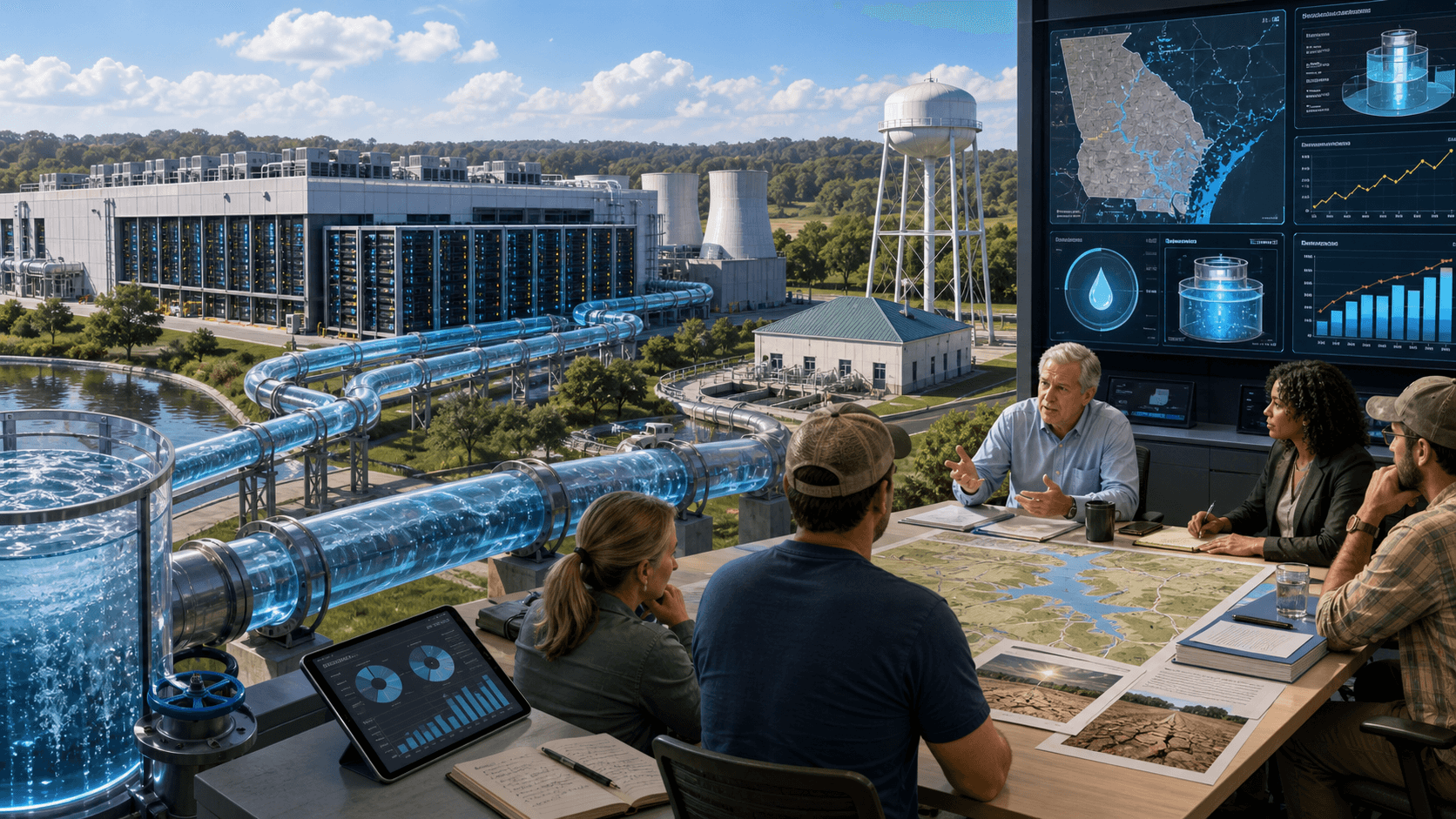
The QTS Water Fight Shows AI Data Centers Need Public Infrastructure Accounting
A Georgia data-center water dispute shows why AI infrastructure must make local utility impacts visible before trust collapses.
The AI infrastructure debate becomes much less abstract when residents complain about low water pressure and officials discover that a data center has been drawing millions of gallons through untracked industrial connections.
Ars Technica reported on a Fayette County, Georgia investigation involving a QTS data-center campus that used roughly 30 million gallons of water before the usage was fully monitored and billed. Local coverage has added nuance around construction, metering, public records, and misconceptions, but the broader lesson is clear: AI infrastructure needs public accounting before local trust fails.
Sources: Ars Technica, Planetizen, GovTech, The Citizen.
The architecture in one picture
graph TD
    A[AI compute demand] --> B[Data center construction]
    B --> C[Water hookups and cooling]
    C --> D[Utility monitoring]
    D --> E[Billing and reporting]
    E --> F[Community trust]
    C --> G[Low pressure or service concern]
    G --> F
| Infrastructure question | Why it matters | Trust-building answer |
|---|---|---|
| Water draw | Affects local systems | Public metering and regular reporting |
| Construction use | Can be temporary but large | Separate construction accounting |
| Billing | Signals fairness | Clear retroactive and ongoing charges |
| Community impact | Shapes political support | Local benefit and response plans |
Water is part of the AI stack now
Data centers are often described through compute, power, and chips. Water is treated as a footnote until something goes wrong. That is no longer tenable. Cooling, construction, power generation, and semiconductor manufacturing all create water dependencies that communities can feel directly.
The operating lesson hiding in plain sight
The useful reading of this story is not simply that another company moved, another deal surfaced, or another forecast changed. The useful reading is that AI data center water accountability is forcing AI out of the abstract and into operating systems that have budgets, incentives, failure modes, and politics.
That is where the real work begins. AI stories are often told as if capability travels alone. It does not. Capability travels with water metering, billing, public records, and community trust. It changes who has leverage, who bears risk, who has to prove compliance, and who has to explain the cost when the system scales. A model can look magical in a demo and still become expensive, fragile, or politically toxic once it touches production.
For a local infrastructure policymaker, the key question is not whether this trend is impressive. It is where the accountability boundary sits. If the system produces data, who can use it. If it consumes infrastructure, who pays for it. If it reorganizes capital, who gets disclosure. If it changes the network, who owns resilience. If it touches water, power, or public trust, who can verify the claims.
The hidden risk is letting infrastructure impacts become visible only after residents complain. That risk is not a reason to stop building. It is a reason to build with evidence. The next phase of AI advantage will belong to teams that can connect ambition to measurement: cost per useful task, verified data rights, uptime under load, water and energy transparency, governance procedures that survive scrutiny, and tooling that lets humans review rather than merely hope.
Why this matters beyond the headline
This is part of a wider shift in the AI economy. The market is learning that intelligence is not a single commodity. It is a supply chain. It needs training data, model access, data centers, chips, networking, energy, cooling, capital, legal agreements, deployment playbooks, and social permission. Weakness in any layer can slow the whole system.
That is why the most interesting AI stories in 2026 often sound less like model stories and more like infrastructure, finance, labor, or governance stories. The model is still important, but the bottleneck keeps moving. One week it is GPU supply. The next week it is data licensing. Then power. Then water. Then enterprise trust. Then litigation. Then network fabric. Serious operators have to follow the bottleneck, not the hype cycle.
The second-order effect is that AI strategy becomes multidisciplinary. Engineering teams need legal context. Legal teams need architecture context. Finance teams need compute literacy. Public officials need enough technical fluency to distinguish genuine constraints from vendor fog. Workers need transparency about how AI systems observe or augment their work. Communities need to know whether a data center is a tax windfall, a utility burden, or both.
What builders should copy
Builders should copy the discipline of turning a messy dependency into a visible interface. If the dependency is data, make rights and provenance inspectable. If the dependency is cloud capacity, make utilization and cost visible. If the dependency is governance, make disclosures and recusals explicit. If the dependency is water or energy, make consumption measurable and public enough to sustain trust. If the dependency is network fabric, make reliability and latency observable rather than assumed.
The best AI products and infrastructure companies will not merely say they are responsible. They will make responsibility operational. That means logs, controls, contracts, measurements, permission boundaries, and economic models that can be audited. The teams that do this will move faster, because they will spend less time fighting preventable trust failures.
What leaders should ask now
- Which layer of the AI supply chain does this story expose.
- Which stakeholder has new risk because of the exposed layer.
- What evidence would prove the company is handling that risk well.
- Which claim should be verified before procurement, investment, or policy support.
- What would make this story look different six months from now.
These questions keep the conversation practical. They also make the news more useful. Instead of reacting to each headline as a separate shock, leaders can map it back to the same operating stack: data, compute, capital, infrastructure, governance, and adoption.
The billing dispute became a legitimacy problem
The QTS case is not only about whether a retroactive bill was paid. It is about whether local residents believe utility impacts are visible, monitored, and fairly allocated. Once people think a facility can consume resources unnoticed, the technical explanation arrives too late.
The operating lesson hiding in plain sight
The useful reading of this story is not simply that another company moved, another deal surfaced, or another forecast changed. The useful reading is that AI data center water accountability is forcing AI out of the abstract and into operating systems that have budgets, incentives, failure modes, and politics.
That is where the real work begins. AI stories are often told as if capability travels alone. It does not. Capability travels with water metering, billing, public records, and community trust. It changes who has leverage, who bears risk, who has to prove compliance, and who has to explain the cost when the system scales. A model can look magical in a demo and still become expensive, fragile, or politically toxic once it touches production.
For a local infrastructure policymaker, the key question is not whether this trend is impressive. It is where the accountability boundary sits. If the system produces data, who can use it. If it consumes infrastructure, who pays for it. If it reorganizes capital, who gets disclosure. If it changes the network, who owns resilience. If it touches water, power, or public trust, who can verify the claims.
The hidden risk is letting infrastructure impacts become visible only after residents complain. That risk is not a reason to stop building. It is a reason to build with evidence. The next phase of AI advantage will belong to teams that can connect ambition to measurement: cost per useful task, verified data rights, uptime under load, water and energy transparency, governance procedures that survive scrutiny, and tooling that lets humans review rather than merely hope.
Why this matters beyond the headline
This is part of a wider shift in the AI economy. The market is learning that intelligence is not a single commodity. It is a supply chain. It needs training data, model access, data centers, chips, networking, energy, cooling, capital, legal agreements, deployment playbooks, and social permission. Weakness in any layer can slow the whole system.
That is why the most interesting AI stories in 2026 often sound less like model stories and more like infrastructure, finance, labor, or governance stories. The model is still important, but the bottleneck keeps moving. One week it is GPU supply. The next week it is data licensing. Then power. Then water. Then enterprise trust. Then litigation. Then network fabric. Serious operators have to follow the bottleneck, not the hype cycle.
The second-order effect is that AI strategy becomes multidisciplinary. Engineering teams need legal context. Legal teams need architecture context. Finance teams need compute literacy. Public officials need enough technical fluency to distinguish genuine constraints from vendor fog. Workers need transparency about how AI systems observe or augment their work. Communities need to know whether a data center is a tax windfall, a utility burden, or both.
What builders should copy
Builders should copy the discipline of turning a messy dependency into a visible interface. If the dependency is data, make rights and provenance inspectable. If the dependency is cloud capacity, make utilization and cost visible. If the dependency is governance, make disclosures and recusals explicit. If the dependency is water or energy, make consumption measurable and public enough to sustain trust. If the dependency is network fabric, make reliability and latency observable rather than assumed.
The best AI products and infrastructure companies will not merely say they are responsible. They will make responsibility operational. That means logs, controls, contracts, measurements, permission boundaries, and economic models that can be audited. The teams that do this will move faster, because they will spend less time fighting preventable trust failures.
What leaders should ask now
- Which layer of the AI supply chain does this story expose.
- Which stakeholder has new risk because of the exposed layer.
- What evidence would prove the company is handling that risk well.
- Which claim should be verified before procurement, investment, or policy support.
- What would make this story look different six months from now.
These questions keep the conversation practical. They also make the news more useful. Instead of reacting to each headline as a separate shock, leaders can map it back to the same operating stack: data, compute, capital, infrastructure, governance, and adoption.
Data-center operators need local dashboards
Serious infrastructure companies should expect to provide more than economic development promises. Communities will want water use, power draw, emergency plans, construction impacts, and ratepayer protections. Those numbers should not have to emerge through public-records fights.
The operating lesson hiding in plain sight
The useful reading of this story is not simply that another company moved, another deal surfaced, or another forecast changed. The useful reading is that AI data center water accountability is forcing AI out of the abstract and into operating systems that have budgets, incentives, failure modes, and politics.
That is where the real work begins. AI stories are often told as if capability travels alone. It does not. Capability travels with water metering, billing, public records, and community trust. It changes who has leverage, who bears risk, who has to prove compliance, and who has to explain the cost when the system scales. A model can look magical in a demo and still become expensive, fragile, or politically toxic once it touches production.
For a local infrastructure policymaker, the key question is not whether this trend is impressive. It is where the accountability boundary sits. If the system produces data, who can use it. If it consumes infrastructure, who pays for it. If it reorganizes capital, who gets disclosure. If it changes the network, who owns resilience. If it touches water, power, or public trust, who can verify the claims.
The hidden risk is letting infrastructure impacts become visible only after residents complain. That risk is not a reason to stop building. It is a reason to build with evidence. The next phase of AI advantage will belong to teams that can connect ambition to measurement: cost per useful task, verified data rights, uptime under load, water and energy transparency, governance procedures that survive scrutiny, and tooling that lets humans review rather than merely hope.
Why this matters beyond the headline
This is part of a wider shift in the AI economy. The market is learning that intelligence is not a single commodity. It is a supply chain. It needs training data, model access, data centers, chips, networking, energy, cooling, capital, legal agreements, deployment playbooks, and social permission. Weakness in any layer can slow the whole system.
That is why the most interesting AI stories in 2026 often sound less like model stories and more like infrastructure, finance, labor, or governance stories. The model is still important, but the bottleneck keeps moving. One week it is GPU supply. The next week it is data licensing. Then power. Then water. Then enterprise trust. Then litigation. Then network fabric. Serious operators have to follow the bottleneck, not the hype cycle.
The second-order effect is that AI strategy becomes multidisciplinary. Engineering teams need legal context. Legal teams need architecture context. Finance teams need compute literacy. Public officials need enough technical fluency to distinguish genuine constraints from vendor fog. Workers need transparency about how AI systems observe or augment their work. Communities need to know whether a data center is a tax windfall, a utility burden, or both.
What builders should copy
Builders should copy the discipline of turning a messy dependency into a visible interface. If the dependency is data, make rights and provenance inspectable. If the dependency is cloud capacity, make utilization and cost visible. If the dependency is governance, make disclosures and recusals explicit. If the dependency is water or energy, make consumption measurable and public enough to sustain trust. If the dependency is network fabric, make reliability and latency observable rather than assumed.
The best AI products and infrastructure companies will not merely say they are responsible. They will make responsibility operational. That means logs, controls, contracts, measurements, permission boundaries, and economic models that can be audited. The teams that do this will move faster, because they will spend less time fighting preventable trust failures.
What leaders should ask now
- Which layer of the AI supply chain does this story expose.
- Which stakeholder has new risk because of the exposed layer.
- What evidence would prove the company is handling that risk well.
- Which claim should be verified before procurement, investment, or policy support.
- What would make this story look different six months from now.
These questions keep the conversation practical. They also make the news more useful. Instead of reacting to each headline as a separate shock, leaders can map it back to the same operating stack: data, compute, capital, infrastructure, governance, and adoption.
AI demand will make every local mistake national
The phrase AI data center now carries political charge. A local metering error can become a national symbol of unaccountable AI expansion. Operators that want speed should invest in transparency early, because opacity is now a permitting risk.
The operating lesson hiding in plain sight
The useful reading of this story is not simply that another company moved, another deal surfaced, or another forecast changed. The useful reading is that AI data center water accountability is forcing AI out of the abstract and into operating systems that have budgets, incentives, failure modes, and politics.
That is where the real work begins. AI stories are often told as if capability travels alone. It does not. Capability travels with water metering, billing, public records, and community trust. It changes who has leverage, who bears risk, who has to prove compliance, and who has to explain the cost when the system scales. A model can look magical in a demo and still become expensive, fragile, or politically toxic once it touches production.
For a local infrastructure policymaker, the key question is not whether this trend is impressive. It is where the accountability boundary sits. If the system produces data, who can use it. If it consumes infrastructure, who pays for it. If it reorganizes capital, who gets disclosure. If it changes the network, who owns resilience. If it touches water, power, or public trust, who can verify the claims.
The hidden risk is letting infrastructure impacts become visible only after residents complain. That risk is not a reason to stop building. It is a reason to build with evidence. The next phase of AI advantage will belong to teams that can connect ambition to measurement: cost per useful task, verified data rights, uptime under load, water and energy transparency, governance procedures that survive scrutiny, and tooling that lets humans review rather than merely hope.
Why this matters beyond the headline
This is part of a wider shift in the AI economy. The market is learning that intelligence is not a single commodity. It is a supply chain. It needs training data, model access, data centers, chips, networking, energy, cooling, capital, legal agreements, deployment playbooks, and social permission. Weakness in any layer can slow the whole system.
That is why the most interesting AI stories in 2026 often sound less like model stories and more like infrastructure, finance, labor, or governance stories. The model is still important, but the bottleneck keeps moving. One week it is GPU supply. The next week it is data licensing. Then power. Then water. Then enterprise trust. Then litigation. Then network fabric. Serious operators have to follow the bottleneck, not the hype cycle.
The second-order effect is that AI strategy becomes multidisciplinary. Engineering teams need legal context. Legal teams need architecture context. Finance teams need compute literacy. Public officials need enough technical fluency to distinguish genuine constraints from vendor fog. Workers need transparency about how AI systems observe or augment their work. Communities need to know whether a data center is a tax windfall, a utility burden, or both.
What builders should copy
Builders should copy the discipline of turning a messy dependency into a visible interface. If the dependency is data, make rights and provenance inspectable. If the dependency is cloud capacity, make utilization and cost visible. If the dependency is governance, make disclosures and recusals explicit. If the dependency is water or energy, make consumption measurable and public enough to sustain trust. If the dependency is network fabric, make reliability and latency observable rather than assumed.
The best AI products and infrastructure companies will not merely say they are responsible. They will make responsibility operational. That means logs, controls, contracts, measurements, permission boundaries, and economic models that can be audited. The teams that do this will move faster, because they will spend less time fighting preventable trust failures.
What leaders should ask now
- Which layer of the AI supply chain does this story expose.
- Which stakeholder has new risk because of the exposed layer.
- What evidence would prove the company is handling that risk well.
- Which claim should be verified before procurement, investment, or policy support.
- What would make this story look different six months from now.
These questions keep the conversation practical. They also make the news more useful. Instead of reacting to each headline as a separate shock, leaders can map it back to the same operating stack: data, compute, capital, infrastructure, governance, and adoption.
What to watch next
The next signal is whether this story becomes a one-week headline or a durable operating change. That distinction matters. AI is producing a constant stream of claims, but only a smaller set changes budgets, contracts, policy, procurement, and product architecture.
The practical test is evidence. Does the company show the economics. Does the supplier prove the rights. Does the infrastructure operator disclose the resource use. Does the platform provider make governance inspectable. Does the buyer know which human remains accountable. Those questions may sound less exciting than model benchmarks, but they decide whether AI becomes reliable infrastructure or an expensive improvisation.
The strongest AI organizations in 2026 will not be the ones that chase every headline. They will be the ones that map each headline to a specific layer of the stack and then improve that layer. Data provenance. Cloud economics. Governance. Water and power accounting. Network reliability. These are not side issues. They are the substance of AI deployment now.
The story to watch is not whether AI keeps growing. It will. The story is whether the systems around it mature fast enough to make that growth trustworthy.