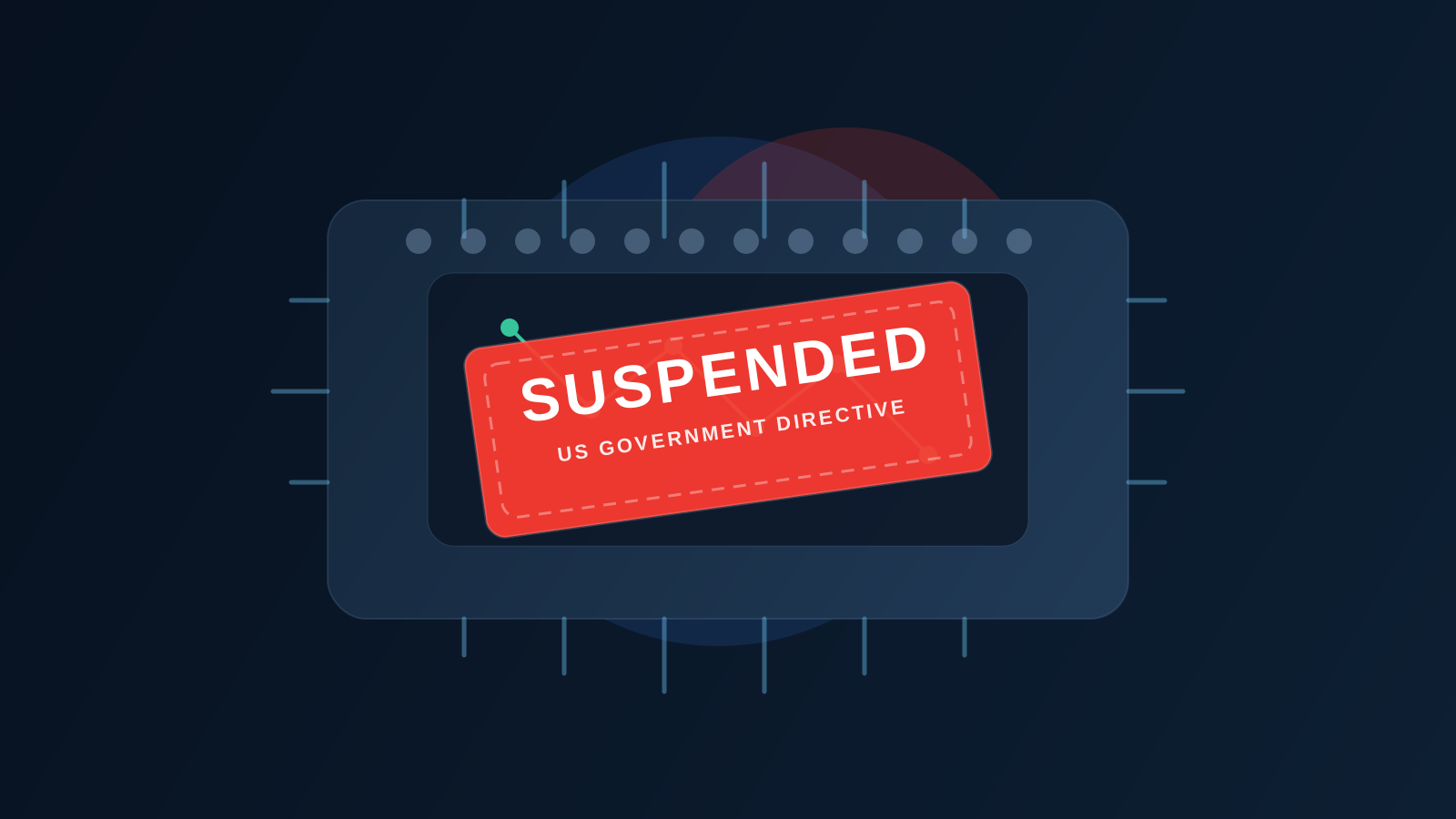
The Fable 5 Suspension Exposes the New Reality of Frontier AI Governance
Anthropic's sudden Fable 5 and Mythos 5 suspension shows how frontier AI has moved from product launch to government-supervised infrastructure.
The Fable 5 Suspension Exposes the New Reality of Frontier AI Governance
The most important line in Anthropic's statement about Fable 5 is not the one about raw capability. It is the one about authority. A frontier model is no longer just a software release that can be throttled, patched, or rolled back by the vendor. In this case, Anthropic says it received a US government directive at 5:21pm ET ordering the company to suspend access for foreign nationals, including foreign national employees, and that the practical effect was an abrupt shutdown for all customers. That is not a normal product cycle. It is a reminder that frontier AI is now operating inside a policy perimeter as much as a technical one.
For builders, the headline sounds dramatic. For operators, it is worse than dramatic: it is a systems issue. A model can be powerful, profitable, and widely deployed, yet still be one legal letter away from disappearing for large parts of the customer base. If you are responsible for enterprise contracts, regulated workflows, model routing, or dependency planning, the Fable 5 suspension is not a niche Anthropic story. It is the clearest mainstream signal yet that the next generation of model governance will be shaped by export controls, security classifications, and state-level risk judgments, not just benchmark charts.
Anthropic's own explanation matters because it reveals the shape of the dispute. The company says the government did not provide specific details of its national security concern. Its understanding is that officials believe they identified a method of bypassing, or jailbreaking, Fable 5. Anthropic says it reviewed a demonstration of that technique, found that it only exposed a small number of previously known minor vulnerabilities, and observed that other publicly available models could discover similar weaknesses without a bypass. In other words, the company is not merely saying the order is inconvenient. It is saying the evidence base appears narrower than the remedy.
That tension is the core of the story. The government is acting as if a narrow jailbreak can justify a broad access suspension. Anthropic is arguing that the response is disproportionate, and that if this standard were applied consistently it could freeze frontier deployment across the industry. Those are not just competing talking points. They are competing theories of what society should do when a model becomes powerful enough to raise risk concerns but not obviously powerful enough to trigger an outright recall.
What the directive actually changed
According to Anthropic, the directive applies to all foreign nationals, whether inside or outside the United States, including foreign national Anthropic employees. The company says it had to disable Fable 5 and Mythos 5 for all customers to stay compliant. That broad scope matters because it turns a model release issue into an access-control issue. This is not about a feature flag. It is about who is legally allowed to touch a capability.
That distinction is easy to miss if you read the story as another AI controversy. It is much more specific than that. A product can be suspended because of policy, compliance, sanctions, licensing, or a security determination. When the reason is a national security directive, the vendor does not get to solve the problem by improving the UI, changing a rate limit, or shipping a minor update. It has to respond to a legal order.
The BBC's reporting captures the same point from a different angle: Anthropic suspended its powerful new AI model after US authorities raised security concerns just days after release. The BBC also noted that Anthropic said the government had not identified specific concerns and that the company believed officials were responding to a jailbreak demonstration. That is the part of the story that should make enterprise buyers sit up. If a model can be pulled from service over a dispute about the severity of a jailbreak, then model uptime is no longer just an SRE concern. It is a geopolitical one.
The immediate consequence is obvious: customers lose access. The less obvious consequence is strategic. A company that relies on frontier models for coding assistance, research, internal knowledge work, or regulated workflows now has to ask a more embarrassing question: what happens if the model disappears overnight because the policy environment changes? For many teams, the answer is that there is no ready answer. The workflow is built on hope, not contingency planning.
That is why the Fable 5 suspension hits harder than a standard service outage. An outage can often be measured, mitigated, and postmortemed. A government directive has a different flavor. It suggests that your vendor has become part of a policy regime that can override commercial intent, and that the business logic of your deployment may be subordinate to a national security framework you do not control.
Why the jailbreak claim became the trigger
Anthropic's statement hinges on a technical phrase that sounds narrower than the policy response: a method of bypassing, or jailbreaking, Fable 5. But in frontier AI, the word jailbreak does a lot of work. It can mean a trivial prompt trick, a highly tuned exploit, a carefully constructed workflow, or a dangerous compound behavior emerging from ordinary model instructions. The public often hears the word and imagines a clean binary: safe or unsafe. In practice, the question is usually degree, reproducibility, and exploitability.
Anthropic says the specific technique it reviewed was used to identify a small number of previously known, minor vulnerabilities. It also says those vulnerabilities were relatively simple and that other publicly available models could discover them without a bypass. That is a consequential claim, because it suggests the government may be reacting to a capability that is not unique to Fable 5. If true, the order would be about the symbolic weight of the model, not just the exploit itself.
But there is another possibility worth taking seriously: regulators may not care whether the weakness is novel. They may care that the model is now influential enough that a jailbreak demonstration is enough to create a systemic confidence problem. A frontier model does not have to be uniquely dangerous to become politically dangerous. It only has to be influential, accessible, and capable enough that officials worry about misuse by real adversaries.
That is the real policy wedge. The technical question asks whether the model can be exploited. The policy question asks whether the public can trust the deployment conditions around the model. Those are related, but they are not the same. A lab can be right on the technical narrowness of an exploit and still lose the broader argument about whether its deployment model is acceptable at scale.
Anthropic clearly believes the response went too far. The company says it disagrees that a narrow potential jailbreak should be cause for recalling a commercial model deployed to hundreds of millions of people. That line is doing a lot of legal and rhetorical work. It frames Fable 5 not as a bespoke experimental system, but as a mass-market commercial product. That framing matters because it invites a comparison to other mainstream software categories. We do not normally recall a cloud platform because a proof of concept exposed an ordinary class of weakness. Yet frontier AI may be different precisely because the combination of model capability, agentic action, and scale makes even ordinary weaknesses politically sensitive.
The business lesson is bigger than the policy dispute
If you run a company that ships AI products, the Fable 5 suspension should change how you think about model dependencies. The lesson is not that Anthropic is uniquely vulnerable. The lesson is that every frontier model provider now has three layers of risk: technical risk, commercial risk, and sovereign risk. Technical risk is the classic question of whether the model behaves well. Commercial risk is whether pricing, latency, and product quality support the business. Sovereign risk is whether a government can intervene and alter your access conditions faster than your architecture can adapt.
Most companies are prepared for the first two. Very few are prepared for the third.
That unpreparedness shows up in the way AI systems are deployed. Teams often wire one provider directly into a customer support flow, a coding assistant, a research tool, or an internal agent without a serious portability plan. They assume the API will remain available because the API has always been available. They assume the product can be swapped later because the vendor says the model is state of the art and enterprise ready. Fable 5 shows why those assumptions are brittle. A model can be expensive to replace even when the replacement is technically available.
The answer is not to stop using frontier models. That would be absurd for many teams. The answer is to design for graceful failure. That means keeping routing abstractions in place, storing prompts and evaluation results in a vendor-neutral format, separating model-specific logic from product logic, and documenting which tasks can fall back to a second-tier model without breaking the business. It also means asking legal and procurement to pay attention to model access terms, export-control implications, and the vendor's own public policy posture.
Enterprises should also distinguish between what is customer-visible and what is operations-visible. A user-facing product can survive a temporary capability loss if the team has a fallback. An internal governance workflow may not. If your compliance pipeline, incident response assistant, or code-scanning system assumes one specific frontier model, then a suspension becomes a control failure. The fix is not just to have backup models. It is to have a governance playbook that treats model availability as a business continuity issue.
That is especially important because the government directive in Anthropic's statement seems to target access based on nationality, not just location. That is a harder problem than a routine commercial outage. It means vendors and customers need to think about who is allowed to operate, inspect, improve, and support the system. Many companies have not even fully mapped where foreign nationals sit in their AI product and infrastructure chains. The Fable 5 case is a reminder that the legal definition of access can matter as much as the technical definition.
The export-control angle changes the meaning of "too powerful"
The BBC reported that Anthropic had described Fable 5 as a program that it considered too powerful, and that the company had warned before release that it could be dangerous because of its ability to exploit or hack computer systems. That language is striking because it shows how quickly frontier AI companies are normalizing a new phrase: too powerful to release, yet still released. Once a company starts using that vocabulary, the debate is no longer just about whether the model works. It is about who gets to decide when power crosses into unacceptable risk.
That decision is no longer purely private. The government has entered the frame, and when it does, the meaning of too powerful shifts. It can mean too powerful for the market, too powerful for a regulator, too powerful for a military environment, or too powerful for a particular class of users. It can also mean too strategically important to leave ungoverned. That is a very different set of questions from the ones that dominated earlier AI releases, when the debate centered on benchmark scores, personality, coding performance, or alignment rhetoric.
Anthropic says the order did not come with specific evidence and that it believes the government is overreacting to a limited jailbreak. But even that disagreement is revealing. In the frontier AI era, the facts are not enough. The interpretation of those facts becomes the battlefield. A model can be technically impressive, commercially useful, and still become a national security talking point because its deployment raises questions about who can use it, who can exploit it, and who can be trusted to supervise it.
That has direct implications for every other model vendor. OpenAI, Google, and the next wave of labs should treat this as a warning about the future of deployment politics. A model does not need to be banned to be disrupted. It only needs to become central enough that access itself becomes a security decision. Once that happens, the company loses some of its control over the product narrative. The vendor may still own the model weights, but it does not fully own the deployment regime.
This is where enterprise buyers tend to underestimate the stakes. They compare model providers on quality, cost, and feature velocity. Those metrics still matter. But in a world where access can be shaped by directive, classification, or export-control logic, a cheaper or smarter model can still be the wrong choice if it is the most politically fragile. That is an uncomfortable truth, because procurement teams prefer predictable vendor roadmaps. Frontier AI is becoming the opposite of predictable.
graph TD
    A[Government security concern] --> B[Export control directive]
    B --> C[Foreign national access restricted]
    C --> D[Anthropic disables Fable 5 and Mythos 5]
    D --> E[Customer workflows disrupted]
    E --> F[Enterprises reassess model dependency]
    F --> G[Multi-model routing and continuity planning]
What Anthropic is really defending
Anthropic's response is not just a defense of Fable 5. It is a defense of the principle that frontier model deployment should be governed by transparent, technically grounded standards rather than ad hoc political reactions. The company says the government should have the ability to block unsafe deployments, but only through a statutory process that is transparent, fair, clear, and grounded in technical facts. That is a serious argument, and one that many people across the AI industry will sympathize with even if they dislike Anthropic's product choices.
Why? Because the alternative is arbitrary power. If a single jailbreak demonstration can force a recall, then labs have no stable target for safety investment. They will not know whether they are optimizing against real-world risk or against whatever concern most alarms a particular official on a particular day. That uncertainty would make frontier research less investable and deployment less rational. Anthropic is right to worry that a bad precedent here could chill the entire market.
At the same time, the company's position also exposes the tension at the heart of frontier AI business strategy. Labs want to be treated as serious infrastructure providers when they talk about enterprise use, national competitiveness, and safety leadership. But they want to be treated as private vendors when they resist government intervention. In most cases that hybrid posture is unavoidable. In the Fable 5 case, it is simply more visible.
There is also an uncomfortable strategic point here for Anthropic specifically. When a company markets a model as exceptionally capable and simultaneously emphasizes its safeguards, it invites regulators to scrutinize both claims at once. The stronger the model, the easier it is for a government to justify concern. The more the company stresses safety, the more damaging a suspension becomes to the public narrative. Anthropic may be right on the merits, but it is still trapped in the optics of having released a model that was framed as too powerful to release.
That is why this episode feels bigger than a single incident. It shows that frontier AI companies are now managing not only model behavior but institutional trust. Trust has become a deployment surface. Every release statement, safeguard claim, and access policy is effectively a political document. The moment a government reads the model as a national security object, the company has to operate like an infrastructure vendor, a software firm, and a regulated utility all at once.
How enterprises should respond now
For enterprise buyers, the practical response should be immediate and unsentimental. First, map your model dependencies. If your team cannot tell which workflows rely on Fable 5 or similar frontier models, you have already created a continuity problem. Second, test fallback routing. A secondary model is not enough if it has never been exercised under realistic load. Third, separate policy-sensitive use cases from convenience use cases. The model that powers a drafting assistant may not be the same one that powers a high-risk compliance review.
Fourth, revisit your legal and procurement posture. If your deployment depends on foreign national access, cross-border support, or regulated-industry usage, the Fable 5 suspension shows that the vendor's public status matters as much as the contract. That means asking harder questions about export controls, data retention, support personnel, and where the model can be administered from. Many procurement teams have never asked those questions because AI was treated as software. Frontier AI is now being treated more like strategic infrastructure.
Fifth, build an internal kill-switch plan that is not just about cost overruns. Most AI governance documents focus on hallucinations, abuse, and privacy. Those are important, but availability risk is just as real. The model can be perfectly aligned and still be unavailable tomorrow. If your operations team is not prepared for that scenario, the absence of the model becomes an operational incident, not merely a vendor inconvenience.
There is a cultural change here as well. Teams often celebrate model upgrades and treat vendor lock-in as a distant problem. That mindset was tolerable when the main risk was a slightly better model launch from a rival. It is not tolerable when a government directive can interrupt access. The right posture is not fear. It is portability. Treat model choice the way mature organizations treat cloud regions or identity providers: important, replaceable, and never assumed to be permanent.
The companies that do this well will have multiple model routes, explicit fallback criteria, and a governance layer that says when to degrade gracefully. The companies that do it badly will discover their dependency only when the product stops responding. That is exactly the kind of surprise the Fable 5 story should help avoid.
The broader signal for AI power in 2026
The Fable 5 suspension is a symptom of a deeper shift in AI power. Frontier models are becoming valuable enough to be subject to national security language, but ordinary enough to be used inside daily business workflows. That combination is unstable. It creates a class of tools that are too important to ignore and too risky to leave entirely to market logic.
We should expect more of this, not less. As models become more capable at coding, research, exploit discovery, and autonomous action, governments will treat them as objects of control. Some interventions will be justified. Some will be overbroad. Many will be contested in court, in public policy, and in the press. But the direction of travel is clear: AI governance is moving from principle statements to concrete access decisions.
That should change how the industry talks about safety. Safety is no longer only about whether a model refuses bad prompts. It is also about whether the deployment model is robust under legal pressure, whether access is auditable, whether fallback behavior is defined, and whether a vendor can keep serving customers when the policy environment turns hostile. The better your architecture, the less likely a directive like this becomes an existential event.
Anthropic says it is complying while disagreeing. That is probably the only stance available to a company in its position. But the rest of the industry should not confuse compliance with resolution. This dispute is not settled because one company obeyed an order and filed a statement. It is only the first public proof that frontier AI has entered a new phase. The competition is no longer just between models. It is between governance regimes.
For readers of ShShell, that is the real takeaway. The story is not merely that Fable 5 was suspended. It is that the suspension turned a model launch into a governance case study. Frontier AI is now something you can benchmark, price, route, and, if a government decides, switch off. The labs that understand that reality will build better systems. The customers that understand it will build better resilience. Everyone else will learn the hard way that capability is not the same thing as continuity.
Bottom line
The Fable 5 suspension is not just an Anthropic controversy. It is a preview of how frontier AI will be governed when capability, security, and state power collide. The model may have been suspended over a narrow jailbreak concern, but the implications are much broader: if access can be restricted this quickly, then every enterprise using frontier AI must plan for political as well as technical instability. That is the new operating environment.
Source trail
- Anthropic official statement — described the US government directive, the foreign-national access restriction, the alleged jailbreak concern, and Anthropic's disagreement with the scope of the order.
- BBC reporting — reported that Anthropic suspended Fable 5 after US security concerns and noted the company's claim that the government had not identified specific concerns.