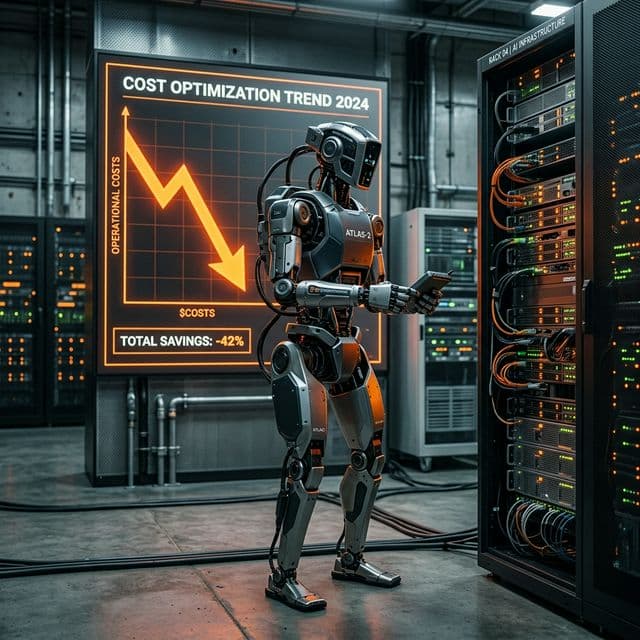
The Zero-Marginal Intelligence Era: How Crashing Inference Costs are Powering Physical AI
AI inference costs have plummeted 280-fold since 2024, enabling a new generation of 'Physical AI' where humanoid robots and edge devices can think in real-time.
The Zero-Marginal Intelligence Era: How Crashing Inference Costs are Powering Physical AI
We are witnessing the "commoditization of thought." On March 20, 2026, economists and technical analysts reported a staggering data point: the cost of AI inference—the actual "running" of an AI model—has plummeted over 280-fold since late 2024. For models of GPT-3.5 caliber, the marginal cost of a million tokens is now approaching a fraction of a cent.
This "Inference Crash" is the single most important economic driver of 2026. It is the catalyst that has enfin turned "Digital AI" into "Physical AI" (Embodied AI). When intelligence is expensive, it stays in the data center. When intelligence is cheap, it moves into the house, the factory floor, and the robot.
The Economic Engine: Efficiency and Open Source
The reason for this price collapse is twofold: hardware breakthroughs and architectural optimization.
- Specialized Silicons: Platforms like NVIDIA's Vera Rubin and the Groq 3 LPU have optimized the "Decode Phase" of LLMs, allowing for 35x higher throughput per megawatt of power.
- Model Pruning and Quantization: Researchers have discovered that 40% of standard model weights were "digital dead weight." Models like MiMo-V2-Flash provide 90% of the cognitive power with only 10% of the compute requirement.
Comparative Inference Costs (Million Tokens)
| Date | Model Tier | Cost (USD) | Relative Drop |
|---|---|---|---|
| Nov 2022 | GPT-3.5 | $2.00 | Baseline |
| Mar 2024 | GPT-4o | $5.00 | High (Complex) |
| Aug 2025 | Llama 3 (Open) | $0.10 | 20x Drop |
| Mar 2026 | Flash-Tier 2026 | $0.007 | ~280x Drop |
Physical AI: The "ChatGPT Moment" for Robotics
The primary beneficiary of cheap inference is the robotics industry. In 2024, if you wanted a robot to "see and reason," you had to send video to the cloud, wait for a 2-second lag, and pay $0.05 per action. This was too slow and too expensive for a dishwasher or an assembly line.
In 2026, with inference costs crashing, we have the VLA Convergence (Vision-Language-Action). Humanoid robots like the Boston Dynamics Atlas 2 and Hyundai's industrial units now run reasoning loops locally, at 60Hz (60 thoughts per second).
The Physical AI Reasoning Loop
graph TD
    A[Robot Sensors: Vision/Tactile] --> B[Local Edge Processor]
    B --> C{VLA Model: "Pick up the red mug"}
    C --> |Goal Decomposition| D[Inverse Kinematics]
    D --> E[Actuators: Physical Movement]

    E --> F[Environment Feedback]
    F --> A

    style C fill:#FF4B4B,stroke:#333,stroke-width:2px,color:#fff
    style B fill:#76b900,stroke:#333
The Humanoid Inflection Point
March 2026 marks the point where humanoid robots are transitioning from "viral laboratory videos" to "line-item commercial assets."
- Logistics: Humanoids are now common in "Dark Warehouses," where they handle unstructured items that traditional conveyor belts cannot.
- Household Tasks: LG's CLOiD service robot, released earlier this month, can autonomously navigate a multi-story home, identifying laundry, loading dishwashers, and interacting with residents via natural language.
- Disaster Response: The convergence of Physical AI and high-speed satellite links (Starlink Gen 3) allows rescue robots to venture into unstable environments, reasoning through pathfinding in real-time without human pilots.
Infrastructure: From Training to Inference
As costs crash, the "Total AI Budget" for enterprises is shifting. In 2024, 80% of spending was on training models. In 2026, 80% of spending is on inference.
The industry has moved toward an "Always-On" Infrastructure Trade. Investors are no longer just looking at GPU manufacturers; they are looking at the massive electricity providers and liquid-cooling firms required to keep billions of "Physical AI thoughts" running 24/7.
Frequently Asked Questions (FAQ)
Is cheap AI less safe?
Not necessarily. While lower costs allow more people to use AI, they also allow for more Verification Layers. A low-cost "Safety Agent" can now audit every token generated by a primary model for less than 0.01% extra cost.
Will robots take all physical jobs?
The Gartner report (released Mar 20) suggests that robots will handle the "3 D's": Dull, Dirty, and Dangerous tasks. However, the plummeting cost of intelligence means that the supervision of these robots will become a major new employment sector.
Can I run a VLA model on my phone?
Almost. High-end flagship phones in 2026 can run "Tiny-VLA" models that can control simple smart-home devices or AR overlays, but sophisticated humanoid control still requires a dedicated edge-chip like the Vera Rubin Space-1.
Conclusion: The Intelligence Utility
We are entering an era where intelligence is no longer a luxury—it is a utility, like water or the internet. As inference costs approach zero, the constraints on what we can build are no longer computational, but imaginative. The "Physical AI" revolution of 2026 is just the first step in a world where our machines don't just follow recipes, they understand the world and act within it to solve our most pressing physical challenges.
This investigative report was synthesized by Sudeep Devkota for the Daily AI News initiative. Data sourced from the 2026 AI Inference Index and technical whitepapers from Boston Dynamics and NVIDIA.