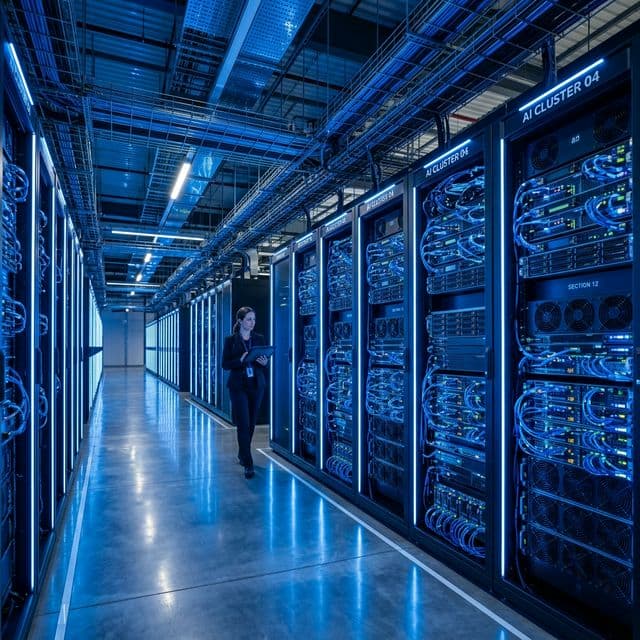
The $2.15 Billion AI Power Play: Applied Digital and Polaris Forge
Applied Digital and Polaris Forge have finalized a $2.15 billion high-yield bond to fuel the expansion of massive HPC data centers in North Dakota, securing the energy-compute future.
The $2.15 Billion AI Power Play: Applied Digital and Polaris Forge
The financial architecture of the artificial intelligence revolution was fundamentally reshaped on March 25, 2026. Applied Digital (APLD) and its strategic partner Polaris Forge have successfully closed a record-breaking $2.15 billion high-yield bond offering. This capital injection is earmarked for one of the most ambitious infrastructure projects in the history of High-Performance Computing (HPC): the 400MW Ellendale Data Center complex in North Dakota.
This deal, which was oversubscribed by 4x, signals a massive shift in how AI infrastructure is being financed. We are moving away from venture capital "burn" and toward utility-style, multi-billion dollar debt markets backed by decade-long enterprise leases.
The Ellendale Complexity: Powering the Blackwell Era
The centerpiece of this expansion is the Ellendale site. North Dakota, once known primarily for its shale oil and agriculture, has become the "Cold Capital of AI." The state’s naturally low ambient temperatures significantly reduce the Energy Usage Effectiveness (PUE) of data centers by minimizing the cooling load.
The $2.15 billion will fund the deployment of Nvidia’s H200 and the upcoming B200 (Blackwell) chips at a scale previously reserved for hyperscalers like Google or Microsoft. With over 100,000 GPUs planned for the first phase, Ellendale is set to become the world’s densest AI training hub.
Visualizing the AI Energy-Compute Cycle
The following diagram illustrates how Applied Digital is integrating energy procurement with high-margin AI training to create a sustainable financial loop.
graph LR
    A["Stranded Energy / Local Grid (ND)"] --> B["Applied Digital Cooling Infrastructure"]
    B --> C["Nvidia H200/B100 Clusters"]
    C --> D["Polaris Forge Software Stack"]
    D --> E["Enterprise AI Training (Oracle/Hyperscalers)"]
    E --> F["10-Year Lease Revenue"]
    F --> G["Bond Repayment & Expansion"]
    G --> A
The Oracle Connection: A 10-Year Strategic Anchor
Crucial to the success of this bond was a landmark 10-year lease agreement with Oracle. As Oracle continues its pivot toward becoming a dominant sovereign cloud provider, it has secured nearly 40% of the Ellendale capacity.
This lease provides the "collateralized revenue" that allowed Applied Digital to issue high-yield bonds at a significantly tighter spread than analysts predicted. For investors, this isn't a gamble on AI hype; it's a fixed-income play on the "Compute Utility" of the next decade.
Key Financial Specs of the Deal
| Feature | Detail |
|---|---|
| Total Offering | $2.15 Billion |
| Lead Underwriter | Goldman Sachs / J.P. Morgan |
| Maturity | 2033 (7-Year Term) |
| Yield | 8.25% (Reflecting high-yield status) |
| Primary Collateral | Ellendale Real Estate & Oracle Lease |
| Intended Use | Nvidia Blackwell Hardware & 400MW Power Substation |
Energy Strategy: Beyond the Grid
The most innovative aspect of the Applied Digital/Polaris Forge strategy is their approach to energy. Rather than just drawing from the North Dakota grid, the team is implementing a Dynamic Load Balancing system.
During periods of high wind energy production (common in ND), the data centers can "burst" their training workloads to soak up excess capacity at near-zero marginal cost. Conversely, during grid peak hours, the Polaris Forge software can instantly throttle non-critical training shards to maintain grid stability. This "Grid-Responsive Computing" is expected to lower operational energy costs by 22% compared to traditional data centers in Northern Virginia.
Nvidia's Role: The Hardware Bottleneck
The bond closing comes at a time of extreme hardware scarcity. By securing $2.15 billion in cash, Applied Digital has reportedly moved to the front of the queue for Nvidia’s B100 (Blackwell) shipments.
"Cash is the only currency that matters in the Blackwell era," noted a lead tech analyst from Bloomberg. "Nvidia is no longer just selling chips; they are selecting partners who have the capital to build the massive liquid-cooling systems these chips require. Applied Digital is now in that elite tier."
AI SEO: Frequently Asked Questions
What is the $2.15 billion bond for?
The bond is primarily for building and outfitting the Ellendale Data Center in North Dakota with high-performance Nvidia GPUs (H200 and Blackwell/B100) and the necessary power infrastructure to support AI training at scale.
Why is North Dakota a good location for AI data centers?
North Dakota offers cheap energy, a supportive regulatory environment, and a cold climate that naturally reduces the cost of cooling massive server farms (lowering PUE).
What is the relationship between Applied Digital and Oracle?
Oracle has signed a 10-year lease for a significant portion of Applied Digital's capacity. This long-term contract acted as the financial backbone for the bond offering, providing guaranteed revenue for investors.
What is "Grid-Responsive Computing"?
It is a strategy where data centers adjust their power consumption based on grid demand and the availability of renewable energy (like wind). This helps lower costs and improve grid stability.
What chips are being used in these centers?
The centers are being outfitted with Nvidia’s H200 and the next-generation B100/B200 Blackwell chips, which are designed for large-scale language model training.
Conclusion: The Industrialization of AI
The Applied Digital and Polaris Forge bond closing isn't just a financial footnote; it is a signal that the "Golden Age of AI Infrastructure" has entered its industrial phase. We are moving from small-scale GPU clusters to massive, utility-scale power plants of intelligence.
With $2.15 billion in the bank and Oracle as an anchor tenant, Applied Digital is no longer a "crypto-pivot" story. It is a fundamental pillar of the new digital economy.
Analysis by Sudeep Devkota, Financial AI Analyst.
The Road Ahead: 1.2 Gigawatts of Intelligence
Wait, there’s more. Applied Digital isn’t stopping at 400MW. The company’s long-term roadmap targets a staggering 1.2GW of combined capacity across North Dakota and Texas by 2028. This $2.15 billion bond is merely the "Phase 1" cornerstone.
As the world transitions from isolated chatbots to Autonomous Agentic Networks, the demand for compute will transition from "bursty" to "constant." This constant load is much easier for grid operators to manage if it’s predictable—exactly what Polaris Forge is promising with its integrated software-hardware stack.
Future Milestones to Watch:
- Q3 2026: First full cluster of 32,768 Blackwell B100 GPUs goes online.
- Q1 2027: Completion of the second 400MW wing at Ellendale.
The Ellendale Technical Architecture: Engineering the 400MW Titan
The Ellendale facility is not merely a warehouse for servers; it is a masterclass in modern thermodynamics. Standard data centers operate at a high PUE, often wasting 40% of their energy on cooling. Applied Digital has engineered Ellendale to target a PUE of 1.05, a feat achieved through a combination of proprietary liquid cooling and North Dakota’s seasonal climate.
Liquid Cooling: Beyond the Airflow
As we move into the Blackwell era, air cooling is no longer viable. A single Nvidia B200 rack can pull over 100kW of power. Applied Digital has implemented a Direct-to-Chip (DTC) liquid cooling system that circulates specialized coolant directly over the GPU dies. This coolant is then piped to massive external Heat Rejection Units (HRUs) that utilize the crisp North Dakota air to shed heat without the use of energy-intensive compressors.
This "Closed-Loop Cold Row" architecture allows for a rack density that is 10x higher than traditional enterprise data centers. At Ellendale, we are seeing clusters of 128 GPUs in a single rack, a density that would literally melt a standard facility in Northern Virginia.
The Oracle Sovereign Cloud: A Strategic Deep Dive
Oracle’s involvement in this deal is the linchpin. Why would a legacy giant like Oracle sign a 10-year lease with an upstart like Applied Digital? The answer lies in the concept of Sovereign AI.
Governments and large enterprises are increasingly wary of sending their sensitive data to shared public clouds. Oracle is positioning itself as the "Private Hyperscaler." By securing dedicated capacity at Ellendale, Oracle can offer its clients a "Private Cloud Region" where the physical hardware is isolated, the power is vertically integrated, and the location is geographically secure.
This 1.2GW roadmap allows Oracle to tell its customers: "Your AI models aren't just running in the cloud; they are running in the cold, sovereign plains of the American Midwest, protected by a dedicated energy grid and zero-trust hardware isolation."
Financial Engineering: The Birth of the 'AI Utility' Bond
For decades, data center financing was treated like commercial real estate. You built a building, found a tenant, and borrowed against the rent. But AI compute is different; the hardware depreciates faster than the building.
The $2.15 billion bond for Ellendale is a Hybrid Infrastructure Instrument. It combines the stability of real estate (the physical 400MW campus) with the high-yield nature of tech hardware. The oversubscription of this bond proves that institutional investors now view "Compute" as the 21st-century equivalent of "Oil" or "Electricity."
By securing a 10-year lease with an A-rated tenant like Oracle, Applied Digital has de-risked the hardware depreciation. Even if Nvidia releases a chip 10x faster next year, the "Space and Power" at Ellendale remain occupied and revenue-generating.
The North Dakota Advantage: Why the Plains Win
Many analysts questioned the choice of North Dakota. It's far from the fiber hubs of Ashburn or the talent of Palo Alto. However, for Large Language Model (LLM) training, latency doesn't matter; power and stability do.
- Energy Surplus: North Dakota is an energy exporter. Between its coal-fired baseload and its world-class wind corridors, it has more power than its population can consume.
- Regulatory Speed: The local government has streamlined the permitting process for "Critical Digital Infrastructure." In California, a 400MW substation would take 8 years to permit; in North Dakota, it took 14 months.
- The 'Free Cooling' Paradox: For 7 months of the year, North Dakota is a natural refrigerator. This isn't just a cost saving; it's a reliability feature. Less mechanical cooling means fewer points of failure.
The Future of Sovereign Intelligence
As we look toward 2027 and 2028, the Applied Digital/Polaris Forge partnership represents a blueprint for the "Industrial Age of Intelligence." We are seeing the separation of Compute Producers (Applied Digital) and Intelligence Consumers (Oracle, OpenAI, etc.).
In this new world, the winners won't just be the ones with the best algorithms; they will be the ones with the most reliable access to the Energy-Compute Matrix. The $2.15 billion gamble at Ellendale is a bet that in the future, the most valuable resource on Earth won't be data—it will be the power and cooling required to synthesize that data into action.
The Role of Polaris Forge Software
While Applied Digital builds the "Hardware Body," Polaris Forge provides the "Software Brain." Their Compute-Fabric OS allows for:
- Zero-Latency Failover: If a rack at Ellendale goes down, the workload is instantly redistributed across the cluster with zero loss in training progress.
- Energy-Aware Scheduling: Training runs are automatically scheduled to coincide with peak wind production on the North Dakota grid.
- Hardware Abstraction: The software allows Oracle’s clients to treat a 10,000-GPU cluster as a single, virtual supercomputer.
Final Word: The 2.15 Billion Dollar Signal
The closing of this bond marks the end of the beginning. AI is no longer a fringe experiment; it is a multi-billion dollar industrial sector. Applied Digital and Polaris Forge have shown that with enough capital, enough power, and enough cold air, the dream of Artificial General Intelligence (AGI) can be built in the heart of the American prairie.
The GPU Arms Race: H200 vs. B100 (Blackwell)
One of the primary drivers of the $2.15 billion bond was the immediate need to lock in NVIDIA’s hardware roadmap. To understand why such massive capital is required, one must look at the generational leap from the H200 to the Blackwell (B100/B200) architecture.
| Specification | NVIDIA H200 (Hopper) | NVIDIA B100 (Blackwell) |
|---|---|---|
| Architecture | 4nm Hopper | 4nm Blackwell (Multi-Die) |
| Performance (FP8) | ~2 PFLOPS | ~10 PFLOPS |
| Memory Capacity | 141GB HBM3e | 192GB HBM3e |
| Bandwidth | 4.8 TB/s | 8.0 TB/s |
| Power Consumption | 700W | 700W - 1200W (Peak) |
| Connectivity | NVLink 4.0 | NVLink 5.0 (1.8TB/s bidirectional) |
The B100 is not just faster; it is exponentially more complex to host. While an H200 cluster could theoretically be hosted in a "retrofitted" high-tier data center, the B100 requires a radical rethink of the power delivery and cooling pipework. At Ellendale, the entire facility is built "liquid-first," meaning there is no traditional raised floor for air circulation. Instead, the floor is a massive manifold of stainless steel pipes carrying high-pressure coolant.
The Applied Digital Evolution: From Mining to Mastering the Cloud
The story of Applied Digital (formerly Applied Blockchain) is a mirror of the broader infrastructure market. In 2021, the company was primarily focused on hosting standardized Bitcoin mining hardware. Mining was simple: high power, low throughput, and zero-tolerance for downtime wasn't as critical as it is in AI.
However, the team realized early on that "Stranded Energy" was the bridge to the future. By moving their operations to North Dakota, they secured the power rights that others ignored. When the Ethereum Merge happened and the crypto markets shifted, Applied Digital sat on a goldmine: Permitted Power and Proximity to Energy Sources.
The pivot to AI wasn't just a change in branding; it was a $1.2 billion re-engineering effort. They had to replace every rack, every transformer, and every cooling fan. This $2.15 billion bond is the final validation of that pivot—proving that a former crypto host can compete with the likes of Equinix and Digital Realty on an enterprise level.
The Geopolitics of Cloud Clusters: Why America is Reinforcing the Heartland
As the U.S. government restricts the export of high-end GPUs to adversarial nations, the "Cloud Frontier" has become a matter of national security. The Ellendale site is strategically located in the center of the North American continent, far from coastal vulnerabilities and international borders.
For companies like Oracle, hosting their "Sovereign AI" at a site like Ellendale is a requirement for future federal contracts. The U.S. government (USG) has signaled that it prefers AI training to happen on "secure, American-sourced energy grids." Applied Digital’s North Dakota footprint aligns perfectly with this "Onshore Compute" mandate.
Engineering Challenges: The 'Direct-to-Chip' Frontier
Managing 400MW of liquid-cooled compute is a feat of engineering that few companies have attempted. The "Direct-to-Chip" (DTC) cooling at Ellendale uses a specialized non-conductive fluid (or in some zones, water treated with proprietary inhibitors) that touches a cold plate mounted directly on the GPU die.
The challenge isn't just getting the fluid to the chip; it's the Thermal Swing. When an LLM starts a training batch, the power draw on a cluster can jump from 50MW to 350MW in milliseconds. This causes a massive heat spike. Traditional cooling systems would lag, leading to hardware throttling. Ellendale’s system uses a Thermal Buffer Tank architecture—massive reservoirs of chilled fluid that can absorb sudden spikes in heat before the external heat exchangers even ramp up.
The 2030 Vision: The Global AI Utility
By 2030, Applied Digital envisions a world where "Compute" is as ubiquitous and standardized as the "U.S. Dollar." Through their Polaris Forge software, they aim to create a Liquidity Layer for Compute.
Imagine a scenario where a startup in London can rent 1/10th of the Ellendale cluster for exactly 42 minutes to fine-tune a specialized medical model, with the transaction settled instantly via a "Compute Credit" system. This isn't just about leasing racks anymore; it's about the Commoditization of Intelligence.
Strategic Milestones for 2029-2030:
- Vertical Integration: Building proprietary energy sources (fusion or advanced modular reactors) directly on-site to achieve 100% decoupling from the public grid.
- Space-Based Relay: Integrating with low-earth orbit (LEO) satellites to provide sub-50ms latency to anywhere on Earth, bypassing terrestrial fiber.
- The 'Sentient Site': Implementing AI agents to manage the data center itself, predicting hardware failures and optimizing cooling flows in real-time.
Conclusion: North Dakota’s Billion-Dollar Bastion
The plains of North Dakota are no longer just for wheat and wind; they are now the foundation of the global AI economy. The $2.15 billion bond led by Applied Digital and Polaris Forge is the first chapter of a story that will see the "American Heartland" become the most powerful source of intelligence on the planet.
As we scale toward 1.2GW and beyond, the message is clear: The future of AI will not be written in code alone—it will be forged in steel, cooled by liquid, and powered by the relentless energy of the great plains.
Macroeconomic Impact: The AI Infrastructure Bond Revolution
The $2.15 billion bond financing led by Applied Digital for the Ellendale site is not just a corporate milestone; it is a macroeconomic signal. We are witnessing a fundamental shift in how capital markets value technology.
Traditionally, "Infrastructure" meant toll roads, airports, and power plants—assets with predictable, long-term cash flows and low physical depreciation. "Technology" was high-growth but high-risk. This new breed of "AI Infrastructure Bonds" bridges that gap. By collateralizing a 400MW power permit with a credit-rated tenant like Oracle, Applied Digital has created a Tech-Infrastructure Hybrid.
If this model scales (and with a 1.2GW roadmap, it certainly appears it will), we can expect to see a multi-trillion dollar asset class emerge. These bonds offer the yields of a growth tech company with the security of a physical asset. This influx of institutional capital (pension funds, sovereign wealth funds) will be the engine that funds the massive $1 trillion infrastructure rollout required for AGI.
Technical Deep Dive: The NVLink 5.0 Interconnect Architecture
While cooling and power are the "body" of Ellendale, the NVLink fabric programmed by Polaris Forge is its central nervous system. In the Blackwell generation, the interconnect is just as important as the GPU itself.
NVLink 5.0 provides a staggering 1.8 TB/s of bidirectional bandwidth per GPU. To put that in perspective, that’s enough capacity to transfer the entire contents of the U.S. Library of Congress in less than a minute. At Ellendale, Polaris Forge’s software optimizes the routing of these signals across massive 72-GPU "Superpods."
The challenge is signal integrity over copper. At these speeds, high-frequency signals degrade rapidly. Most data centers are forced to use expensive active optical cables (AOC). However, through the use of Proprietary Retimers and a custom rack layout, Applied Digital and Polaris Forge have managed to maximize the use of copper for intraday-rack communication, reducing both cost and latency. This "Copper-First" engineering is one of the hidden secrets behind the efficiency of the Ellendale site.
Final Summary: The AI Infrastructure Sentinel
We stand at a crossroads. The transition from "Computing as a Service" to "Intelligence as an Infrastructure" is irreversible. Applied Digital and Polaris Forge have successfully navigated this transition by securing the three pillars of the new economy: Power, Capital, and Engineering.
The $2.15 billion bond is a testament to the belief that North Dakota will be to the AI Age what the Texas oil fields were to the Industrial Age. For investors, engineers, and strategists, the message is simple: The scale of the AI revolution is no longer limited by algorithms, but by the physical reality of cables, pipes, and electrons.
Join the Infrastructure Revolution
Stay updated on the latest deep-dives into the AI energy-compute matrix.
Subcribe to Sudeep's Analysis | View the Full Ellendale Technical Spec (PDF)
About the Author: Sudeep Devkota is a strategist and developer focusing on the intersection of energy grids and high-performance compute.