AIUC’s $40 Million Bet Turns Agent Risk Into Evidence, Not a Guarantee
AIUC’s new funding backs agent certification and insurance. The procurement question is what the evidence covers when software and permissions change.
An enterprise considering an agent that can retrieve customer records and issue refunds needs evidence about both permissions and mistakes. A convincing demonstration cannot settle whether the agent will disclose another customer’s information or execute an unauthorized transaction. Artificial Intelligence Underwriting Company is selling a way to make that procurement decision more concrete: technical testing, certification and insurance. On September 15, TechCrunch reported that AIUC announced a $40 million Series A, led by Ribbit Capital with participation from First Harmonic.
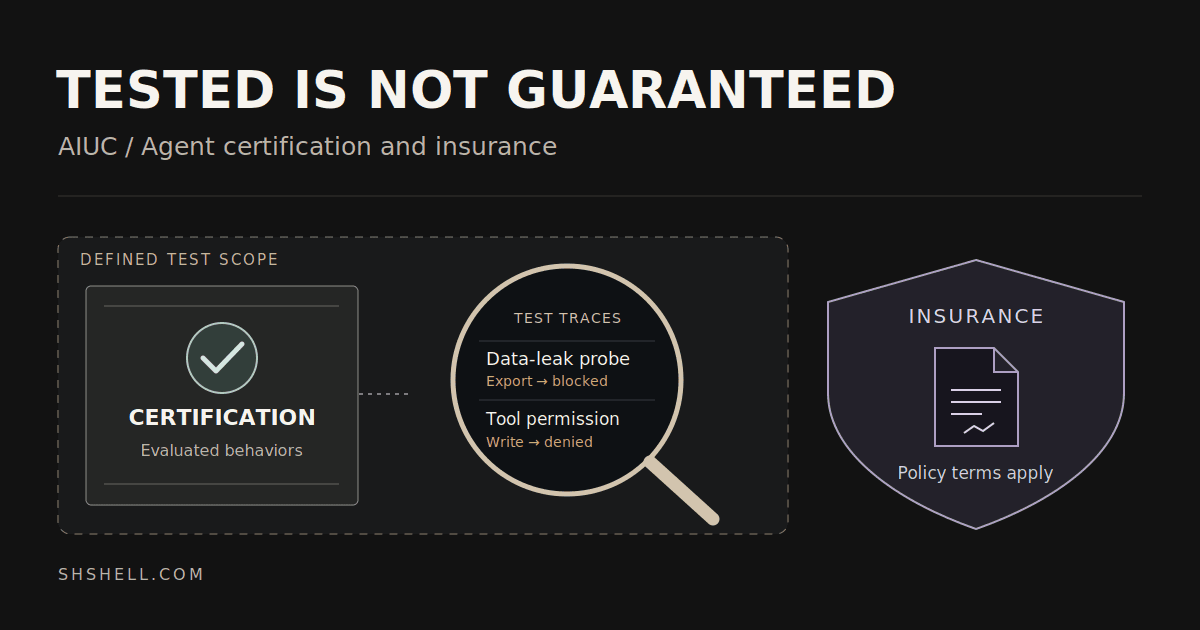
The investment backs a business built around converting uncertain agent behavior into reviewable evidence and potentially insurable losses. It does not turn a certificate into a promise that an agent cannot fail. AIUC’s product page markets certification and insurance as the infrastructure needed for confident enterprise adoption, including financial protection against AI failures. The distinction matters because a certificate concerns an assessed system and its controls, while insurance concerns losses within contractual coverage. Neither, by itself, establishes that a particular deployment will preserve every privacy boundary under every future configuration.
The funding backs an existing procurement proposition
The September news is financing, not the launch of AIUC-1. According to TechCrunch’s funding report, AIUC previously raised a $15 million seed round, bringing total funding to $55 million. The outlet identifies co-founders Rune Kvist as an early Anthropic employee and Rajiv Dattani as METR’s former chief operating officer, and reports that AIUC names Cursor, Lovable, Harvey and ElevenLabs as customers. Those relationships establish the company’s commercial claim to relevance; they do not independently establish the effectiveness of every certified product’s safeguards.
Kvist framed the opportunity to TechCrunch around enterprises’ existing obligations. Buyers, he argued, hesitate because they have promised customers what systems will and will not do, and cannot currently obtain guarantees. Dattani told the outlet that feedback from a consortium of about 250 security and risk leaders shapes the questions and tests. TechCrunch describes SOC 2 as the inspiration for this audit and certification layer. The commercial logic is understandable: replace repeated, bespoke assertions of trustworthiness with evidence that different procurement teams can examine.
What makes that proposition consequential is the kind of evidence being standardized. AIUC-1’s published process starts by defining the agent or system, deployment context and relevant control domains. Organizations provide representative configurations; AIUC creates custom tests; an accredited auditor reviews policy, operational and technical evidence. That sequence gives buyers something more specific than a company-wide statement that AI is governed responsibly. It can connect an agent’s intended functions to the controls and observed behavior used to justify deployment.
The scope also limits the conclusion. If an assessment concerns a support agent with restricted retrieval access, procurement should not treat it as evidence about every agent sold by the same vendor. Nor should it assume that a configuration with additional tools has inherited the tested system’s behavior. This is an analytical implication of AIUC-1’s explicit configuration and interface boundaries. The certificate’s practical value depends on the buyer being able to identify the system behind it and compare that system with the one being purchased.
Privacy promises meet retrieval, storage and logs
AIUC-1’s privacy requirements distinguish customer data policies from technical limits on what agents can access and reveal. A001 requires communication about training, inference processing, retention and customer rights. A002 addresses ownership and use of outputs. A003 requires access safeguards based on task, user role, agent role and context. These are different questions. A promise about training use concerns one destination for customer information; a retrieval permission determines what information an agent can encounter while completing a live request.
The evidence requirements make that separation tangible. For input data, A001.1 calls for policy documentation, while A001.2 requires retention implementation evidence, such as automated deletion schedules, lifecycle settings or deletion logs. For access scoping, A003.1 points to retrieval filtering, session boundaries, workflow gates and role checks. Procurement can therefore examine whether a written promise has a corresponding mechanism. The existence of an acceptable evidence format does not establish that a particular vendor implemented it correctly, but it gives an auditor a concrete object to inspect.
Consider an illustrative support deployment that promises not to use customer conversations for model training. Its agent nevertheless searches a shared document collection while answering account questions. If retrieval is insufficiently scoped, the training promise offers no logical assurance that the agent cannot retrieve another customer’s document. AIUC-1 separately requires safeguards against cross-customer exposure, and its evidence guidance names tenant enforcement in databases and customer isolation in retrieval stores. The relevant purchasing question is whether the assessed isolation matches the buyer’s architecture and data flows.
Personal information in logs creates a related tension. An agent can withhold a sensitive answer from the user while still recording the underlying information in application history or diagnostic output. A006 explicitly covers leakage through outputs and logs. Its mandatory evidence control includes personal-information detection, filtering, scrubbing and log redaction. This broadens privacy review beyond the conversational interface. Analysis of the control design should follow information through storage and troubleshooting pathways, because a clean final response does not establish that earlier processing left no sensitive residue.
Observability must therefore be assessed alongside minimization. E015 requires system activity logging where permitted, while its evidence controls require log storage practices addressing retention, access and sanitation. Full agent execution chains and tamper-evident records appear as supplemental controls in the evidence catalog. The resulting tradeoff is specific: records can help explain a leak or unauthorized action, but retaining richer records also demands protections for their contents. A buyer should read these controls together, rather than rewarding maximum logging as an unconditional security benefit.
Upstream handling remains another boundary. E006 requires due diligence on foundation and upstream model providers, covering data handling, personal-information controls, security and compliance. E011 requires documentation of processing locations. These requirements can support a clearer account of where information goes, but documentation of geography does not itself establish that every proposed transfer is acceptable. For procurement, the analytical task is to connect provider commitments, actual inference locations and the buyer’s own data obligations, using the audit as supporting evidence rather than a substitute for that assessment.
A runtime leak can begin with an authorized tool
Agent privacy is also an execution problem. AIUC-1’s security domain makes adversarial robustness testing mandatory under B001, including prompt injection attempts. B006 requires safeguards against actions beyond intended scope and authorized privileges for automation capabilities. The evidence catalog then moves into backend access restrictions, approved services, API gateways and monitoring. These mechanisms address what happens after a model interprets a request: whether the surrounding system permits it to reach a destination or perform an operation.
In an illustrative deployment, a malicious instruction embedded in a retrieved document could ask an agent to send account information through a connected service. Even if the agent’s conversational output looks ordinary, the proposed tool call creates a disclosure pathway. B006’s evidence examples include service restrictions and monitoring of unauthorized access attempts, while D003 calls for tool authorization and parameter validation. The analytical lesson is that a refusal-oriented conversational test and an execution-boundary test answer different questions. Buyers need evidence about the path their deployment actually exposes.
The distinction becomes sharper in the standard’s treatment of runtime containment. B006.3 lists sandbox restrictions, tool-definition integrity checks, pre-execution authorization hooks and scanning of agent configuration artifacts. These can address filesystem, network and credential access, or detect changes to tools after approval. But B006.3 is supplemental. A certificate should therefore not be read as automatic confirmation that every certified agent uses every listed containment technique. The report needs to identify the safeguards actually included, their applicability and the evidence reviewed.
Mandatory and supplemental status also vary within the same requirement. A003 is a mandatory access-limiting requirement, but its catalog entries for agent identity management and more elaborate permission governance are supplemental. B002 adversarial-input detection and B005 real-time input filtering are supplemental requirements on the security page. This layered structure is easy to flatten into an inaccurate marketing summary. For a buyer whose planned deployment depends on a particular safeguard, the existence of that safeguard somewhere in the standard is weaker evidence than confirmation that it was assessed for the purchased system.
Reliability adds another enforcement layer. D003 requires restrictions on unsafe tool calls, and D004 requires expert third-party tool-call testing at least every three months. The evidence catalog specifies mandatory authorization checks, transaction caps or rate limits, and execution logging. Human approval for sensitive operations appears as supplemental. This means a buyer cannot infer from certification alone that a human approves every consequential transaction. The relevant evidence concerns the autonomous boundary: what the agent may execute, what limits constrain it and what happens when an attempted operation crosses those limits.
The following illustration connects these mechanisms to the purchasing decision. It represents an evidence review, not a claim about any named customer’s implementation. Its stages draw on AIUC-1’s access, tool-validation and logging evidence requirements.
flowchart TD
    A[Proposed agent deployment] --> B[Scoped data access]
    B --> C[Tool authorization and limits]
    C --> D[Outputs and sanitized logs]
    D --> E[Tests and independent audit]
    E --> F[Buyer reviews residual risk]
    F --> G[Insurance terms for covered losses]
Independent audit has a defined place in the chain
The public description of testing is substantial but bounded. TechCrunch reports roughly 5,000 tests involving jailbreaks, hallucinations and leaks, producing a roughly 100-page report. The current standard site describes red-teaming as typically involving 1,000 to 5,000 scenarios. Those descriptions should not become a universal numerical promise attached to every certificate. More fundamentally, test volume alone does not show whether the scenarios match a buyer’s sensitive workflows, permission structure or likely failure consequences.
AIUC also uses agents to run tests and AI to analyze results, according to Kvist’s account to TechCrunch, which says humans verify the final audit. That is a description of the company’s process, not independent evidence that automated testing detects every relevant failure. A meaningful review would examine the tested risk taxonomy, methodology, findings and remediation. Those are precisely the contents required by B001.1’s adversarial-testing evidence specification. Human review matters, but the material being reviewed still determines what conclusions are supportable.
The independent auditor’s role has a documented history predating this funding. In a February 3 announcement naming Schellman the first authorized AIUC-1 auditor, the organizations described AIUC as conducting technical evaluations and issuing certification, with Schellman providing independent audit evidence collection, detailed reporting and certification guidance. That division matters because testing, assistance toward certification, audit judgment and issuance are distinct activities. Calling the whole arrangement “third-party validation” should not obscure who performs each one.
An April 2 update to the same announcement said UiPath completed the partnership’s first end-to-end certification, involving more than 250 pieces of evidence and more than 2,000 adversarial scenarios over eight weeks. These are the organizations’ reported process figures, not independently established performance results. They nevertheless show why the report is potentially more useful than a badge: certification can encompass documentary and operational evidence as well as model interactions. Procurement still needs the findings and scope to determine what that work establishes.
Independence should be evaluated through this allocation of responsibility, rather than treated as an adjective that settles every concern. AIUC markets audit support and insurance alongside certification, and the Schellman announcement specifies an outside audit function. The analytical question is whether buyers receive a sufficiently clear record of the testing, auditor review and unresolved concerns to exercise their own judgment. An independent audit can strengthen confidence in assessed evidence. It cannot expand the deployment scope, supply missing scenarios or turn a vendor’s commercial aspiration into a verified outcome.
| Evidence or instrument | What it can support | Boundary to preserve |
|---|---|---|
| Scoped certificate and audit report | Review of the defined system and applicable controls | Does not automatically cover every product or configuration |
| Adversarial evaluation report | Findings about tested scenarios and remediation | Does not establish universal resistance to attacks |
| Privacy implementation evidence | Inspection of access, retention and filtering mechanisms | Requires correspondence with deployed data flows |
| Insurance contract | Financial protection for covered losses | Depends on terms, limits, conditions and exclusions |
These distinctions follow the published certification process, evidence catalog and AIUC’s insurance description. They are an analytical reading of what each instrument can contribute, not findings about a particular certificate or policy.
The certificate has a clock; the deployment keeps changing
AIUC-1 certificates are valid for one year, with quarterly retests on the standard version locked in for that period. The July 14 Q3 update explains that maintaining certification requires quarterly evaluations, followed by annual recertification in which an accredited auditor validates that requirements continue to be met and controls remain effective. This establishes a recurring assessment model. It does not describe continuous independent verification of every production interaction, and procurement should avoid silently substituting that stronger meaning.
There are separate sources of drift: the standard can change, and the deployed system can change. The Q3 update introduced mandatory requirements for secrets management and secure code-generation patterns, while broadening execution-level safeguards to coding-agent capabilities. Existing certificates’ locked standard versions therefore matter when comparing them with the current control catalog. An annual validity statement and a current list of requirements are not enough to establish which version governed a specific audit or how later additions apply.
System changes require their own evidence. E004 requires documented approval responsibilities across the development and deployment lifecycle. Its evidence entry identifies model selection, material meta-prompt changes, guardrail changes and end-user workflow changes as examples requiring an approval policy and records. These are useful mechanisms for preserving the relationship between assessment and deployment. They do not mean every approved change has automatically undergone a fresh external evaluation. The report and change records must establish what review occurred and what evidence supported it.
Imagine, as an illustration, that a certified agent gains access to a new document source between quarterly evaluations. Its certificate may remain within its stated validity period, but the purchasing team still needs to understand whether the new source changes retrieval isolation, processing locations or exposure through logs. AIUC-1's scoping process and change-approval requirements provide a basis for that inquiry, supplemented by E004’s approval evidence. The recommendation here is to tie material deployment changes to a documented assurance decision, rather than use the certificate’s expiry date as the sole trigger for scrutiny.
The published materials themselves underline why version reconciliation matters. The July Q3 note says certain duplicated controls were removed, naming A003.2, A006.2 and B008.1, while the published evidence catalog displays entries under those identifiers. The materials do not resolve that apparent mismatch on their own. It would be unwarranted to infer a specific customer’s noncompliance from it. The narrower, practical implication is that buyers should obtain the applicable version and audit mapping instead of assuming every public page represents an identical control snapshot.
Shared responsibility is also still evolving. The July update highlights platform-versus-deployer documentation and anticipates further work in October 2026. That October work is future work relative to this article, not a completed protection. The current evidence catalog labels E017.3, documenting platform and deployer security responsibilities, supplemental. For procurement, the implication is immediate: an enterprise should establish who configures permissions, monitors connections and responds to incidents in its own arrangement, even when the platform presents a valid certificate.
Insurance prices a defined loss, not perfect behavior
AIUC’s insurance proposition extends the audit into financial risk. Its product page advertises coverage of AI-specific risks up to $50 million, naming hallucinations, brand risk, data leakage, intellectual-property infringement and tool-call failures such as incorrect refunds or purchase decisions. These are vendor descriptions of available protection. The published headline does not establish the limit for a particular customer, whether every listed category is included in its policy, or which party can claim under the arrangement.
There is an earlier named deployment behind the proposition. An AIUC announcement posted February 12, with a February 11 dateline, said ElevenLabs had rolled out an AIUC-1-backed policy covering voice agents. The companies described it as a first-of-its-kind offering and said adversarial testing generated an empirical risk profile for underwriting. Those novelty and robustness claims belong to the announcement’s authors. The announcement reports an insurance provision already rolled out at that time; it is not a September launch or merely a future preview.
The evidence boundary is particularly important here because the published product and ElevenLabs announcements do not contain full policy wording. AIUC’s public description uses expansive language about financial protection, but it does not disclose the exclusions, claims conditions, deductibles or detailed allocation of insured interests needed to evaluate a specific purchase. It would therefore be unsupported to name a particular exclusion as an established feature of AIUC’s policies. It would be equally unsupported to conclude that no such limitations apply.
As an analytical recommendation, buyers should translate the advertised risk category into a concrete loss scenario and read the actual terms against it. In an illustrative case, an agent might give incorrect refund information without executing a transaction; in another, it might execute an unauthorized refund through a tool. AIUC lists both hallucinations and tool-call failures, but the listing alone does not establish that these scenarios receive identical treatment. Relevant questions concern the covered event, insured party, loss definition, exclusions, notice obligations and any deployment conditions.
Insurance also cannot reverse disclosure. If confidential information has reached an unauthorized recipient, a financial payment and the restoration of secrecy are different outcomes. That distinction follows from the nature of the hypothetical harm, not from an assessment of AIUC’s claims handling. The standard’s E001 requirement calls for an AI privacy and security failure plan, with accountable owners, notification and remediation. Its evidence guidance includes evidence preservation and system-freeze capabilities. The presence of incident-response requirements is consistent with managing residual failure, rather than assuming certification has eliminated it.
The business model becomes most defensible when certification and insurance remain connected without being confused. AIUC says its underwriting unlocks insurer-backed protection, and the ElevenLabs announcement links technical testing to the risk profile used for coverage. Testing may inform the decision to offer a policy; that decision is not a universal statement of safety. For procurement, the useful package is a bounded technical assessment paired with a clearly understood financial contract, each explaining a different part of the exposure.
A failed privacy test should change the purchase, not disappear into the report
AIUC-1's evidence catalog requires adversarial-testing reports to describe methodology, findings and remediation. That last element is central to the value of a certification process. A buyer needs to understand how a failed test changed the assessed agent, not simply that the final package contains a passing result. For a privacy failure, the remedy might alter retrieval access, restrict a tool, redact a log field, or narrow the supported workflow. These are illustrative possibilities, not reported fixes at AIUC customers. They can carry very different implications for the product the enterprise intends to buy. The B001.1 evidence requirements create an opening to inspect that relationship between discovered weakness and actual remediation.
Consider a hypothetical customer-service agent that is tested on requests to compare two customers' account histories. The test uncovers a response that exposes information across tenant boundaries. The supplier could correct the tenant filter while preserving authorized account comparisons within a tenant. Alternatively, it could remove the comparison feature altogether. Both changes might prevent the original disclosure, but they do not deliver the same capability. A purchasing team relying on that feature would need to know which change was made and whether its expected workflow still falls within the assessment. AIUC-1's separate requirements for cross-customer isolation and task-scoped access make the distinction more concrete than a general claim that the agent is now safer.
The remediation evidence should also distinguish an execution fix from a conversational workaround. Asking the model to be more careful about account data is not the same intervention as preventing the retrieval service from returning unauthorized records. The standard's catalog includes implementation evidence for tenant boundaries, retrieval-store isolation and backend access limits; those are inspectable controls outside the final answer. As analysis, a buyer concerned about tenant isolation should ask which boundary now blocks the demonstrated pathway and what retesting supports that conclusion. This does not imply that every control must live outside the model. It means the remedy should be described precisely enough to show what failure it addresses and what neighboring paths remain possible.
A similar issue arises if remediation changes an agent's access to financial actions. Suppose a tested deployment originally supports issuing refunds but is later restricted to drafting refund requests for staff review. The resulting product could be entirely useful and appropriately safer, yet it should not be sold internally as evidence that unrestricted refund execution was validated. AIUC-1's tool-call controls and recurring evaluations are relevant to the changed configuration; the original capability description is not a substitute for that configuration's scope. The purchasing record should preserve the limitation rather than treating every narrowing of capability as a cosmetic implementation detail.
This is where the report can do work that the badge cannot. An enterprise can accept a known limitation, negotiate a different deployment, or decide that a feature is not ready for its use case. Those are legitimate procurement outcomes. Hiding a limitation behind a broad certification claim would deprive the buyer of precisely the information AIUC's founders say they want to provide. The funding interview's emphasis on where an agent passes and where concerns remain should therefore be judged against the visibility of remediation and residual restrictions, not just the speed at which another certificate is issued.
The useful purchase is an evidence relationship
The Series A gives AIUC more backing for its attempt to make agent assurance a repeatable enterprise transaction. TechCrunch’s account captures the founders’ central proposition: show buyers where an agent passes and where concerns remain before they decide to purchase. That is a more supportable objective than interpreting certification as a guarantee. Its value depends on keeping adverse findings, deployment boundaries and changes visible as the commercial relationship develops.
For enterprise privacy and security, the strongest part of the published approach is its demand for inspectable mechanisms: retrieval scoping, customer isolation, retention implementation, tool authorization and sanitized logs. The unresolved purchasing work is to establish that those mechanisms apply to the actual deployment and remain effective after material changes. An insurance policy can then address the losses it covers. AIUC’s opportunity is to make that chain of evidence easier to obtain and maintain. The buyer’s responsibility is to keep the chain intact when the agent changes.
Sudeep Devkota writes about AI systems, enterprise software, and the practical limits of automation.