The AI Data Center Boom Has Hit a Local Political Wall
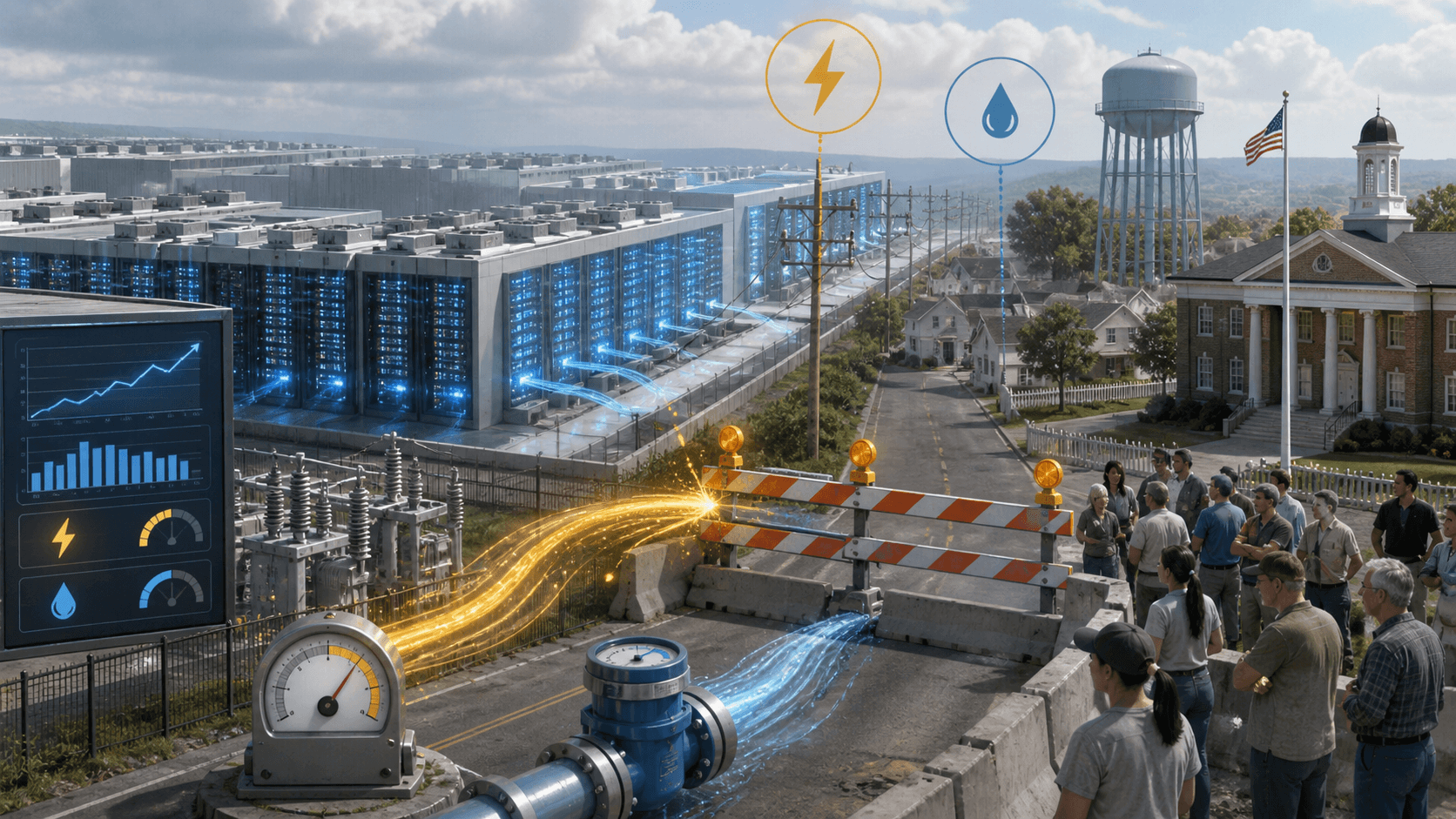
Public opposition to AI data centers is turning power, water, land, and local consent into binding limits on the industry's compute buildout.
The physical expansion of artificial intelligence has collided with the realities of local governance. An August 19 report from Axios describes rising public opposition to data center construction as a growing constraint on U.S. AI infrastructure. Communities are organizing to block or condition new facilities, citing concerns about electricity bills, water consumption, land development, and the limited number of permanent local jobs.
This development matters because the artificial intelligence industry has historically treated compute scaling as a purely financial and supply-chain problem, assuming that if capital and silicon were available, data centers would naturally follow. That assumption is now breaking down at the municipal and state levels. The latest AI news indicates that the bottleneck for the next generation of large language models is no longer just the yield of advanced semiconductor nodes, but the willingness of local zoning boards, utility commissions, and voters to host the massive, resource-intensive facilities required for AI training and inference.
flowchart TD
    A[AI compute demand] --> B[New data center proposals]
    B --> C[Power water and land pressure]
    C --> D[Local voter opposition]
    D --> E[Permitting and political restrictions]
    E --> F[Slower capacity growth]
    F --> G[Higher compute cost and tighter model supply]
    B --> H[Community benefit agreements]
    H --> D
The Macroeconomic Scale of Compute Infrastructure
To understand the intensity of the local backlash, one must first grasp the sheer financial mass of the current infrastructure buildout. The artificial intelligence sector is currently engaged in one of the most rapid and capital-intensive physical expansions in modern corporate history.
According to estimates from Goldman Sachs cited in the Axios report, United States AI investment is projected to reach approximately 600 billion dollars this year alone. To put this figure into macroeconomic perspective, this represents roughly 2 percent of the entire United States Gross Domestic Product and an astonishing 10 percent of all business fixed investment. This capital is not merely flowing into software development or algorithmic research; the vast majority of it is being deployed into hard physical assets. It is purchasing land, securing high-voltage transformers, laying thousands of miles of fiber-optic cable, and pouring millions of tons of concrete.
This unprecedented capital deployment is driven by the scaling laws of generative AI. The development of frontier models requires massive, interconnected clusters of specialized accelerators operating in continuous synchronization for months at a time. Unlike traditional cloud computing facilities, which handle bursty, distributed web traffic and can be geographically dispersed, AI training clusters demand extreme physical density to minimize latency between nodes. This density translates directly into extreme localized demands for electrical power and thermal management.
When a technology company proposes a new facility to support these operations, they are no longer asking a municipality to host a standard warehouse of servers. They are asking the community to accommodate an industrial facility that may consume as much electricity as a mid-sized city and require millions of gallons of water daily for cooling. The Goldman Sachs data underscores that the industry has the financial resources to build these facilities almost anywhere, but the capital markets cannot force a local utility to upgrade its transmission lines or compel a town council to rezone agricultural land. The friction between global capital allocation and local resource realities has created a severe bottleneck.
Decoding the Voter Backlash and Public Sentiment
The political resistance to this infrastructure is not merely anecdotal; it is now empirically documented and surprisingly broad-based. The Axios report highlighted a recent poll conducted by Echelon Insights, which revealed a startling deficit of public goodwill toward the artificial intelligence industry's physical footprint.
According to the polling data, only 27 percent of voters expressed support for having an AI data center built in their own community. This figure is remarkably low for an economic development project. In fact, the Echelon Insights poll found that support for AI data centers was lower than for every other type of infrastructure project tested, including nuclear power plants.
Understanding why a local population would prefer a nuclear facility over a server farm requires examining the complex intersection of local economics, resource scarcity, and psychological anxiety surrounding Artificial Intelligence News.
| Infrastructure Project Type | Primary Local Resource Burden | Typical Permanent Local Job Creation | Perceived Community Benefit |
|---|---|---|---|
| Traditional Manufacturing | Moderate power, high land use | 500 to 2,000+ jobs | High (tax base, employment) |
| Nuclear Power Plant | High water use, strict zoning | 400 to 700+ highly paid jobs | High (grid stability, jobs) |
| Standard Cloud Data Center | Moderate power, moderate water | 50 to 150 jobs | Moderate (property tax revenue) |
| AI Training Data Center | Extreme power, extreme water | 30 to 80 jobs | Low (resource drain, job anxiety) |
The opposition is driven by several distinct but compounding factors:
First, there is the issue of local utility rates. Data centers require massive amounts of continuous baseload power. When a new facility demands hundreds of megawatts of capacity, the local utility must often upgrade transmission lines, build new substations, or even procure new generation capacity. If the regulatory structure allows the utility to pass these infrastructure costs onto the broader ratepayer base, local residents end up subsidizing the expansion of global technology conglomerates through higher monthly electricity bills.
Second, the environmental footprint is highly visible and deeply felt. The high thermal density of AI accelerators often necessitates liquid cooling systems. In many designs, this involves evaporative cooling towers that consume millions of gallons of potable water, putting severe strain on local aquifers and municipal water supplies, particularly in regions already prone to drought. Furthermore, the sheer physical size of these campuses requires the clearing of vast tracts of land, altering the visual and ecological character of the surrounding area.
Third, the promise of economic revitalization often rings hollow. While the construction phase of a mega-facility brings a temporary boom of specialized contracting jobs, the permanent operational workforce is remarkably small. A facility that costs billions of dollars to build may only employ a few dozen permanent security guards, maintenance technicians, and network engineers. The ratio of capital investment to permanent local job creation is among the lowest of any industrial sector.
Finally, there is a profound psychological component unique to this specific technology. The Axios report explicitly connects local opposition to widespread anxiety about AI-related job losses. Voters are being asked to sacrifice their local resources, endure construction disruptions, and potentially pay higher utility rates to power the very AI tools and AI agents that they fear might eventually automate their own livelihoods. This creates a deeply adversarial dynamic that traditional infrastructure projects do not face.
The Physics and Economics of the Local Veto
To fully grasp why local political opposition is so effective at halting global AI ambitions, one must examine the mechanics of infrastructure deployment. The technology sector is accustomed to moving fast and breaking things in the digital realm, but physical infrastructure is governed by a complex web of local, state, and federal regulations that intentionally prioritize deliberate review over speed.
The primary mechanism of the local veto is the zoning board. Land use in the United States is overwhelmingly controlled at the municipal or county level. Before a single shovel hits the dirt, a developer must secure zoning variances, environmental impact permits, and site plan approvals. These processes require public hearings, which provide organized opposition groups with a highly visible platform to air their grievances and pressure elected officials. A motivated group of local citizens can delay a project for years through administrative appeals and environmental litigation, turning a rapid deployment schedule into a protracted legal battle.
Beyond zoning, the power interconnection queue is a formidable barrier. The International Energy Agency has extensively documented the growing strain that digital infrastructure places on global power grids. In the United States, securing a high-capacity interconnection agreement from a regional transmission organization can take half a decade. When local opposition groups pressure public utility commissions to scrutinize these agreements, they can effectively block a facility by denying it the electricity required to operate. The grid cannot be bypassed; it is a hard physical limit.
Water rights present a similar vulnerability. In many jurisdictions, particularly in the American West and Southwest, water allocation is a highly contentious political issue. When a proposed facility threatens to draw heavily from a local watershed, agricultural interests and residential advocates frequently form powerful coalitions to block the necessary water permits. Without guaranteed access to cooling water, the dense architecture required for large language models simply cannot function without catastrophic thermal failure.
State-Level Policy Interventions: The Pennsylvania Blueprint
As local friction increases, state governments are beginning to step in, attempting to mediate the conflict between economic development and community protection. A critical development in this space occurred recently when Pennsylvania Governor Josh Shapiro signed a comprehensive executive order establishing strict new requirements for data center development within the state.
According to the Pennsylvania Governor's Office, this executive order fundamentally changes the regulatory landscape for digital infrastructure. It moves the state away from the permissive, incentive-heavy approach that characterized the early cloud computing boom, replacing it with a framework that demands significant concessions from technology companies.
The Pennsylvania executive order mandates stringent requirements across several domains:
- Affordability and Ratepayer Protection: The order requires regulatory mechanisms to ensure that the massive infrastructure upgrades necessitated by data centers do not result in increased utility rates for residential and small business customers. The financial burden of grid expansion must be borne by the developer.
- Community Engagement: Developers can no longer rely on quiet backroom deals with municipal leaders. The order mandates transparent, structured community engagement processes early in the planning phase, giving residents a formalized voice in the development process.
- Workforce Development: Recognizing the low permanent employment numbers, the state is requiring developers to invest in local workforce training programs, ensuring that the community receives some long-term economic benefit beyond temporary construction labor.
- Environmental Protection: The order imposes strict transparency requirements regarding energy and water consumption, pushing developers toward more sustainable cooling technologies and renewable energy procurement.
- A Larger Local Role: The framework explicitly empowers local municipalities to negotiate binding agreements with developers, ensuring that community concerns are addressed before state-level permits are issued.
This policy intervention is a clear signal that the era of frictionless infrastructure expansion is over. The Pennsylvania blueprint provides a replicable model for other states grappling with similar pressures. It demonstrates how public opposition is being codified into binding administrative law, forcing the industry to adapt its deployment strategies.
This state-level action also contrasts sharply with broader federal ambitions. Earlier this year, the White House unveiled a national legislative framework aimed at accelerating domestic AI capabilities to maintain geopolitical competitiveness. However, federal mandates regarding technological supremacy often ring hollow when they clash with local zoning laws and utility regulations. The federal government can appropriate funds for research, but it cannot easily force a reluctant county commission to approve a massive industrial rezoning. The real battleground for AI supremacy is currently located in municipal planning offices.
Vendor Mitigation Strategies and Community Benefit Agreements
Faced with mounting political resistance and tightening state regulations, the major players in the artificial intelligence sector are attempting to pivot their public relations and operational strategies. Companies like OpenAI and Meta are increasingly relying on localized messaging and the deployment of community benefit funds to smooth the path for new facilities.
OpenAI, for instance, has begun heavily promoting its investments in responsible infrastructure, particularly highlighting initiatives in states like Texas. Their messaging emphasizes partnerships with local utilities to procure renewable energy and efforts to design more efficient cooling systems. Similarly, Meta has long maintained a public-facing portal detailing its sustainability efforts and community investments surrounding its physical footprint.
The primary tool emerging from these efforts is the Community Benefit Agreement. A CBA is a legally binding contract between a developer and community groups, wherein the developer agrees to provide specific local amenities, funds, or operational guarantees in exchange for the community's support—or at least its agreement not to litigate—the project.
| Mitigation Strategy | Industry Promise | Community Reality and Verification Challenges |
|---|---|---|
| Renewable Energy Matching | Purchasing wind/solar credits to offset 100% of power use. | Credits do not prevent local grid strain or localized emissions from backup diesel generators. |
| Water Replenishment | Investing in local watershed restoration projects. | Restoration takes decades; the data center draws millions of gallons immediately. |
| Community Grants | Millions of dollars allocated to local schools and nonprofits. | Often a fraction of the tax abatements the company receives from the municipality. |
| Waste Heat Recovery | Exporting server heat to warm local homes or greenhouses. | Highly complex to implement; rarely scales beyond pilot projects in the US market. |
However, as the Axios report and subsequent analysis suggest, there is a critical distinction to be made between corporate commitments and demonstrated long-term outcomes. While a technology giant might promise millions of dollars in grants for local STEM education or pledge to eventually transition a facility to entirely renewable energy, these promises often lack robust enforcement mechanisms.
Communities are becoming increasingly sophisticated in their negotiations. They are learning that voluntary corporate sustainability reports are not a substitute for binding contractual obligations. When a vendor claims that a new facility will be "water positive" or "net-zero," local opposition groups are now demanding to see the specific engineering plans and demanding financial penalties if those targets are not met. The burden of proof has shifted entirely onto the developer. The industry can no longer rely on the sheer prestige of being a cutting-edge technology company to secure local consent.
Downstream Impacts on AI Training and Deployment
The friction at the local infrastructure level is not merely a localized real estate problem; it has profound downstream implications for the entire artificial intelligence ecosystem. The physical limits imposed by community opposition directly impact the cost, availability, and trajectory of AI development.
First and foremost is the issue of compute capacity and cost. If the industry cannot build data centers at the pace required by its internal roadmaps, the supply of available compute will tighten. When the supply of a critical resource tightens while demand remains explosive, the price invariably rises. This dynamic threatens to significantly increase the cost of training large language models.
For the massive, well-capitalized incumbents, higher compute costs are a manageable margin pressure. However, for the broader ecosystem of startups, academic researchers, and open-source developers, a constrained compute market could be devastating. If the cost of renting high-performance clusters skyrockets because new capacity is tied up in zoning disputes, the development of specialized AI tools and domain-specific models will slow down. The democratization of AI relies on abundant, cheap compute; local political walls threaten to make compute scarce and expensive.
Furthermore, the physical constraints are forcing a reevaluation of model architecture and deployment strategies. If energy and thermal limits are hard-capped by local regulations, researchers must focus more heavily on algorithmic efficiency. We are already seeing increased emphasis on techniques like quantization, sparse mixture-of-experts architectures, and more efficient attention mechanisms. While these innovations are valuable, they are partially being driven by the necessity of operating within constrained physical environments.
The rise of autonomous AI agents also complicates this picture. As AI systems move from passive chatbots to active agents that continuously execute tasks, browse the web, and interact with software environments, the inference compute demand will skyrocket. Training a model is a massive, one-time energy expenditure, but deploying millions of AI agents requires continuous, highly reliable, low-latency inference capacity. If local communities refuse to host the edge data centers required to support this inference load, the performance and responsiveness of agentic systems will suffer, particularly in regions far from established compute hubs.
The industry is also exploring alternative, albeit extreme, infrastructure solutions to bypass local opposition. There is growing discussion around placing data centers in highly remote locations, directly adjacent to stranded energy assets like isolated hydroelectric dams or dedicated small modular nuclear reactors. While these concepts bypass municipal zoning boards, they introduce massive new complexities regarding network latency, physical security, and the sheer logistical difficulty of building and maintaining advanced technology hubs in the wilderness.
The Evidence Limits and Unresolved Uncertainties
While the trend of rising local opposition is clearly documented, it is important to acknowledge the limits of the current evidence and the unresolved uncertainties in this market dynamic.
The polling data from Echelon Insights provides a snapshot of current public sentiment, but public opinion is malleable. It remains to be seen whether the industry's aggressive pivot toward localized public relations and community benefit funding can effectively move the needle on voter support. If companies can successfully demonstrate that a new facility will genuinely lower local taxes or provide substantial, visible community upgrades, the 27 percent support figure could shift.
Furthermore, the long-term impact of state-level interventions like the Pennsylvania executive order is not yet fully understood. While the order introduces friction, it also provides a standardized regulatory pathway. Some developers may prefer a strict but predictable regulatory environment over the chaotic, ad-hoc battles of local municipal zoning. It is possible that codified state regulations, while demanding more concessions, could ultimately streamline the permitting process by removing the uncertainty of localized vetoes.
There is also uncertainty regarding the actual enforcement of these new political boundaries. When a multi-trillion-dollar industry faces a critical bottleneck, it exerts immense lobbying pressure. It is entirely possible that we will see efforts to preempt local zoning authority at the state or even federal level, declaring AI infrastructure to be a matter of critical national security that supersedes municipal concerns. The tension between local democracy and national technological imperatives is far from resolved.
Finally, the technological landscape itself is a moving target. While current generative AI architectures are extraordinarily resource-intensive, future breakthroughs in optical computing, neuromorphic chips, or fundamentally different algorithmic paradigms could drastically reduce the power and water footprint of AI training. If the physical demands of the technology decrease, the local political friction will likely subside. However, relying on hypothetical future breakthroughs is not a viable strategy for companies trying to deploy capital today.
Navigating the New Infrastructure Reality
The collision between the AI data center boom and local political realities represents a fundamental maturation of the artificial intelligence industry. The sector is transitioning from a purely digital phenomenon, constrained only by the speed of software development and silicon manufacturing, into a heavy industry, subject to the same physical, environmental, and political constraints as steel mills and power plants.
The August 19 Axios report and the subsequent policy actions in states like Pennsylvania confirm that community consent is now a critical path dependency for AI scaling. The 600 billion dollars in projected investment cannot be deployed through sheer financial force; it must be negotiated, compromised, and integrated into the local fabric of the communities expected to host it.
For builders and buyers of AI infrastructure, the operational playbook must change immediately. Site selection can no longer be driven solely by the availability of cheap land and theoretical grid capacity. It must now incorporate deep political risk analysis, proactive community engagement, and a willingness to sign binding, expensive community benefit agreements. The cost of these concessions must be factored into the overall unit economics of compute.
Looking forward, the industry should expect this political wall to become taller and more formalized. As the localized impacts of massive power and water consumption become more apparent, and as anxiety over AI-driven economic disruption persists, local municipalities will increasingly view data centers not as economic saviors, but as extractive industrial facilities requiring heavy regulation. The companies that will successfully navigate this new reality are not necessarily those with the most advanced algorithms, but those that can master the complex, deeply human politics of local infrastructure development. The era of frictionless compute expansion has decisively ended; the era of negotiated infrastructure has begun.