Superhuman Buys Fathom to Carry the Decision Beyond the Call
Fathom gives Superhuman meeting context for its agents. The acquisition’s real test is turning spoken decisions into reviewable work.
A decision can survive a meeting transcript and still disappear from the work that follows. Consider a hypothetical customer call: the tracker still lists September 25, but an account manager agrees to September 30 provided an engineer completes validation by September 28. A proposed tracker update should preserve the validation condition and assign the account manager the customer follow-up; an email draft should repeat the same conditional commitment. The reviewer would compare those fields with the conversation before approving them. If a summary captures the discussion but the email uses the old date or the tracker drops the condition, the handoff has failed. That gap is the commercial target of Superhuman’s September 14 announcement that it has acquired Fathom. The company plans to connect meeting intelligence to its applications and agents, making spoken commitments available where subsequent work happens.
Superhuman is therefore buying more than a way to produce readable notes. It is buying an established capture product and a source of context for deciding what an agent should do next. Crucially, the buyer is the productivity platform formerly called Grammarly, whose suite includes Superhuman Mail, rather than simply the historical email application. The acquisition announcement describes future integration across email, calendar, collaborative documents, and databases. It does not establish that Fathom conversations already flow through every part of that suite, or that agents can now execute the entire handoff without supervision.
The valuable moment comes after the summary
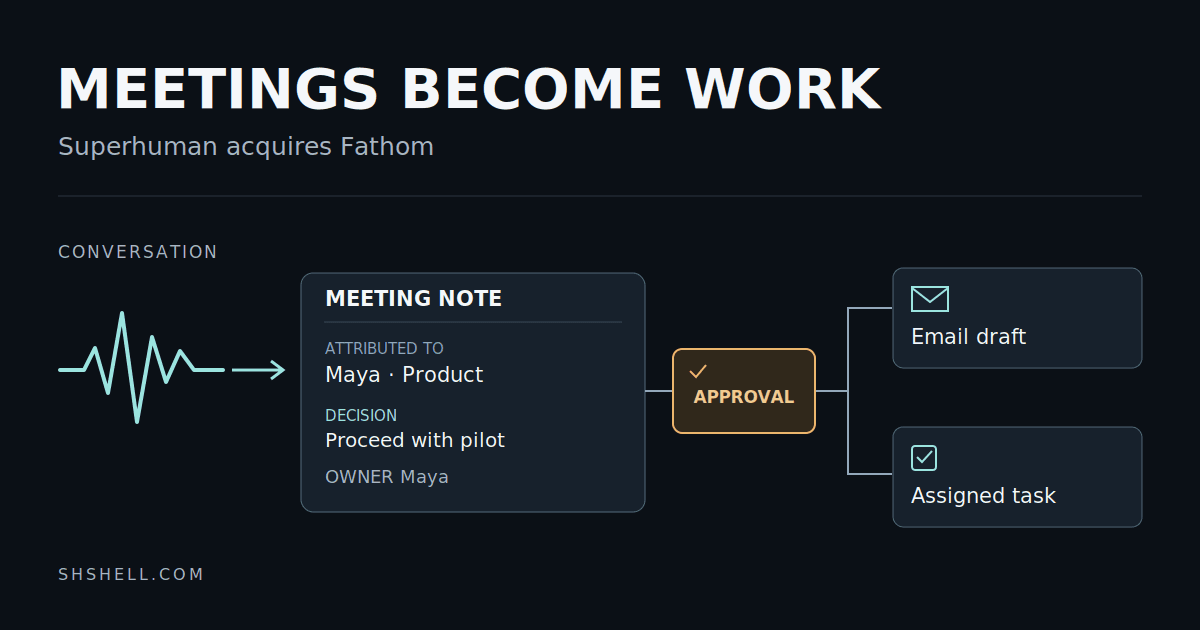
The announcement’s most revealing example is deliberately modest. Superhuman says an agent in Go could review a standup transcript, draft status changes for a project tracker in Superhuman Docs, and notify a project manager to review and approve them before finalization. This is an illustration of intended integration, not a documented release of that workflow. Nevertheless, it identifies the transaction’s practical logic: the meeting becomes evidence for a proposed change to an operational record. A summary is an intermediate product; the commercially consequential output is a tracker that reflects the team’s actual decisions.
That distinction changes the standard by which the acquisition should be judged. A useful recap can leave interpretation with its reader. A proposed database update must resolve which project is involved, whether a statement represents a commitment, and whether an earlier decision has been superseded. Superhuman’s own standup example includes a human approval step, preserving a place to resolve those questions. The analytical opportunity is not simply faster transcription. It is reducing the effort needed to translate a conversation into a specific, inspectable action while retaining the qualifications that made the decision accurate.
Fathom already markets capabilities beyond isolated summaries. Its current product page describes searchable transcripts, questions across past conversations, customizable summaries, topic monitoring, and automatic synchronization of meeting insights with other tools. Those are vendor descriptions, not independently demonstrated results, but they establish that Superhuman is acquiring a product already positioned around continuing use of meeting data. The proposed suite integration would extend that trajectory. It should not be portrayed as the moment Fathom first gained the ability to move information outside a transcript or help users retrieve something said in an earlier call.
There is also a difference between recording an action item and establishing its authority. In the hypothetical delivery discussion, “we could move the date” and “we have agreed to move the date” point toward different updates. An effective handoff would preserve who spoke, the surrounding qualification, and the relationship to the existing record. Fathom’s founder Richard White emphasized speaker attribution when discussing its earlier capture update with TechCrunch in April. That emphasis becomes especially relevant when a transcript is used to propose business changes rather than merely answer a reader’s question.
The buyer has places to put the conversation
The corporate naming history matters because it explains the range of those possible changes. In an October 29, 2025 announcement, Rahul Vohra said the parent company formerly known as Grammarly would take the Superhuman name, while the email application would become Superhuman Mail. That historical announcement described a suite beginning with Mail, Coda, Grammarly, and Superhuman Go. Its promises about forthcoming subscriptions and features belong to that period; they are not evidence of a new September 2026 launch. The lasting relevance is the distinction between a parent platform and one application within it.
The current product structure gives meeting information several different destinations. Superhuman’s product page presents Mail as the email application, Go as an assistant that brings agents into existing tools, and Docs as a collaborative surface for documents, projects, workflows, and data. It also advertises custom agents that turn meeting notes into recaps and owner-specific follow-ups. Existing assistance with notes is not the same as a completed Fathom integration. It does, however, show why ownership of meeting capture could matter: the company already presents products for preparing communications and maintaining the records to which those communications refer.
Docs is particularly important to the acquisition’s logic. The Coda product page now identifies Coda as Superhuman Docs and describes an evolution involving enterprise-ready databases and AI Views. The underlying product description combines documents, spreadsheets, applications, trackers, and integrations. These are company claims about the product’s design, but they clarify why the acquisition announcement uses a project tracker as its example. Meeting context could inform a structured object with fields and ownership, rather than landing only as another paragraph in an email. That offers a more concrete destination for follow-through, provided the intended connection is implemented.
Go supplies the proposed coordination layer. Superhuman’s agents page says users can define instructions, triggers, and connected applications for custom agents, and describes connectors that support record updates, replies, and task progression. Those advertised capabilities should not be read as universal access or unlimited authority. Analytically, however, they explain the fit: Fathom can supply conversational evidence, Go can select or run an instructed workflow, and Mail or Docs can hold the resulting draft or update. The acquisition combines potential input, coordination, and destination without proving that their permissions and behavior are already unified.
That combination also explains why the deal is broader than adding a recording button to an inbox. An email reply is only one possible consequence of a discussion. A conversation may affect a project status, a customer record, a document, and a follow-up invitation, each with different recipients and consequences. Superhuman explicitly plans integration across those work surfaces. The defensible interpretation is that it wants meeting context to inform multiple workflows. Whether those workflows become dependable products remains a separate question from whether the acquisition gives the company the necessary building blocks.
Buying capture means buying the difficult details
Superhuman’s decision followed its own work in the category. TechCrunch reported on September 14 that the company had tested a notetaker internally with selected users earlier in the year before choosing to acquire an existing product. In an interview with the outlet, chief executive Shishir Mehrotra said the effort increased confidence in demand while revealing how much had to be built to handle meeting recording well. He praised technical intricacies in Fathom without specifying them. That supports a build-versus-buy explanation, but it does not support claims about undisclosed proprietary advantages.
The capture experience had already been changing before the acquisition. In April 15 reporting, TechCrunch described Fathom’s update allowing transcription without an assistant joining the call. Fathom said users could choose recording modes and that its approach also supported video recording. White told the outlet that speaker diarization had been a focus, arguing that missing speaker identification in some bot-free tools made historical questions harder to answer correctly. These were the company’s explanations of its work, not comparative testing by TechCrunch or ShShell.
The relevance to Superhuman is precise. If an agent is asked to prepare a follow-up based on what an account manager promised, identifying the speaker is part of identifying the obligation. If an engineer discussed a possibility that a manager later rejected, retrieving the earlier sentence alone would be insufficient. These are hypothetical failure modes, not reported Fathom incidents. They explain why the April emphasis on attribution and querying a meeting database belongs in the acquisition story: capture quality influences the quality of the evidence available to downstream agents.
Release timing requires care here. The April article described an iOS application for recording in-person meetings as planned. Fathom’s privacy policy, updated August 16, 2026, subsequently discusses users who download its iOS application and opt into a voiceprint feature. That policy language describes data handling; it does not establish a complete mobile launch timeline or feature rollout. The current Fathom product page explicitly advertises bot-free availability, while Superhuman’s acquisition announcement describes bot-free options and live summaries. None of those statements makes the intended suite-wide Fathom connection a generally available feature.
Integration already exists, but ownership changes the ambition
Fathom brings existing routes out of its own application. Its product page says meeting notes, insights, and action items synchronize with tools including Slack, Salesforce, HubSpot, Notion, and Asana. Its developer portal provides entry points for API keys, meeting webhooks, TypeScript and Python SDKs, and public integrations using OAuth. The portal's overview does not enumerate endpoint behavior or permissions, so it cannot substantiate a particular production workflow. It does establish that Fathom is offering developers mechanisms for connecting meeting data to other software, rather than treating the recording archive as a closed destination.
The earlier push toward external AI tools is relevant too. TechCrunch’s April report said Fathom was releasing a Model Context Protocol server to let users bring meeting data into their AI tools. The current product page advertises meeting data inside ChatGPT, Claude, and other tools. Together, those sources support an existing direction toward reusable meeting context. They do not establish that every external assistant receives the same data, shares the same controls, or can perform the same actions. Access to context and authority to change a business system remain separate capabilities.
The acquisition’s incremental promise is therefore coordination. A connector can move a summary; an integrated workflow could use a relevant passage to prepare a change in the application where the user is already working. Superhuman’s announcement argues that connecting meetings with emails, documents, data, and workflows will make the knowledge actionable wherever people and agents work. That is a strategy statement. The following comparison separates documented product descriptions from the proposed combination, so that an existing export capability does not become mistaken evidence of a newly completed autonomous workflow.
| Handoff layer | Documented capability | Integration limit |
|---|---|---|
| Capture and retrieval | Fathom advertises bot-free capture, summaries, and search across conversations. Product page | Accuracy claims are the vendor’s. |
| External connections | Fathom exposes API, webhook, SDK, and OAuth documentation. Developer portal | OAuth support alone does not establish a particular workflow's permissions. |
| Agent configuration | Superhuman advertises instructions, triggers, and app connections. Agents page | This does not demonstrate native Fathom access. |
| Meeting-driven updates | Superhuman illustrates a transcript informing a Docs tracker draft with manager approval. Announcement | The example describes intended integration. |
The intended handoff can be represented simply, following Superhuman’s standup example. This is the company’s proposed workflow, not a diagram of a verified deployment.
flowchart LR
    A[Standup transcript] --> B[Go agent reviews context]
    B --> C[Draft tracker updates in Docs]
    C --> D[Project manager reviews]
    D --> E[Approved updates finalized]
The approval step is the most consequential part of that sequence. It creates an opportunity to compare the proposed operational change with the conversation before the record becomes authoritative. As an analytical recommendation, that review should show enough source context to evaluate the draft rather than merely offering an accept button. Superhuman’s announcement specifies review and approval, but does not describe the interface, source references, correction behavior, or handling of conflicting discussions. Those details will determine whether the workflow actually reduces interpretation work or simply moves it into a different screen.
Distribution is the business case, not proof of adoption
For Fathom, the attraction includes access to a larger platform audience. In his September interview with TechCrunch, White described Superhuman’s reach as an opportunity to distribute the product more widely and build faster. He said an independent Fathom would otherwise have to build capabilities already present in Superhuman’s platform. That is the seller’s strategic rationale, rather than evidence that the integration will automatically convert existing suite users into active Fathom users. Distribution can make a product easier to encounter; it cannot by itself establish demand for recording a particular organization’s meetings.
The reported scale figures also describe different things. TechCrunch reported more than 400,000 monthly active Fathom users and attributed to the company the statement that more than 1 million people had recorded meetings. Superhuman’s acquisition announcement describes its own reach as more than 40 million people and 50,000 organizations. Fathom’s product page says it is used at more than 300,000 companies. These figures should not be combined into a revenue estimate or treated as equivalent measures of paid enterprise adoption. They support a distribution argument without quantifying its eventual commercial payoff.
The deal also reflects pressure to make meeting software useful beyond the call. TechCrunch’s acquisition reporting describes a competitive notetaker market and growing expectations that venture-backed products do more than capture conversations. In that setting, owning both meeting context and applications that consume it may offer a clearer expansion path than improving summaries alone. That is an interpretation of the product combination, not proof that standalone notetakers cannot compete. Fathom’s existing integrations themselves show that broader workflows need not depend on common corporate ownership.
Neither the company announcement nor the published TechCrunch acquisition report states a transaction price. The announcement also does not provide a detailed integration schedule or explain how the acquisition will affect Fathom packaging. Those omissions limit what enterprise buyers can conclude today. The strategic fit is visible, but the economic proposition still depends on eventual access, plan boundaries, and how much of the proposed workflow arrives as a maintained product rather than a customer-built connection.
A traveling transcript carries permissions with it
The governance question follows directly from the intended product behavior. Superhuman wants meeting information to become available across connected workflows, while Fathom’s August privacy policy defines meeting content broadly: recordings, transcripts, notes, attendee names and emails, and related calendar information. In an illustrative customer discussion, that could place a commercial promise beside personal information or internal qualifications. Moving the useful decision into a tracker should not be assumed to require moving the entire conversation to everyone who can read that tracker. The acquisition announcement does not specify how the future integration will separate those scopes.
Fathom’s policy makes an important distinction between individual service use and enterprise arrangements. Where an enterprise customer provides a Team, Business, or Enterprise account, Fathom says it acts as a processor or service provider under customer instructions, with the customer determining the purposes and means of processing. The same policy says third-party integrations may receive notes, video-clip links, or transcript portions. For the proposed Superhuman workflow, the analytical implication is that a useful connection must respect both the original meeting’s access conditions and the destination’s permissions. Common ownership alone does not establish that those conditions are identical.
Bot-free capture does not remove participant considerations. Fathom’s privacy policy tells users to obtain necessary permissions and consents from other participants before recording or sharing their information, and notes that some jurisdictions require all parties’ consent. It also says recordings may be shared with other participants according to automatic-sharing settings and requests. These are the vendor’s stated requirements and practices. Their relevance to the acquisition is practical: making capture less visibly intrusive does not settle who should subsequently receive its content, particularly when that content may inform an agent acting in another application.
Training claims require equally careful separation. Fathom says in its privacy policy that, depending on account settings, it may create and use de-identified meeting-derived data to train, improve, and customize its in-house models, with an opt-out available. It separately says it does not authorize third parties to train their models using personal information or meeting content. Superhuman’s agents page says user data is not used to train third-party models. These statements address different parts of data handling. A prohibition on third-party training should not be paraphrased as a blanket prohibition on every form of model improvement.
Retention further complicates the idea of context traveling wherever work happens. Fathom’s policy says accounts and their personal information remain unless actively deleted, describes commercially reasonable efforts to delete recordings and personal information within 30 days of an account-deletion request without guaranteeing that timeframe, and directs enterprise-account deletion requests to customer administrators. It also says connected third-party services have their own privacy practices. For a future meeting-to-work integration, the unresolved question is how corrections or deletions would affect material already copied into a draft, tracker, or other connected destination.
The acquisition itself is contemplated in the policy, but that is not a substitute for an integration specification. Fathom’s merger and asset-transfer provision permits personal-information transfers in connection with a corporate transaction and says subsequent use will be governed by the policy in effect when the information was collected. Meanwhile, Superhuman’s agents page says agents do not retain information between sessions or across agents by default. A durable meeting archive and an agent’s default session behavior are different matters. The published sources do not explain how those boundaries will interact once Fathom becomes a native source of context.
A rejected update is useful meeting intelligence too
Superhuman's proposed standup-to-tracker workflow raises a question that is easy to miss in the acquisition announcement: what should happen when the project manager rejects the draft? The company specifies approval before finalization, but does not describe a rejection or correction loop. That omission matters to the commercial thesis. If the same misunderstood commitment repeatedly returns as a suggested update, capturing more conversations may increase the manager's review burden. A correction mechanism would need to distinguish a mistaken transcript from a mistaken interpretation and from a manager changing a decision after the meeting. These are different kinds of feedback, not interchangeable indications that the original recording was inaccurate. The announced workflow gives Superhuman a specific place to make those distinctions visible.
Take an illustrative standup in which a developer says the release is ready provided a customer migration finishes. The manager rejects an unconditional tracker update because the migration is still pending. A useful revision would preserve the original statement and attach the condition to the proposed status, rather than silently rewriting the record of what was said. Once the migration finishes, the same conditional commitment might legitimately support a different update. This is not a claim that Fathom or Go already performs that reconciliation. It is a product requirement implied by joining a searchable meeting history to an application that maintains current project state.
The distinction also suggests a better buying question than whether the acquisition adds another summary format. Fathom already advertises customizable summaries and historical search, while Superhuman proposes using that information in Docs. A team should ask how disagreements are resolved at that junction and whether the revised draft still points back to the relevant conversation. That would make the integration valuable even before it gains broader autonomy: it could help people correct misunderstandings without losing the evidence that made the discussion useful in the first place. The existing Fathom capabilities and planned Docs handoff identify the two sides of that still-unproven connection.
The decisive product test is a reviewable change
The first useful test of this acquisition should therefore be narrower than a promise that agents understand the whole company. Superhuman has already supplied a concrete candidate: a standup informs a tracker draft that a manager approves. As analysis, a strong implementation would let that manager see which statement justified the change, preserve unresolved conditions, and distinguish a proposed commitment from an accepted one. Those are evaluation criteria, not announced features. The company’s example makes the destination and approval boundary clear while leaving the mechanics of trustworthy interpretation open.
A second test is whether connected context remains useful when conversations disagree. In a hypothetical project, one meeting proposes a deadline and a later customer call changes it conditionally. Retrieving both discussions is valuable only if the draft update reflects their relationship. Fathom advertises questions across past conversations and searchable decisions, while Superhuman describes agents working from connected data. The acquisition could bring those capabilities together, but the published evidence does not demonstrate reconciliation of conflicting commitments. That distinction matters because a fluent summary can conceal a disagreement that an operational record must resolve.
Enterprise evaluation should also distinguish assistance from authorization. Superhuman currently describes calendar assistance that drafts an invitation and sends it to the user for approval, and its Fathom example similarly retains manager review. Those product descriptions suggest useful bounded patterns: prepare the work, expose the proposed result, and let an authorized person finalize it. They do not establish one universal approval policy for all agents. The relevant analytical standard is whether each workflow’s authority matches its consequence, rather than whether the platform can apply the same degree of autonomy everywhere.
Superhuman’s purchase is consequential because it connects a source of spoken decisions with products intended to carry those decisions forward. Fathom supplies existing capture, retrieval, and integration capabilities; the parent suite supplies prospective destinations and agent workflows. The September 14 announcement establishes the acquisition and the ambition, while leaving the combined experience ahead. Its success will become visible when a decision can reach the right record with its meaning intact and its approval clear. The valuable deliverable is the completed handoff: work that accurately reflects what the conversation actually authorized.
Sudeep Devkota writes about AI systems, enterprise software, and the practical limits of automation.