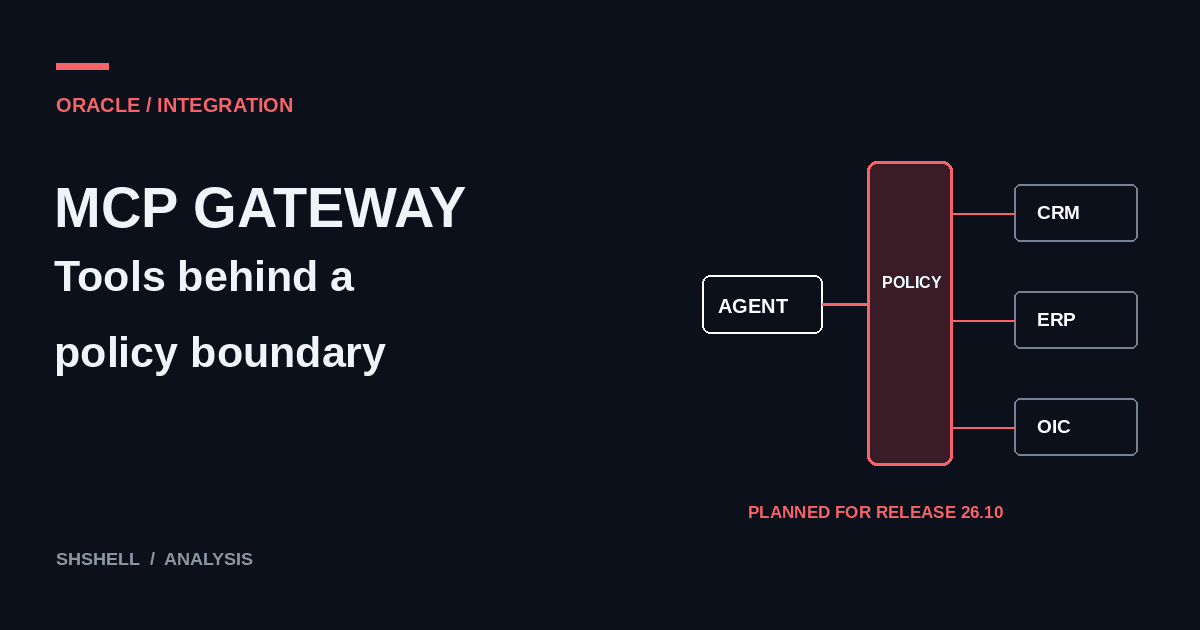
Oracle’s MCP Gateway Puts Enterprise Tool Access Behind a Policy Boundary
Oracle plans an MCP gateway for release 26.10. Its tool filters, credential controls and policy checks matter more than another agent demo.
Oracle’s MCP Gateway Puts Enterprise Tool Access Behind a Policy Boundary
A customer-service assistant should not need the same authority to explain an invoice as it needs to change the account behind it. Yet both actions can appear as neighboring tools in an agent’s workspace. That proximity is the architectural problem behind Oracle’s new MCP gateway: connecting an assistant to business software is not the same as deciding what the assistant may do there.
In its September 10, 2026 announcement, Oracle describes Oracle Integration MCP Gateway as a centrally governed path from Model Context Protocol clients to Oracle Integration and approved third-party MCP servers. The proposed boundary covers requester identity, tool exposure, security and business policies, downstream credentials, routing, and operational visibility. It is part of Oracle Integration, also called OIC, rather than a newly announced general-purpose agent model.
The availability language deserves attention before any architecture diagram does. Oracle says the gateway features will be available in the Oracle Integration 26.10 release. This is scheduled availability, not a statement that the gateway is generally available now. The release identifier should not be converted into a guaranteed calendar delivery date. Teams can evaluate the announced design; they still need release documentation and confirmation of availability for their environment before treating it as deployable infrastructure.
The useful question is therefore narrower than whether Oracle has made enterprise agents safe. It is whether moving the access boundary into an integration platform could let an organization expose useful business capabilities without handing each agent the credentials and permissions behind those capabilities.
Oracle is governing the route, not supplying the agent’s judgment
Oracle’s description of the gateway starts with one endpoint for MCP clients and multiple registered MCP servers behind it. The gateway evaluates configured controls before allowing access to OIC MCP servers or approved third-party servers. That arrangement changes where administrators express access decisions. Instead of depending entirely on each agent implementation to restrict itself, they get a shared point through which the relevant tool traffic can pass.
MCP supplies the discovery and invocation vocabulary in this account. A client can discover available tools and request that a server invoke one. Oracle’s additional proposition is to govern that interaction: establish who is asking, restrict what is exposed, evaluate applicable policies, and route an approved request. A common protocol and a common policy boundary solve related but different problems. Compatibility does not tell a company whether an employee should be allowed to execute a particular business action.
Consider the difference between understanding a refund request and being authorized to issue the refund. A language model might correctly interpret the customer’s complaint while lacking authority to change a financial record. Conversely, a properly authenticated agent could misunderstand the complaint. The gateway’s announced controls address access and policy enforcement; they are not evidence that the model’s reasoning, interpretation, or eventual explanation is correct.
This distinction also limits the gateway’s reach. A controlled route is valuable only for traffic that actually uses it. An organization evaluating this design should investigate other paths to the same underlying applications, including direct credentials held by agent clients. That is an architectural recommendation, not an Oracle claim about automatic network isolation. The announcement does not establish that creating a gateway disables every alternative connection.
Tool discovery becomes an administrative decision
The most immediate control in Oracle’s announced configuration workflow is the tool filter. Administrators register participating MCP servers, select tools, create reusable security and business policies, and apply policies at gateway, server, or individual-tool scope. Oracle says filters govern both discovering and invoking explicitly approved tools. This is more specific than merely asking an assistant in its prompt to avoid dangerous actions.
A filtered catalog can make the agent’s working environment smaller. For a diagnostic assistant, a server might contain both inspection tools and tools that change production settings. Exposing only the diagnostic subset gives the assistant fewer opportunities to select an inappropriate operation. Oracle itself uses the distinction between diagnostics and production changes to illustrate least privilege. It does not claim that every registered server automatically arrives with an organization’s correct tool boundaries.
The scope choices matter operationally. A gateway-wide rule can express a restriction intended for every participating server. A server-specific policy can reflect the sensitivity of a particular connected application. A tool-specific policy can address the difference between reading an account and altering it. These are announced policy attachment points, not a documented precedence algorithm. Buyers should ask how overlapping rules interact rather than infer whether the broadest, narrowest, or most recently edited rule wins.
Tool selection also creates a maintenance obligation. If a downstream server adds a capability or changes an existing tool’s meaning, the administrator needs a review process for the exposed catalog. The release post does not specify discovery refresh behavior, schema-change handling, or automatic approval rules for newly added tools. Those questions belong in acceptance testing because a tool boundary that was appropriate yesterday may not describe the same business action after a server update.
Identity and credentials are separate sides of the gateway
According to Oracle’s request-handling description, the gateway authenticates and authorizes the requester, which may be an agent, user, or service. It can then resolve downstream credentials through controlled stores, so the agent does not need direct access to those credentials. The two activities should not be collapsed into a single assertion that authentication makes every subsequent action legitimate.
Requester identity answers who arrived at the boundary. Downstream credential resolution determines how an approved interaction reaches another system. In an enterprise evaluation, the relationship between them is crucial: does the resulting application action preserve the relevant user context, or does it operate under a service identity with separate restrictions? Oracle’s announcement does not provide enough implementation detail to answer that for every configuration. Architects should require an explicit identity mapping for the workflow they intend to expose.
Central credential handling has a clear design attraction. An agent client that never receives a downstream secret cannot accidentally reproduce that particular secret in its own prompt history or configuration export. But this does not make the information returned by the tool harmless. A properly mediated request can still retrieve sensitive business data. Credential protection and response-data protection therefore need separate evaluation, even when a product offers both in the same access path.
There is also a practical revocation question. If an employee changes role, administrators need to understand which identity, tool permission, policy, and downstream access changes are necessary to remove the old authority. The announcement establishes centralized identity and credential controls, not their propagation timing or every identity-provider integration. A buyer should ask Oracle to demonstrate the entire revocation path for an actual intended workflow, including what a previously connected client can still attempt afterward.
Business rules can reject a request without understanding the whole business
Oracle’s demo outline includes a PII policy for sensitive information on the request and response path, and business-rule policies intended to protect against malformed, incomplete, hallucinated, or business-noncompliant requests. The broader announcement says policies can be evaluated before forwarding a request and, where applicable, while returning a response. The qualification matters: not every conceivable control is promised at every point.
A business rule can be valuable precisely because it does not need to reason like the agent. If a workflow requires a valid customer identifier, an explicit check can reject a request that lacks one rather than trusting the model to supply an acceptable value. That is a useful place to catch some consequences of hallucination. It is not a general hallucination detector: a wrong identifier that satisfies the configured checks may still refer to a real but unintended customer.
PII handling deserves the same precision. The announcement identifies a policy category and its location in the interaction. It does not publish a comprehensive detection taxonomy, measured detection performance, or a guarantee that every sensitive field and free-text disclosure will be caught. An enterprise should test its own customer records, internal identifiers, and document formats against the actual released behavior. It should not substitute the existence of a PII control for evidence about what that control recognizes.
Nor does a valid individual request establish that a sequence of requests is appropriate. Reading a customer record, reading a supplier record, and initiating a workflow might each be permitted while their combination serves the wrong purpose. The release post does not establish a general stateful monitor that understands every cross-tool business intention. Where the desired restriction depends on a transaction’s history or business state, evaluators should identify the application or orchestration logic responsible for enforcing it.
Where Oracle Integration ends and the MCP gateway begins
Oracle distinguishes the gateway from the existing integration foundation around it. OIC supplies application connectivity, integrations and automations, business decisions, orchestration, and human participation in approvals, reviews, and exception handling. The gateway governs MCP access to those capabilities. Treating every OIC capability as a newly announced gateway feature would blur an important product boundary.
The following diagram is a conceptual reading of Oracle’s description, not an implementation specification. In particular, the response-policy branch is conditional because Oracle describes response evaluation as applicable in some cases. It does not show a prescribed API, credential-store product, or policy execution order beyond the high-level interaction presented in the announcement.
flowchart LR
    C[MCP client] --> G[OIC MCP Gateway]
    G --> A[Identity and approved tools]
    A --> P[Applicable request policies]
    P --> K[Controlled credential resolution]
    K --> O[OIC MCP server]
    K --> T[Approved third-party MCP server]
    O --> R[Applicable response policies]
    T --> R
    R --> C
    G -.-> V[Activity and policy visibility]
For an integration team, this separation suggests a useful design discipline: expose a business capability, not a pile of low-level privileges. A hypothetical agent that needs to request a reviewed account adjustment may be better served by an integration designed for that process than by unrestricted access to every underlying record mutation. That is a recommendation about how to use the announced architecture, not confirmation that Oracle ships such a ready-made tool.
It also identifies where human approval should live. Oracle says OIC can include people in business processes. The gateway can govern access to the integration that participates in such a process. The announcement does not establish that adding a gateway policy automatically inserts an approval step into any arbitrary third-party tool. The approval’s triggering conditions, review interface, and effect on execution remain workflow design questions.
A hypothetical support desk: reading an invoice is not correcting it
Imagine a company designing an assistant for employees who handle billing complaints. This is a hypothetical evaluation scenario, not a reported Oracle deployment. Its starting point is the distinction Oracle makes between retrieving customer information and sending sensitive actions for human review. The desired result is an assistant that can investigate a complaint without acquiring general authority over the customer account.
The company could begin by identifying an approved read-only capability that retrieves the relevant billing information. It would then decide what the requesting employee is entitled to see, which customer identifiers the request must contain, and which returned fields are necessary for answering the complaint. Those decisions map to the announced identity, tool-filter, business-policy, and sensitive-information controls. They do not require inventing an endpoint name or assuming a particular billing-system adapter exists.
Now suppose the employee asks the assistant to correct the bill. The key decision is whether a correction tool belongs in this assistant’s catalog at all. If review is mandatory, the company might instead expose an integration that starts a correction request and leaves approval inside the business process. Successful creation of that request would not mean the invoice had been changed. The assistant’s user-facing response should distinguish submission, review, and completion.
The scenario becomes informative when the test is adversarial but ordinary: the employee supplies the wrong account, omits a required identifier, requests another customer’s history, or asks the assistant to skip review because the customer is angry. Evaluators should inspect both the gateway decision and the downstream application state. A denial message is insufficient if the application nevertheless changed; a successful tool call is insufficient if the customer received the wrong explanation.
A further test should ask what happens when a correction request succeeds downstream but the client loses the response. Repeating the tool call could have business consequences. Oracle’s launch post does not specify transaction deduplication or exactly-once execution guarantees. The company must find out whether the integration or application already handles repeated submissions, and how the assistant can learn the status without blindly trying the same action again.
A hypothetical operations agent: diagnostics with a hard stopping point
A second evaluation can begin with Oracle’s own diagnostic-versus-production-change example. Suppose an operations team wants an assistant to gather approved health information from an OIC integration and a third-party MCP server during an incident. This is another hypothetical workflow. The aim is to shorten investigation, not to establish that Oracle has deployed or benchmarked this exact arrangement.
The team would select diagnostic tools from both servers while excluding tools that alter production configuration. This tests a concrete part of the proposed architecture: can one gateway present the intended subset across multiple registered servers? It also creates a useful stopping point. When the assistant concludes that a configuration change might help, it should produce evidence for an operator rather than silently discover a route to execute the change itself.
The tool descriptions deserve review alongside the permissions. A nominally diagnostic operation may return secrets in logs or reveal configuration that should not leave the operations group. Restricting the catalog is therefore only the first boundary. The team should test the response policies applicable to its diagnostic payloads and decide which results the assistant may include in a ticket or explanation. This is a proposed test of Oracle’s stated controls, not an assertion about guaranteed log redaction.
Failure behavior is especially important during an incident. If one downstream server is unavailable, the assistant should not describe the combined investigation as complete. If a policy denies access to a health signal, the assistant should distinguish that denial from evidence that the system is healthy. A useful evaluation would compare the narrative the operator receives with the actual tool outcomes recorded along the gateway path.
The hard stopping point should survive pressure. An operator asking for an urgent fix does not by itself justify exposing a mutation tool that was intentionally excluded. If the organization wants an emergency-change process, it must design and test that process separately. Otherwise the diagnostic pilot has quietly become a production-control pilot, with different authority and different consequences, despite keeping the same conversational interface.
A third-party MCP server remains a separate trust decision
Oracle explicitly includes approved third-party MCP servers behind the gateway alongside OIC servers. That expands the architectural usefulness beyond Oracle-hosted integrations, but the word approved does real work. Registration should mean an organization has made a decision about a server and its tools, not that the gateway has independently established the trustworthiness of whatever service an administrator points it toward.
For the hypothetical support assistant, consider adding a third-party shipment-status tool. Its business purpose may be narrow: retrieve the delivery state associated with a customer’s order. The evaluation should start by asking which identifiers must leave the company, which system owns the delivery information, and whether the returned text is suitable for the assistant’s audience. This remains an illustrative design review, not a claim that Oracle supplies a particular shipping integration or verifies a shipping provider’s answers.
The outbound and inbound decisions differ. A request policy might reject a missing order reference, while an applicable response policy might address sensitive information in the returned data. Neither alone establishes that the shipment status is fresh or belongs to the intended order. The downstream service and the integration’s interpretation of its response still matter. The gateway can govern a call without becoming the authoritative source for the business fact returned by that call.
A contract change would therefore require more than checking that the server is still reachable. If the tool begins returning a broader customer profile instead of a delivery summary, the old approval may no longer fit. If its operation changes from checking a shipment to also creating a support case, a formerly observational capability has acquired a side effect. Administrators should review the tool’s business meaning, not just whether its name remains in the allowed list.
Responsibility should be assigned at the same level of detail. The team approving the server needs an owner for its tool definitions, an owner for the business process that consumes its answers, and a way to withdraw the capability when that relationship changes. Oracle’s centralized registration and tool filtering provide places to express those decisions. The announcement does not say they automatically supply the organizational review, vendor assessment, or ongoing semantic compatibility checks behind them.
This is also where the single-endpoint proposition can be misunderstood. Giving the client one connection does not make the downstream estate homogeneous. Different servers may fail differently, return different levels of detail, or represent completion in different ways. An integration team should decide which differences the business workflow must normalize and which must remain visible to the assistant. Otherwise the unified endpoint merely hides complexity that reappears when a customer asks why an apparently successful action did not achieve the intended result.
Observability must reconstruct the business action, not just the connection
Oracle says the gateway can capture request activity, tool usage, outcomes, policy decisions, and health signals. Its demo outline also points to monitoring across client requests, policy evaluation, invocation, response handling, and downstream outcomes. This gives evaluators a specific observability surface to investigate. It is not a published promise about every log field, retention period, export format, or correlation mechanism.
For the billing scenario, the important investigative question is not simply whether the client connected. Reviewers need to determine which customer was involved, what action was requested, what was allowed, and whether the downstream workflow actually changed state. Some of that evidence may live in the gateway and some in OIC or the billing system. A sensible pilot should establish how those records can be joined before an ambiguous transaction becomes an incident.
Operators should also distinguish policy success from business success. A gateway can correctly authorize and forward a request that the destination later rejects because the account has changed. Conversely, an application may complete an operation while the response path fails. Monitoring that collapses these outcomes into one success flag would make recovery difficult. The announcement’s multiple visibility categories are promising precisely because there are several different events worth observing.
Capturing more data is not automatically better. Logging complete customer responses could create another repository of sensitive information. The evaluation should therefore ask what evidence is necessary to investigate a decision, which payloads can be omitted or minimized, and who can inspect the resulting records. Those are design questions prompted by the gateway’s announced observability, not additional Oracle features inferred from the word audit.
The questions release 26.10 still has to answer
The September announcement provides a feature outline and demo sequence, but it does not supply a full operating contract. It gives no measured gateway latency, throughput comparison, pricing schedule, or comprehensive compatibility matrix in the post. Absence from that announcement is not proof the eventual product will lack an answer. It does mean a buyer cannot responsibly fill the gaps with assumed enterprise defaults.
The first acceptance discussion should stay close to the intended MCP clients and servers. Ask which protocol capabilities and connection behaviors are supported in the released version, how tool definitions are updated, and how failures are surfaced. A successful demonstration with one client and a sample query does not establish compatibility with every agent framework or third-party server. The relevant compatibility test is the combination the organization actually intends to operate.
The next discussion should address policy administration. Who may register a server, approve a tool, edit a business rule, or inspect activity? How are conflicting policies resolved, and how can a change be tested before it affects active workflows? These questions concern the governance system itself. Centralizing tool access creates a powerful administrative surface, so the controls over changing that surface deserve scrutiny alongside the controls it applies to agents.
Finally, test degraded operation. What happens when a credential cannot be resolved, a policy dependency is unavailable, or a server times out after receiving an action? Does the client receive enough information to stop safely and ask for help? Do operators have a documented recovery path? The announcement is not a basis for claiming rate limits, rollback, failover, or automatic transaction recovery. Those requirements should be verified explicitly rather than imported from expectations about the word gateway.
The first tool worth exposing may be the smallest one
Oracle’s announced direction makes most sense for a team that can already describe a bounded business capability and wants MCP clients to reach it under shared controls. The gateway is not a reason to expose an entire application estate at once. A narrow catalog gives administrators something concrete to inspect and gives users a clearer account of what an assistant can actually accomplish.
Before release availability is confirmed, an integration team can do useful preparation without pretending to have deployed the product: choose the business action, identify its owner, separate reads from mutations, locate the existing approval logic, and document the evidence needed to establish completion. Each decision reduces ambiguity that a gateway alone cannot resolve.
The decisive pilot should then be deliberately unglamorous. Ask the assistant to do one legitimate task, one forbidden task, and one task whose outcome becomes uncertain halfway through. If the organization can explain all three results from the actual policy decisions and application state, it has learned something valuable. If it can only replay a convincing conversation, the enterprise boundary is still missing.
Sudeep Devkota edits ShShell.ai and writes about AI systems, enterprise infrastructure, and the operational consequences of giving software agents access to business tools.