OpenAI's Habitat Story Shows Why AI Infrastructure Breaks Far From the GPU
OpenAI's storage account traces failures to Python scheduling, synchronized configuration and connection reuse, not simply insufficient database capacity.
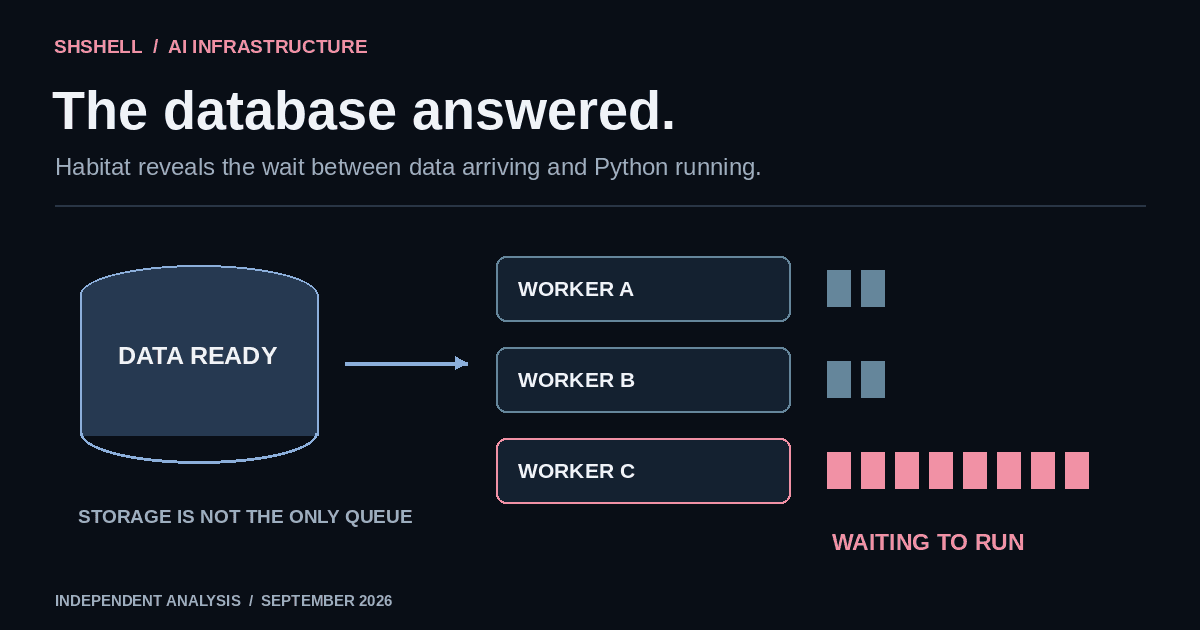
The database had answered. The user was still waiting. In OpenAI's account of scaling its Habitat storage platform, some of the slowest requests were delayed not by the storage engine but by Python coroutines waiting to run again. That is a less glamorous bottleneck than a shortage of accelerators, and a useful explanation of why buying more model capacity does not automatically make an AI product feel faster.
OpenAI published its first Habitat scaling installment on September 11, 2026. The company describes a platform that began as a Python client library supporting GPTs at DevDay 2023 and evolved into a separate service over Azure Cosmos DB and other storage resources. This September 12 analysis focuses on the engineering mechanisms in that account. The reported scale and operational history are OpenAI's claims, not independently audited measurements. The engineering article is the primary source.
The story is about control as much as throughput. OpenAI centralized storage logic because coordinating client-library changes across many services had become unsafe. It then had to make that new service predictable under load. Configuration polling, connection reuse and worker scheduling became part of the user experience because every product request depended on the data path beneath it.
A shared library became a distributed deployment problem
Habitat initially hid database mechanics behind a small Python interface. Product engineers did not have to manage routing, authorization, serialization, encryption or connection pooling directly. That made the library attractive: it reduced the amount of storage-specific knowledge required to build a product feature. OpenAI says adoption spread without a central campaign to force teams away from other database access patterns.
The same convenience eventually created a coordination problem. Once many services carried their own copy of the storage client, changing routing behavior meant updating all of them. OpenAI describes a migration intended to reduce the impact of a regional outage. Rolling out the necessary logic, adding shadowing and fixing a bug each required coordination. Then an unrelated service rollback restored an older, buggy client and caused an outage. OpenAI's account supplies that sequence.
That failure is more revealing than a generic claim that microservices are complicated. The storage platform's correctness depended on the deployment state of applications owned by other teams. A rollback that was locally reasonable could violate a global assumption. The library had become a distributed control plane without a reliable way to make every participant change together.
Moving the logic into a service reduced that operational fan-out. A storage change could be deployed centrally rather than waiting for dozens of callers. The tradeoff was a new network hop and a new shared dependency. OpenAI accepted those costs because it needed a single point of control for behavior that had become too consequential to distribute casually.
Centralization creates a security boundary and a failure boundary
OpenAI describes Habitat as a place to enforce access control, audit activity and limit direct access to underlying storage. That is a meaningful benefit in an organization where both people and agents may operate tools. A product service should not need broad database credentials simply to retrieve a small authorized object. The Habitat article presents centralized security as part of the service's purpose.
The architectural principle is separation of responsibility. Product code asks for a permitted operation; the storage layer determines where the data lives and whether the request is allowed. That can make policy changes easier to apply consistently. It can also make mistakes more consequential because a defect in the shared layer can affect many products at once.
An organization copying the pattern should therefore ask what must remain available if the central service degrades. Login state, account settings and ordinary content reads may have different criticality. The answer should influence isolation, caching and overload policy. Centralizing code does not mean treating all traffic as equally important.
The same logic applies to audit records. A single enforcement point can improve observability, but only if request identity and authorization context survive the hop. If the storage service sees every caller as one broad service account, centralization may hide rather than clarify who accessed what. The useful design is not simply one endpoint; it is one enforceable contract with enough context to make the right decision.
Python was a sequencing decision, not a declaration of victory
OpenAI says it kept Python for the first service implementation to move quickly and stabilize the platform, while expecting its inefficiencies to require a later rewrite at much larger scale. The article characterizes that choice as deliberate technical debt. It also says the company expected improving coding models to make a future migration easier. Those are the company's retrospective judgments, not a general prescription for every high-throughput service.
The important distinction is between choosing a language forever and choosing the next useful stage of a migration. Rewriting the client library and changing the deployment architecture simultaneously would have added risk. Preserving familiar logic let the team establish the service boundary first. Performance work then became a way to buy time for the next architectural move. OpenAI explains the sequencing.
That does not mean performance was ignored. A storage service sits on a latency-sensitive path, and the company describes substantial effort to keep Python scheduling overhead under control. A quick implementation is only useful if it remains reliable enough to support the transition it was meant to enable.
For smaller AI companies, the lesson is not to imitate OpenAI's eventual scale. It is to identify which uncertainty must be resolved first. If ownership and deployment coordination are the immediate problem, a familiar-language service may be sensible. If CPU-heavy processing already dominates the request path, preserving that stack without a plan may simply move the bottleneck into a more centralized location.
Asyncio can overlap waiting without making CPU work disappear
Python's asyncio model is well suited to overlapping input and output, but an event loop still has to schedule tasks and execute their CPU work. OpenAI describes Habitat responsibilities including routing, compression, encryption, checksumming and background health checks. Those tasks compete for execution time with requests whose database responses are already ready.
The Python documentation explains that an event loop runs tasks and callbacks and that blocking work can delay other tasks. Its development guidance includes tools for detecting slow callbacks and avoiding blocking operations in the event-loop thread. The asyncio development guide and event-loop reference provide the underlying programming context.
OpenAI's observed failure was therefore not mysterious once the right interval was measured. A trace could show a quick downstream response and still have a long end-to-end duration because the coroutine responsible for processing that response waited to be scheduled. Database latency alone would point investigators at the wrong component.
The company says it measured scheduling delay by periodically scheduling background work and comparing expected with actual execution. It then kept the number of concurrent requests per process relatively small and scaled the number of worker processes. That is a workload-specific tuning choice. Increasing concurrency without examining event-loop delay could make apparent utilization better while making user-facing tail latency worse.
The slowest lookup can dominate an otherwise fast request
OpenAI says a user request can involve many database calls, making the slowest dependent call important to perceived latency. An application does not become responsive merely because its average lookup is fast. If a required branch stalls, the user may wait for that branch even while everything else finishes promptly.
This is why tail behavior deserves its own instrumentation. An aggregate average can conceal a small set of overloaded workers, synchronized background tasks or unlucky connections. A service-level latency chart should be paired with per-process load, queueing and dependency timing. The Habitat account is valuable because it follows the delay through those layers instead of stopping at a single percentile dashboard. OpenAI's traces and explanation describe the problem.
A hypothetical AI workspace might retrieve conversation state, permissions, preferences and tool settings before answering. If one permission lookup repeatedly lands on an overloaded worker, the model can appear slow even when inference is healthy. Increasing GPU capacity would not fix that path. The engineering response should follow the actual critical dependency.
This also affects how product teams interpret performance experiments. A model upgrade can coincide with a storage regression and receive the blame, or a cache improvement can make a model seem faster than it is. Separating inference time, orchestration time and state-access time makes those conclusions more defensible.
A feature-flag refresh became a synchronized pause
One of OpenAI's most concrete examples concerns Statsig configuration polling. The service periodically fetched a large configuration containing production rules across services. With polling on the same interval and no jitter, workers could spend time parsing the configuration together. The article describes a deployment choice involving multiple Python processes per pod that amplified the synchronized interruption.
The fix was not a new database engine. OpenAI says it reduced the configuration to a targeted subset, increased the refresh interval and introduced jitter. That combination reduced unnecessary work and stopped background tasks from aligning so neatly. The configuration example is a reminder that control-plane traffic can interfere with the data plane.
An AI application can reproduce this pattern with policy refreshes, tool catalogs, model-routing rules or prompt configuration. A background operation that is cheap for one process becomes disruptive when every worker performs it at the same moment. The problem is the shape of the work over time, not only the total amount.
A sensible test should therefore include refresh boundaries rather than only steady-state traffic. Observe whether latency spikes at configuration intervals and whether newly started workers synchronize after a deployment. Jitter is not a substitute for reducing excessive work, but it can prevent a necessary background task from becoming a recurring system-wide pause.
Connection reuse can reward the slowest server
The connection-pool incident is the sharpest part of the Habitat story. OpenAI says some processes received far more concurrent requests than the average. After a burst ended, a subset remained degraded and continued attracting traffic. Investigation led to last-in, first-out connection reuse in the aiohttp version and configuration the team was using.
The mechanism is counterintuitive. A slow request returns its connection to the pool later. If the client immediately prefers the most recently returned connection, it can send new work back toward the server that was already slow. More work makes that server slower, reinforcing the imbalance. OpenAI says switching to first-in, first-out reuse broke the loop. The article is the source for that historical behavior; it should not be generalized into an unqualified claim about every current aiohttp release.
The current aiohttp client reference describes session-level connection pooling and keepalive behavior. It establishes why clients reuse connections, but the exact reuse policy and operational effect depend on implementation and workload. Teams should inspect the version they actually run rather than apply a historical patch by slogan.
OpenAI connects the incident to metastable failure: a state that sustains itself even after the initiating load subsides. Facebook's earlier engineering account describes that broader class of self-reinforcing failure in a different network context. That primary engineering account is useful context, not evidence that the two systems had identical bugs.
flowchart LR
    A[Traffic burst] --> B[One Habitat worker slows]
    B --> C[Its connection returns later]
    C --> D[Historical LIFO reuse selects it again]
    D --> E[More requests reach slow worker]
    E --> B
    F[FIFO reuse or load-aware proxy] --> G[Break the reinforcing imbalance]
More workers can move the bottleneck into the network
Scaling out Python processes reduced the work competing inside each event loop, but it created another pressure point: connections. OpenAI describes how a large process population could overwhelm downstream systems during deployments or amplify the impact of a connection leak. Capacity measured only in requests per second would miss that resource dimension.
The company says it uses Envoy to aggregate connections, upgrade Python's HTTP/1 traffic to HTTP/2 upstream and apply rate limits and circuit breakers. HTTP/2 can multiplex requests over a connection, reducing the number of separate connections needed for the same logical traffic. Envoy's connection-pooling documentation explains those protocol-level properties.
This is not free capacity. Streams, queues, connection limits and upstream resources still need bounds. Envoy's circuit-breaking documentation describes limits on connections, pending requests and other resource categories. The point is to make overload behavior explicit rather than let every application process independently create as much pressure as it can.
For an AI service with many short-lived agent workers, the analogy is direct. Starting more agents can increase connections to storage, secrets services and observability systems before it increases useful completed work. A deployment that launches every worker at once can behave like a traffic event. Rollout pacing and connection budgeting belong in capacity planning alongside model throughput.
A constrained API is an infrastructure feature
OpenAI says Habitat deliberately exposes a simple NoSQL-style API rather than arbitrary SQL capable of broad scans and joins. The stated goal is predictable, bounded work. That is a limitation from a query-language perspective and an advantage from an operational perspective. The service can reason more clearly about isolation, load balancing and request cost when callers cannot accidentally create unbounded fan-out.
The article contrasts that approach with the difficulty of reviewing every query and schema change as an organization grows. This is not proof that Postgres is unsuitable for large systems or that SQL inevitably causes outages. It is a description of why OpenAI chose a narrower contract for this shared online-storage layer. The Habitat design discussion should be read at that level of specificity.
Azure Cosmos DB's partitioning documentation explains how logical partitions follow a partition-key value and why key choice affects performance. Its consistency documentation describes different tradeoffs among consistency, availability, latency and throughput. Those are relevant constraints beneath the service, but the Habitat post does not establish which consistency level every OpenAI dataset uses. Partitioning and consistency levels are separate design decisions.
A smaller company can apply the principle without adopting the same database. Define the online operations that must be fast and predictable, and keep expensive analytical queries off that path. A convenient general-purpose endpoint can become a reliability hazard when many teams and agents begin generating requests against it.
Overload policy decides which work survives
A service that accepts every request until it collapses is not necessarily more helpful than one that rejects some work early. Google's site-reliability guidance on overload explains the importance of bounded resource use and deliberate handling of excess demand. The SRE chapter provides broader operational context for the same class of problem.
In Habitat's case, scheduling, pooling and proxy limits all influence how pressure propagates. A queue that grows without bound can turn a short burst into a long period of stale work. Retries can multiply the load. Connection limits can protect a dependency but also create waiting elsewhere. The useful question is not whether one component has a limit; it is whether the combined system sheds or delays work in a controlled way.
For an agent platform, some operations may be safely retried while others represent state-changing actions that require careful deduplication. A storage timeout does not always mean a write failed. The application needs an operation contract that lets it resolve uncertainty without blindly issuing the same effect again. That is an architectural implication, not a claim that the Habitat article documents every such mechanism.
Load tests should include recovery after a burst, not only maximum sustainable throughput. The connection-pool incident demonstrates why: a system can remain unhealthy after demand falls. A passing test should show that queues drain, worker imbalance subsides and the service returns to ordinary behavior without hidden manual intervention.
The migration needs a compatibility contract of its own
Pulling a library into a service changes more than deployment ownership. Callers now depend on a network API, its error behavior and its versioning rules. OpenAI's account makes clear why centralized deployment was attractive, but a company adopting the pattern still has to decide which behavior remains compatible when the service changes. A stable endpoint name is not enough if the meaning of a timeout or authorization error changes underneath clients.
The earlier routing incident shows why rollback compatibility deserves explicit testing. A new storage service may be deployed while older callers remain active, and a product team may roll back for reasons unrelated to storage. The platform should identify which combinations are supported and what happens when a caller lacks a newly required field. Otherwise the same coordination problem can reappear in a different form.
Shadowing can help compare routing or read behavior before a cutover, but it needs a clear safety boundary. A shadow read is different from a duplicated write. The test design should avoid turning an observational migration into a second source of side effects. OpenAI describes adding shadowing during its routing work; the general operational implication is to define exactly what is being compared and what is allowed to execute.
A useful migration record would include the old and new request semantics, representative error cases, rollback assumptions and the checks used to establish equivalence. That documentation is not bureaucratic overhead when many product services depend on the same storage contract. It is what lets teams move independently without recreating the failure in which an unrelated rollback restores an unsafe client.
Storage dashboards should expose imbalance, not average it away
The Habitat connection incident illustrates why a fleet-wide utilization average can be falsely reassuring. If some workers are overloaded while others have room, adding more workers may not improve the affected requests. The distribution mechanism has to send work to them. OpenAI's account says connection reuse concentrated load on a subset of processes, which is exactly the kind of condition an average can hide.
Operators should inspect the spread of concurrent requests, event-loop delay and connection counts across workers. They should also correlate those measurements with deployments and background refreshes. A burst aligned with process startup suggests a different cause from a steady increase across every worker. The goal is to preserve enough detail to distinguish capacity shortage from uneven assignment.
For an agent service, the relevant breakdown may also include tenant or workload class. A large batch of background research should not make interactive account operations indistinguishable in the same queue. That does not imply OpenAI uses a particular tenant policy; the article explicitly defers some multi-tenancy detail. It identifies a question that another operator should answer before claiming the shared platform is isolated.
The most informative performance test is often the one that deliberately creates an uneven condition: a slow upstream, a bursty client or a synchronized refresh. Observe where the load moves and whether the system recovers. That test directly probes the interactions described in the Habitat story, while a smooth uniform benchmark may never encounter the feedback loop that actually causes the outage.
The useful lesson is to trace the request all the way through
There is a reporting caveat in the public materials: the RSS summary and the fetched article body presented different throughput figures during this research. This article therefore does not use a headline request-rate number as its thesis. The engineering mechanisms are specific enough to analyze without treating inconsistent promotional counters as independently verified measurements.
OpenAI also frames the post as the first installment of a longer account, with more detail on read performance, multi-tenancy and its Cosmos DB partnership deferred. Readers should not fill those gaps with assumptions about internal topology, cost or consistency. The current evidence supports a story about evolution, scheduling and load behavior, not a complete blueprint of OpenAI's storage estate.
The strongest lesson is practical. When an AI product slows down, follow the request through authentication, state retrieval, orchestration, inference and result delivery. Measure the time spent waiting for a process to run, not only the time spent waiting for a database. Inspect background work and connection policies before assuming the next accelerator purchase will solve the problem.
Habitat's failures were not evidence that the storage team had forgotten how to scale. They were the consequences of useful local decisions interacting under rapid growth: reuse connections, refresh configuration, add workers and hide database complexity. Reliable AI infrastructure depends on noticing when those conveniences begin reinforcing one another in the wrong direction. The GPU can be ready while the rest of the system is still deciding who gets to run next.