Going Dark for Intelligence: The Rise of Off-Grid AI Data Center Campuses
Faced with a 78GW demand in Texas and a crumbling national grid, AI giants are bypassing the utility companies entirely to build self-powered off-grid campuses.
Going Dark for Intelligence: The Rise of Off-Grid AI Data Center Campuses
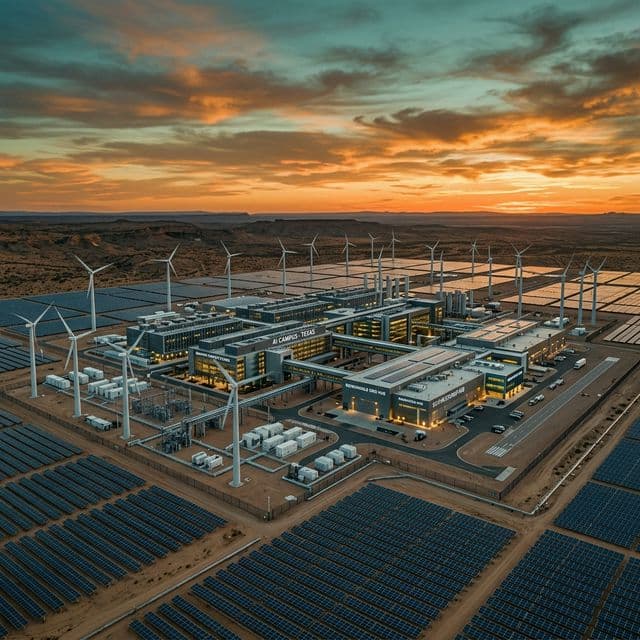
The 20th-century power grid is officially too small for the 21st-century mind. In March 2026, a revolutionary trend in infrastructure has emerged: The "Dark" Data Center. Large-scale AI providers, led by Meta and Amazon, are no longer asking for grid connections. Instead, they are building massive, self-contained AI campuses that generate 100% of their own power on-site.
This shift is driven by a simple, terrifying number: 78 Gigawatts. That is the projected power demand for data centers in Texas alone by 2031—exceeding the total industrial capacity of some entire countries.
The Grid as a Bottleneck
Utility companies in the United States and Europe are quoting 5-to-10-year wait times for new grid connections. For an AI industry that moves in months, this is a death sentence.
"We can't wait for a committee to approve a transformer in 2032," said a spokesperson for the Texas AI Infrastructure Coalition. "We are building our own power plants, our own substations, and our own microgrids. We are going off-grid to stay online."
The Anatomy of an Off-Grid AI Campus
| Component | Standard Data Center | Off-Grid AI Campus (2026) |
|---|---|---|
| Primary Power | Local Utility Grid | On-site Natural Gas / SMR Nuclear |
| Storage | Battery Backups (Lead-Acid) | Mega-Battery Arrays (LFP) |
| Redundancy | Diesel Generators | Hydrogen Cells & Liquid Methane |
| Grid Interaction | Dependent Consumer | Microgrid Island / Energy Producer |
Visualizing the Off-Grid Power Cycle
The following diagram illustrates how modern AI campuses are decoupling themselves from the public energy system to achieve 99.9999% reliability.
graph LR
    subgraph "The Self-Powered Island"
    A[On-site SMR/Turbines] --> B[Campus Microgrid]
    B --> C[Compute Clusters]
    B --> D[Massive Energy Storage]
    D --> B
    end

    E[Public Grid] -.->|Emergency Only| B
    C -->|Heat Waste| F[Local Desalination/District Heat]

    style A fill:#4a90e2,stroke:#333,color:#fff
    style C fill:#333,stroke:#4a90e2,color:#fff
    style E fill:#ddd,stroke:#999
The Economic Separation
By generating their own power, AI companies are avoiding "Grid Surcharges" and "Peak Demand Pricing." Internal analysis suggests that an off-grid campus can operate with 30% lower energy costs over its 20-year lifecycle compared to grid-dependent facilities.
However, this transition is controversial. Environmental groups argue that "Dark" campuses allow tech giants to bypass public transparency regarding their carbon footprint, while local residents worry about the strain on local natural gas supplies.
Frequently Asked Questions (FAQ)
Is this "True" green energy?
It depends on the fuel. While many off-grid campuses in 2026 rely on natural gas turbines to meet immediate loads, there is a frantic move toward Nuclear SMR integration and Hydrogen swarms to meet carbon-neutral mandates.
Can the grid handle the loss of these major customers?
Ironically, the removal of these massive loads from the public grid may actually prevent blackouts for residential consumers. By "going dark," the AI industry is effectively subsidizing the reliability of the public system by reducing industrial competition for electrons.
Where are these campuses being built?
West Texas, Wyoming, and parts of Northern Europe are the current hotspots. These regions offer land, existing gas infrastructure, and cold climates that reduce cooling costs.
Conclusion: The Sovereign Infrastructure
The rise of off-grid AI campuses marks the transition of "Big Tech" into "Big Infrastructure." In 2026, the company that wins the AGI race won't just have the best scientists; they will have the most reliable, sovereign energy supply. We are building the city of the future, and for the first time, it doesn't need to be plugged in.
Infrastructure analysis by Sudeep Devkota. Data sourced from the Texas Reliability Council and the 2026 Cloud Energy Audit.