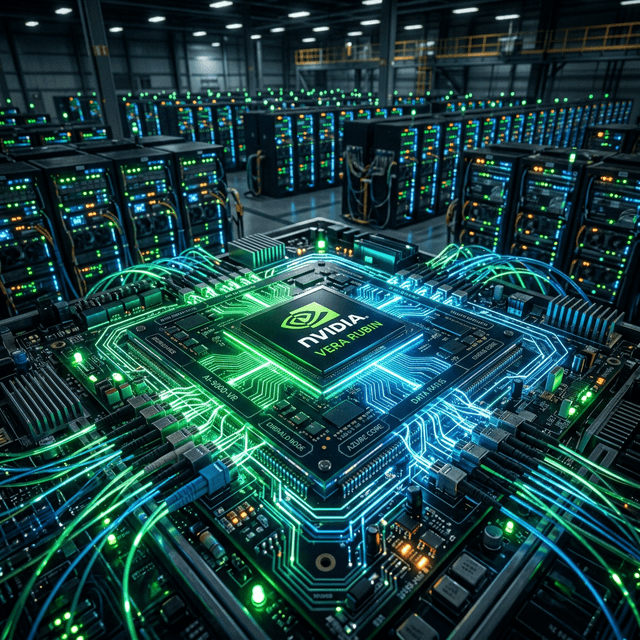
NVIDIA Vera Rubin: Powering the Age of AI Factories and Agentic Systems
NVIDIA unveils its most powerful architecture yet, Vera Rubin, designed to facilitate the next generation of agentic AI and power global-scale AI factories.
NVIDIA Vera Rubin: Powering the Age of AI Factories and Agentic Systems
In an industry where hardware performance is the primary bottleneck for software ambition, NVIDIA has once again rewritten the rulebook. On March 16, 2026, CEO Jensen Huang stood before a global audience at GTC to unveil the Vera Rubin platform—a comprehensive system architecture named after the pioneering astronomer who discovered evidence of dark matter.
The Vera Rubin platform is not just a faster GPU; it is the first hardware family designed from the silicon up to support the high-frequency, complex reasoning requirements of Agentic AI.
The Architecture of Infinite Inference
The transition from "Chatbots" to "Agentic Swarms" has created a unique compute challenge. While chatbots need high throughput for text generation, agentic systems need low-latency visual processing, recursive reasoning loops, and massive parallelization.
Key Innovations of the Vera Rubin Platform
| Component | Technical Breakthrough | Impact on Agentic AI |
|---|---|---|
| Rubin-100 GPU | 500 TFLOPS (FP8) per chip | Enables real-time multimodal reasoning. |
| Vera Superchip | Integrated ARM CPU + Rubin GPU | Eliminates the PCI latency for agent decision loops. |
| NVLink-6 Swarm | 2.5 TB/s Interconnect | Connects up to 1024 GPUs as a single logic unit. |
| LP-HBM4 Utility | 8 TB/s Memory Bandwidth | Allows massive LAMs to stay resident in memory. |
Moving Beyond the Datacenter to the "AI Factory"
Jensen Huang emphasized that the world is moving beyond generic cloud computing toward AI Factories. These are purpose-built facilities where data goes in, and "Intelligence" (in the form of autonomous agents) comes out.
The Vera Rubin platform provides the blueprint for these factories. By integrating the NVIDIA Groq 3 LPU (Language Processing Unit) technology—acquired in late 2025—the platform can handle the "token-heavy" loops required for agents to "think out loud" inside internal chain-of-thought sequences without slowing down the external user experience.
Chain-of-Thought Acceleration
One of the most significant bottlenecks in agentic AI is the "Reasoning Latency." Before an agent takes an action, it often generates hundreds of internal tokens to plan its move. The Vera Rubin architecture features a dedicated Reasoning Cache that speeds up these internal tokens by 10x compared to the previous Blackwell architecture.
graph TD
    A[Agent Receives Goal] --> B[Visual Input Processing]
    B --> C[Internal Reasoning Swarm]
    C --> D{Parallel Action Planning}
    D --> |Action 1| E[API Execution]
    D --> |Action 2| F[GUI Interaction]
    E --> G[State Feedback]
    F --> G
    G --> B
    style C fill:#00ff00,stroke:#333,stroke-width:2px
The "Local Rubin" Revolution
While the largest Rubin clusters live in AI factories, NVIDIA also announced the Rubin Nano. This is a consumer-grade chip designed for laptops and edge devices. It allows Agentic AI to run locally on your machine, ensuring that your most sensitive workflows—like banking automation or legal document review—never have to leave your physical device.
This "Edge Autonomy" is critical for privacy-first enterprises that are weary of sending entire operating system screenshots to the cloud for processing.
Sustainability: The Energy Efficiency Paradox
The massive power consumption of AI has become a global regulatory concern. NVIDIA claims that the Vera Rubin platform is 4x more energy-efficient per unit of intelligence than Blackwell.
By using advanced Liquid Cooling at Scale (LCS) and a new power management protocol called AI-Throttling, the platform can dynamically allocate power. When an agent is "idle" (waiting for a network response), the chip drops to near-zero power consumption in milliseconds, a feat that was previously impossible without significant wake-up latency.
FAQ: What You Need to Know About Vera Rubin
Is Vera Rubin compatible with existing AI models?
Yes. It natively supports all major frameworks including PyTorch, TensorFlow, and JAX. However, models optimized for Action-Space Reasoning (like GPT-5.4 and Claude 4) will see the most significant gains.
When will the first Vera Rubin systems ship?
Initial samples are currently with hyperscalers (Azure, AWS, Google Cloud). General availability for the Vera Superchip is slated for Q3 2026.
How does this affect the price of AI?
By increasing inference efficiency by 400%, NVIDIA expects the cost of running an autonomous digital coworker to drop by 60% over the next two years, making Agentic AI accessible to small-to-medium businesses.
Conclusion
The Vera Rubin platform marks the end of the "Generative Era" of hardware and the beginning of the "Agentic Era." By building a system that treats "Action" and "Reasoning" as first-class citizens alongside "Text Generation," NVIDIA has provided the foundation upon which the next decade of autonomous software will be built.
This article is part of our deep-dive series into the core technologies defining 2026. Next up: How the EU is responding to these autonomous systems with the new AI Omnibus.