NVIDIA's CUDA-Q Logical Brings Quantum Claims Back to Resource Accounting
CUDA-Q Logical puts quantum architecture claims against qubit budgets, execution time, and the GPU infrastructure needed to support them.
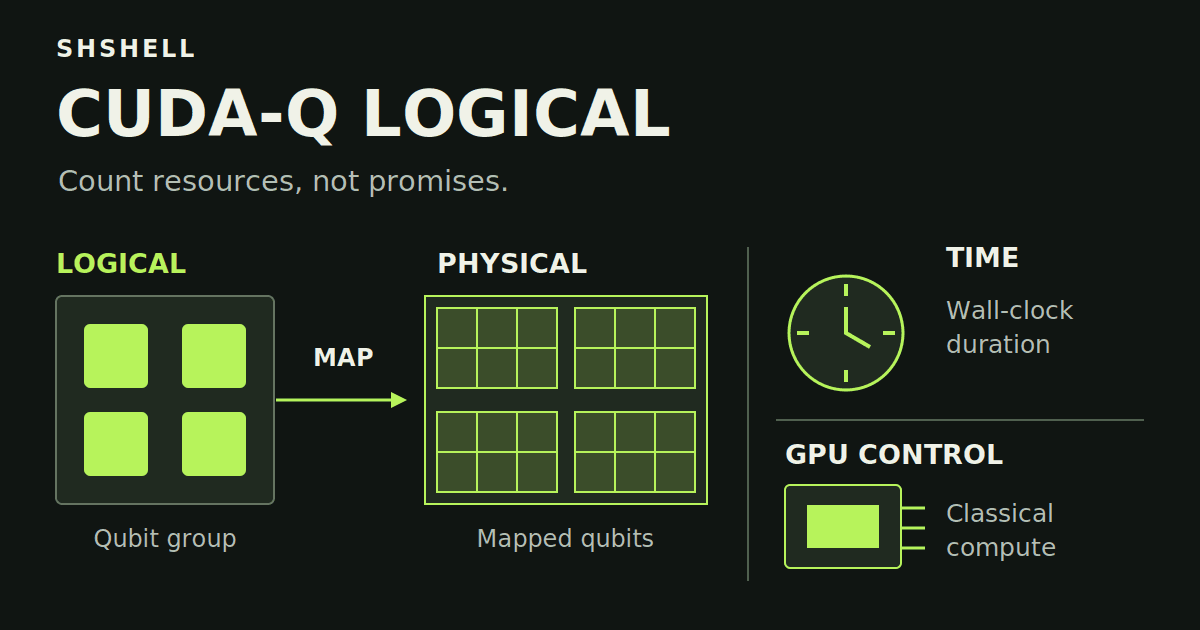
NVIDIA’s September 14 release of CUDA-Q Logical puts a more demanding question behind quantum computing announcements: what resources would an application actually consume after error correction, hardware connectivity, and classical control are included? The new orchestration layer extends CUDA-Q into programmable fault-tolerant system design. Its most consequential promise is the ability to trace an algorithm through those interdependent choices and revise the resulting resource estimate when any of them changes. That makes the announcement an infrastructure story, with qubit counts serving as one entry in a larger engineering account. NVIDIA’s release identifies this co-design problem as the reason for the expansion.
The accompanying claims only become useful when their units remain separate. Fermilab’s reported acceleration concerns architecture development time. Iceberg Quantum and Diraq’s qubit figures describe a modeled implementation. Sandia National Laboratories’ QUOPS benchmark measures executable circuit size and effective throughput. NVIDIA Ising and NVQLink address parts of the classical machinery supporting quantum processors. These claims occupy different places in the same system, and their significance depends on keeping their units, assumptions, and evidence separate. Together they suggest a more inspectable way to develop quantum infrastructure; they do not establish commercial quantum utility.
The resource budget begins before a processor runs
A physical qubit is a hardware element used to hold and manipulate quantum information. A logical qubit is an encoded unit of quantum information protected through an error-correction scheme involving physical qubits. The distinction matters because an application expressed in logical qubits still has to be implemented using imperfect physical operations. Encoding information is only part of the task: the machine must detect errors, interpret those observations, and carry out logical operations without allowing faults to overwhelm the computation.
That is why the apparent simplicity of a logical-qubit count can be misleading. An encoded memory and an application processor place different demands on the surrounding architecture. A resource estimate must account for the physical qubits carrying data, the operations supporting error correction, the connectivity needed to perform gates, and the time spent coordinating those activities. Quantinuum’s September 14 explanation of QUOPS explicitly identifies syndrome measurement, decoding, logical gate construction, magic-state production, routing, and control as parts of the conversion from physical operations into logical computation.
CUDA-Q Logical addresses the software representation of that conversion. NVIDIA describes a programmable framework in which researchers can switch among algorithms, error-correction codes, and hardware architectures to evaluate resource requirements. This is a meaningful expansion of the abstraction offered by the broader platform. The CUDA-Q developer page describes a kernel-based programming model spanning CPUs, GPUs, and quantum processing units, with compilation targeting different backends. Logical orchestration adds the ability to explore the error-corrected system between a high-level application and those physical targets.
The engineering value comes from exposing dependencies. A code that stores logical information efficiently may require connections that are expensive on a particular processor. A hardware arrangement that makes those connections convenient may impose a different timing or control burden. An algorithm that looks economical when expressed in abstract logical operations may become costly after its gates are translated into executable sequences. Retargeting allows researchers to revisit those consequences without treating each combination as an entirely separate software project.
Portability therefore needs a careful interpretation. The same application description can provide a consistent starting point for comparisons, but that does not imply equal physical cost across devices. In fact, useful retargeting should make unequal costs visible. If a compiler obscures routing, movement, or decoding assumptions, it can make unlike implementations appear deceptively similar. The strongest interpretation of NVIDIA’s announcement is that a common workflow can preserve the application while exposing what each implementation requires.
That shifts the object being evaluated from a processor specification to a coupled design. The relevant question becomes whether the algorithm, code, machine layout, and classical support can jointly meet an application’s requirements. NVIDIA’s release names drug discovery, financial modeling, and materials development as intended application areas. Those are prospective destinations. The immediate deliverable is a method for investigating what reaching them would demand, including configurations that turn out to be impractical.
Fermilab’s faster clock belongs to the design process
The Fermilab example offers the clearest illustration of an immediate software benefit. NVIDIA reports that researchers used CUDA-Q Logical to validate prior results and evaluate physical-qubit requirements, runtimes, and other resources across error-correction approaches and hardware. It characterizes the reduction from five months to three weeks as a sevenfold acceleration. The accompanying statement attributed to Fermilab’s Anna Grassellino explains the comparison in terms of exploring combinations that would otherwise have required building specialized infrastructure. The release is the source of that performance claim.
The measured activity is architecture and algorithm development work. It is not the execution time of a quantum application on a processor. A workflow can become much faster at producing a resource estimate while concluding that the estimated quantum computation remains prohibitively slow. It can also make a previously attractive design look worse by incorporating constraints that a specialized earlier calculation omitted. Both outcomes would be useful, because the purpose of resource analysis is to improve decisions rather than guarantee favorable numbers.
The comparison also has an important evidentiary boundary. Fermilab’s quoted baseline describes what would typically have taken about five months of specialized infrastructure work. NVIDIA's release does not provide a controlled study of developer productivity, a breakdown of engineering hours, or repeated trials across research teams. The result is a named laboratory’s experience as presented in NVIDIA’s announcement. It supports the claim that reusable orchestration can shorten a particular development workflow, without establishing a universal productivity multiplier.
Hypothetical example: a research group has a fixed logical adder circuit and wants to evaluate a surface-code implementation against a qLDPC implementation. It keeps the intended computation and acceptable failure target constant, then supplies each architecture’s connectivity and operation assumptions. A reusable compilation workflow could produce both physical mappings and make revisions less laborious. If the qLDPC mapping saves physical qubits but requires a slower movement schedule, the team has learned about a tradeoff. Faster completion of that comparison says nothing by itself about how quickly either eventual machine will execute the adder.
This kind of productivity matters because co-design is iterative. Researchers need to distinguish a genuine hardware bottleneck from a limitation introduced by the chosen code or compilation strategy. When every alternative requires substantial custom infrastructure, the cost of testing an idea can restrict the design space before physics does. Fermilab’s reported experience suggests CUDA-Q Logical can reduce that friction. The next useful evidence would show whether others can reproduce its resource conclusions and extend the workflow to materially different architectures.
A smaller qubit estimate still has to survive the machine
Iceberg Quantum and Diraq provide the release’s most concrete example of a hardware-aware resource estimate. Their joint announcement describes mapping Iceberg’s Pinnacle architecture onto Diraq’s silicon spin-qubit platform. The reported target is 1,000 logical qubits using 150,000 physical qubits. NVIDIA describes that physical-qubit requirement as roughly ten times lower than Diraq’s previous estimates. These are projected resources for a modeled architecture, not an announcement that a machine with those logical capabilities has been built and operated. Iceberg’s account explicitly describes the work as a step toward deployment on real hardware.
The interesting technical detail is how the companies addressed connectivity. Pinnacle requires non-local interactions, while Diraq’s implementation generates the necessary connectivity by shuttling qubits around an array. Movement contributes errors, so a code’s abstract efficiency does not automatically survive its hardware mapping. According to the joint account, Pinnacle’s modular processing blocks limit the needed non-local connectivity to individual blocks. The team optimized codes, circuits, and shuttling schedules so movement would contribute no more to the modeled error budget than other sources such as physical gates.
That is a stronger resource argument than simply publishing an attractive encoding ratio. The collaboration says it allocated physical qubits, identified the codes, and mapped required connections into movement schedules. It also reports numerical simulations incorporating shuttling-dependent noise and end-to-end compilation of logical primitives, including adder circuits. These details explain why CUDA-Q Logical matters to the claim: the compiler provides a path from a logical construction to a proposed sequence of physical operations, allowing the resource estimate to reflect more of the actual architecture.
The evidence remains conditional on the model. Simulating movement-dependent noise tests the consequences of specified assumptions; it does not establish that a manufactured processor will exhibit those assumptions throughout an application run. Likewise, agreement between a prior architecture estimate and a more hardware-aware estimate supports internal consistency. It does not validate device yield, sustained control performance, or the complete runtime behavior of a future installation. The companies’ own description of work before hardware deployment makes that distinction essential.
Diraq’s publication of the joint announcement repeats the same collaboration and projected result. It is another primary location for the claim, not independent corroboration. NVIDIA’s release adds visibility and its comparison with earlier estimates, but the three vendor accounts should not be treated as separate experimental confirmations. Their shared evidentiary contribution is a documented mapping exercise with numerical simulation and compilation.
The practical consequence is still substantial for architecture planning. A hardware-aware estimate can challenge the assumption that a particular family of codes necessarily demands unacceptable connectivity overhead. It can identify which movement patterns and error budgets deserve physical testing next. The correct engineering response is to preserve those assumptions as testable requirements. If the physical implementation later deviates from them, the same resource workflow should reveal how much of the projected advantage remains.
Code rate is one line in the ledger
Infleqtion’s September 14 announcement exposes a different accounting boundary: physical data qubits are not automatically the complete physical-qubit budget. The company reports constructing and validating a high-rate error-correction code using approximately six physical data qubits per logical qubit, with about a fivefold improvement in code rate over its surface-code comparison. Its release consistently qualifies the relevant qubits as data qubits. Removing that word would broaden the claim beyond what the stated result establishes.
Infleqtion integrated the qLDPC open-source library with an early-access version of CUDA-Q Logical. In its description, qLDPC supplies the code mathematics and CUDA-Q Logical supplies the compilation model. Researchers constructed the code, validated its structure, and brought it into a working compiler pipeline, confirming that the encoded block holds multiple distinct logical qubits. The architecture targets reconfigurable neutral-atom arrays, whose flexible connectivity and parallel operations are presented as suitable for the high-rate construction.
The company also states what remains in development: syndrome extraction, neutral-atom noise modeling, decoder benchmarking, and extension toward physical execution. Those are consequential additions. Syndrome extraction provides the observations used to detect errors; decoding interprets them. Their physical operations and classical processing are part of running an error-corrected system. A favorable data-qubit ratio is an architectural opportunity whose value depends on how these additional functions are implemented.
The two vendor examples therefore should not be placed on a common efficiency leaderboard. Iceberg and Diraq discuss a projected hardware architecture with movement-aware modeling. Infleqtion reports code construction and compiler integration using a specifically defined data-qubit measure. They concern different hardware and different stages of completeness. The comparison that helps readers is a comparison of what the claims measure.
| Claim | What the stated measure captures | What it does not establish |
|---|---|---|
| Fermilab development acceleration | Time to explore fault-tolerant designs in the reported workflow | Faster quantum execution |
| Pinnacle on Diraq | Modeled physical resources with a specified hardware mapping | A built machine delivering the target |
| Infleqtion code rate | Physical data qubits used by the encoded construction | Complete system overhead or runtime |
| QUOPS size and rate | Successful benchmark computation and effective throughput | Utility for every application |
| NVQLink callback latency | Communication timing through a defined control interface | Complete application response time |
For infrastructure teams, this distinction is more useful than a single headline ratio. It determines which estimate can inform a capacity plan and which still needs additional system components. Infleqtion itself says the benefits of packing more logical information into the machine depend on preserving them through atom movement and classical decoding. That qualification identifies the next engineering burden rather than weakening the result: the code’s efficiency must survive the rest of the architecture.
QUOPS puts capability and time on separate axes
Sandia’s QUOPS addresses the measurement problem from the execution side. Its research preprint, Benchmarking the computational power of quantum computers, was submitted on September 10, 2026. NVIDIA’s CUDA-Q Logical announcement and Quantinuum’s explanatory article are dated September 14. The distinction matters: the release publicizes and integrates an already submitted benchmark, rather than marking the paper’s submission date. The arXiv record establishes that chronology and describes both physical-qubit experiments and a simple logical-qubit processor assessment.
QUOPS asks how large a relevant benchmark circuit a system can successfully execute and how quickly it can execute it. In Quantinuum’s explanation, Q represents the largest qualifying circuit size within a utility-motivated region, while Ω represents effective operations per second at that point. Circuit size is defined as twice the width multiplied by the depth. The benchmark uses randomized workloads across different computational shapes, tests success against a threshold, and identifies a capability region. These definitions provide a structured alternative to inferring performance from isolated device specifications.
The separate throughput measure is critical. A system may support a larger successful computation while taking longer to deliver it. Error mitigation can also increase the computation a machine can attempt while adding sampling overhead. Quantinuum’s account explains that QUOPS rate incorporates the corresponding overhead for the general mitigation treatments it discusses. This keeps an improvement in apparent computational reach from automatically becoming an improvement in useful work delivered per unit time.
Sandia’s paper reports applying QUOPS to processors from Quantinuum, Google, and IBM, and to a logical processor implemented on Quantinuum hardware. Those experiments show the benchmark being used across different systems and encoding levels. They do not make every projected future capability an experimental result. The abstract separately describes projections across successive generations of fault-tolerant computers. Preserving that distinction allows the same measurement framework to support both present observation and future planning without confusing them.
The benchmark also remains workload-dependent. A capability region records how success varies with circuit shape; collapsing that region into a headline score necessarily leaves information behind. An application may stress connectivity, gate construction, or classical feedback differently from the randomized circuits. Quantinuum explicitly says QUOPS will coexist with application-specific suites, component measurements, hybrid HPC benchmarks, and independent verification. That is a sound limit for a common system metric: it makes comparisons more disciplined while leaving application qualification necessary.
Hypothetical example: a computing center is evaluating a processor for a workload with a narrow circuit and a long dependency chain. A proposed machine has an attractive QUOPS headline score achieved at a different width and depth. The center would need the surrounding capability region and a mapping of its own workload before concluding that the score covers its requirement. It would also need effective execution time at the relevant operating point, including the repetition or mitigation overhead required for the requested result quality.
Sandia’s PRAQTICE repository identifies its QUOPS directory as containing code and data for the paper, with implementations and results directories visible in the repository. NVIDIA says a reference implementation is available in CUDA-Q. These are useful foundations for inspection and reproduction. Their availability should enable scrutiny of benchmark choices and reported results; it is not itself evidence that outside parties have independently reproduced every claim.
The GPU belongs inside the quantum resource model
The GPU’s role in this announcement extends beyond emulating quantum circuits during research. NVIDIA describes a stack in which classical accelerated computing helps calibrate processors, decode quantum errors, and coordinate logical workloads. Those functions can affect whether a quantum processor delivers its intended computation at all. For AI architecture, the consequential integration is therefore the placement of classical compute in the quantum operating loop, where response time and sustained processing capacity become part of the machine’s requirements.
NVQLink supplies an architectural framework for that coupling. NVIDIA’s platform description identifies a GPU-accelerated real-time host, a quantum system controller, a network between them, and the CUDA-Q real-time API. The controller handles coherent control and readout, while the host supports latency-sensitive computation. The reference network uses RDMA over Ethernet, but the documentation allows alternative network implementations that support the required API. This is a concrete interface model for connecting quantum control to accelerated computing.
The same page distinguishes advertised reference performance from compatibility. It presents low-latency and high-throughput specifications, yet its FAQ says NVQLink does not prescribe a single latency requirement because processors and offloaded functions have different needs. Compatibility is validated through a CUDA-Q function measuring controller-to-host callback round-trip latency. That makes the measured callback a defined interface property, rather than a blanket promise about every decoder, calibration task, or application executed through the system.
This matters when resource estimates become runtime plans. Moving observations to a GPU quickly is one requirement. Performing the necessary calculation and returning an actionable response within the relevant deadline is another. A complete design must connect the communication measurement to the actual decoder or control workload. NVIDIA’s page lists just-in-time compilation, dynamic routing, and on-the-fly decoder reconfiguration among logical orchestration uses. Those activities make classical computation an operational dependency with its own timing demands.
The following diagram separates design-time estimates from execution evidence while showing where accelerated control enters the architecture. It is an analytical map of the reported claims, not a measured deployment topology.
flowchart TD
    A["Logical application"] --> B["CUDA-Q Logical"]
    C["Error-correction code"] --> B
    D["Hardware and noise assumptions"] --> B
    B --> E["Physical mapping and resource estimate"]
    E --> F["Hardware implementation to validate"]
    F --> G["Quantum processor and controller"]
    G --> H["NVQLink real-time connection"]
    H --> I["GPU calibration and decoding"]
    I --> H
    H --> G
    G --> J["QUOPS capability and throughput"]
    J --> K["Application-specific qualification"]
Hypothetical example: a proposed architecture uses a decoder that processes each incoming batch of error observations successfully in isolation. During a sustained logical workload, the GPU host also receives calibration work and other control requests. The relevant test is whether decoding deadlines continue to be met under that combined load. Neither an encoding ratio nor a network callback measurement resolves that question alone. The resource account needs the actual mix of classical tasks and their timing requirements.
The NVQLink page’s update metadata is dated March 16, 2026. Its architectural details are therefore context for the September release, not evidence that NVQLink itself launched that day. NVIDIA’s September 14 news adds examples of ecosystem integration, including control systems and QPU-GPU architectures. Those announcements indicate implementation activity around the interface; they do not provide a complete accounting of sustained application performance.
AI calibration and quantum model training are different workloads
NVIDIA’s release says Diraq used NVIDIA Ising to calibrate its silicon-based qubit processor. The claim places AI in the task of configuring or improving quantum hardware operation. It does not say that Diraq used the quantum processor to train an AI model. Keeping the direction of assistance explicit is especially important in a platform that brings AI, GPUs, simulation, and quantum execution into one programming environment.
The broader CUDA-Q platform description identifies several distinct relationships: GPU-accelerated quantum simulation, AI-assisted quantum algorithm design, combinations of quantum algorithms with GPU AI models, and Ising decoder models for real-time error correction. These are different workloads with different success criteria. Calibration is assessed through the operating behavior of the device it helps configure. Decoding must interpret error information accurately and quickly enough for the chosen architecture. Algorithm design concerns the quality and cost of the circuits produced.
NVIDIA's announcement does not provide a detailed Diraq calibration experiment, its baseline procedure, or a measured effect on complete application runtime. It therefore supports the statement that Ising was used for calibration, with the engineering benefit still requiring more specific evidence. A useful next account would connect the calibration procedure to measured device behavior and then show how that behavior changes resource assumptions. That would close the loop between AI-assisted operation and the logical architecture model.
Phasecraft’s September 14 announcement illustrates another distinct role for classical infrastructure. The company describes using NVIDIA Hopper hardware and cuQuantum for variational quantum eigensolver emulations, producing a molecular dataset used with its density functional theory work. These are GPU-based emulations supporting molecular modeling research. The result belongs in the account of accelerated simulation and data generation, with any future quantum-hardware benefit remaining a separate proposition.
This work can still contribute to co-design. Emulation gives researchers a way to investigate candidate circuits and application formulations before a suitable quantum machine is available. It can help identify which workloads should be mapped through a logical compiler and which resource demands deserve attention. But the path from simulation data to an application running on a fault-tolerant processor includes the encoding, physical mapping, and execution constraints described elsewhere in the release. GPU research output does not erase those costs.
Seen together, Ising calibration and Phasecraft’s emulations explain why AI infrastructure appears throughout the announcement without establishing a general claim about quantum acceleration of AI training. GPUs support the development and operation of quantum systems in several ways. Each role should be evaluated through its own output and its downstream effect on the complete computation. That is the same accounting discipline applied to physical qubits, now extended to classical compute.
A reproducible resource account becomes the next deliverable
The strongest common thread across Fermilab, Pinnacle, Infleqtion, and QUOPS is the possibility of connecting claims that previously required different kinds of explanation. Fermilab’s workflow concerns how efficiently researchers can evaluate a design. Pinnacle’s mapping concerns whether code efficiency survives hardware constraints. Infleqtion’s integration concerns bringing a code construction into a compiler while additional execution components remain under development. QUOPS concerns what a running system can successfully deliver. Their relationship is a progression of evidence, with each stage asking a different question.
An inspectable resource account would preserve that progression. It would identify the logical workload, code choice, hardware assumptions, physical mapping, noise treatment, classical support, and expected execution cost. Later measurements could then be compared with the assumptions that produced the estimate. This is an analytical requirement suggested by these examples, rather than a claim that every CUDA-Q Logical user already publishes such a complete record. The value of shared tooling will depend partly on whether it makes that record easier to produce.
Retargeting becomes especially important when evidence changes. If measured shuttling errors differ from those used in Pinnacle’s simulation, the architecture estimate should be rerun with the revised inputs. If Infleqtion’s decoder or syndrome-extraction design introduces additional overhead, the full resource budget should reflect it. If a QUOPS rate changes under a different execution configuration, the conditions behind the result should travel with the score. Reusable software can make these revisions more practical, but honest reporting still has to identify them.
The source base sets a firm limit on the article’s conclusions. These are vendor announcements, platform documentation, a laboratory-led research preprint with industry participation, and an associated repository. Iceberg and Diraq publish a joint account; Quantinuum describes a benchmark to which it contributed. Such sources provide specific technical claims and useful artifacts, but they are not independent verification of commercial quantum utility. Their strongest contribution is to make the next questions more concrete.
CUDA-Q Logical’s September 14 release consequently raises the standard for what should accompany the next ambitious quantum resource claim. A logical-qubit target should arrive with its executable mapping and complete cost assumptions; a runtime promise should include effective throughput under the relevant control workload. The decisive next evidence is a published comparison between a retargetable architecture estimate and sustained measurements on its implementation, showing which qubit, noise, decoding, and timing assumptions survived contact with the machine.