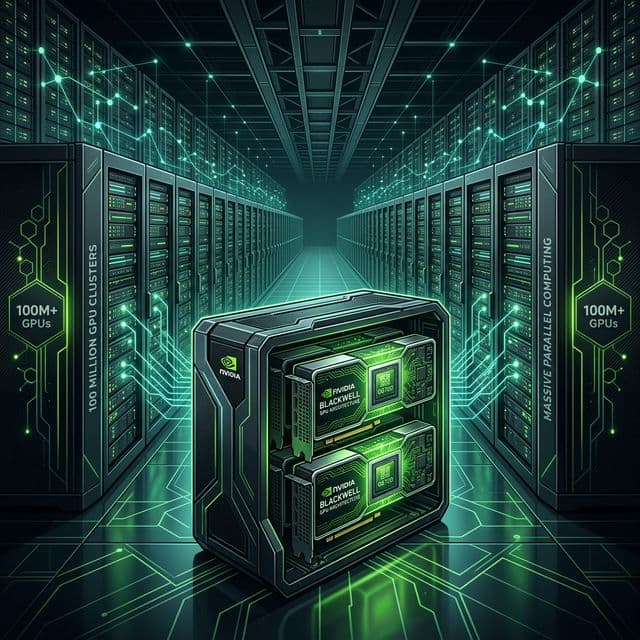
NVIDIA Blackwell 2.0: The Blueprint for the 100-Million-GPU Cluster Era
# NVIDIA Blackwell 2.0: The Blueprint for the 100-Million-GPU Cluster Era Just when the industry thought the peak of silicon engineering was reached, NVIDIA ha...
NVIDIA Blackwell 2.0: The Blueprint for the 100-Million-GPU Cluster Era
Just when the industry thought the peak of silicon engineering was reached, NVIDIA has reset the bar with the launch of Blackwell 2.0. Announced this morning at a surprise technical keynote, the new architecture represents the first true "System-on-a-Cluster" design, specifically engineered for the training of Zettaparameter models.
The Scaling Wall is Dead
In 2024 and 2025, the primary bottleneck for AI scaling moved from model architecture to data center networking and power density. Blackwell 2.0 addresses this with three breakthrough technologies:
- NVLink 6.0: Delivering a staggering 18 TB/s per GPU of bidirectional bandwidth, NVLink 6.0 treats a cluster of 100,000 GPUs as a single, unified memory domain.
- Quantum-X Photonic Interconnect: This new optical switching layer allows for the interconnection of up to 100 million GPUs with sub-microsecond latency, bypassing traditional Ethernet bottlenecks entirely.
- T-1000 Tensor Cores: Dedicated hardware acceleration for FP2 (2-bit precision) training, allowing for 16x larger models to fit into the same memory footprint without a significant loss in reasoning accuracy.
The 100-Million-GPU Cluster
Jensen Huang described the first "National AI Grid," a proposal for a distributed compute facility spanning multiple states, powered by small modular reactors (SMRs). This facility is designed to house 100 million Blackwell 2.0 units, creating a "World Model" capable of simulating global weather, physics, and biological systems in faster-than-real-time.
"We are no longer building computers. We are building the nervous system of civilization." — Jensen Huang
Impact on the Market
The announcement sent shockwaves through the industry:
- Cloud Providers: Microsoft and Google have already placed orders for the first "SkyPod" clusters, each consisting of 5 million GPUs.
- Energy Sector: The focus on SMRs has triggered a 20% surge in nuclear energy stocks.
- AI Startups: The cost of training a "Frontier-class" model on Blackwell 2.0 is expected to drop by 40%, potentially leveling the playing field for mid-tier labs.
Conclusion
Blackwell 2.0 isn't just a faster chip; it's the infrastructure for the next decade of AI evolution. As we move into the era of 100-million-GPU clusters, the line between "compute" and "intelligence" continues to blur.