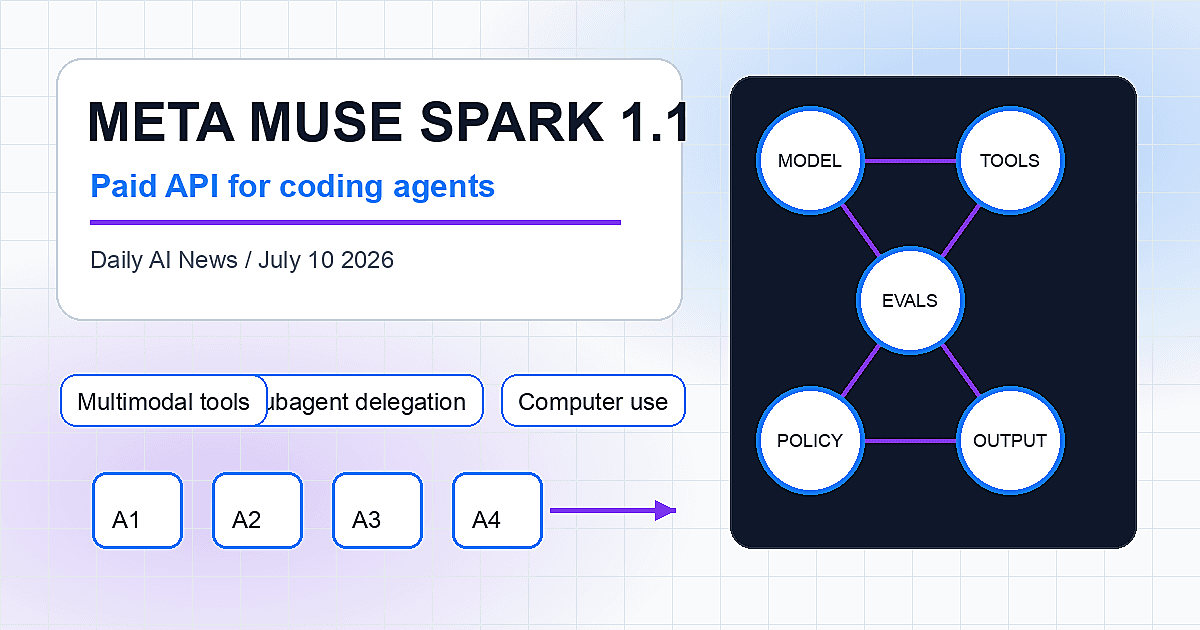
Meta Muse Spark 1.1 Pushes the AI Coding War Into Paid Agent APIs
Meta Muse Spark 1.1 launches with tool use, computer use, coding gains, and a public Meta Model API preview.
Meta introduced Muse Spark 1.1 on July 9, 2026 as a multimodal reasoning model from Meta Superintelligence Labs and opened a public preview of the Meta Model API. That is why this belongs near the top of latest AI news rather than in a slow-moving product catalog. Meta is trying to convert its AI spending into a developer product, not just a consumer assistant.
The timing matters because AI agents are moving out of demo mode. Buyers are no longer asking only which large language models sound clever in a chat window. They are asking which systems can read a messy workspace, choose tools, preserve context, manage cost, refuse the wrong requests, and leave behind enough evidence that a human can approve the result. Meta AI is placing its answer into that harder market.
For ShShell readers tracking Artificial Intelligence News, the useful question is simple: what changed in the operating model? The answer is not one benchmark, one launch blog, or one pricing line. It is the combination of release timing, model mechanics, tool behavior, cost structure, evaluation claims, safety posture, and the workflow pressure now hitting engineering teams, research teams, analysts, and operations leaders.
Sources used for this analysis: Meta Muse Spark 1.1 announcement, TechCrunch coverage, The Verge coverage.
The July signal behind Meta AI's move
The event is Meta's July 9 launch of Muse Spark 1.1 and the Meta Model API preview. The story is Meta shifting from social-platform AI and open-model branding into paid agent infrastructure for developers. The mechanism is a multimodal model with long context, multi-agent orchestration, tool use, computer use, coding, and safety claims. The open question is whether Meta can earn developer trust in a market where OpenAI, Anthropic, Google, and xAI already compete on agent harnesses and benchmarks.
The release lands at a moment when the word agent is finally being forced to do real work. A year ago, many agent demos were clever wrappers around a chat model. They could call a tool, maybe browse a page, maybe write a small script, and then they often fell apart when the task lasted more than a few turns. The current wave is different because the labs are competing on persistence, context control, external action, and cost per completed job.
That shift changes how Latest AI News should be read. A stronger benchmark is useful, but a benchmark by itself does not tell a CIO whether to migrate an internal assistant, does not tell a developer whether to trust a code change, and does not tell a security leader whether a model should be allowed near sensitive systems. The market is moving toward proof that a model can complete a bounded unit of work under constraints. Meta AI's announcement should be judged against that operational standard.
Here are the key facts that anchor the story:
- Meta says Muse Spark 1.1 is built for agentic tasks, with gains in tool use, computer use, coding, and multimodal understanding.
- The model is available in Thinking mode in the Meta AI app and on meta.ai, while developers can access it through the Meta Model API public preview.
- Meta says Muse Spark 1.1 can zero-shot generalize to new native tools, MCP servers, and custom skills.
- The launch note says the model can manage a one million token context window and compact context while retaining critical steps.
- Meta describes multi-agent orchestration where a main agent gathers context, plans, and delegates execution across parallel subagents.
- Computer-use training emphasizes deciding when to write scripts, when to click through an interface, and when to batch actions.
- Meta's coding examples include debugging a chat web app by taking screenshots, tracing user-visible failures to code, fixing issues, and validating changes.
- Multimodal examples include turning smartphone video into useful photos and a Facebook Marketplace listing through browser control.
- Meta says safety evaluations across chemical and biological, cybersecurity, and loss-of-control risk categories show the model operates within safe margins.
- Coverage from The Verge and TechCrunch framed the launch as Meta's move into the crowded agentic coding and paid model API market.
Those details matter because they are specific. They are not generic claims about generative AI becoming more productive. They describe a model, product, policy, or workflow that now has to compete in a measurable market. The hard part for builders is deciding which of these facts changes architecture today and which should wait for field evidence.
How the system actually works in practice
graph TD
    A["Developer task"] --> B["Meta Model API"]
    B --> C["Muse Spark 1.1 main agent"]
    C --> D["Planning mode"]
    C --> E["Context compaction"]
    C --> F["Subagent delegation"]
    F --> G["Coding harness"]
    F --> H["Browser or desktop workflow"]
    F --> I["Multimodal inspection"]
    G --> J["Validated output"]
    H --> J
    I --> J
The operating pattern is visible in the diagram. The model is no longer isolated from the rest of the work surface. It sits between a user's intent and a set of tools, files, interfaces, memories, safety checks, and verification steps. That position is powerful because it can compress an hour of coordination into a few model turns. It is also risky because the model can now make mistakes inside systems where mistakes have side effects.
For builders, the design question is not whether Meta AI has a capable model. The design question is where the model should be placed in the workflow. A coding model can draft a patch, but should it merge the patch? A research model can inspect sources, but should it publish a report without a reviewer? A computer-use model can navigate a browser, but should it act on a live customer account? The answer depends on evidence, reversibility, logging, and the cost of failure.
One practical pattern is to treat the model as a high-speed junior operator with strong memory and uneven judgment. That framing is less glamorous than calling it a digital coworker, but it leads to better systems. Give it a clear task boundary. Give it tool permissions that match the risk. Require it to produce artifacts a human can inspect. Measure not only whether it completes the task, but how many tool calls, tokens, retries, and human corrections were needed.
The current release also makes context management a serious product feature. Long context windows, compaction, prompt caching, memory updates, or agent state are not cosmetic. They decide whether an agent can survive real work: a codebase with old conventions, a research corpus with contradictory evidence, a customer account with partial data, or a robotic environment where yesterday's route is not safe today. When context handling fails, the model starts fresh in the middle of the job and becomes dangerous in quiet ways.
What changes for developers and AI teams
Developers should read this announcement as a pressure test for their own agent architecture. If an organization still treats prompts as loose strings in a ticket, it will struggle to adopt stronger models responsibly. The new model wave expects harnesses: versioned prompts, durable task state, tool registries, permission boundaries, evaluation sets, artifact storage, and deployment gates. The model is important, but the harness determines whether the capability becomes production value or an expensive incident.
The first change is evaluation. Teams should stop asking, "Is this model smart?" and start asking, "Can it complete our actual work unit under our constraints?" A support automation team might evaluate escalation accuracy, source-grounded answers, CRM update safety, and rollback paths. A software team might evaluate failing-test reproduction, root-cause accuracy, patch size, code style, and whether the agent ran the right validation. A research team might evaluate source coverage, citation quality, uncertainty handling, and whether the model separates confirmed facts from inference.
The second change is routing. Not every task deserves the strongest model. If Meta AI's release is part of a broader family or competitive tier, the winning architecture may route easy tasks to cheaper models and reserve the top tier for ambiguous, high-impact work. That requires more than a dropdown. It requires task classification, budget caps, fallback models, and a policy for when the agent should ask for human review.
The third change is observability. Agentic AI fails differently from ordinary software. It may not crash; it may do the wrong thing confidently, skip a verification step, summarize a source too loosely, or use a tool at the wrong moment. Logs need to capture prompt versions, model versions, retrieved context, tool inputs, tool outputs, cost, latency, and final artifacts. Without that trace, teams cannot debug production AI systems with the discipline they apply to APIs and databases.
Why buyers should care about cost per completed task
The market conversation often treats token price as the main economic variable. Token price matters, but it is incomplete. A cheaper model that takes twice as many turns, calls tools wastefully, or needs heavy human cleanup can be more expensive than a premium model that finishes cleanly. A more expensive model can also be wasteful if it is used for routine transformations a smaller model could handle.
The right metric is cost per accepted outcome. For software engineering, that might be cost per merged pull request that passes review. For security, it might be cost per validated finding that reduces exposure. For research, it might be cost per defensible brief. For physical AI, it might be cost per safe completed route. For office agents, it might be cost per task completed without rework. Meta AI's announcement should be tested against those outcome metrics, not only launch-page claims.
There is also a procurement lesson. AI buyers should separate three costs that are often blended together: model inference, orchestration overhead, and governance overhead. Inference is the obvious bill. Orchestration includes retries, tool calls, embeddings, storage, browser sessions, and queue time. Governance includes review, audit, security approvals, red-team testing, and incident response. Stronger models can reduce orchestration and governance overhead if they behave reliably. They can increase both if teams grant broad permissions too early.
That is why the best enterprise pilots will not be "try the new model for everything." They will choose one workflow with a measurable baseline. They will run side-by-side comparisons against the current model. They will capture cost, latency, quality, and intervention rate. They will define a failure taxonomy before deployment. Then they will expand only when the evidence is boring enough to trust.
The risk boundary is moving with the capability
Every article about AI agents now has to talk about risk because the risk is tied to the capability itself. A model that writes better code can write better insecure code. A model that navigates interfaces can navigate the wrong interface. A model that remembers context can remember sensitive context. A model that calls tools can call tools at the wrong time. A model that can help defenders in cybersecurity can also change what access control needs to mean.
The near-term risk is not science fiction. It is operational drift. Teams will give a model a little more authority because yesterday's demo looked good. Then another team will copy the pattern. Then the prompt will change. Then a tool permission will be added. Then the workflow will become business critical without anyone writing down the new control plane. This is how agentic AI risk arrives in normal companies: gradually, through convenience.
The stronger response is not to ban the model. It is to make the safety boundary explicit. Define which tools are read-only, which tools require approval, which actions are reversible, and which tasks are never delegated. Keep high-risk environments separate from exploratory environments. Make the agent explain what it plans to do before it acts when the action has side effects. Store enough evidence that a reviewer can reconstruct what happened after the fact.
Meta AI's release should therefore be read as a governance trigger. If a team is excited by the capability, it should be equally interested in the control surface. The organizations that benefit most from this generation of AI tools will not be the ones that simply buy the newest model. They will be the ones that redesign workflow ownership around models that can act.
Concrete ways teams can test Meta AI's claims
The first useful test is a replay test. Take ten real tasks completed by humans last month, remove confidential details where necessary, and ask the model to complete them in the same environment with the same documentation. Measure whether it reaches the accepted outcome, how much context it needed, which tools it used, and where it asked for help. This avoids synthetic prompts that flatter the model but do not reflect daily work.
The second useful test is a disturbance test. Change the environment while the task is running. Move a file. Change a dependency. Add a contradictory source. Modify a UI label. Insert an outdated instruction. Good agents should notice and adapt. Weak agents will continue confidently from a stale plan. This matters because real workflows are not static exam questions.
The third useful test is an audit test. After the model completes the task, ask a reviewer who did not watch the run to reconstruct what happened from logs and artifacts. If the reviewer cannot tell which sources were used, which tools were called, why the final answer is justified, and where uncertainty remains, the system is not production-ready. The model may be good, but the workflow is not governable.
The fourth useful test is a refusal and escalation test. Give the model requests that should be blocked, narrowed, or escalated. If it refuses too broadly, productivity suffers. If it refuses too narrowly, risk rises. The right behavior is contextual: routine low-risk work should proceed; ambiguous or dangerous work should create a review path with enough explanation for a human to decide.
The competitive map after this release
Meta AI's move sits inside a crowded July 2026 field. OpenAI is pushing reasoning models deeper into work agents and cyber-defense workflows. Anthropic is turning Sonnet-class models into scalable agentic defaults. Meta is entering paid developer APIs with multimodal, multi-agent coding claims. xAI is tying Grok to Cursor and GB300-scale training. Mistral is taking embodied AI into robot navigation. The shared theme is action.
That shared theme makes the market more serious. Labs can no longer win only by saying their model is more intelligent. They need to show that intelligence can be packaged into reliable work. They need pricing that maps to outcomes. They need safety systems that do not destroy usefulness. They need developer surfaces that fit existing tools. They need enough transparency for buyers to compare claims without relying entirely on vendor-controlled demos.
For smaller AI companies, this creates both pressure and opportunity. The pressure is obvious: frontier labs are absorbing more of the product surface. The opportunity is in specialization. A startup that builds the best evaluation harness for legal agents, the safest approval layer for browser agents, the best observability stack for tool calls, or the strongest data connector for regulated teams can still matter. As models become stronger, the surrounding control plane becomes more valuable, not less.
What builders should do next
Builders should update their model evaluation matrix this week, not next quarter. Add Meta AI's release to a side-by-side test only if the workflow has a real acceptance criterion. Do not evaluate it with generic prompts. Use messy tasks, stale documentation, partial context, and real verification steps. The goal is not to produce a flattering demo. The goal is to learn whether the model changes your architecture.
AI platform teams should also review prompt and skill governance. If prompts are scattered across notebooks, Slack messages, application constants, and undocumented dashboards, stronger models will make the mess more expensive. Version the instructions. Own them. Review them. Connect them to evals. Treat prompts, tool schemas, and system policies as production assets.
Security teams should map model access to data and action tiers. A model that can only summarize public docs belongs in a different tier from a model that can read customer records, open terminals, call payment APIs, or modify production infrastructure. The launch news is exciting, but permission design is where the business result will be won or lost.
Executives should ask for one metric: accepted outcomes per dollar under policy. That metric forces the conversation away from hype. It makes teams account for quality, cost, latency, human review, and risk. It also gives procurement a better way to compare OpenAI, Anthropic, Meta, xAI, Mistral, Google, and smaller model providers as the market shifts every week.
The line to remember
Meta Muse Spark 1.1 Pushes the AI Coding War Into Paid Agent APIs is a sign that the AI market is becoming less impressed by raw conversation and more interested in completed work. The model matters, but the durable advantage will come from the system around it: the tools it can use, the permissions it obeys, the memory it keeps, the evaluations it passes, and the evidence it leaves behind.
That is the useful lesson from this latest AI news cycle. Treat every new model release as a workflow-design event. Ask what the model can now do that was previously too expensive, too slow, or too unreliable. Then ask what new control surface that capability requires. The teams that answer both questions together will get more from AI agents than the teams that only chase the newest name in the model picker.
Source Notes
Topic-Specific Signal Table
| Signal | Why it matters for AI News Today readers |
|---|---|
| Meta says Muse Spark 1.1 is built for agentic tasks, with gains in tool use, computer use, coding, and multimodal understanding. | Turns the announcement into a concrete buying, building, governance, or research decision. |
| The model is available in Thinking mode in the Meta AI app and on meta.ai, while developers can access it through the Meta Model API public preview. | Turns the announcement into a concrete buying, building, governance, or research decision. |
| Meta says Muse Spark 1.1 can zero-shot generalize to new native tools, MCP servers, and custom skills. | Turns the announcement into a concrete buying, building, governance, or research decision. |
| The launch note says the model can manage a one million token context window and compact context while retaining critical steps. | Turns the announcement into a concrete buying, building, governance, or research decision. |
| Meta describes multi-agent orchestration where a main agent gathers context, plans, and delegates execution across parallel subagents. | Turns the announcement into a concrete buying, building, governance, or research decision. |
| Computer-use training emphasizes deciding when to write scripts, when to click through an interface, and when to batch actions. | Turns the announcement into a concrete buying, building, governance, or research decision. |
| Meta's coding examples include debugging a chat web app by taking screenshots, tracing user-visible failures to code, fixing issues, and validating changes. | Turns the announcement into a concrete buying, building, governance, or research decision. |
| Multimodal examples include turning smartphone video into useful photos and a Facebook Marketplace listing through browser control. | Turns the announcement into a concrete buying, building, governance, or research decision. |
Author Perspective
Sudeep Devkota is a technology analyst and founder of ShShell, covering frontier AI, enterprise strategy, infrastructure, and the business of intelligence.