The Agentic Mandate: Gartner Predicts 40% of Enterprise Apps Will Integrate AI Agents by Late 2026
Gartner's latest forecast indicates a massive shift in corporate software architecture, as task-specific AI agents become the new standard for enterprise applications.
The Agentic Mandate: Gartner Predicts 40% of Enterprise Apps Will Integrate AI Agents by Late 2026
The era of the "AI search box" is rapidly coming to an end, replaced by a much more powerful paradigm: Agentic AI. According to the latest research from Gartner released on March 20, 2026, the corporate world is on the cusp of an architectural revolution. Gartner projects that by the end of 2026, 40% of enterprise applications will incorporate task-specific AI agents, up from a negligible 5% just 18 months ago.
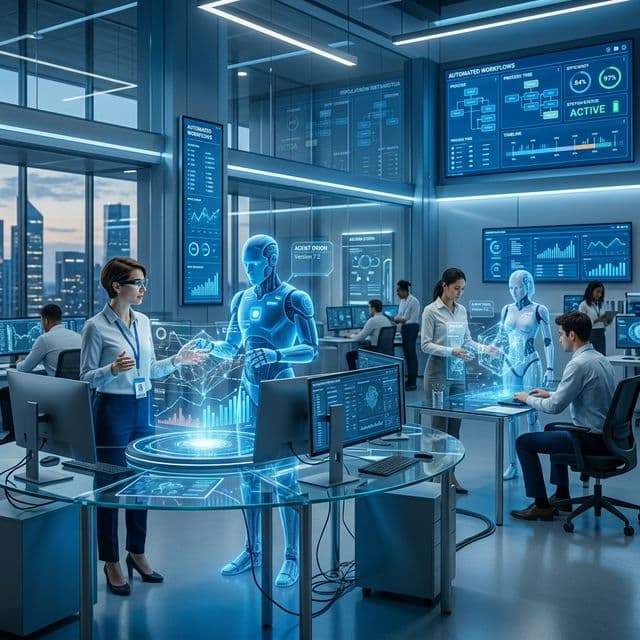
This isn't just about adding a chatbot to a sidebar. This is the rise of the Digital Coworker—autonomous systems capable of navigating software, making decisions, and executing multi-step workflows without constant human oversight.
From Assistants to Autonomous Agents
The transition from "AI Assistants" (think Microsoft Copilot 2024) to "AI Agents" (Gemini Cowork 2026) is the defining technical shift of the year. Gartner identifies three core differences that define this new "Agentic" standard:
- Goal-Oriented Reasoning: Unlike assistants that wait for prompts, agents are assigned outcomes. An agent is told "Reconcile June's invoices," and it autonomously determines which files to open and which vendors to contact.
- Cross-App Orchestration: Agents operate across silos. A single agent can move data from a legacy CRM to a modern Slack channel and then into an ERP system using an iPaaS bridge.
- Persistence: Agents represent "Always-On" intelligence. They can run background tasks for hours—monitoring supply chains or analyzing market shifts—and only interrupt their human counterparts when a high-level decision is required.
The Five Stages of Agentic Evolution (Gartner Model)
graph LR
    A[Stage 1: Embedded Assistants] --> B[Stage 2: Task-Specific Agents]
    B --> C[Stage 3: Multi-Agent Teams]
    C --> D[Stage 4: Autonomous Ecosystems]
    D --> E[Stage 5: High-Agency Personalities]

    style B fill:#4285F4,stroke:#333,stroke-width:4px,color:#fff
    style A fill:#ddd,stroke:#999
As of March 2026, most global enterprises are transitioning from Stage 1 to Stage 2.
The Role of iPaaS in Agentic Success
A critical component of this forecast is the reliance on Integration Platform as a Service (iPaaS). Gartner emphasizes that agents are only as good as their access to data. By late 2026, 75% of large enterprises will rely on specialized iPaaS solutions to provide the "connective tissue" for their agentic armies.
"Agents without integration are just smart parrots trapped in a cage," noted Gene Alvarez, Distinguished VP Analyst at Gartner. "The real ROI comes when the agent can reach into the database, pull the trigger on a transaction, and update the record in real-time."
Economic Impact: The $450 Billion Opportunity
The financial implications of this shift are staggering. Gartner forecasts that agent-driven automation will account for 30% of all enterprise application software revenue by 2035, creating a market worth over $450 billion.
However, this growth comes with a warning: "Agent Washing" is becoming the new "Cloud Washing." Gartner warns C-level executives to be wary of vendors who simply relabel old-school RPA (Robotic Process Automation) scripts as "Advanced AI Agents." True agents require a reasoning engine—a foundation model—at their core.
Comparison: RPA vs. Agentic AI
| Feature | Legacy RPA (2018-2024) | Agentic AI (2026+) |
|---|---|---|
| Logic | Rule-Based (If-Then-Else) | Probabilistic & Reasoning |
| Adaptability | Breaks on UI changes | Navigates novel interfaces |
| Scope | Repetitive, high-volume tasks | Creative, strategic workflows |
| Interaction | Siloed scripts | Collaborative "Digital Coworkers" |
| Deployment | Brittle, high maintenance | Self-healing and learning |
The Human Factor: Digital Doppelgängers
As agents become more capable, the relationship between humans and their software is evolving. Gartner's report touches on the burgeoning concept of "Digital Doppelgängers"—AI agents that are trained on an individual employee’s specific preferences, writing style, and decision-making history.
This raises significant HR and policy questions:
- Who owns the "training data" generated by a high-performing employee?
- Should workers be compensated for the work performed by their digital proxies?
- How do you prevent "Agent Bias" from scaling throughout an organization?
Frequently Asked Questions
What is the difference between an AI Assistant and an AI Agent?
An assistant is reactive (it answers prompts), while an agent is proactive (it executes goals). Assistants help you do a task; agents do the task for you.
Will AI agents replace corporate jobs by late 2026?
Gartner suggests AI agents will primarily act as "force multipliers" rather than direct replacements. While some entry-level data entry roles may be automated, the demand for "Agent Managers"—humans who can oversee and audit AI workflows—is expected to spike.
How do I prepare my company for the agentic transition?
Gartner recommends a three-pronged approach: 1) Audit your internal APIs for agent accessibility; 2) Implement a robust AI governance framework; 3) Pilot "Stage 2" task-specific agents in low-risk departments like Internal HR or IT Support.
Conclusion: The Narrow Window for Strategy
With 40% of the market moving toward agentic architectures in the next nine months, Gartner's message is clear: the window for forming an agentic strategy is closing. Companies that fail to integrate "Digital Coworkers" into their workflows today will find themselves competing against rivals with significantly lower operational friction and much higher cognitive bandwidth by 2027.
This investigative technical report was synthesized by Sudeep Devkota. Data sourced from Gartner Research’s March 2026 Enterprise AI Outlook and the iPaaS Infrastructure Index.