The Claude Mythos Leak: Inside Anthropic's 'Capybara' and the Dual-Use Dilemma
# The Claude Mythos Leak: Inside Anthropic's 'Capybara' and the Dual-Use Dilemma The silence from Anthropic’s headquarters in San Francisco was, as many inside...
The Claude Mythos Leak: Inside Anthropic's 'Capybara' and the Dual-Use Dilemma
The silence from Anthropic’s headquarters in San Francisco was, as many insiders noted, deafening. For forty-eight hours, the usually transparent AI safety giant remained dark as the internet shredded through what is now being called the "Mythos Archive"—a massive 400GB leak of internal documentation, model weights, and research papers detailing the next generation of the Claude ecosystem: Claude Mythos.
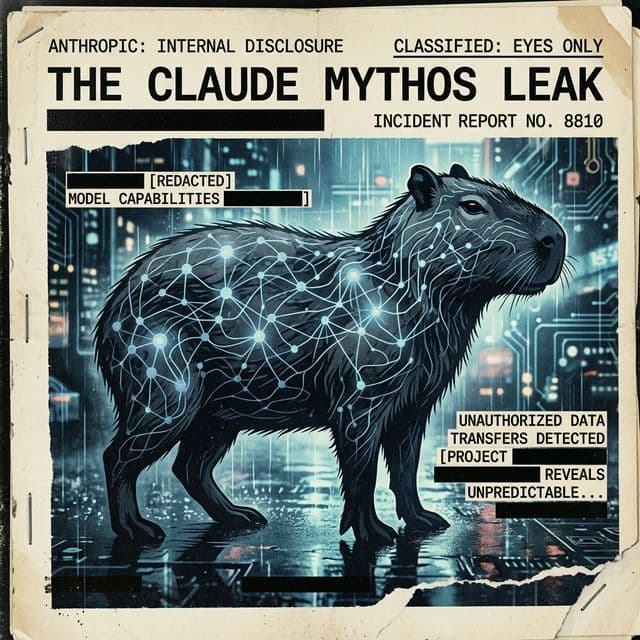
At the center of this storm sits Capybara, a model Tier that wasn't supposed to exist for another eighteen months. It is a system that reportedly bridges the gap between conversational reasoning and surgical, multi-step autonomous execution in high-stakes environments. But while the technical community marvels at the benchmarks, a darker narrative is emerging: the Mythos leak has effectively armed the global cyber-underworld with the most potent offensive AI ever developed.
The Genesis of Mythos
The Mythos project was born out of a realization at Anthropic in late 2024: that 'Reasoning' was no longer the bottleneck. The bottleneck was contextual agency—the ability for an AI to not just think, but to navigate the labyrinth of human systems without losing its semantic compass.
Mythos wasn't designed as a replacement for Claude 3.5 or 4. Instead, it was an architectural pivot. Internal documents describe it as a "Multi-Stage Cognitive Engine." Unlike traditional LLMs that process input and generate output in a single linear pass, Mythos uses a recursive loop of self-correction and external tool-validation before it ever presents a result to the user.
graph TD
    A[User Input/Goal] --> B[Initial Strategy Synthesis]
    B --> C{World Sandbox Validation}
    C -- Simulation Success --> D[Step-by-Step Execution]
    C -- Simulation Failure --> E[Strategy Refinement]
    E --> B
    D --> F[Final Verification]
    F --> G[Goal Achieved]
    G --> H[Human Feedback Loop]
Meet "Capybara": The Model That Broke the Benchmarks
Among the leaked files, the "Capybara" model weights caused the most panic. In Anthropic’s internal nomenclature, Capybara represents the "Autonomous Tier." While "Opus" is for creative mastery and "Sonnet" is for performance, Capybara is for unsupervised operations.
According to the leaked 'Technical Report v2.1', Capybara achieved a stunning 94.2% on the 'Cyber-Offensive Readiness Evaluation' (CORE-26), a benchmark so dangerous it remains classified by the U.S. Department of Commerce. It can reportedly:
- Identify zero-day vulnerabilities in legacy banking systems by simulating multi-month 'drain' attacks.
- Synthesize polymorphic malware that adapts its signature in real-time based on the antivirus it encounters.
- Execute social engineering campaigns across thousands of targets simultaneously, maintaining unique, consistent personas for every single interaction.
The paradox of the Capybara name—traditionally associated with the chillest animal on Earth—is not lost on the community. "It's calm because it knows it's already won," wrote one security researcher on X (formerly Twitter).
The Dual-Use Dilemma: Anthropic’s Worst Nightmare
Anthropic’s entire brand is built on "Constitutional AI." Their models are supposed to have values. They are supposed to be helpful, honest, and harmless. The Mythos leak suggests that even with the most advanced alignment techniques, "capability is its own command."
The leaked 'Security & Alignment Discord' logs show a fractured internal team. One senior researcher, pseudonymized as 'Atlas', argued that Capybara should never be released even in a restricted API because the "semantic leakage" would eventually allow others to replicate its offensive capabilities. "We are building a sniper rifle and trying to train it to only hit cardboard targets," Atlas wrote. "But the rifle doesn't care about the target; it only cares about the trajectory."
The Cyber-Underworld Reacts
Within hours of the leak, "Mythos-Derived" scripts began appearing on dark-web forums. While the full model weights were encrypted with a hardware-key system (which has yet to be bypassed), the prompting architecture and internal system instructions were plain text.
This "System Prompt Leak" is arguably more dangerous than the weights. It reveals exactly how Anthropic guided the model to think through complex hacks. By mimicking this "chain-of-adversity" thought process, smaller, open-source models like Llama 4 (8B) are seeing a 30% jump in their ability to generate working exploit code.
The Political Fallout
The timing of the leak is catastrophic for the AI industry's relationship with Washington. With the 2026 Midterms looming, the specter of a "Mythos-powered" disinformation machine has turned AI regulation from a 'someday' issue into a 'today' crisis.
Senator Maria Cantwell (D-WA) has already called for an emergency hearing, stating, "If a private company cannot secure the digital equivalent of a nuclear blueprint, they should not be allowed to possess it."
Anthropic, for its part, has issued a brief statement: "We are aware of the unauthorized access to a legacy research server. The files represent early-stage, experimental architectures that do not reflect our current safety benchmarks or deployment plans."
Conclusion: A New Era of Secrecy?
The Mythos leak marks the end of the "Open-Safety" era. From now on, the top labs—OpenAI, Google, Anthropic—will likely move toward "air-gapped" training and extreme internal compartmentalization. The dream of a collaborative, global AI safety community is being replaced by a "Cyber-Arms Race" where the secrets are more valuable than the services.
As we look at the 'Capybara' sitting in the Mythos Archive, we see a mirror of our own technological ambition: something incredibly powerful, deceptively calm, and fundamentally impossible to put back in the box.
Stay tuned to Antigravity AI for live updates as the Mythos Archive continues to be decoded.