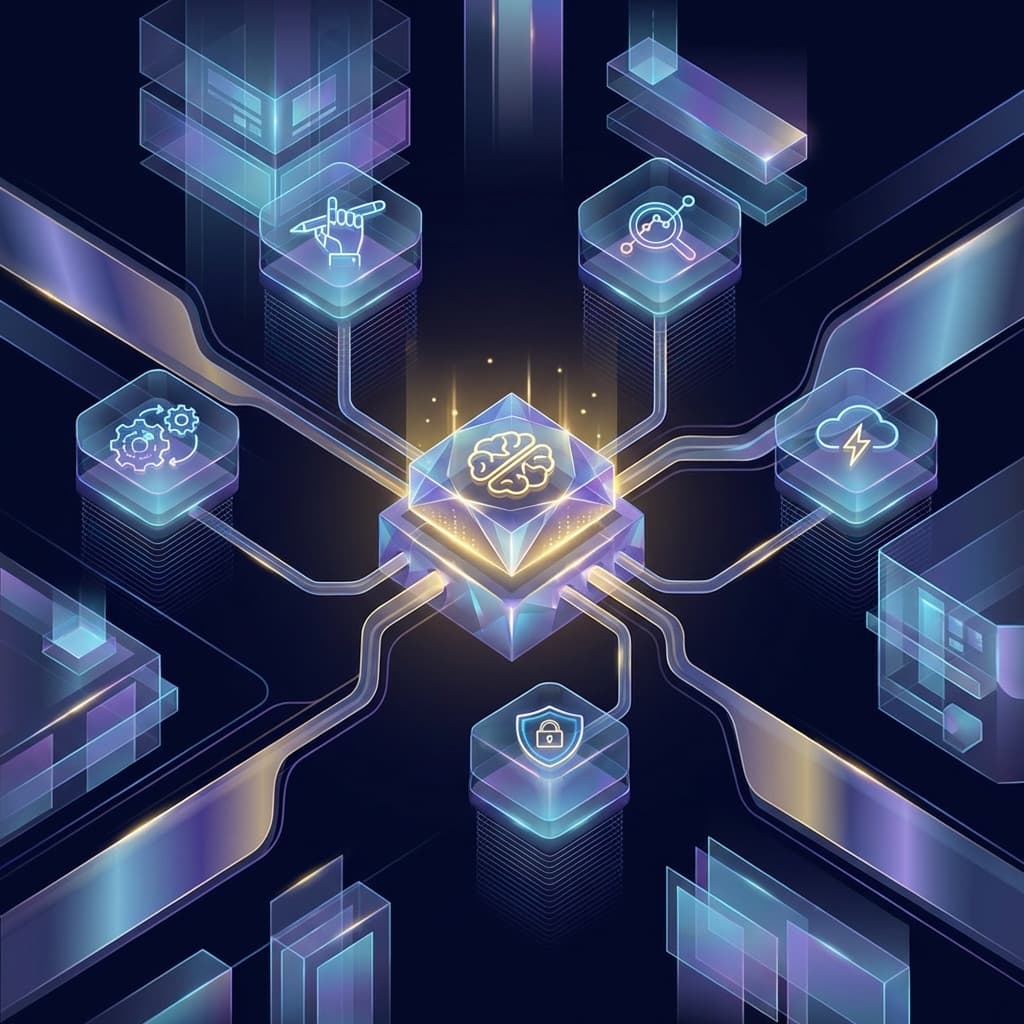
Beyond the Chatbot: Why 2026 is the Year of Agentic Orchestration
A 3,000+ word definitive guide to the shift from standalone chatbots to sophisticated multi-agent orchestration systems. Explore architectural patterns, economic impacts, and the future of autonomous digital workforces.
Beyond the Chatbot: Why 2026 is the Year of Agentic Orchestration
We’ve all been there: staring at a blinking cursor in a chat window, trying to convince a large language model to perform a task that feels just slightly outside its reach. For the past few years, the "Chatbot" has been the face of AI. It was the friendly interface that ushered us into the age of generative intelligence. But as we step into 2026, the honeymoon with the standalone chatbot is officially over.
The industry is undergoing a seismic shift. We are moving away from "stateless" bots that wait for a human to type a prompt, and toward autonomous systems that can manage themselves. This shift is what we call Agentic Orchestration.
In this guide, I want to take you on a journey from the simple beginnings of AI chat to the complex, beautiful, and sometimes "magic" world of multi-agent systems. This is your one-stop-shop for understanding why the single-prompt world is dying and how the orchestrators are taking over. We will look at the architecture, the economics, the ethics, and the "Meaning" behind this transition.
1. The Realization: The Death of the "Chat Loop"
In 2023 and 2024, the goal was simple: "Talk to your data." We built tools that let us ask questions of PDFs, spreadsheets, and databases. It felt revolutionary. But as businesses tried to scale these tools, they hit a brick wall.
A chatbot is like a very smart intern who knows everything but can’t actually do anything. You can ask the intern, "How much did we spend on cloud hosting last month?" and they will give you the answer. But if you want to say, "The hosting bill is too high; find the rogue instances, shut them down, and alert the dev team," a chatbot fails.
The reason is simple: Statefulness and Agency.
The "Intern" Problem
Imagine you hire a brilliant intern. Every time you want them to do something, you have to stand over their shoulder and give them one instruction at a time.
- "Go find the file." (Wait for them to return)
- "Now read the second page." (Wait for them to return)
- "Now call the vendor." (Wait for them to return)
This is a Chat Loop. It’s high-friction, low-scale, and eventually, the cost of managing the intern exceeds the value of the work they do.
In 2026, we are firing the intern and hiring a Project Manager. An orchestrator doesn't need you to stand over its shoulder. It needs a Goal. Once given a goal, it assembles its own team, manages the sub-tasks, and only returns to you when the mission is accomplished or when a strategic decision is required.
2. The 80% Failure Rate: Why "Agents" Became a Buzzword
By mid-2025, the term "AI Agent" had lost all meaning. Every software company on the planet claimed to have "Agents." But users quickly realized that these weren't agents—they were just chatbots with a "Search" button.
Research shows that 80% of current "agents" are just glorified chatbots.
Why did they fail?
- Context Collapse: When one model tries to hold the entire world in its memory (the chat history), it eventually gets "hallucination fog." It forgets the original objective because it's too busy thinking about the tool output from three steps ago.
- The Recursive Death Spiral: You give an agent a tool to call an API. The API is down. The agent "thinks" and decides to try again. The API is still down. The agent tries again. Before you know it, the agent has called the broken API 5,000 times in 2 minutes, costing you $200 in tokens and potentially getting your IP blacklisted.
- Lack of Determinism: If you ask a chatbot to write a report on Monday, it might be great. If you ask it on Tuesday, it might decide to write a poem instead. Businesses cannot build infrastructure on "maybe."
The fix for all three of these is Orchestration.
3. The Great Shift: From Model-Centric to Architecture-Centric
If 2024 was about which model was the best (GPT vs. Claude vs. Gemini), 2026 is about which architecture is the best.
We are moving into an era of Architecture-Centric AI. In this world, the model is just a component—a processor. The true intelligence lives in how you connect those processors together.
The Orchestration Layer
Think of a world-class orchestra. You have a violin section, a percussion section, and woodwinds. Each musician is an expert in their narrow field. But without a conductor, you don't have a symphony; you have noise.
Orchestration is the layer of logic—written in code—that sits ABOVE the AI models. It acts as the "Prefrontal Cortex" of the digital organism.
4. The 5 Design Patterns of 2026 Orchestration
To understand how high-performing AI works today, you need to understand the five patterns that have replaced the simple "Prompt and Response."
1. The Sequential Chain (The Assembly Line)
This is the simplest form. Agent A does X, hands the result to Agent B, who does Y.
- Example: A "Newsletter Agent" where the Researcher Agent finds stories, the Writer Agent drafts the summaries, and the Editor Agent applies the brand voice.
- Why it works: Each agent only needs a tiny window of context, making them faster and cheaper.
2. The Parallel Swarm (The Brainstorm)
One prompt is sent to five different agents simultaneously.
- Example: A "Code Reviewer" where three different agents look at the same code: one for security bugs, one for performance, and one for style.
- Why it works: It's much faster than one agent trying to look for everything at once.
3. The Evaluator-Optimizer (The Craftsperson and the Critic)
This is the gold standard for quality. You have a Generator Agent and an Evaluator Agent. The Generator creates a draft. The Evaluator critiques it. The Generator tries again.
- Example: "Write a landing page. If the Evaluator says it’s too wordy, rewrite it until the word count is under 200 but the conversion impact is high."
- Why it works: It eliminates the "first-thought-best-thought" bias of LLMs.
4. The Router pattern (The Triage)
A very small, "fast" model looks at the user input and decides which "specialist" model should handle it.
- Example: If the user asks about billing, route to the Finance Agent. If they ask about code, route to the Coding Agent.
- Why it works: It saves money. You don't need a massive, expensive model to answer a simple billing question.
5. The Supervisor Pattern (The Digital Manager)
This is the most "visionary" pattern. A Supervisor Agent manages a team of specialists. It doesn't do the work; it coordinates. It keeps the "Global State" while the specialists only see their local tasks.
5. The Economics of Autonomy: The ROI of "Thinking Time"
In the "Chatbot era," we measured the cost of AI by Tokens. In the "Agentic era," we measure it by Outcomes.
The Shift in Billing
In 2024, companies worried about their monthly OpenAI bill. In 2026, they look at their Total Cost of Ownership (TCO) per Resolved Issue.
Let's look at the math:
- Human Employee: $50/hour. Can resolve 5 complex customer issues per hour. Cost: $10/issue.
- Chatbot: $0.05 per prompt. Resolves 10% of issues. Remaining 90% go to humans. Effective cost: still high.
- Orchestrated Agentic Workforce: $0.50 per issue (more tokens, thinking time, multi-agent calls). Resolves 85% of issues autonomously.
- Result: You save 80% on operational costs while providing 24/7 service.
"Reasoning" is the New Currency
The release of models like OpenAI's 'o1' and DeepSeek's 'R1' changed the game. These models don't just "predict the next word"; they Reason. They spend "Thinking Time" before they speak. Orchestration allows us to decide when to pay for that thinking time.
- If a user asks "What time is it in Tokyo?", we use a 1-cent model with zero thinking time.
- If a user asks "How should we restructure our supply chain to survive a trade war?", we route that to a multi-agent orchestration that might spend 10 minutes (and $5 in tokens) reasoning through the problem.
6. Technical Deep Dive: From "Prompting" to "Programming"
If you want to understand the "Meaning" behind the tech, you have to look at the death of the "System Prompt."
In 2024, we wrote 500-word system prompts: "You are a helpful assistant. You should be polite. You should always use JSON. You should never mention your internal thoughts..." This was a disaster. The longer the prompt, the more the model "drifts."
In 2026, we don't use long prompts. We use Graph Architectures.
The State Machine
Modern orchestration treats a business process as a State Machine.
- State A (START): User asks a question.
- Transition: Does the user have a valid session?
- State B (DATA_FETCH): Fetch the user's account info.
- Transition: Is the account in good standing?
- State C (GENERATE_RESPONSE): Use the data to answer.
Each step is a "Node." Each transition is an "Edge." By building AI this way, we introduce Determinism. The AI is no longer "guessing" what step comes next; the code is forcing it to follow a proven path. This is the difference between a "Chatbot" and a "Software Agent."
7. The Day in the Life: An Orchestrated Enterprise in 2026
To make this real, let’s look at a fictional company, "Atlas Logistics," in November 2026.
09:00 AM - The Weather Alert
The Weather Agent (A-1) detects a major snowstorm approaching Chicago. It doesn't tell a human. It sends an event to the Logistics Supervisor (Orchestrator).
09:05 AM - The Impact Assessment
The Supervisor spawns three Inventory Agents to check the status of all shipments moving through Chicago hub. At the same time, it triggers the Communications Agent to draft proactive emails for every customer whose package might be delayed.
09:15 AM - The "Brainstorm"
The Supervisor notices that $2M worth of perishable goods are in the path of the storm. It routes this to a Strategic Reasoning Agent (using a high-reasoning model). The agent suggests rerouting the shipments through the Memphis hub.
09:20 AM - The Human-in-the-Loop
The Supervisor sends a notification to the Logistics Manager's phone:
"Snowstorm in Chicago. I have developed a plan to reroute Perishables through Memphis. Cost: $12k. Impact: Prevents $2M loss. The Communications Agent has already drafted updates for the 450 affected customers. Approve reroute and notifications?"
09:21 AM - Execution
The human clicks "YES." The Negotiation Agents automatically contact truckers via API/email to update their routes. The Tracking Agent updates the customer portal. The Financial Agent logs the $12k variance in the master budget.
This entire process took 21 minutes. In 2024, this would have taken 6 humans three days of frantic meetings, phone calls, and spreadsheets.
8. The Transition: Why RAG is No Longer Enough
For the last two years, people have focused on RAG (Retrieval-Augmented Generation). The idea was simple: find some text, shove it into the prompt, and ask the AI to summarize it.
RAG is a "Chatbot" technology. It’s passive.
In 2026, we have moved to Active Context Engineering. Instead of just "retrieving" text, we "package" it. We use Data Molecules—self-contained units of data that include not just the text, but the policies, the metadata, and the "Agent Instructions" for how to handle that data.
When an orchestrated agent receives a "Data Molecule" about a customer's contract, it doesn't just see the words. It sees the "Rule" that says: "This customer has a 24-hour SLA. If a ticket is open for 20 hours, escalate to Supervisor."
The data itself has become Agentic.
9. Ethics, Governance, and the "Trust Gap"
The biggest "meaningful" challenge of 2026 is Traceability. When things go wrong in a multi-agent system, who is to blame? If Agent A gave wrong data to Agent B, who then triggered a $1M wire transfer, how do we fix it?
Building the "Transparency Layer"
We have moved away from "Black Box" AI. Every orchestration now includes a Transparency Layer (or an Audit Trail).
- Every Agent Decision is Logged: Not just the text, but the "Thought Trace."
- Automated Bias Testing: Every 24 hours, a specialized "Security Agent" runs 1,000 "Shadow Inputs" through the system to see if the agents have started developing biases or making riskier decisions over time.
- The Kill Switch: Every orchestrated system has a hard-coded "Decision Boundary." If an agent tries to perform an action outside its budget or policy, the orchestration code blocks it before it hits the API.
10. How to Get Started: The "One-Stop" Roadmap
If you are reading this and feeling overwhelmed, don't be. You don't need to build 50 agents today. You need to start with the Orchestration Mindset.
Step 1: Deconstruct Your "Value Chain"
Stop looking at your business as a list of jobs. Look at it as a list of Decisions.
- Which decisions are repetitive?
- Which decisions require "looking up data"?
- Which decisions are high-stakes?
Step 2: Build the "Supervisor" First
Don't build a better chatbot. Build a "Switchboard." Build a piece of code that can take a user request and simply Categorize it. That is the first step toward orchestration.
Step 3: Use the "Micro-Agent" Philosophy
Instead of one giant bot that tried to be everything, build five tiny bots that each do ONE thing perfectly.
- One for writing emails.
- One for searching the web.
- One for checking the database.
- One for formatting JSON.
- One for editing tone.
Step 4: Focus on the "Meaning"
Always ask: "Why does this agent exist?" If its existence doesn't lower the "Friction of Decision Making," it's just a toy.
11. Conclusion: Giving Back to the Tech Community
I wrote this guide as a "one-stop-shop" because, like many of you, I was tired of finding fragmented information. I wanted to see the big picture.
The move from Chatbots to Agentic Orchestration is more than just a tech trend; it’s a fundamental change in how humanity interacts with information. We are no longer just "asking" for things; we are "partnering" with digital systems to achieve outcomes.
2026 is the year we stop being "users" and start being "Architects." The magic isn't in what the models can say. The magic is in what you can make them do.
Stay visionary. Stay focused. The autonomous workforce isn't coming; it's here.
FAQ: Common Questions on Orchestration
Q: Is orchestration more expensive than a single chatbot? A: In terms of tokens, yes. In terms of business value and error reduction, it is significantly cheaper.
Q: Do I need a specialized model for orchestration? A: No. You can use GPT-4o, Claude 3.5 Sonnet, or Gemini 1.5 Pro. The orchestration happens in your code (Python/TypeScript), not in the model itself.
Q: How many agents is "too many"? A: There is no hard limit, but once you go above 5-7 agents, you MUST use a "Supervisor" architecture to prevent communication chaos.
ShShell.com - The Home of Narrative Storytelling for the AI Age. If you found this guide valuable, share it with your team. Let's build the future of agentic orchestration together.