Generative AI
Google’s Document Slicing Feature Turns Multimodal AI Pricing Into a Retrieval Decision
Google’s new document-slicing direction shows why multimodal AI costs depend on selecting the evidence a model actually needs.
Read Article →
44 articles
Google’s new document-slicing direction shows why multimodal AI costs depend on selecting the evidence a model actually needs.
Phonon’s new text-to-speech work highlights the on-device tradeoff between natural voices, latency, memory, and privacy across real hardware.
OpenAI’s Images 2.6 adds faster generation, GIF creation, more precise editing, and new API controls across ChatGPT, Codex, and the API.
Apple’s October 27 Creator Studio update adds AI assistance, MCP, MotionVFX, and cross-app workflows. The real change is workflow integration, not another model demo.
OpenAI describes using thousands of agents to uncover leads in biological data, raising a practical question: how do researchers verify parallel machine-generated hypotheses?
Google’s Gemini 4 Argon developer release makes context, tool use, latency, and evaluation part of one model-selection decision.
Google Research’s Diffusion Controller adds a lightweight steering network to frozen image models, targeting prompt alignment without rebuilding the generator.
Google Playground lets people create and play custom games with AI, shifting generative media from prompts toward interactive rules and authorship.
Hugging Face’s Open TTS Leaderboard adds scalable evaluation for multilingual speech and voice cloning, exposing the tradeoff between naturalness, identity, and consent.
Meta’s Muse Image and Muse Video research shifts the generative-media question from prettier samples to controllable editing, temporal consistency, and accountable deployment.
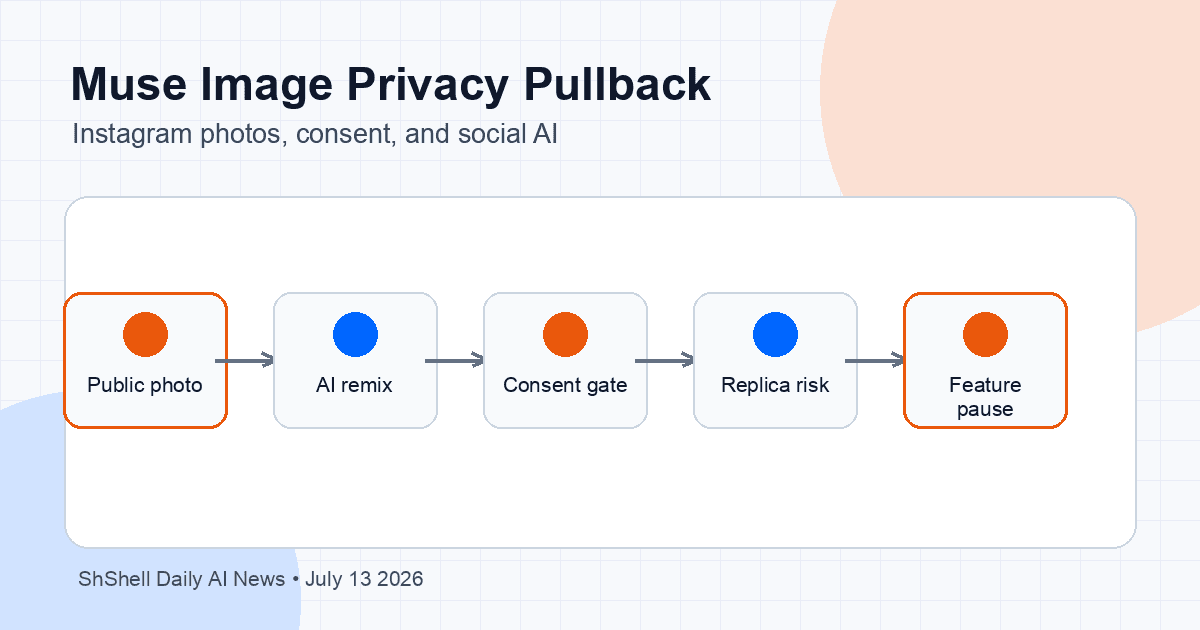
Meta Muse Image launched inside Meta AI, then privacy backlash over Instagram image access made the rollout a live AI governance test.
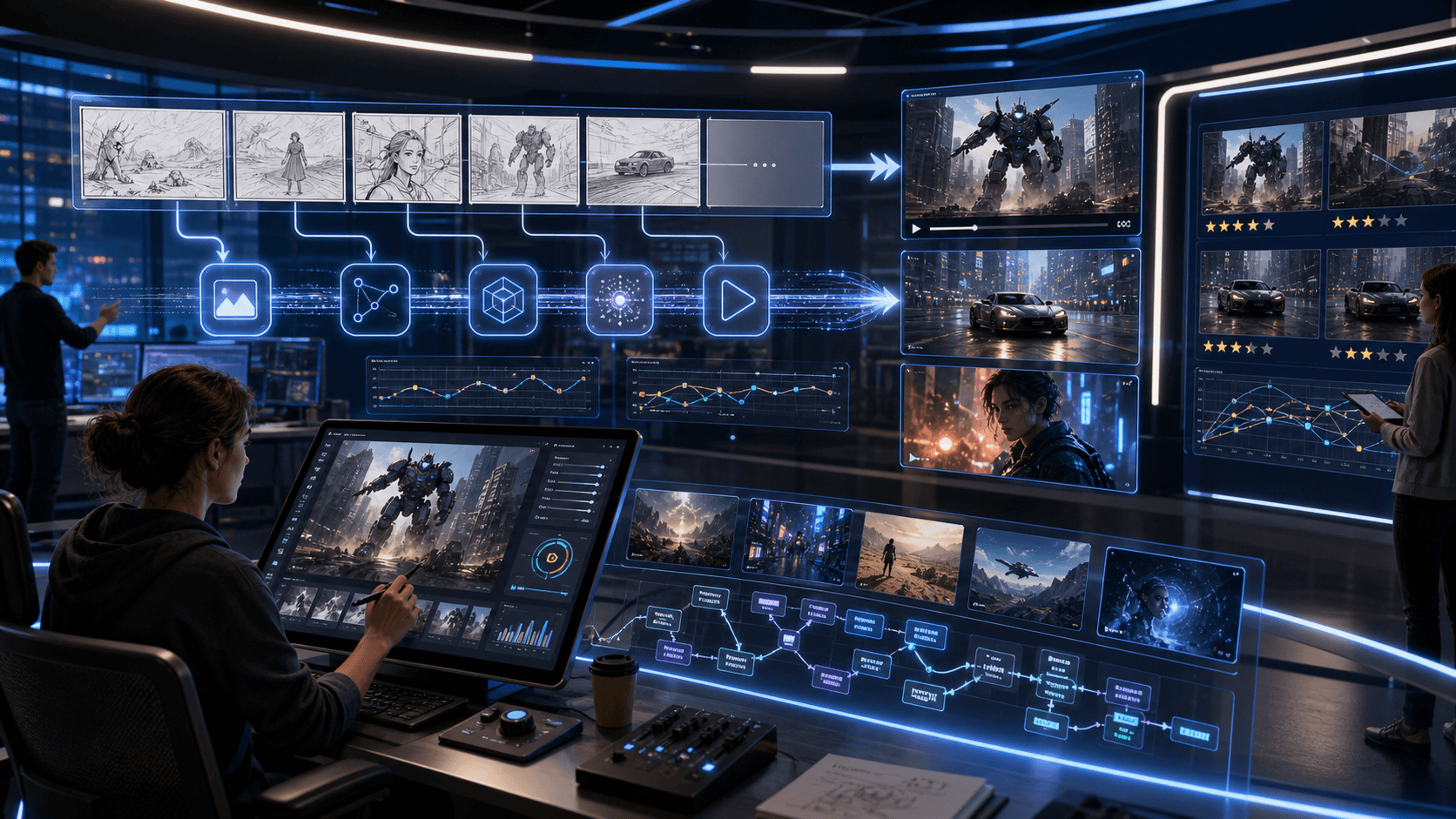
xAI Grok Imagine Video 1.5 adds pressure to the generative AI video race, AI tools market, prompt engineering workflows, and creator APIs.
Google's Gemini Omni brings conversational video editing, Flow agents, and Flow Music tools into a broader creative AI studio.

From Chatbot to RAG. Three hands-on projects to prove your mastery of Generative AI fundamentals.

Defining AI in simple terms and exploring everyday examples of AI in our world.

Understanding how Generative AI sits within the broader fields of Machine Learning and Deep Learning.

Predicting labels vs. creating new data. Understanding the fundamental shift in how AI assists us.

From rule-based systems to GANs and the massive Transformer breakthrough.
Reviewing the AI landscape and testing your ability to distinguish between different AI types.

Understanding the scale, training, and significance of models like GPT-4 and Claude.
From Tokens to Embeddings. Understanding the mechanics of how a computer 'reads' meaning.
Attention Mechanisms and Context. Understanding the 'Secret Sauce' that allows AI to reason across long documents.

Common failure modes. Why AI makes things up and how to detect biased or incorrect outputs.

Choosing your model. Comparing the strengths and tradeoffs of GPT-4, Claude, Gemini, and Llama.
Reviewing the mechanics of LLMs and conducting a comparative model experiment.

The Prompt as an Interface. Understanding why the quality of your input directly determines the utility of the AI.
Zero-shot, Few-shot, and Chain-of-Thought. The three pillars of professional AI interaction.
Defining Persona and Role. How to create an 'Invisible' layer of instructions that controls the AI's personality and safety.

From Text to Table. How to force the AI to return data in specific formats like JSON, Markdown, or CSV.
The Refinement Loop. How to treat prompting as an experiment rather than a one-off command.
Reviewing professional prompting techniques and completing a structured output project.

How AI draws. Understanding Diffusion models and the tools used to create stunning visual content from text.

The Sound of AI. Exploring text-to-speech, music generation, and the emerging frontier of AI-generated video.

AI as a Coding Assistant. How to use LLMs to write, debug, and explain programming languages.
Reviewing non-text GenAI and practicing image generation and code refactoring.
Connecting AI to Reality. How to ground AI responses in your own private data to prevent hallucinations.

The Memory of AI. Understanding how we store and search 'Meaning' using embeddings and specialized databases.
From Chatbot to Coworker. Understanding AI agents that can use tools and make autonomous decisions.
AI on your desktop. Learn why and how to run powerful models locally for total privacy and zero cost.
Reviewing the AI tech stack and building a simple RAG pipeline and local AI setup.
The Weight of Creation. Discussing deepfakes, copyright, and the environmental impact of large-scale AI.
Protecting the Prompt. Understanding prompt injection attacks and data leakage risks in AI systems.
Where we are heading. Discussing Small Language Models (SLMs), autonomous agents, and the new skills required for the AI era.
Finalizing the course with a discussion on ethics and an outlook on the AI co-pilot era.