xAI Grok Imagine Video 1.5 Raises the Stakes for Generative AI Video Tools
xAI Grok Imagine Video 1.5 adds pressure to the generative AI video race, AI tools market, prompt engineering workflows, and creator APIs.
xAI Grok Imagine Video 1.5 Raises the Stakes for Generative AI Video Tools
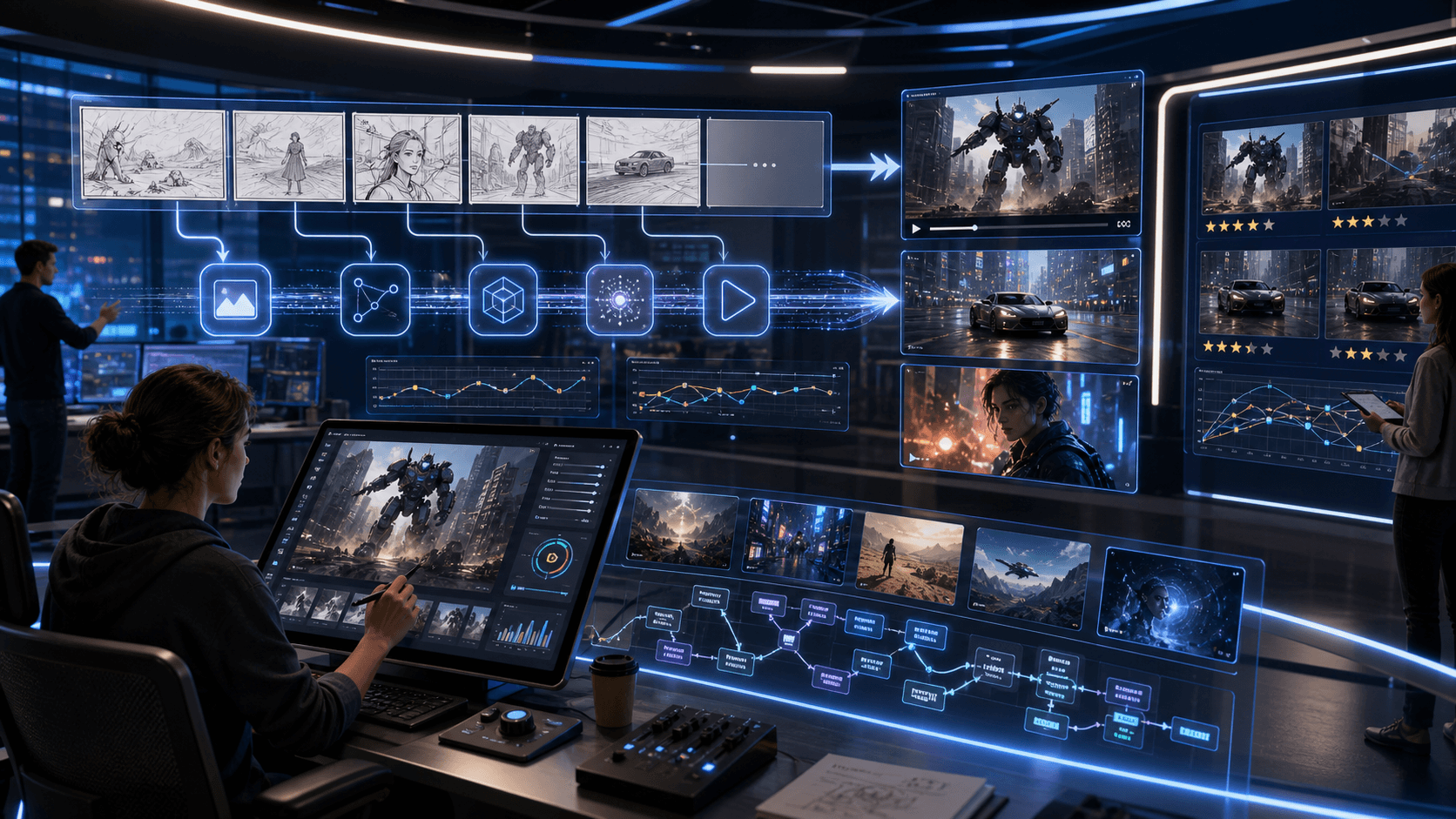
xAI's Grok Imagine Video 1.5 is part of a bigger change in generative AI: video models are moving from novelty clips into production tooling. The question is no longer only whether a model can produce a visually striking short scene. The harder question is whether creators, advertisers, developers, educators, and product teams can control motion, character consistency, rights, cost, iteration, and API reliability well enough to use AI video in a real workflow.
That is why Grok Imagine Video 1.5 matters. xAI already has a consumer-facing Grok surface and a cultural advantage around fast, social, viral interaction. If it can connect video generation to prompt workflows, creator iteration, and developer access, it puts pressure on every other AI video tool to become more than a demo gallery.
Source trail
- xAI official site
- xAI Grok product page
- Analytics India Magazine AI coverage
- VentureBeat AI coverage
- The Verge AI coverage
This article uses those sources as the factual base and adds ShShell analysis for creators, developers, AI product teams, and readers tracking latest AI news. Model availability, API access, pricing, and policy details should be checked against xAI's current product documentation before production planning.
What Grok Imagine Video 1.5 is changing
Grok Imagine Video 1.5 is being discussed as a step forward in xAI's image-to-video and prompt-to-video ambitions. The exact product details matter, but the broader market signal is already clear: generative AI video is becoming a competitive platform category. The companies in this race are not just selling output quality. They are selling iteration speed, prompt control, brand safety, developer integration, and the ability to turn a short clip into a repeatable workflow.
Video is harder than text or still images because the model has to maintain consistency over time. A prompt can request a product shot, a character, a camera move, a setting, and an action. The model has to preserve identity, physics, lighting, object placement, and motion across frames. A single beautiful frame is not enough. If a character's face changes, a product logo warps, or the camera motion breaks, the clip may be unusable for professional work.
That is why this story belongs in AI News Today. The AI tools market is moving from "can it generate" to "can it be directed." Prompt engineering for video is becoming a production skill: scene blocking, camera language, timing, motion constraints, negative prompts, seed control, reference frames, and revision workflows.
Why xAI's distribution matters
xAI's advantage is not only model development. It is distribution through Grok and the wider social context around the product. Video generation becomes more powerful when users can make, remix, share, and iterate quickly. A model that lives near conversation can turn a text exchange into a visual asset. A model that lives near social sharing can turn a generation into immediate distribution.
That creates a different competitive path from studio-first video tools. Some AI video platforms aim at professional editors, advertisers, and enterprise creative teams. xAI may be able to push from the consumer and social side, where speed and novelty matter, then work upward into developer and commercial workflows. The risk is that consumer speed can conflict with provenance, rights, and brand safety. The opportunity is that rapid iteration can teach the model ecosystem what users actually want.
The API question is central. If Grok Imagine Video becomes accessible to developers with predictable pricing, latency, and policy rules, it stops being only a creative feature. It becomes infrastructure for apps: automated social content, education snippets, game prototypes, product mockups, marketing variants, personalized explainers, and interactive storytelling.
The workflow behind serious AI video
graph TD
    Brief[Creative brief or app request]
    Prompt[Prompt and reference assets]
    Generate[Grok Imagine Video generation]
    Review[Human or automated review]
    Edit[Revision, crop, extend, or regenerate]
    Rights[Provenance and rights check]
    Publish[Publish or API delivery]
    Metrics[Engagement and quality feedback]
    Brief --> Prompt
    Prompt --> Generate
    Generate --> Review
    Review --> Edit
    Edit --> Generate
    Review --> Rights
    Rights --> Publish
    Publish --> Metrics
    Metrics --> Brief
The diagram shows why video tools need more than a model endpoint. A production workflow includes prompts, references, generation, review, revision, rights checks, publishing, and feedback. The model is only one part of that loop. The winning AI video tools will make the loop faster without removing human control where it matters.
For creators, the loop is creative. For developers, the loop is operational. An app needs to know whether a generation succeeded, how long it took, what it cost, whether it violated policy, whether it can be retried, and whether the output is safe to show to a user. Those details decide whether Grok Imagine Video 1.5 becomes a toy or a dependable API.
Who is affected first
Creators are first. Short-form video, memes, ads, explainers, thumbnails, storyboards, and social edits are obvious targets. A better video model lets creators test ideas faster, especially when the cost of shooting or animating would be too high for early exploration.
Marketing teams are second. They want variants: different hooks, different product angles, different languages, different scenes, different formats, and different platforms. AI video can help create drafts, but the output still has to respect brand rules, claims, rights, and audience expectations. A clip that looks good but misrepresents a product is not useful.
Developers are third. They need stable APIs, predictable latency, policy documentation, content moderation hooks, versioning, and clear output metadata. If xAI wants Grok Imagine Video to matter beyond the Grok app, the developer experience has to be strong.
What builders should evaluate
The first evaluation dimension is temporal consistency. Does the subject remain the same across frames. Do hands, faces, logos, products, and background objects stay coherent. Does the motion match the prompt. Does the camera move smoothly. Are transitions controlled or random.
The second dimension is editability. Can the user keep the same character and change only the action. Can they extend a clip. Can they create variants from a reference image. Can they lock a product identity. Can they crop to social formats without losing the subject. Professional users care about revision control more than one lucky generation.
The third dimension is production economics. How much does an accepted clip cost after failed generations. What is the latency. How many retries are needed. Are there rate limits. Can the API return progress events. Is there batch generation. Does the model support different durations, resolutions, aspect ratios, or safety settings.
Video prompt engineering is becoming a real skill
Prompt engineering for video is not the same as prompt engineering for text. Text prompts are mostly semantic. Video prompts are temporal and spatial. A good video prompt has to describe subject, setting, camera movement, action sequence, style, lighting, duration, and constraints. It also has to avoid ambiguity that produces unstable motion.
For example, a weak prompt says, "make a futuristic product ad." A stronger prompt says, "six-second close-up product ad, matte black smart glasses on a glass table, slow clockwise camera orbit, blue rim light, no text, no people, clean studio background, product remains centered, realistic reflections." The second prompt gives the model visual and temporal boundaries.
Creators will also need prompt libraries. The best ai prompts for video will become reusable production recipes: product hero shot, interview cutaway, app explainer, travel transition, stylized avatar intro, classroom diagram, social teaser. AI courses and ai training should teach these recipes with examples of failure and revision, not just one polished output.
The rights and provenance problem will not go away
Generative AI video raises obvious rights questions. Was the output trained on copyrighted material. Can it imitate a living artist's style. Can it create a likeness that resembles a real person. Can a brand use the clip commercially. Does the tool provide provenance metadata. Can viewers tell whether the clip is synthetic.
xAI will have to answer these questions if Grok Imagine Video moves into commercial workflows. Consumer play is one thing. Brand and enterprise deployment is different. Marketing teams need indemnity, policy documentation, audit trails, and controls for likeness, logos, trademarks, and sensitive content. Newsrooms and educators need labeling and provenance.
The synthetic media risk is also social. Better AI video can help creators, but it can also make misleading clips cheaper. Product teams should assume that safety, watermarking, provenance, and moderation will become buying criteria. A model that generates impressive clips but gives no control over policy will be hard to adopt in serious environments.
What an API needs to provide
| API need | Why it matters for Grok Imagine Video | What developers should look for |
|---|---|---|
| Predictable latency | Apps need to manage user expectations. | Progress events, async jobs, webhooks, and timeout guidance. |
| Cost transparency | Failed generations are part of the real cost. | Pricing per duration, resolution, retry, and accepted output. |
| Prompt and seed control | Creators need repeatability. | Reference inputs, deterministic options, variant generation, and prompt history. |
| Safety status | Apps need to handle refusals and moderation. | Machine-readable policy result and retry guidance. |
| Output metadata | Teams need provenance and auditability. | Model version, generation time, prompt hash, resolution, and rights metadata. |
This table is where the Latest AI News angle becomes practical. The model will get attention. The API details will decide adoption.
Where Grok Imagine fits against competitors
The AI video field is crowded. OpenAI's Sora, Google's Veo line, Runway, Pika, Luma, Adobe, Meta, and others are all attacking parts of the video generation market. Each competitor has a different advantage: model quality, editing tools, enterprise trust, creative community, distribution, design workflows, or developer access.
xAI's possible advantage is speed and integration with a conversational product. If users can brainstorm with Grok, generate a clip, revise it conversationally, and share it quickly, the workflow becomes natural. The weakness could be professional control. Studio users may demand timeline editing, brand kits, rights assurances, and deterministic revision that a social-first product may not prioritize at first.
That means Grok Imagine Video 1.5 should be judged by use case. It may be excellent for ideation, social content, prototype visuals, and fast creative exploration. It may need more tooling before it becomes a primary system for enterprise advertising, regulated education, or brand campaigns.
What buyers and creators should ask
Creators should ask whether the tool helps them finish work, not only start it. Can they revise without losing the best parts of a clip. Can they keep a character consistent. Can they remove a visual artifact. Can they generate the same scene in multiple aspect ratios. Can they export in formats that fit their publishing workflow.
Marketing buyers should ask whether the tool supports approval. Can teams review prompts and outputs. Can they block unsafe themes. Can they preserve brand assets. Can they track who generated what. Can they prove a clip was synthetic if a platform or regulator asks.
Developers should ask whether the API behaves like infrastructure. Does it have documented limits. Can failures be retried safely. Are jobs idempotent. Can outputs be stored securely. Can policy failures be handled gracefully. Can the product route low-risk and high-risk requests differently.
What learners should take from this
For people trying to Learn AI, Grok Imagine Video is a reminder that generative ai is becoming multimodal production work. Text, image, audio, and video systems each require different prompting and evaluation habits. A video model is not judged only by correctness. It is judged by motion, continuity, composition, editability, and output usability.
AI courses should teach video prompt engineering through iteration. Start with a prompt. Generate. Identify what broke: camera, subject, identity, lighting, timing, or policy. Rewrite the prompt. Add reference images. Compare outputs. Track which changes improved the clip. That is a more realistic learning loop than showing one perfect example.
Developers should also learn the API side: async jobs, media storage, queueing, moderation, cost caps, webhook handling, and user review. AI video can quickly become expensive or risky if the app treats generation as a simple synchronous text completion.
The risks that matter most
The first risk is synthetic misinformation. Better video models make it easier to create plausible clips of events that did not happen. Provenance and labeling will not solve everything, but they are necessary for responsible deployment.
The second risk is rights confusion. Creators need clarity about commercial use, likeness, copyrighted references, and model terms. A tool that creates uncertainty can slow adoption even if the visuals are strong.
The third risk is workflow disappointment. Many users will generate impressive first clips and then struggle to revise them. Professional adoption depends on control. If Video 1.5 improves visual quality but not iteration, it will remain more useful for ideation than final production.
The fourth risk is cost opacity. AI video uses more compute than text. If users need ten generations for one acceptable clip, the real unit cost is the accepted output, not the single generation.
How teams should benchmark Grok Imagine Video 1.5
Teams should build a video benchmark around their own content, not around viral examples. A useful test set includes product shots, character scenes, camera moves, text-free ads, instructional clips, social teasers, and brand-sensitive prompts. Each prompt should define expected duration, aspect ratio, subject consistency, camera behavior, and unacceptable artifacts.
The scoring should be practical. Did the subject remain consistent. Did the action follow the prompt. Did the model preserve product shape and logo integrity. Did the clip avoid unwanted text or distorted hands. Did it meet the required aspect ratio. Did it require one generation or six. Did reviewers approve it. Did the output need manual editing. These questions measure workflow value better than a generic beauty score.
Teams should also test negative prompts and policy cases. Can the model refuse unsafe likeness requests. Can it avoid imitating a real person. Can it prevent misleading news-like scenes. Can it handle a brand prompt without introducing unauthorized marks. Can it explain why a generation failed. A video model that is hard to control will create legal and reputational risk even when the clips look good.
For developers, benchmark the API behavior too. Submit jobs concurrently. Retry failed jobs. Cancel jobs. Store outputs. Run cost caps. Simulate users refreshing the page while a generation is running. Test moderation hooks. The model is only useful inside an app if the surrounding service behaves reliably.
The product gap between consumer fun and enterprise use
Consumer users often tolerate surprise. Enterprise users need repeatability. A Grok user may enjoy a weird, funny, or unexpected clip. A brand team needs the product to look correct every time. A training team needs the instructional sequence to be accurate. A developer building an app needs stable behavior across thousands of requests.
This gap will determine where Grok Imagine Video 1.5 fits first. If the strongest experience is inside Grok, xAI may win attention and social usage quickly. If the company adds strong controls, API documentation, rights terms, and review workflows, it can move deeper into professional AI tools. Those are different maturity levels.
The same distinction applies to prompt engineering. A casual user can write a playful prompt and accept whatever appears. A production user needs prompt templates, locked references, brand constraints, and revision history. The tooling around the model has to support that discipline.
What a responsible app integration looks like
A developer adding AI video to an app should not expose the raw generator without guardrails. The app should collect a clear user intent, apply prompt templates, check policy before generation, send the job asynchronously, store the output securely, run post-generation moderation, and present the result for review before publication.
The app should also make cost visible. Video generation can become expensive quickly. Users need limits, previews, lower-resolution drafts, and clear retry behavior. Product teams need dashboards showing accepted clips, failed clips, average retries, latency, and cost by workflow.
For user-generated content platforms, provenance should be part of the data model. Store the prompt hash, model version, generation time, user ID, moderation status, and any edits. If a clip is reported later, the platform should be able to investigate how it was created. That is not only a legal issue. It is how trust survives at scale.
Where creators will feel the change first
The first real impact will be pre-production. AI video is already useful for storyboards, mood exploration, pitch concepts, product visualization, and social tests. A creator can test five visual directions before hiring a crew, opening an editor, or commissioning animation. That does not eliminate production craft. It changes where ideation starts.
The second impact is localization. A brand can test different settings, captions, cultural references, and visual metaphors for different markets. That requires careful review, because localization errors can be embarrassing or offensive. But the ability to generate variations quickly changes creative planning.
The third impact is education. Teachers, course creators, and technical writers can generate short explanatory clips, process animations, and scenario visuals. The challenge is accuracy. An AI-generated instructional video that looks polished but shows the wrong sequence is worse than no video. Educational uses need review by someone who understands the subject.
What to watch next
Watch whether xAI publishes clearer details on Grok Imagine Video 1.5 availability, duration, resolution, input modes, safety limits, and API access. Watch whether developers get documentation or whether the feature remains primarily inside the Grok consumer surface.
Watch creator behavior too. If users start building repeatable prompt styles, templates, and workflows around Grok Imagine, that is a stronger signal than a few viral demos. Community workflow patterns often reveal product-market fit before enterprise case studies do.
Finally, watch provenance and policy. The AI video race will not be won only by the most cinematic output. It will be won by the tools that combine quality with control, trust, and integration.
Bottom line
xAI Grok Imagine Video 1.5 raises the stakes because generative AI video is becoming a tooling market. The model has to create good clips, but the product has to help users direct, revise, approve, label, and integrate those clips.
For builders following Latest AI News, the practical lesson is clear: evaluate AI video by workflow, not screenshots. Ask what the model can generate, how reliably it can be controlled, how outputs are reviewed, what rights attach to the media, and whether the API can support a real product. That is the difference between a viral clip generator and a durable AI tool.