The Ghost Town of Agency: Who is Actually Consuming All These AI Agents?
Analysis of the 2026 AI market: why we have 10,000 builders for every 10 real buyers, and how the 'normalization' of AI is quietly solving the paradox.
The Ghost Town of Agency: Who is Actually Consuming All These AI Agents?
If you spend five minutes on "AI Twitter" or browsing Product Hunt in March 2026, you will see a world of unlimited construction. There are agents for your email, agents for your terminal, agents that build other agents, and agents that audit the agents that build agents.
The barrier to entry for "building" has never been lower. With tools like Nemotron 3 Super and GPT-5.4, any developer can wrap an API and call it an "Autonomous Employee."
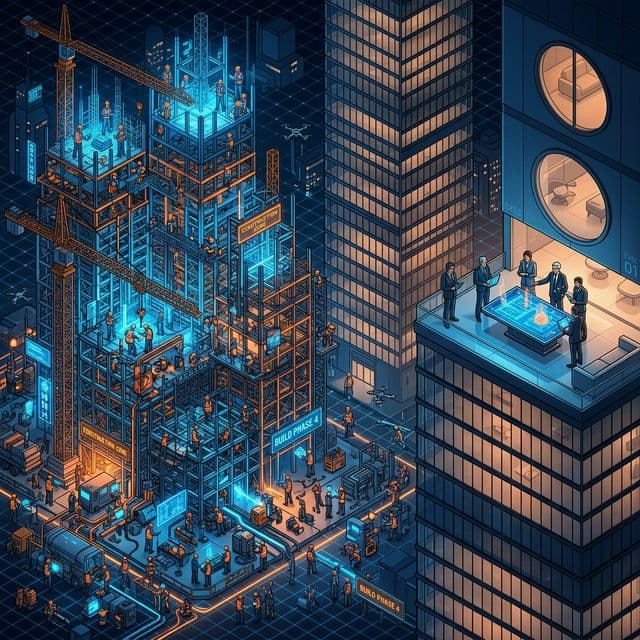
But walk into a Fortune 500 office or a mid-sized accounting firm, and you'll find a startling silence. The builders are everywhere, but where are the buyers? Why does the market feel like a high-tech construction site where nobody ever moves in?
The Builder vs. Buyer Paradox
The current state of AI is defined by what we call the Builder Paradox. In traditional software cycles (dot-com, mobile, cloud), there was a clear delay between a technology appearing and people building products with it. With AI, the building is instantaneous.
Why are there more builders than buyers?
- Low Initial Ceiling, High Final Floor: It takes 20 minutes to build a "legal research agent" prototype. It takes 20 months to make it reliable enough that a law firm will actually pay for it and trust it with a billion-dollar case.
- The "Integration Debt": Buyers don't want another dashboard. They want their existing ERP, CRM, and Slack to "just work." Most builders are building standalone apps, whereas buyers are waiting for Active Knowledge Nodes (like the recent Gemini for Workspace update) to come to them.
- The Marginal Cost Crisis: Unlike traditional SaaS, AI isn't "free" to scale. Every query costs the builder money. Buyers are hesitant to sign "Unlimited" contracts when they don't yet know the ROI of a "thoughtful" agent.
The Agent Value Chain (2026)
graph TD
    A[Model Labs: Raw Intelligence] -->|API| B[Wrappers: Fast Builders]
    B -->|The Chasm| C[Solution Architects: The Real Value]
    C -->|Customized Orchestration| D[The Buyer: Results Over Tools]

    style B fill:#ffcccc,stroke:#333,stroke-dasharray: 5 5
    style C fill:#ccffcc,stroke:#333,stroke-width:4px
    style D fill:#4285F4,stroke:#333,color:#fff
How AI is Normalizing (The Invisible Phase)
The "Ghost Town" feeling is actually a sign of Normalization. We are moving out of the "Hype Cycle" and into the "Infrastructure Cycle."
Normalization happens when we stop talking about "AI" and start talking about "Features."
- 2024: "Look at this amazing Agent that can draft an email!"
- 2026: "Why hasn't my email system finished summarizing the morning's meetings yet?"
AI is becoming like electricity or Wi-Fi. You only notice it when it's broken. This normalization is shifting consumption away from "Buying an Agent" and toward "Subscribing to a Result."
The "Real" Consumers: Who is actually paying?
While the general consumer market is still playing with "waifu" agents and travel planners, the heavy consumption is happening in the "Dark Alleys" of industry:
| Sector | Consumption Driver | Primary Agent Type |
|---|---|---|
| Logistics | Real-time path optimization & customs filing. | VLA Agents (Vision-Language-Action) |
| Cybersecurity | Million-event-per-second audit swarms. | Sentinel Agents |
| Scientific R&D | Automated high-throughput hypothesis testing. | Reasoning Kernels |
| Telecom | Predictive 6G load balancing. | Infrastructure Agents |
Frequently Asked Questions
Is the AI Agent market a bubble?
The wrapper market is almost certainly a bubble. Builders who contribute nothing but a UI on top of OpenAI's API are being "absorbed" by the platforms themselves. However, the agentic logic market (those solving the "Integration Debt") is projected to grow from $7.8B to $52B by 2030.
How do I move from a Builder to a Seller?
Stop building "Tools." Start building "Outcomes." A buyer doesn't want an "Agentic SQL Writer"; they want a "Weekly Revenue Report that is 100% accurate and requires zero manual data entry."
Why can't I find a buyer for my agent?
You are likely building for a "General" use case. In 2026, the generalized market is owned by Google, Microsoft, and Apple. To find a buyer, you must go Vertical. Build for the specialized needs of a pediatric cardiologist or a maritime insurance broker. High specificity is the only defense against the giants.
Conclusion: The Quiet Revolution
The "Ghost Town" is a temporary illusion. We are in the "Plumbing Phase" of Agentic AI. The builders are busy laying the digital pipes, and the buyers are waiting for the water to actually reach their taps.
As AI normalizes, we will stop seeing "AI Agents" as a separate category of employees. They will simply be how software operates. The winners won't be the ones who built the flashiest agent prototype, but the ones who successfully integrated intelligence into the "boring" foundation of the global economy.
Analysis by Sudeep Devkota. Data synthesized from the 2026 Gartner Agentic Forecast and the Silicon Valley 'Builder-to-Buyer' Ratio Index.