The Drive is Alive: Google's Gemini for Workspace Turns Files into Active Agents
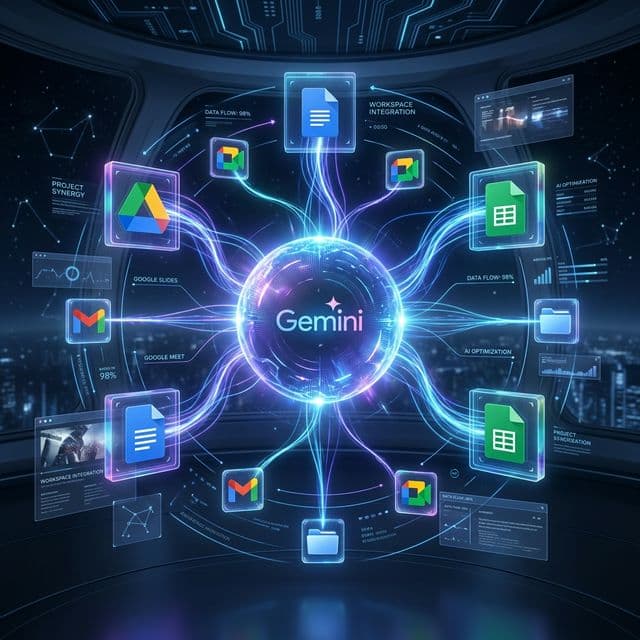
Google's latest upgrade to Gemini for Workspace transforms your Drive from a static storage unit into an active swarm of agents capable of cross-app orchestration.
The Drive is Alive: Google's Gemini for Workspace Turns Files into Active Agents
The concept of "storing files" is becoming obsolete. On March 22, 2026, Google announced a paradigm-shifting update to Gemini for Workspace, effectively transforming Google Drive from a passive repository into a dynamic, agentic ecosystem.
This update introduces Active Knowledge Nodes, a technology that allows Gemini to not just "search" your files, but to assign autonomous agents to monitor, synthesize, and act upon the information within them in real-time.
From Search to Synthesis: The Power of Active Nodes
In the past, using AI in Workspace meant asking Gemini to "write an email based on this Doc." With the new update, the file itself becomes a trigger for action.
"We are moving from a world where you go to your files, to a world where your files come to you with solutions," said Thomas Kurian, CEO of Google Cloud. "Your Q4 budget spreadsheet isn't just a grid of numbers anymore; it's an active observer that can autonomously alert you if spending trends diverge from your 2026 strategic plan."
Key Capabilities of the New Gemini Workspace
- Cross-App Orchestration: Gemini can now take a decision made in a Google Meet transcript, update a project timeline in Sheets, and draft the follow-up brief in Docs—all without a single human click.
- Autonomous Polling: Agents can be set to "poll" external data sources (like market rates or competitor news) and update your internal Docs silently in the background.
- Semantic Permissions: The system understands the intent of privacy. You can tell Gemini: "Allow this agent to read my research but don't let it see the financial projections," and it will reason through the file content to ensure compliance.
The Architecture of an Active Workspace
The underlying logic relies on a new Multi-Agent Orchestrator that resides within the Workspace kernel. This allows for a "Swarm" approach to productivity.
graph TD
    User((User)) -->|Set Goal| Orchestrator[Gemini Orchestrator]
    Orchestrator --> AgentA[Research Agent]
    Orchestrator --> AgentB[Drafting Agent]
    Orchestrator --> AgentC[Compliance Agent]

    subgraph "Google Drive (Active Nodes)"
    AgentA --- Doc1[Project Alpha Notes]
    AgentA --- Doc2[Market Trends 2026]
    AgentB --- Doc3[Proposal Draft]
    AgentC --- Doc4[Policy Handbook]
    end

    Doc3 -->|Output| User

    style Orchestrator fill:#4285F4,stroke:#333,stroke-width:2px,color:#fff
    style AgentA fill:#34A853,stroke:#333,color:#fff
Impact on Enterprise Productivity
For large organizations, this represents the end of "Internal Information Debt." Gartner projects that companies using agentic workspace environments will see a 35% reduction in administrative overhead by late 2027.
| Feature | Legacy Workspace (2024) | Agentic Workspace (2026+) |
|---|---|---|
| Data Interaction | Manual Search & Tab Switching | Real-time Stream Synthesis |
| Logic Execution | Human-led macros | Goal-oriented autonomous agents |
| Context Awareness | Limited to open tabs | Holistic "Drive-wide" memory |
| File Role | Static record | Active Knowledge Node |
Frequently Asked Questions (FAQ)
Does Gemini have full access to my private Drive?
Gemini operates under a "Zero-Trust Agent" model. You must explicitly promote a folder to an "Active Knowledge Zone" before agents can perform autonomous synthesis. Your personal, non-work files remain opaque to the orchestrator by default.
Can Gemini act on my behalf in external apps?
Yes, using the newly released Google Vibe Connectors, Gemini can interact with third-party tools like Salesforce, Slack, and Jira, provided you have enabled the necessary OAuth permissions.
Is this available for Personal Google accounts?
Currently, the "Active Knowledge Nodes" feature is rolling out to Google Workspace Enterprise and Education Plus tiers. A "Gemini Family" version with simplified agent capabilities is expected in late 2026.
Conclusion: The End of Friction
The upgrade to Gemini for Workspace marks the moment when "Artificial Intelligence" becomes "Applied Agency." By turning our static documents into active participants in our workflow, Google isn't just saving us time—they are fundamentally changing the nature of digital labor. The burden of "managing" information is shifting from the human mind to the agentic cloud, leaving us free to focus on the one thing AI still can't do: defining the goals that matter.
This research report was synthesized by Sudeep Devkota. Data and insights sourced from the Google Cloud NEXT '26 keynote and the March 2026 Workspace Technical Brief.