White House AI Growth Orders Put Model Review and Military Adoption on Separate Tracks
New White House AI growth signals split voluntary model review from military adoption, raising AI governance stakes.
White House AI Growth Orders Put Model Review and Military Adoption on Separate Tracks
Washington is trying to accelerate AI and inspect it at the same time. That sounds balanced until the orders hit the real world, where a voluntary pre-release model review does not carry the same force as a procurement push that tells agencies and defense teams to move faster.
This article treats reported claims as reported, confirmed statements as confirmed, and strategic implications as ShShell analysis. That distinction matters because several of today's AI stories sit between product launch, regulatory positioning, and capital-market narrative.
Source trail
- The Guardian: Trump pushing AI growth
- White House AI executive orders
- NIST AI Risk Management Framework
- CISA AI guidance
Ten source-grounded facts that anchor the story
- The Guardian reported that the White House issued two AI executive orders, one encouraging military adoption and another requesting pre-release reviews of powerful models.
- The model review direction was described as a request rather than a hard enforcement mechanism, which leaves compliance incentives unclear.
- The military adoption order points toward faster operational use of AI across defense workflows.
- The policy split matters because frontier AI risk review and deployment pressure often pull in opposite directions.
- The White House has signaled interest in AI growth, public-private partnership, and industrial competitiveness rather than a pause-first framework.
- NIST already provides an AI Risk Management Framework that agencies and companies can use to structure measurement, governance, mapping, and mitigation.
- CISA has separately warned that AI systems create security concerns across model supply chains, software dependencies, and operational use.
- For AI builders, voluntary review only works if there are clear test categories, documentation norms, red-team boundaries, and consequences for ignoring material risks.
- For government buyers, military use raises procurement questions around classified data, human authorization, model logging, and accountability for downstream actions.
- The unresolved question is whether voluntary review can keep up with a policy environment that is explicitly optimized for rapid AI deployment.
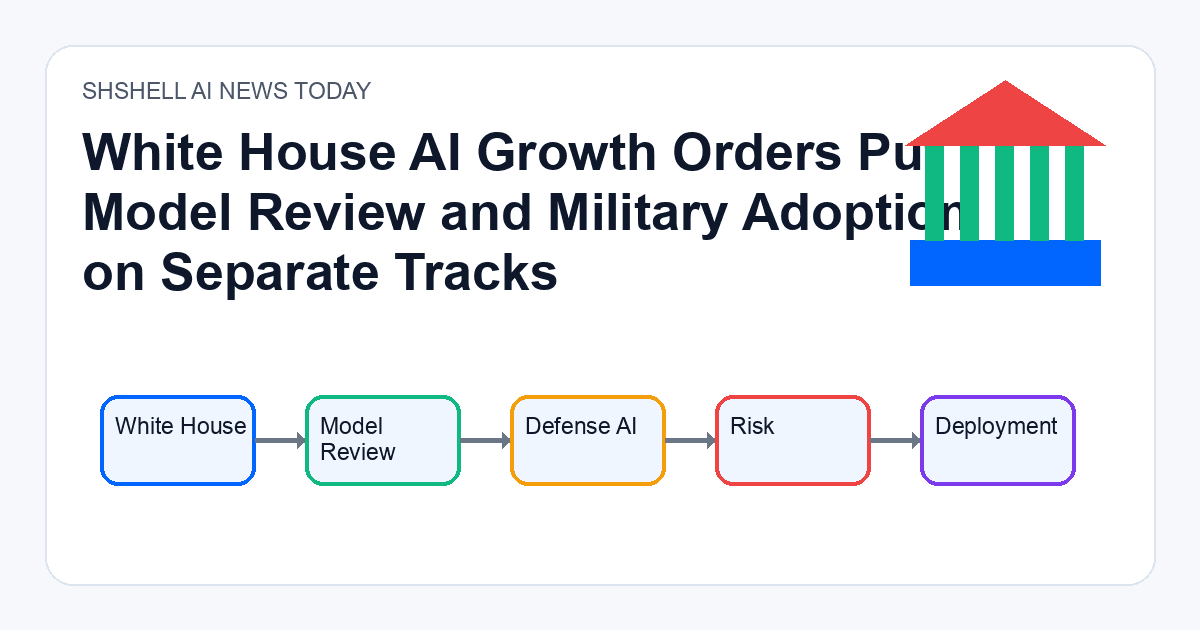
The operating map for this AI News Today story
graph TD
    A[White House orders] --> B[Voluntary model review]
    B[Voluntary model review] --> C[Frontier labs]
    C[Frontier labs] --> D[Defense adoption]
    D[Defense adoption] --> E[Agency buyers]
    E[Agency buyers] --> F[Risk framework]
    F[Risk framework] --> G[Operational AI]
What changed today and why it is not just another AI headline
Why voluntary model review is not the same as enforceable oversight is the part of this story that matters for ShShell readers because it changes how teams should interpret the latest AI news. The headline is not floating above the market. It is tied to a specific fact: The Guardian reported that the White House issued two AI executive orders, one encouraging military adoption and another requesting pre-release reviews of powerful models.
That detail creates a concrete operating question. If a team is building ai agents, buying enterprise AI tools, teaching prompt engineering, or planning local generative AI workflows, the decision cannot stop at whether the announcement sounds advanced. The team has to ask which data moves, which model acts, which human approves, and which system records the result.
The difference from last year's chatbot cycle is accountability. Large language models and llms are now being wrapped in agents, app actions, policy controls, and infrastructure commitments. Another fact anchors that shift: The model review direction was described as a request rather than a hard enforcement mechanism, which leaves compliance incentives unclear. That is a specific constraint, not a generic trend line.
A buyer should read this as a deployment story. The surface may be a product launch, a policy fight, a filing, or a hardware rumor, but the practical issue is whether the workflow survives ordinary use. Does the agent have enough context? Does the user understand the permission boundary? Can the operator audit what happened? Can the cost model survive repeated use?
For learners following Artificial Intelligence News, this is also a useful way to learn AI without getting trapped in model hype. Every serious AI system has a capability layer, a control layer, and an economics layer. The capability layer answers what the model can do. The control layer answers who can make it act. The economics layer answers whether it can run at scale without surprising the user, the buyer, or the regulator.
The decision table for builders, buyers, and operators
| Decision layer | What changed | What to verify before acting |
|---|---|---|
| Product surface | The story moves AI closer to daily workflows | User control, latency, scope, and evidence |
| Model layer | Large language models become part of a larger operating stack | Capability claims, fallback behavior, and evaluation data |
| Data boundary | Personal, enterprise, or infrastructure data becomes central | Retention, access rights, audit logs, and vendor exposure |
| Governance layer | Policy or procurement pressure shapes deployment | Review process, documentation, and accountability |
| Economics layer | Compute, memory, revenue, or market valuation changes the adoption case | Unit cost, pricing durability, and lock-in risk |
How military adoption changes the risk surface
How military adoption changes the risk surface is the part of this story that matters for ShShell readers because it changes how teams should interpret the latest AI news. The headline is not floating above the market. It is tied to a specific fact: The military adoption order points toward faster operational use of AI across defense workflows.
That detail creates a concrete operating question. If a team is building ai agents, buying enterprise AI tools, teaching prompt engineering, or planning local generative AI workflows, the decision cannot stop at whether the announcement sounds advanced. The team has to ask which data moves, which model acts, which human approves, and which system records the result.
The difference from last year's chatbot cycle is accountability. Large language models and llms are now being wrapped in agents, app actions, policy controls, and infrastructure commitments. Another fact anchors that shift: The policy split matters because frontier AI risk review and deployment pressure often pull in opposite directions. That is a specific constraint, not a generic trend line.
A buyer should read this as a deployment story. The surface may be a product launch, a policy fight, a filing, or a hardware rumor, but the practical issue is whether the workflow survives ordinary use. Does the agent have enough context? Does the user understand the permission boundary? Can the operator audit what happened? Can the cost model survive repeated use?
For learners following Artificial Intelligence News, this is also a useful way to learn AI without getting trapped in model hype. Every serious AI system has a capability layer, a control layer, and an economics layer. The capability layer answers what the model can do. The control layer answers who can make it act. The economics layer answers whether it can run at scale without surprising the user, the buyer, or the regulator.
Where nist-style measurement fits into frontier ai policy
Where nist-style measurement fits into frontier ai policy is the part of this story that matters for ShShell readers because it changes how teams should interpret the latest AI news. The headline is not floating above the market. It is tied to a specific fact: The White House has signaled interest in AI growth, public-private partnership, and industrial competitiveness rather than a pause-first framework.
That detail creates a concrete operating question. If a team is building ai agents, buying enterprise AI tools, teaching prompt engineering, or planning local generative AI workflows, the decision cannot stop at whether the announcement sounds advanced. The team has to ask which data moves, which model acts, which human approves, and which system records the result.
The difference from last year's chatbot cycle is accountability. Large language models and llms are now being wrapped in agents, app actions, policy controls, and infrastructure commitments. Another fact anchors that shift: NIST already provides an AI Risk Management Framework that agencies and companies can use to structure measurement, governance, mapping, and mitigation. That is a specific constraint, not a generic trend line.
A buyer should read this as a deployment story. The surface may be a product launch, a policy fight, a filing, or a hardware rumor, but the practical issue is whether the workflow survives ordinary use. Does the agent have enough context? Does the user understand the permission boundary? Can the operator audit what happened? Can the cost model survive repeated use?
For learners following Artificial Intelligence News, this is also a useful way to learn AI without getting trapped in model hype. Every serious AI system has a capability layer, a control layer, and an economics layer. The capability layer answers what the model can do. The control layer answers who can make it act. The economics layer answers whether it can run at scale without surprising the user, the buyer, or the regulator.
Why labs may welcome review language while racing deployment
Why labs may welcome review language while racing deployment is the part of this story that matters for ShShell readers because it changes how teams should interpret the latest AI news. The headline is not floating above the market. It is tied to a specific fact: CISA has separately warned that AI systems create security concerns across model supply chains, software dependencies, and operational use.
That detail creates a concrete operating question. If a team is building ai agents, buying enterprise AI tools, teaching prompt engineering, or planning local generative AI workflows, the decision cannot stop at whether the announcement sounds advanced. The team has to ask which data moves, which model acts, which human approves, and which system records the result.
The difference from last year's chatbot cycle is accountability. Large language models and llms are now being wrapped in agents, app actions, policy controls, and infrastructure commitments. Another fact anchors that shift: For AI builders, voluntary review only works if there are clear test categories, documentation norms, red-team boundaries, and consequences for ignoring material risks. That is a specific constraint, not a generic trend line.
A buyer should read this as a deployment story. The surface may be a product launch, a policy fight, a filing, or a hardware rumor, but the practical issue is whether the workflow survives ordinary use. Does the agent have enough context? Does the user understand the permission boundary? Can the operator audit what happened? Can the cost model survive repeated use?
For learners following Artificial Intelligence News, this is also a useful way to learn AI without getting trapped in model hype. Every serious AI system has a capability layer, a control layer, and an economics layer. The capability layer answers what the model can do. The control layer answers who can make it act. The economics layer answers whether it can run at scale without surprising the user, the buyer, or the regulator.
What operators should document before government ai work scales
What operators should document before government ai work scales is the part of this story that matters for ShShell readers because it changes how teams should interpret the latest AI news. The headline is not floating above the market. It is tied to a specific fact: For government buyers, military use raises procurement questions around classified data, human authorization, model logging, and accountability for downstream actions.
That detail creates a concrete operating question. If a team is building ai agents, buying enterprise AI tools, teaching prompt engineering, or planning local generative AI workflows, the decision cannot stop at whether the announcement sounds advanced. The team has to ask which data moves, which model acts, which human approves, and which system records the result.
The difference from last year's chatbot cycle is accountability. Large language models and llms are now being wrapped in agents, app actions, policy controls, and infrastructure commitments. Another fact anchors that shift: The unresolved question is whether voluntary review can keep up with a policy environment that is explicitly optimized for rapid AI deployment. That is a specific constraint, not a generic trend line.
A buyer should read this as a deployment story. The surface may be a product launch, a policy fight, a filing, or a hardware rumor, but the practical issue is whether the workflow survives ordinary use. Does the agent have enough context? Does the user understand the permission boundary? Can the operator audit what happened? Can the cost model survive repeated use?
For learners following Artificial Intelligence News, this is also a useful way to learn AI without getting trapped in model hype. Every serious AI system has a capability layer, a control layer, and an economics layer. The capability layer answers what the model can do. The control layer answers who can make it act. The economics layer answers whether it can run at scale without surprising the user, the buyer, or the regulator.
How this affects AI tools, prompts, agents, and training plans
The immediate training update is simple: teach the workflow, not only the model name. A course on ai prompts or prompt engineering should use this story to show how prompts become part of a larger system with permissions, data movement, and verification. A prompt that works in a sandbox may fail in production if the user cannot inspect tool calls or if the agent has no safe rollback path.
AI teams should update evaluation checklists around the exact event covered here. They should define the user goal, the source of context, the action boundary, the failure mode, and the review step. For White House, that means turning a news item into a repeatable test rather than treating it as a slogan.
A practical agent evaluation should include at least four artifacts: the prompt or intent, the data sources touched, the actions proposed or executed, and the final evidence presented to the human. Without those artifacts, organizations cannot distinguish helpful automation from opaque automation.
This is where Learn AI content has to mature. Readers do not need another definition of generative ai. They need to understand how a model turns into a product surface, how that surface gets permission to act, and how teams keep enough control to trust the output.
What could go wrong next
The first risk is overreading the announcement. For AI builders, voluntary review only works if there are clear test categories, documentation norms, red-team boundaries, and consequences for ignoring material risks. That means the right stance is neither dismissal nor blind enthusiasm. Teams should wait for documentation, pricing, model cards, rollout details, API limits, or regulatory text before committing architecture around the claim.
The second risk is underestimating operational friction. AI systems fail in mundane ways: stale context, vague permissions, ambiguous user intent, hidden cost, weak logging, brittle integrations, and unclear ownership when an automated step causes harm. Those failures rarely appear in keynote language, but they decide whether a system survives inside a real company.
The third risk is confusing access with readiness. A feature can be technically available and still be unsuitable for sensitive workflows. A model can be benchmark-leading and still require fallback. A GPU can have more memory and still be priced beyond many local AI users. A policy can request review and still lack enforcement teeth. The details are the product.
The fourth risk is narrative lock-in. Once White House becomes the frame, the market may start repeating the simple version of the story. Builders should keep asking what evidence would change their mind. That habit matters more than any single AI News Today cycle.
What to watch next
Watch for primary documentation. Announcements and media reports are useful starting points, but production decisions need release notes, API docs, compliance language, support policies, and pricing. If a vendor cannot explain how the system handles data, actions, and review, the buyer should treat the product as early-stage.
Watch for adoption signals that cannot be faked easily: enterprise renewals, developer SDK usage, public customer case studies with measurable outcomes, third-party audits, benchmark replication, and stable integration docs. These signals matter more than social-media demos.
Watch for regulatory response. The strongest AI products now sit inside markets that regulators already care about: phones, cloud, defense, labor, search, finance, and education. A technical advantage can turn into a policy fight when the model starts acting inside protected workflows.
Watch for cost compression. The next wave of useful ai tools will not be won only by the most capable model. It will be won by systems that route work intelligently, use local inference where it makes sense, call frontier models only when needed, and expose enough evidence for humans to trust the result.
The practical ShShell takeaway
The useful reading of White House AI Growth Orders Put Model Review and Military Adoption on Separate Tracks is not that one company won the week. The useful reading is that AI is becoming infrastructure, interface, policy, and finance at the same time. That combination is why this belongs in latest AI news rather than a narrow product update.
For builders, the next action is to map the workflow before picking the model. Write down the data the agent needs, the action it may take, the evidence it must return, the cost ceiling, and the human approval point. That map will expose whether the story is relevant to your product or merely interesting.
For buyers, the next action is to demand operational detail. Ask how permissions work, what logs exist, how data is retained, what happens during fallback, how failures are reported, and how the vendor proves value after the first pilot. The answers will separate serious AI platforms from glossy demos.
For learners, the next action is to study the interfaces around the model. The future of large language models and llms is not only larger context windows or higher benchmark scores. It is the system design that lets those models search, reason, call tools, respect boundaries, and give humans enough control to keep using them.
The most important follow-up is the enforcement language. A voluntary review request can still matter if procurement teams, insurers, investors, and agency buyers treat review evidence as a buying requirement. Without that market pressure, military adoption can move faster than the measurement discipline meant to keep frontier systems legible publicly.