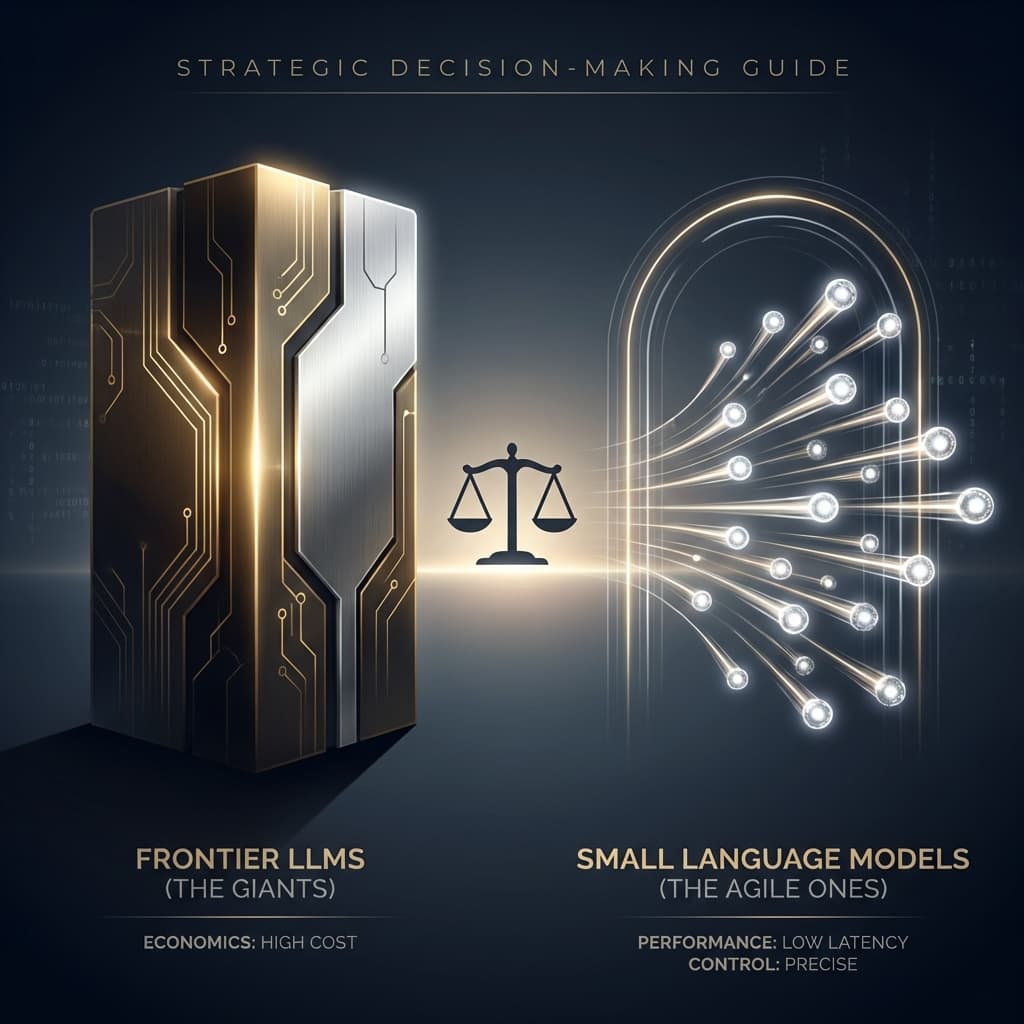
Small Models, Big Impact: Why Your Startup Shouldn’t Chase the Biggest LLM
Bigger isn't always better in the world of AI. Discover why small language models (SLMs) are becoming the secret weapon for startups looking for cost-efficiency, low latency, and total control.
In the early days of the AI boom (approx. 2023), the strategy for any startup was simple: Plug into the biggest model available.
If OpenAI released GPT-4, you used GPT-4. If Anthropic released Claude 3 Opus, you switched to Opus. The assumption was that "Intelligence" was a commodity you bought by the token, and the more parameters a model had, the better your product would be.
But as we settle into 2026, the "Frontier Model" obsession is starting to look like a trap for many startups.
Bigger models are smarter, yes. But they are also slower, more expensive, and—crucially—harder to control. For many use cases, using a frontier LLM is like hiring a Nobel Prize-winning physicist to calculate a 15% tip on a restaurant bill. It’s overkill, and you’re paying for it.
Welcome to the era of the Small Language Model (SLM).
Part 1: The Three Pillars of SLM Success
Why are founders moving away from "The Giants"? It comes down to three things: Cost, Latency, and Control.
1. The Economics of Survival (Cost)
Frontier models are expensive. If your product requires a lot of "chatter" between agents or processes thousands of documents a day, your API bill can quickly eat your margins.
- The Big Guys: $10 - $30 per million tokens.
- The Small Guys: $0.10 - $1.00 per million tokens (or free, if self-hosted).
For a startup, that 10x-100x difference in cost is the difference between being "Default Alive" and "Default Dead."
2. The Need for Speed (Latency)
A giant model has a lot of "thinking" to do. It has to pass your prompt through hundreds of billions of parameters. This takes time. If you are building an AI-powered code assistant or a real-time chat bot, a 5-second delay is a dealbreaker. Users want "Snappy." Small models can deliver responses in milliseconds because they can fit entirely on a single graphics card or even a modern laptop.
3. Owning the "Vibe" (Control)
When you use a frontier API, you are at the mercy of the provider. If they "update" the model to be more helpful, it might suddenly break your carefully crafted formatting. With a small, open-source model (like Llama-3-8B or Mistral), you can Fine-Tune it. You can train it to speak exactly in your brand’s voice, follow your specific JSON schema, or know your custom codebase like the back of its hand. You own the model. It doesn't change unless you change it.
Part 2: The Decision Tree – When to Go Big vs. Small
Founders often ask: "Is a small model smart enough to do [Task X]?" The answer is usually "Yes, if the task is narrow."
Use this simple decision tree for your next feature:
Route A: Use a Frontier API (The Giants)
- The Task: Highly creative writing, complex strategic reasoning, or "Zero-Shot" tasks where you have no examples of what the output should look like.
- Volume: Low. You only run this once an hour or once a day.
- Example: "Write a 5-year strategic plan for a global logistics company."
Route B: Use a Small Model (The Agile Ones)
- The Task: Classification, summarization, formatting text into JSON, or extracting data from a predictable document.
- Volume: High. You are processing thousands of rows of data per minute.
- Example: "Categorize these 5,000 customer feedback comments into 'Bug', 'Feature Request', or 'Compliment'."
Part 3: The Secret Weapon – Fine-Tuning
The "Magic" of small models isn't that they are smarter out of the box. It’s that they are Teachably Specialized.
Imagine you are building a tool for lawyers. A frontier model knows a little about the law, but it also knows a lot about recipes, space travel, and Taylor Swift lyrics.
A Fine-Tuned Small Model knows nothing about Taylor Swift. It has been trained on every legal brief in your state for the last 50 years. Because it has less "distraction" in its brain, it can actually outperform the giant model on legal tasks, while being 90% cheaper and faster.
Part 4: The Hardware Reality
One of the biggest shifts in 2026 is the rise of Local Execution. Startups are increasingly shipping models inside their apps.
- Apple Intelligence runs small models on your iPhone.
- Cursor runs small models on your laptop to predict your next line of code.
By running the model on the user's device, the startup pays $0 in server costs. This is the ultimate business model: Infinite scale at zero cost.
Conclusion: Don't Build on Sand
Choosing the biggest model is the easy choice, but it’s often the lazy choice.
If you are a startup in 2026, your competitive advantage isn't that you have "The Smartest Model." Everyone has access to that. Your advantage is how you orchestrate intelligence.
Build your prototype on the giants, but build your business on the small, the fast, and the specialized.
The "Start-Small" Checklist for Founders:
- Metric First: Measure the cost and latency of your current "Big Model" feature.
- Dataset Hunt: Collect 500 examples of perfect inputs and outputs from your app.
- The Test: Try a "Small" model (like Llama-3-8B) on those 500 examples.
- Fine-Tune: If the small model is 80% as good, fine-tune it. It will likely reach 95% accuracy and save you a fortune.
- Ship: Enjoy the margins.
Small models aren't a compromise. They are a strategy.