Sedai AI Agent Optimization Turns Model Routing Into an Enterprise Cost Control Layer
Sedai launched AI Agent Optimization for routing, observability, governance, and cost control across enterprise AI agents.
Sedai AI Agent Optimization Turns Model Routing Into an Enterprise Cost Control Layer
The expensive part of enterprise AI is no longer only the model call. It is the unmanaged decision about which model every agent should call next.
On June 9, 2026, Sedai launched AI Agent Optimization, an early-access platform that sits between enterprise agents and LLM providers to optimize cost, latency, accuracy, reliability, and governance. The announcement belongs in today’s Artificial Intelligence News because it shows where enterprise AI is moving after the first wave of chatbots: into operational systems that route models, police access, recover from agent mistakes, secure AI usage, or manage hybrid teams of human and software agents.
Sedai says the platform supports OpenAI, Anthropic, Vertex AI, Amazon Bedrock, and Azure Foundry-style environments; analyzes production traffic; groups queries by task; trains a custom AI judge on company feedback; and continuously reroutes work as models change. That mechanism is the center of the story. It is not enough to say a product uses generative AI. The important question is where the system sits, what it can observe, what it can change, how it is governed, and who has to explain the outcome when an autonomous workflow behaves badly.
This article uses Sedai launch announcement, AWS Bedrock Agents documentation, Vertex AI generative AI documentation and related primary references as the factual trail, then adds ShShell analysis for builders, buyers, operators, and learners. Vendor claims are treated as vendor claims unless backed by documentation, product mechanics, named capabilities, dates, figures, or operational constraints.
Source Trail
- Sedai launch announcement
- AWS Bedrock Agents documentation
- Vertex AI generative AI documentation
- Azure AI Foundry documentation
- OpenAI API platform docs
What Changed in the June 9 Announcement
On June 9, 2026, Sedai launched AI Agent Optimization, an early-access platform that sits between enterprise agents and LLM providers to optimize cost, latency, accuracy, reliability, and governance. The timing matters because enterprises are no longer experimenting with one isolated assistant. They are deploying agentic systems across support, security, engineering, analytics, finance, and operations. Those systems can read context, select tools, call APIs, update records, and trigger downstream work. That changes the risk model from content quality to operational control.
The specific shift is this: Sedai says the platform supports OpenAI, Anthropic, Vertex AI, Amazon Bedrock, and Azure Foundry-style environments; analyzes production traffic; groups queries by task; trains a custom AI judge on company feedback; and continuously reroutes work as models change. For readers tracking latest AI news, that is more meaningful than another broad promise about productivity. It describes the control layer around AI tools. If the control layer works, teams can scale useful systems with evidence. If it fails, they get shadow usage, runaway spend, weak audit trails, confused responsibility, and workflows that nobody can confidently unwind.
The company claims the average large enterprise now spends 11.6 million dollars annually on AI models, up from 4.5 million dollars in 2024, with some Fortune 500 companies exceeding 100 million dollars when cloud infrastructure is included. The number matters because it anchors the story in operational pressure. AI adoption is no longer a small experiment charged to an innovation budget. It is becoming a recurring infrastructure line, a security exposure, and a management system that affects how teams are staffed and how customer work is handled.
Who Is Directly Affected
The affected teams are platform engineering, finance operations, AI application teams, SREs, security reviewers, and business owners deploying many ai agents across products or internal workflows. These groups evaluate AI differently from casual users. A casual user may ask whether the answer is helpful. An operator asks whether the system is observable. A security leader asks whether actions are attributable. A finance leader asks whether cost is controlled. A compliance team asks whether the record can be reconstructed. A frontline manager asks whether service quality actually improved after AI took part in the workflow.
The announcement therefore changes the buying conversation. A buyer should not ask only whether the AI model is strong. The better question is whether the product gives the organization a repeatable operating model. That includes permissioning, telemetry, evaluation, escalation, data boundaries, and failure recovery. A product that cannot answer those questions may still be useful for low-risk drafts, but it is not ready to run critical work.
For learners using ShShell to Learn AI, this is the practical lesson. Prompt engineering matters, but enterprise AI success increasingly depends on systems engineering. The valuable skill is knowing how large language models, llms, connectors, policies, logs, evaluations, and human review fit together in a workflow.
How the System Works
The core mechanism can be read as a chain of responsibility. An AI agent or AI-enabled workflow receives context. The system decides whether the request is allowed, which tool or model should handle it, what evidence is available, what action should occur, and what record should be kept. At every link, the product can either add trust or hide risk.
Sedai says the platform supports OpenAI, Anthropic, Vertex AI, Amazon Bedrock, and Azure Foundry-style environments; analyzes production traffic; groups queries by task; trains a custom AI judge on company feedback; and continuously reroutes work as models change. The design is important because autonomous systems fail in ways ordinary software does not. They may choose the wrong source, call the wrong tool, misclassify a user’s intent, spend more tokens than expected, create a correct-looking but incomplete answer, or act before enough evidence exists. A good operating layer makes those failures visible before they become expensive.
In practical terms, the workflow should expose four signals. The first is intent: what the user, agent, or system tried to accomplish. The second is context: what data, identity, application, source, or customer record shaped the decision. The third is action: what the system actually did or attempted. The fourth is outcome: whether the work met the quality, safety, cost, and compliance threshold defined for that process.
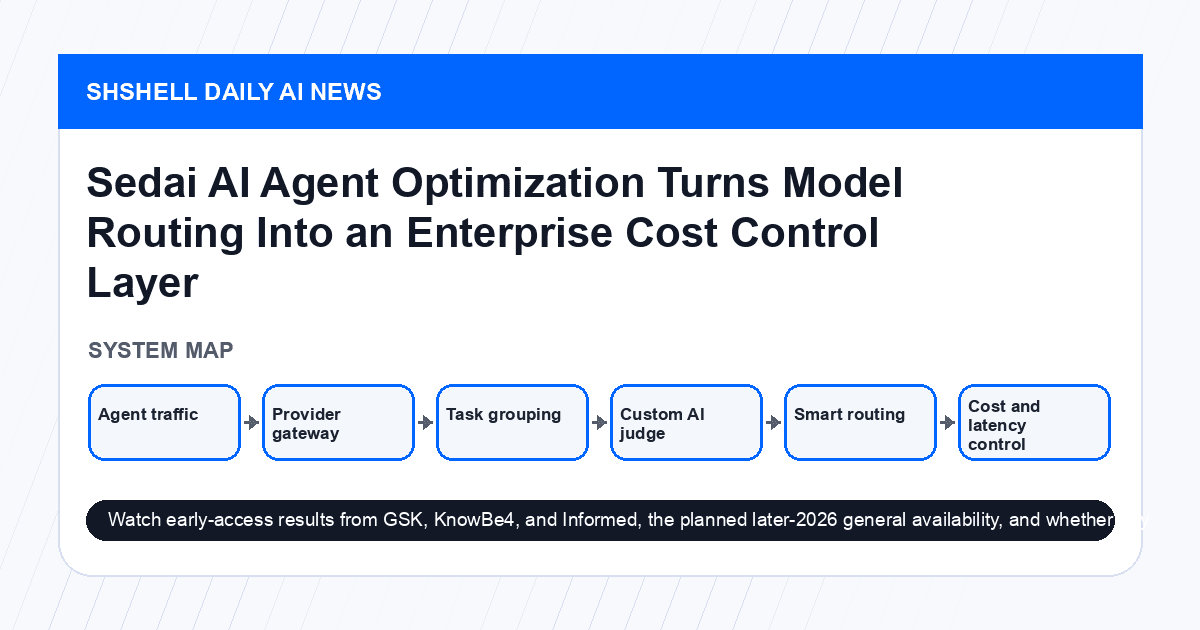
System Map
flowchart LR
    N0["Agent traffic"]
    N1["Provider gateway"]
    N2["Task grouping"]
    N3["Custom AI judge"]
    N4["Smart routing"]
    N5["Cost and latency control"]
    N0 --> N1
    N1 --> N2
    N2 --> N3
    N3 --> N4
    N4 --> N5
This map is narrow on purpose. It models this specific June 9 announcement instead of pretending every AI launch has the same architecture. The key point is that value comes from the handoffs. If the handoff from context to policy is weak, the system can make a confident decision with incomplete information. If the handoff from policy to action is weak, the system can execute outside its approved scope. If the handoff from action to audit is weak, the organization loses the ability to learn from mistakes.
Decision Table for Builders and Buyers
| Operating question | What changed | What to verify |
|---|---|---|
| Model selection | Automatic production-traffic routing | Manual model choice by each team |
| Evaluation | Company-specific AI judge plus feedback | Generic public benchmark only |
| Governance | Org and project-level access controls | Developer self-governance |
| Reliability | Retries, fallback, load balancing | Duplicated per-agent glue code |
The table is a starting point for evaluation. A buyer should push for concrete evidence in each row. Screenshots are not enough. Ask for sample traces, policy examples, exception handling, evaluation methods, rollback behavior, and how the system behaves when a provider, source, API, or identity signal fails.
Builders should treat the same table as an implementation checklist. A launch can be impressive and still fail if it depends on informal human discipline. Enterprise AI systems need controls that are enforced by architecture, not controls that are merely described in onboarding slides.
The Risk Surface
The risk is that automatic routing can optimize the wrong objective if evaluation data is weak, model quality judgments are opaque, or project-level policies are not connected to business risk. That risk is not theoretical. The last year of AI adoption has shown that users move faster than governance. They install browser extensions, connect agents to internal tools, copy sensitive text into assistants, let coding agents modify repositories, and ask automated support systems to resolve customer cases. Most of those actions are understandable. Many are useful. The problem is that usefulness does not remove the need for accountability.
The second risk is metric confusion. Teams may celebrate adoption, number of interactions, model calls, tickets handled, or conversations deflected while missing the harder question: did the system improve the real outcome? In customer operations, that outcome might be resolution quality. In security, it might be risk reduction. In model routing, it might be successful task cost rather than raw token price. In identity governance, it might be least privilege with low false positives. In cyber recovery, it might be verified reversibility rather than optimistic rollback language.
The third risk is vendor lock-in through telemetry. Once a platform becomes the source of logs, policies, and routing decisions, switching costs rise. That does not make the platform bad. It means buyers should understand export options, policy portability, and whether evidence can be inspected outside the vendor’s dashboard.
What Operators Should Test Before Scaling
Start with a shadow run. Let the system observe or recommend without taking final action. Compare its behavior against the existing process. Track false positives, false negatives, review time, escalation quality, cost, user trust, and the number of cases where humans had to reconstruct what happened.
Next, force edge cases. Feed the workflow ambiguous identities, unavailable models, stale sources, conflicting records, high-risk actions, noisy customer messages, unusual API responses, or policy exceptions. A system that handles happy-path demos may still break under routine operational messiness. The best ai agents are not the ones that always continue. They are the ones that know when to stop and ask for review.
Then create a rollback drill. If the system can make a change, the team should practice undoing it. If it can route a model call, the team should know how to override routing. If it can enforce access, the team should know how to investigate an incorrect block. If it can evaluate work, the team should know how to challenge the evaluation. If it can manage humans and AI agents together, managers should know when the AI workforce needs a separate quality review.
The Evidence Buyers Should Ask For
The first evidence request should be a live trace. A live trace should show the input, identity context, selected model or tool, policy decision, action taken, output, cost, latency, evaluation result, and final human review state. If the vendor can show only aggregate dashboards, the buyer still does not know whether the system can explain one bad case. Enterprise AI does not fail in averages. It fails in individual decisions that affect a customer, system, employee, or regulated record.
The second evidence request should be a policy example written in plain operational language. For Sedai AI Agent Optimization Turns Model Routing Into an Enterprise Cost Control Layer, the buyer should be able to describe a specific rule: which team can use which AI workflow, which data classes are excluded, which model providers are allowed, which actions require approval, which alerts are sent to security, and which exceptions are automatically blocked. If a policy cannot be explained without a specialist translating the dashboard, it will be hard to enforce under pressure.
The third evidence request should be a bad-case demonstration. Ask the vendor to show what happens when the source is unavailable, the model provider times out, the agent tries to exceed scope, a user asks for sensitive data, a coding assistant proposes a destructive change, or a customer interaction requires a human. This is where serious systems separate themselves from polished AI demos. The best answer is not always automation. Sometimes the best answer is a clear stop, a precise escalation, and a record that shows why the system refused to continue.
Buyers should also ask how the product learns. If the system improves from feedback, where is the feedback stored, who can see it, how is it protected, and can it accidentally encode bad organizational habits? If the product routes model calls, how often does it retest model performance and what happens when a new model looks cheaper but performs worse on a risky task? If the product evaluates people and AI agents together, how are fairness, consistency, and appeal handled?
Governance Details That Cannot Be Deferred
Governance is easiest to discuss before deployment and hardest to retrofit afterward. The minimum governance plan should include ownership, inventory, policy, review, retention, incident response, and cost controls. Ownership names the person accountable for the workflow. Inventory names the models, agents, tools, data sources, and connected systems. Policy defines allowed and blocked behavior. Review sets the quality bar. Retention defines what evidence is stored and for how long. Incident response defines who gets called when something goes wrong. Cost controls prevent usage from becoming invisible infrastructure spend.
The affected teams are platform engineering, finance operations, AI application teams, SREs, security reviewers, and business owners deploying many ai agents across products or internal workflows. should be in the room before rollout because each group sees a different failure mode. Security sees unauthorized access. Finance sees unbounded cost. Compliance sees missing evidence. Product sees broken user experience. Engineering sees brittle integrations. Business owners see workflow disruption. A strong launch gives each group enough visibility to do its job without turning AI adoption into a committee that blocks every experiment.
The policy should be action-specific. Reading a record is different from writing a record. Summarizing a customer conversation is different from resolving it. Routing an LLM call is different from fine-tuning a model on company feedback. Detecting AI usage is different from blocking it. Managing an AI agent in a workforce dashboard is different from assuming the agent has the same judgment profile as a trained employee. Action-specific governance prevents both under-control and over-control.
How This Fits the Agentic AI Stack
This story is one slice of a larger stack. At the bottom are models and inference providers. Above that are agent frameworks, memory, retrieval, tool connectors, and protocol layers such as MCP. Above that are gateways, observability systems, identity controls, data protection platforms, evaluation layers, and workforce systems. At the top are business workflows: customer support, cyber response, software delivery, finance operations, sales follow-up, research, and compliance review.
On June 9, 2026, Sedai launched AI Agent Optimization, an early-access platform that sits between enterprise agents and LLM providers to optimize cost, latency, accuracy, reliability, and governance. sits in the middle and top of that stack. It is not trying to be a new foundation model. It is trying to make deployed AI more manageable in a specific operational domain. That is why the announcement is relevant even for readers who do not buy the product. It reveals which pain points are becoming urgent enough for vendors to package: cost routing, shadow AI discovery, agent rollback, MCP enforcement, and hybrid workforce management.
For developers, the technical implication is straightforward. Build agents so they can be observed and controlled by these layers. Use stable identities for agents. Name tools clearly. Log tool calls. Capture model versions. Keep prompts and policy changes versioned. Separate read and write capabilities. Design human approval points deliberately. If an agent cannot be inspected, it will be harder to sell into serious environments.
For operators, the implication is equally direct. Do not let every team pick a different standard for AI logs, prompts, model routing, and approvals. The organization needs shared primitives. That does not mean one vendor must own everything. It means every deployed AI system should answer the same core questions: who initiated the work, what context was used, which tool acted, what changed, what did it cost, how was quality measured, and how can the outcome be challenged or undone?
What This Means for AI Training and Prompt Engineering
This story also changes how teams should train employees. AI training cannot stop at prompt templates. Workers need to understand source boundaries, data sensitivity, tool permission, confidence levels, and escalation paths. A good prompt can improve an answer, but a good workflow prevents the answer from becoming an unreviewed action with hidden consequences.
Prompt engineering still has a role. For this class of system, prompts should define task scope, cite approved sources, specify stop conditions, require uncertainty disclosure, and avoid turning policy exceptions into confident recommendations. The most useful ai prompts are not flashy. They are operationally precise.
For AI courses, this topic is a strong example of the difference between using a model and operating a system. A course should ask learners to map inputs, policies, tools, outputs, logs, and human review. That exercise is more valuable than asking learners to memorize the latest model names.
Competitive Implications
The competitive signal is that the AI stack is becoming layered. Model labs compete on capability. Cloud providers compete on runtime and procurement. Security vendors compete on visibility and enforcement. Observability vendors compete on traces and cost attribution. Contact center platforms compete on AI workforce management. Data-protection vendors compete on resilience and reversibility. Buyers increasingly need all of those layers, not one magical chatbot.
That fragmentation creates opportunity and risk. Specialized vendors can solve narrow problems better than a general model provider. But too many specialized tools can create a new governance problem where every team uses a different AI control plane. The practical path is to choose systems that integrate into existing identity, logging, incident, data, and finance workflows.
For startups, the lesson is clear: there is room to build around the operational pain created by AI adoption. For enterprises, the lesson is stricter: do not let every team invent its own answer to model routing, agent access, recovery, AI usage detection, or workforce quality.
What to Watch Next
Watch early-access results from GSK, KnowBe4, and Informed, the planned later-2026 general availability, and whether buyers demand production-traffic evaluation instead of benchmark-only model selection. The next few months will show whether this becomes durable infrastructure or another category label. The proof will come from boring evidence: lower successful-task cost, fewer untracked AI tools, faster but safer recovery, cleaner identity decisions, improved customer outcomes, and audit trails that hold up after something goes wrong.
The broader AI News Today takeaway is simple. Artificial intelligence is moving from interface to institution. The winners will not only generate better text. They will make AI work inspectable, governable, reversible, measurable, and useful inside real organizations.