Perplexity Trusts Astra With Production. Its Test Doubles Are the Real Story.
Perplexity’s Astra account shows the promise of generated service responses—and the production reliability questions simulations cannot settle.
Perplexity’s most revealing claim about GPT-6 Astra concerns the services it can impersonate. In an OpenAI customer case study published September 14, 2026, cofounder and chief strategy officer Johnny Ho describes asking the model to build small testing programs that generate responses resembling those from a language model API or connector. Those substitutes let an application run through a complete workflow under constructed conditions. For a search business, that is a consequential use of generated content: synthetic answers become instruments for checking the software that retrieves and assembles real answers. OpenAI’s Perplexity case study
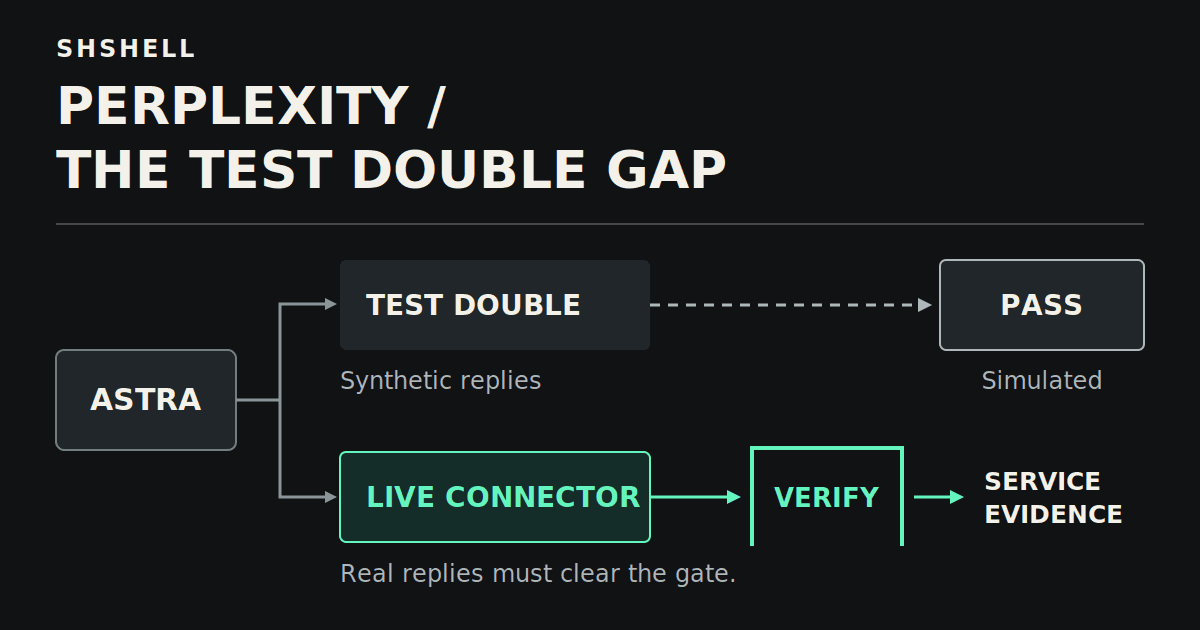
The production trust comes directly from Ho’s account. He says the model can help craft communications, edit real systems and monitor production software, adding: “We’re actually able to trust it with full end-to-end systems and check in on it much less frequently than previous generations of models.” The test doubles are the real story because they expose a concrete mechanism beneath that broad confidence. They also establish its limits. A workflow completed against generated service responses demonstrates behavior inside a constructed environment; it does not establish that live connectors, changing web pages or production infrastructure behave as assumed. OpenAI publishes this customer testimony, without independent measurements of reliability or supervision frequency. OpenAI’s account
The service substitute defines what “end-to-end” covers
Ho’s account is specific about the testing approach and sparse about its implementation. Astra builds a program around an application, generates realistic responses from substitute services and checks the resulting workflow. The case study does not identify the connectors, show the generated tests or explain which dependencies remain live. That leaves the testing boundary as the essential question. An application can execute from its initial request to its final output while a critical external dependency has been replaced. The execution is complete across the chosen boundary, but the evidence remains conditional on the replacement’s accuracy.
Martin Fowler’s “Mocks Aren’t Stubs,” dated January 2, 2007, provides useful vocabulary. Following Gerard Meszaros, Fowler uses “test double” for a substitute object used during testing. Stubs supply programmed answers; fakes have working implementations with shortcuts; mocks carry expectations about interactions. These categories describe what the substitute does, rather than how convincing its output appears. Ho’s description supports calling Astra’s generated service substitutes test doubles or response simulators. It does not establish that they are mocks in Fowler’s narrower sense. Fowler’s definitions
That distinction matters for a search connector. A simulator that returns a plausible list of documents can test whether downstream code parses the list, preserves source identifiers and produces an answer. A substitute that also checks the incoming request can test whether the application sent the intended domain restriction or regional setting. Merely returning the expected documents cannot establish that those controls were transmitted correctly. The test may succeed even when the application asks the wrong question, because its simulated service supplies the right answer regardless.
Generated responses can make difficult cases easier to construct. A testing program can present missing snippets, contradictory source passages, empty results or a connector failure at a chosen point in a workflow. These are proposed applications of the method, not disclosed Perplexity test cases. Their value lies in making application behavior observable under conditions that would otherwise be awkward to reproduce. A carefully designed substitute can deliberately be less pleasant than the real service usually is.
The corresponding weakness is shared assumptions. If the model writes a connector adapter and invents the responses used to validate that adapter, it may reproduce the same misunderstanding in both places. Agreement between implementation and simulation then looks like correctness. The remedy is to anchor expected behavior in independently specified interface contracts and product requirements. The simulator should express those requirements, with review focused on where its assumptions enter the test. Fowler’s distinction between checking state and checking interactions helps explain why a convincing response alone cannot carry the whole assurance burden. Fowler on verification
Search correctness begins before the answer is written
Perplexity’s public interfaces make the testing problem more concrete, without revealing its internal architecture. The Search API documentation describes real-time, ranked web results returned as structured data, with controls for domains, languages, regions and extracted content. It distinguishes those raw results from an LLM-generated answer with citations, for which it directs developers to the Agent API. These are separate product surfaces with different meanings of success. They provide relevant examples of connector behavior, but the case study does not say Astra tested these particular APIs. Perplexity Search API quickstart
For raw search, preserving the structure of a response is only the beginning. An integration may parse every field successfully while losing the ordering that expresses relevance. It may retain a URL but pair it with another result’s snippet. It may pass a country setting incorrectly or apply a domain restriction after retrieval in a way that changes the intended behavior. A simulator can expose such application defects if it includes distinguishable results and verifies the relevant requests. A collection of interchangeable, polished examples gives the test little leverage.
The Agent API adds another layer. Its documentation describes web-grounded answers, inline citations, conversation context and access to multiple model providers through a unified interface. Its examples include separate output items for search results, fetched content and generated messages. They also document an output_text convenience property that aggregates text. That convenience is useful to a caller, but a test that checks only the final string can overlook errors in the relationship between retrieved material and the answer built from it. Perplexity Agent API quickstart
Hypothetical example: an enterprise research application asks for a supplier’s current support policy, restricted to that supplier’s domain. A generated response contains an older policy page and its replacement, with different titles, URLs and passages. The application must preserve those associations, recognize that the passages conflict and avoid attaching the replacement’s citation to the older policy’s terms. The test should also check that the outgoing request includes the intended domain restriction. This would examine a meaningful chain from query construction through evidence handling to answer presentation.
Even a passing result would leave unanswered whether the live search service finds the replacement page, ranks it usefully or extracts the relevant paragraph. Those questions concern the real retrieval service and the changing source material. The distinction is commercially significant because the customer experiences the assembled answer. Responsibility for a wrong answer cannot be understood merely by observing that the final language model produced fluent prose.
A useful testing strategy therefore preserves intermediate meaning. Search results should remain identifiable as they move into fetched excerpts and generated answers. Tests should be able to distinguish retrieval absence, extraction failure and unsupported synthesis. Perplexity’s documented separation between raw results and generated answers provides a practical reason to keep these outcomes separate, even when the user sees them through one interface. Search API documentation
Freshness cannot be manufactured into evidence
Freshness is where realistic simulation most clearly diverges from real validation. Perplexity describes its Search API as returning real-time results, and its documentation’s example responses contain both date and last_updated fields. These fields give an application information to process, but their presence alone cannot establish that the returned passage reflects the latest substantive state of a source. The quickstart does not fully define the temporal guarantees those fields carry. An assurance claim should not silently supply that missing definition. Perplexity Search API
Several separate questions sit inside a request for “current” information. When was the underlying document published? When did its relevant content change? When did the retrieval service observe that content? When did the application obtain its response? When did it construct the answer? A test double can assign values representing these events and check how the application handles them. It cannot establish when the real events occurred. Generating a recent timestamp creates a scenario for testing freshness logic, rather than proof of fresh retrieval.
Hypothetical example: a company maintains a public service-status page. During a controlled validation exercise, its owner changes a designated test notice from “maintenance planned” to “maintenance complete.” A simulator can supply both versions and test whether the application invalidates an older answer when newer evidence arrives. A live probe must separately establish whether the retrieval path discovers the changed notice and whether the answer actually reflects it. The simulator’s successful transition says nothing about an upstream cache that continues returning the older passage.
This example also shows why a fixed expected answer is an awkward production monitor for search. A legitimate source update can make yesterday’s expected answer wrong. The monitor needs an authoritative observation of the test source and an explicit rule about acceptable delay. Otherwise it can mistake healthy change for a defect or certify stale output because its own reference has become stale. The business must choose that delay according to the use case; the public sources establish no Perplexity freshness target.
A response library has a related maintenance problem. Stable fixtures are valuable because they reproduce known conditions, but live services evolve. The answer is not to rewrite every fixture whenever the web changes. Historical cases should remain available to prevent old defects from returning, while separate checks compare current service behavior with the assumptions encoded in those cases. A fresh sample and a durable regression case serve different purposes.
For enterprise buyers, freshness should consequently appear as a distinct reliability commitment. A searchable archive, an operational status assistant and a research tool for changing commercial terms can tolerate different delays. Labeling every successful request “available” conceals those differences. Perplexity’s public emphasis on real-time retrieval makes freshness a product concern, while the simulator offers a way to test the application’s response to stale evidence. Actual freshness still requires observation outside that simulator.
A successful connector call can contain failed work
Perplexity’s public CLI skill provides an unusually concrete example of a failure that broad success checks can miss. It describes content snippets as returning a result for each requested URL and instructs callers to inspect each result’s error. A successful command exit means the request succeeded; individual URLs may still have failed and contain no text. This is documented interface behavior, not evidence of an incident. It is also exactly the kind of distinction a response simulator can make visible. Perplexity’s CLI skill
Hypothetical example: an internal research assistant requests excerpts from a product manual and a related correction notice. The connector request succeeds, the manual returns text, and the correction notice returns an individual error. An inadequate test supplies text for both pages and checks only that an answer exists. A stronger generated case preserves the successful outer response while making the correction unavailable. The expected behavior could be to disclose incomplete evidence, retry within an established policy or stop short of a definitive answer. The product owner must decide which outcome is appropriate.
This failure differs from stale retrieval. The application has explicit evidence that part of its work did not complete, and the defect lies in ignoring that evidence. It also differs from a completely failed request, which may trigger a standard error path. Treating partial completion as a distinct state helps test whether a search application communicates uncertainty honestly rather than converting missing evidence into confident language.
The same CLI document specifies that failures use a different process exit and put an error object on standard error, while successful output uses standard output. It also explains that combining a recency filter with date bounds is rejected by the server. A simulator aimed only at response bodies could miss both process-level error handling and whether requests are valid before useful results arrive. The appropriate testing boundary depends on whether the application calls an SDK, an HTTP endpoint or a terminal command. CLI output and error contract
These distinctions suggest a more valuable measure of a generated test suite than its size: whether it covers materially different meanings of failure. Authentication failure, invalid search controls, missing page content and a successful answer based on incomplete evidence require different responses. Combining them under a generic connector-error case can leave important behavior unexamined.
The simulator must also behave consistently with the scenario. If it claims a URL failed while still supplying the expected passage, the application can appear resilient because the substitute quietly repairs the failure. A model capable of generating realistic language may be tempted toward coherent completion. Test construction needs the opposite discipline in selected cases: preserve the missing information, the contradiction or the interruption so the application must actually handle it.
Monitoring must look through the real search path
Ho explicitly includes production monitoring among Astra’s uses, but OpenAI’s case study does not describe what the model observes or how alerts reach people. The relevant distinction comes from Google’s “Monitoring Distributed Systems” chapter: black-box monitoring tests externally visible behavior as a user would see it, while white-box monitoring uses internal metrics and instrumentation. For Perplexity’s search context, this means that checking an agent’s activity or a connector’s response status is not equivalent to checking the answer a customer receives. Google SRE monitoring guidance
The following diagram presents an assurance design implied by those distinctions. It is an analytical proposal, not a depiction of Perplexity’s disclosed implementation.
flowchart TD
    A["Astra-generated service responses"] --> B["Application workflow test"]
    B --> C["Evidence of handling constructed cases"]
    D["Controlled search query"] --> E["Live connector and retrieval path"]
    E --> F["Answer and citation checks"]
    F --> G["Evidence of observed user behavior"]
    E --> H["Request traces and service metrics"]
    C --> I["Reliability owner reviews evidence"]
    G --> I
    H --> I
A useful black-box probe for search would exercise the real route to a meaningful output. It might check whether a controlled document can be retrieved, whether its distinguishing passage reaches the answer and whether the citation points back to the intended source. The expectations should be narrow enough to judge reliably. Asking a model whether another answer “looks good” produces a much less precise operational signal than checking that a designated source update appears in a response.
Google’s chapter explicitly recognizes that a successful HTTP response can still carry wrong content. It also identifies latency, traffic, errors and saturation as core monitoring signals. Search assurance needs those operational measures, with content checks addressing failures they cannot express. An answer may arrive quickly and still omit the only source that changes the conclusion. Conversely, a semantically correct answer may arrive too late to meet the customer’s operational need. Google on errors and monitoring signals
Internal traces help investigate the difference. OpenTelemetry describes traces as correlated spans representing a request’s path across operations and services, with timestamps, attributes and events. Applied to a search workflow, instrumentation could connect query construction, connector calls, excerpt retrieval and answer generation. This would help locate where a failed probe diverged from expectations. It would not itself establish that a retrieved passage is true or current. The documentation’s January 14, 2026 modification date concerns that page; it is not a release date for this proposed monitoring design. OpenTelemetry traces documentation
The business benefit of fewer manual check-ins depends on this distinction. A person can stop watching routine activity when meaningful failures reliably demand attention. Google’s guidance emphasizes actionable, understandable alerts and warns about noise that causes people to ignore pages. Astra may assist with diagnosis or explanations, but the escalation condition should remain intelligible without trusting its narrative. For a search product, “the controlled source changed and the answer still presents the old state” is a stronger operational statement than “the agent reports that monitoring completed successfully.”
Production exposes conditions a simulator has not observed
Google’s canarying guidance defines a canary as a partial, time-limited deployment evaluated before a wider rollout. Its rationale directly addresses the limit of generated service responses: test environments do not fully match production, and some release defects become visible only under real traffic. The chapter identifies changes to dependencies, configuration and underlying components as possible causes of failure. That is a separate body of engineering guidance, not evidence that Perplexity uses canaries for Astra-generated changes. Google SRE on canarying releases
For a search connector, real execution can reveal an expired credential, a network route problem, an upstream interface change or a response pattern absent from the simulator. Shared load can expose queueing and contention that an isolated program does not reproduce. A simulator can deliberately model these classes once they are specified, but its ability to enact a hypothetical failure does not show whether that failure exists in the deployed environment. Observation and construction answer different questions.
Canaries have limits of their own. A deployment evaluation that includes only ordinary web queries may reveal little about a specialized connector. A short observation period may miss behavior associated with a recurring refresh or a different traffic pattern. Google’s guidance stresses that population, duration, traffic and chosen metrics determine how representative an evaluation is. For search, that implies examining which query types and retrieval paths actually reached the candidate version. A clean aggregate result can conceal an unexercised path. Google on representative canaries
There is also no reason to treat model behavior as the sole moving part. OpenAI’s separate Agents API announcement describes a hosted harness that manages context, tools, environments and subagents, including automatic compaction and versioned access to harness capabilities. The Perplexity case study does not establish that Perplexity uses that API. The announcement nevertheless illustrates why an agent’s effective behavior can depend on orchestration infrastructure as well as its model. OpenAI’s Agents API announcement
That has a practical consequence for interpreting test results. A response simulator exercised through one tool configuration or runtime environment may not cover another. A change in context management could affect whether an agent retains a constraint across a long task. A change in connector configuration could affect which sources it can reach. Reviewing only the generated application code would miss these possible differences.
The useful release record therefore connects the software change to the conditions under which it was evaluated: which dependencies were substituted, which were live, which configurations were used and which user-visible behaviors were checked. This need not become an elaborate documentary ritual. It is the minimum context required to understand why a passing test should influence a release decision, and where production observation must supply additional evidence.
Untrusted passages require deliberately unhelpful doubles
Search connectors carry material the application did not author. That makes hostile content a distinct testing concern alongside stale pages and partial failures. The archived OWASP project page labels its displayed list as the historical 2023 version and identifies a separate current release published August 4, 2026. The archived descriptions identify prompt injection, insecure output handling and excessive agency as application risks. Those descriptions support the threat categories; they should not be presented as the wording or ordering of the current release. OWASP project archive and release notice
A generated search result can contain a passage that looks relevant while instructing the application to disregard the user’s source restriction or disclose unrelated information. Such a fixture tests whether the downstream system treats retrieved text as evidence or as authority. This is different from checking factual accuracy. The passage might quote correct facts and still contain an instruction that should have no operational standing.
A realistic simulator may be particularly useful here because hostile instructions can be embedded within ordinary page structure, excerpts or connector messages. Yet the expected result must be specified outside the hostile text. Otherwise the test risks allowing the same generated content to define both the challenge and what counts as success. The important property is whether the application preserves its established task boundaries while processing untrusted material.
OpenAI’s Astra safety overview reports stronger robustness against prompt injection and describes broader misalignment monitoring for tool-using inference. These are vendor claims about the model and its deployment, not independent findings about Perplexity’s connector integrations. The same overview reports limits to chain-of-thought monitorability under adversarial conditions and argues for auditing techniques beyond examining internal reasoning. That supports using observable actions and outputs as assurance evidence without inferring misconduct in Perplexity’s deployment. OpenAI’s Astra safety overview
For this newsroom analysis, the relevant question is narrower than whether Astra is broadly safe: can a search application demonstrate that retrieved content did not redirect its behavior? A test can examine the requests made, the sources used and the information emitted. Production monitoring can look for corresponding observable violations. Neither requires assuming that an explanation generated by the model fully accounts for its behavior.
The case study does not disclose deployment permissions, authorization controls or the scope of production editing. Ho’s statement about editing real systems cannot fill in those details. Enterprise assurance should keep the two questions separate: whether a model can help produce and test a change, and what operational authority the deployed system actually has. Response simulators illuminate the former and can test specified boundaries; they do not establish the latter by themselves.
Reliability belongs to the business promise
Perplexity’s case study links improvements in coding to improvements in its search engine. Ho says better models can write better programs to search web and internal information and summarize it concisely. That provides the commercial rationale for generated testing: the same capability used to change information workflows can help examine their behavior. The customer account supports that mechanism and Ho’s expressed confidence. It supplies no error-rate series, cost savings or measured reduction in supervision. OpenAI’s customer testimony
The opportunity is to move more engineering attention toward difficult interface cases. If constructing a response simulator becomes easier, a team can spend more effort deciding what the application should do when evidence is missing, stale, contradictory or hostile. That is a plausible business advantage rather than a measured Perplexity outcome. Its value depends on whether the resulting tests reveal defects that matter to customers, not simply whether the model produces more test material.
Those decisions require business ownership. Engineering can identify that a connector returned incomplete evidence. A product owner must decide whether the service should answer with a limitation, offer a retry or decline to complete the task. A reliability owner must decide when repeated incomplete answers warrant operational intervention. Customer-facing teams need language that distinguishes a temporary retrieval problem from an unsupported conclusion. These responsibilities remain even when Astra drafts the implementation, generates the scenarios and helps interpret monitoring data.
Google’s canarying guidance ties release velocity to explicit reliability goals and emphasizes metrics that indicate user-perceivable problems. Applied here, that means a release evaluation should reflect the product’s promise: usable retrieval, appropriate freshness, preserved source relationships and honest treatment of missing evidence. An application that returns polished text for every request can still fail that promise. A temporary, clearly explained inability to answer may satisfy it better than an unsupported assertion. Google on release evaluation and reliability goals
The next persuasive evidence from Perplexity would be a worked connector example showing where Astra’s simulator caught an application defect, which behavior was checked against the live service, and which remaining failure became observable through production monitoring. It should identify the owner of the resulting reliability decision. That would turn “trust with end-to-end systems” into an assessable account of how generated responses improve assurance—and exactly where the real system still has to speak for itself.