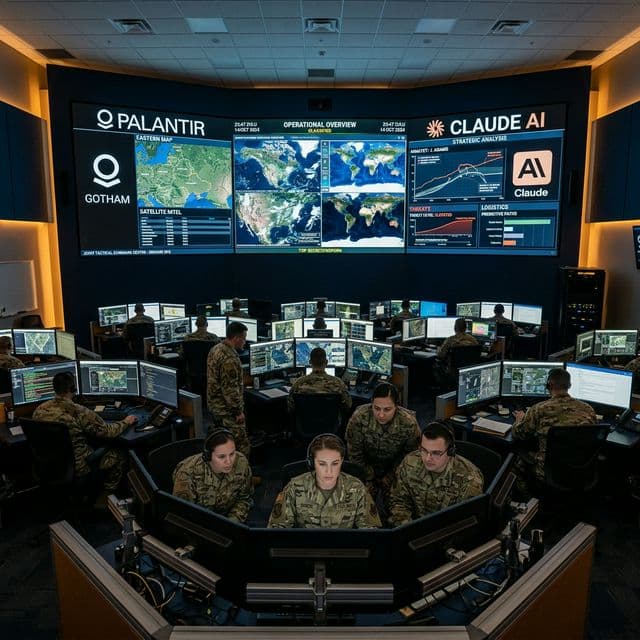
National Security AI: Palantir Integrates Claude for Mission-Critical Logic
Palantir (PLTR) expands its National Security portfolio with a deep integration of Anthropic's Claude 4.6 for tactical planning and high-security analysis.
National Security AI: Palantir Integrates Claude for Mission-Critical Logic
DENVER, CO — On March 25, 2026, Palantir Technologies (NYSE: PLTR) announced a landmark expansion of its Artificial Intelligence Platform (AIP), codenamed Operation Aegis, featuring a deep, kernel-level integration with Anthropic's Claude 4.6. This strategic partnership marks the first time a "high-reasoning" Large Language Model (LLM) has been fully embedded within an air-gapped, IL6-certified environment for National Security and Tactical Planning operations.
The integration, which Palantir CEO Alex Karp described as "the missing reasoning layer for modern defense," seeks to move beyond mere data visualization into the realm of Agentic Strategic Synthesis. By combining Palantir’s unparalleled data ontological foundations with Claude’s superior reasoning capabilities, the platform can now simulate complex geopolitical outcomes and tactical maneuvers with a degree of nuance previously reserved for human staff officers.
Executive Summary: The 5 Ws and H of Operation Aegis
- Who: Palantir Technologies, in exclusive partnership with Anthropic (with AWS providing the secure, localized compute infrastructure).
- What: A deep integration of Claude 4.6 into Palantir AIP, specialized for defense, intelligence, and high-stakes government operations.
- When: Announced March 25, 2026; immediate rollout to early-access partners in the DOD and Five Eyes intelligence community.
- Where: Deployed within Palantir’s FedRAMP High and Impact Level 6 (IL6) cloud environments, ensuring complete data sovereignty.
- Why: To provide military and intelligence commanders with "Reasoning Agents" that can synthesize millions of telemetry points into actionable, logical strategic options in seconds.
- How: Through a proprietary "Secure Reasoning Tunnel" that allows Claude to process sensitive data without the information ever leaving the secure Palantir environment.
The Reasoning Kernel: How Palantir and Claude Collaborate
In the previous generation of defense tech, systems were reactive: they showed what happened. Under Operation Aegis, the system is proactive: it explains why it might happen and how to respond.
graph LR
    subgraph "Palantir Data Foundation"
        D1[Satellite Imagery] --> O[Ontology Layer]
        D2[SIGINT / Signals] --> O
        D3[Geopolitical Feeds] --> O
    end

    subgraph "Claude 4.6 Reasoning Engine"
        R1[Logic Synthesis]
        R2[Scenario Simulation]
        R3[Tactical Drafting]
    end

    O -->|Secure Context| R1
    R1 --> R2
    R2 --> R3
    R3 -->|Actionable Output| U[Field Commander]

    style O fill:#2c3e50,color:#fff
    style R1 fill:#e67e22,color:#fff
    style U fill:#27ae60,color:#fff
Deep Dive: Tactical Game Theory and Mission Synthesis
1. Dynamic Mission Briefings (DMB)
Under the new integration, the manual process of "Intelligence Synthesis"—which typically takes hours for human analysts—is reduced to seconds. Claude 4.6 can ingest raw signal data, drone telemetry, and human intelligence (HUMINT) reports, then generate a tiered briefing based on the rank and requirements of the viewer.
"A Lieutenant in the field needs a different tactical summary than a General in a SCIF," says Palantir’s Head of Defense. "Claude understands context, not just keywords. It knows that a 20% increase in adversary supply chain activity in Sector 7 implies a potential offensive in 48 hours."
2. Tactical Game Theory: Simulating the Adversary
One of the most potent features of Aegis is its ability to perform "Red Team" simulations. Analysts can ask the system: "Given our current troop positions and the adversary's recent moves, what are the three most likely counter-responses if we deploy the 101st Airborne to this coordinate?"
Claude 4.6 then runs thousands of simulations based on historical military doctrine and current real-world constraints, providing a probabilistic outcome for each.
3. Hardware-to-Model Secure Tunneling
Security remains the primary hurdle for AI in defense. The Palantir-Anthropic partnership utilizes Zero-Knowledge Model Processing. The sensitive military data is processed in a localized "sandbox" where the model (Claude) resides, but the model's core weights and the user's data are never stored together permanently, and no data is sent back to Anthropic for "training."
Technical Implementation: Deploying a Reasoning Agent
Defense tech professionals using Palantir AIP can now instantiate "Reasoning Agents" for specific mission sets. Below is a conceptual implementation of how an analyst might configure an agent to monitor for "Security Anomalies" using the new Claude-integrated AIP logic.
Step-by-Step Configuration:
- Define the Data Bounds: Select the specific ontology objects (e.g., 'Supply_Lines', 'Adversary_Movement').
- Assign the Reasoning Prompt: Instruct Claude on the specific military doctrine to apply.
- Establish Verification Gates: Set mandatory human-in-the-loop (HITL) review for high-impact recommendations.
# Conceptual AIP logic for a SecOps Reasoning Agent
import palantir_aip_integration as aip

def initialize_tactical_agent(mission_id):
    # Setup mission context from Palantir Ontology
    mission_context = aip.get_ontology_state(mission_id)

    # Initialize Claude 4.6 as the Reasoning Kernel
    agent = aip.Agent(model="claude-4.6-high-security", context=mission_context)

    # Define a complex query for strategic synthesis
    query = """
    Perform a multi-vector analysis of current supply chain logistics.
    Identify the single point of failure most likely to be targeted by
    an asymmetric adversary in the next 72 hours.
    """

    # Execute the reasoning task
    strategic_report = agent.reason(query)
    return strategic_report

# Example execution by a SecOps analyst
# report = initialize_tactical_agent("OP_POLAR_BEAR_24")
# print(f"Primary Vulnerability: {report.vulnerability_id}")
Market Implications: PLTR Stock and Defense Dominance
Bloomberg analysts have noted that this move makes Palantir's moat "nearly unassailable" in the government sector. Microsoft and C3.ai have struggled to match the deep integration Palantir has achieved with frontline military hardware.
"This is a 'winner-take-all' dynamic," says senior market analyst Sarah Jenkins. "By owning the data ontology and the reasoning kernel, Palantir is becoming the OS for modern warfare. The stock market is beginning to price in a future where Palantir is as essential to the Pentagon as Lockheed or Boeing, but with much higher margins."
Ethical Considerations: The "Kill Chain" and AI
The integration of high-reasoning models into defense leads to inevitable questions about the AI Kill Chain. To address this, Palantir and Anthropic have implemented a strict "Human-Centric Decision Boundary." Claude 4.6 is configured to provide options and analysis, but the platform is programmatically barred from executing lethal actions without explicit, multi-factor human authorization.
"We are building tools that make humans smarter and faster, not tools that replace human judgment and accountability," Karp emphasized during the launch event.
Conclusion: The Era of Persistent Tactical Intelligence
The Palantir-Claude integration represents a seismic shift in national security. As we move into an era of "Persistent Tactical Intelligence," the nations that can best harness the reasoning capabilities of AI will be the ones that define global stability in the late 2020s.
For defense contractors and government agencies looking to leverage this new capability, Palantir has announced a series of "AIP Bootcamps" focused specifically on Agentic National Security Design, beginning in April 2026.
FAQ: Palantir Claude Integration
Q: Does Claude 4.6 see classified data? A: Yes, if the deployment is within an IL6 environment. However, the data remains within the government-controlled Palantir instance and is never sent to Anthropic's public servers.
Q: Is this the same Claude I use for writing emails? A: No. This is a specialized, air-gapped version of Claude 4.6 with custom "Defense Guardrails" and higher-performance reasoning kernels.
Q: How does this affect Palantir's commercial clients? A: While launched for defense, Palantir plans to roll out similar "Reasoning Kernel" updates for enterprise sectors like Finance and Energy by Q3 2026.