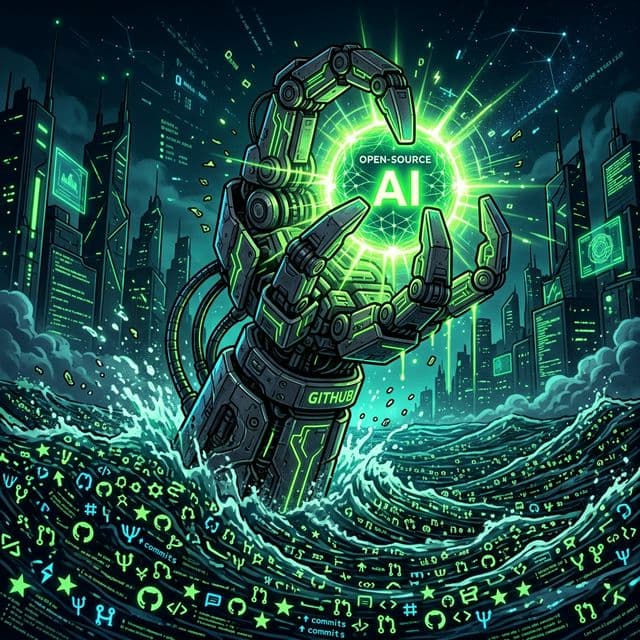
OpenClaw: Decoding the Fastest Growing Open-Source Project in GitHub History
With over 210,000 stars in just months, OpenClaw has become the gold standard for local-first AI assistants, bridging the gap between proprietary models and sovereign user data.
OpenClaw: Decoding the Fastest Growing Open-Source Project in GitHub History
In the world of software development, velocity is the ultimate metric. On March 24, 2026, the tech community is rallying around a project that has shattered every record for organic adoption: OpenClaw.
Started as a passion project for local-first desktop automation, OpenClaw has crossed 210,000 GitHub stars faster than Linux, React, or VS Code. This isn't just another AI wrapper; it is the infrastructure for the Sovereign Agentic Era.
What Makes OpenClaw Different?
While OpenAI and Anthropic build increasingly powerful "Clouds," OpenClaw builds a personal "Vault." Its primary appeal lies in three architectural breakthroughs that proprietary providers cannot easily replicate.
1. The Local-First Inference Bridge
OpenClaw doesn't require a constant connection to a massive server. Instead, it uses a highly optimized Hybrid Inference Engine that runs lightweight reasoning (Llama 4-Lite or Phi-4) on your local laptop to handle UI/UX tasks, while only sending complex semantic logic to the cloud when necessary.
2. The "Self-Writing" Skillset
The most viral feature of OpenClaw is its ability to write its own integrations. If you want OpenClaw to control a niche project management tool that doesn't have an official plugin, you simply point OpenClaw at the tool's documentation. The assistant generates the necessary Python or TypeScript bridge code, tests it in a sandbox, and adds a new "Skill" to its library automatically.
3. Total Data Sovereignty
In an era of corporate AI scraping, OpenClaw is the definitive counter-movement. It operates on a Zero-Exfiltration Policy. Your context, your files, and your keystrokes never leave your machine unless you explicitly authorize an outbound API call.
Mapping the OpenClaw Ecosystem
The architecture is designed as a "Multi-Integrative Hub" where the AI sits at the center of your local OS environment.
graph LR
    subgraph "Local User Machine"
    U[User Intent] --> OC{OpenClaw Core}
    OC -->|Local LLM| S[Skill Engine]
    OC -->|Visual Logic| D[Desktop Control]
    S --> L1[File System]
    S --> L2[Browser CLI]
    S --> L3[Custom App Bridges]
    end

    OC -.->|Optional Heavy Reasoning| C[DeepSeek/GPT-5/Claude]

    style OC fill:#22c55e,stroke:#333,color:#fff
    style S fill:#333,stroke:#22c55e,color:#fff
The "Peter Steinberger" Factor and The Foundation Move
The project's explosion is closely tied to its creator, Peter Steinberger, who recently announced his move to OpenAI. To ensure the project's longevity and neutrality, OpenClaw is transitioning into the OpenClaw Foundation.
"Open source is the only way we avoid an 'AI Dark Age' where a few small groups control all the world's functional intelligence," Steinberger noted in his final commit message before the transition.
Adoption Stats: Mar 2026
- GitHub Stars: 214,802
- Active Contributors: 3,400+
- Third-Party Integrations: 500+
- Mainstream Usage: 12% of Fortune 500 engineering teams have approved OpenClaw for local use.
Frequently Asked Questions (FAQ)
Can I run it on a normal laptop?
Yes. Thanks to 2026-era NPU (Neural Processing Unit) acceleration in the latest Mac and Intel chips, OpenClaw runs smoothly on any machine with at least 16GB of RAM and a modern AI processor.
Does it compete with Claude's 'Computer Use'?
Indirectly. While Claude is more capable at "Broad Reasoning," OpenClaw is faster and more reliable for "System-Level Tasks" because it runs natively on your machine, reducing the latency inherent in cloud-based visual automation.
How do I install it?
Commonly installed via a simple CLI command: npx openclaw init. It automatically detects your installed applications and proposes a set of starting skills based on your workflow.
Conclusion: The Power of Community Code
OpenClaw is a testament to the fact that in 2026, the most powerful "Agent" isn't just an algorithm—it’s a community. By giving developers the tools to build their own local assistants without compromising privacy, OpenClaw has become the default operating system for the next generation of knowledge workers. The claw is out, and it’s grabbing the future of open source.
Open source analysis by Sudeep Devkota. Data sourced from GitHub Pulse and the Q1 2026 Octoverse Snapshot.