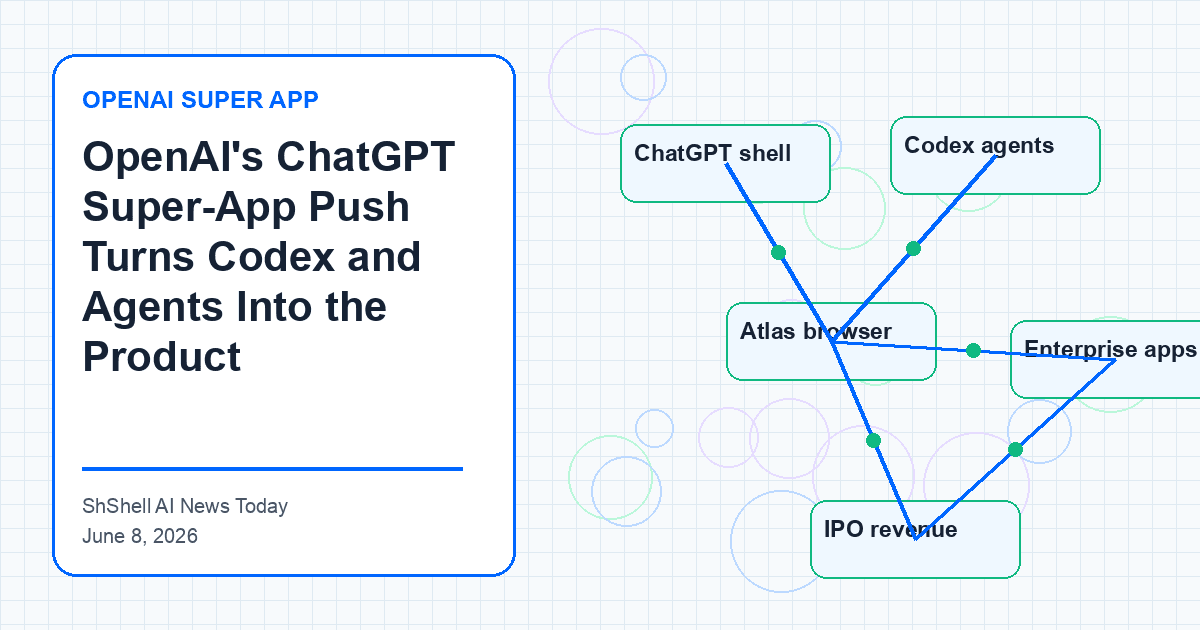
OpenAI's ChatGPT Super-App Push Turns Codex and Agents Into the Product
OpenAI's reported ChatGPT super-app overhaul makes Codex, agents, and enterprise revenue the center of today's latest AI news.
OpenAI's ChatGPT Super-App Push Turns Codex and Agents Into the Product
OpenAI's next product fight is not another model-picker dropdown. It is the question of whether ChatGPT becomes the operating surface where coding agents, browser context, app actions, and enterprise workflows converge.
Source trail
- Reuters via Investing.com — reported on June 7 that OpenAI is planning a major ChatGPT overhaul into a super-app with coding tools and AI agents, while noting Reuters could not independently verify the FT report.
- OpenAI Help Center — documents Codex in ChatGPT mobile, live host context, model retirement dates, app actions, and model-picker changes that make the reported consolidation more plausible.
- TechCrunch — summarized the FT report and framed the expected product as a revamped ChatGPT experience arriving in the coming weeks.
This article uses those sources as the factual base and adds ShShell analysis for builders, buyers, operators, and learners following latest AI news. Reported plans are identified as reports rather than confirmed launches.
Ten source-grounded facts that anchor the story
- Reuters said the Financial Times report described the planned redesign as OpenAI's biggest ChatGPT overhaul yet.
- The reported goal is a super-app that combines coding tools and AI agents to support revenue growth before a potential listing.
- OpenAI's release notes already show Codex moving into ChatGPT mobile with access to host context, approvals, terminal output, diffs, screenshots, and test results.
- OpenAI is retiring older ChatGPT models, including GPT-4.5 on June 27, 2026 and o3 on August 26, 2026, inside ChatGPT only.
- ChatGPT already added write-capable app actions for Box, Notion, Linear, and Dropbox earlier in 2026.
- Reuters explicitly said it could not immediately verify the FT report, so product timing and internal details should be treated as reported plans, not confirmed launch facts.
- The strongest reading is operational rather than promotional: teams should evaluate the workflow, evidence, cost, and permissions before treating the announcement as production-ready.
- The strongest reading is operational rather than promotional: teams should evaluate the workflow, evidence, cost, and permissions before treating the announcement as production-ready.
- The strongest reading is operational rather than promotional: teams should evaluate the workflow, evidence, cost, and permissions before treating the announcement as production-ready.
- The strongest reading is operational rather than promotional: teams should evaluate the workflow, evidence, cost, and permissions before treating the announcement as production-ready.
The operating map
graph TD
    A[ChatGPT user intent] --> B[Unified super app shell]
    B --> C[Codex coding agents]
    B --> D[Browser and page context]
    B --> E[Connected business apps]
    C --> F[Diffs tests approvals]
    D --> F
    E --> F
    F --> G[Enterprise workflow outcome]
Decision table
| Layer | What it changes | What to verify |
|---|---|---|
| Chat | Answer questions and hold memory | Personalization, source grounding, privacy scope |
| Codex | Run long coding tasks from desktop and mobile | Repository access, approvals, test evidence |
| Browser | Bring web pages into the work surface | Citation quality, prompt injection, account boundaries |
| Apps | Read and write inside SaaS tools | Permission scoping, audit logs, rollback |
| Enterprise | Convert usage into recurring revenue | Admin controls, procurement, compliance |
What the reported ChatGPT overhaul actually changes
The important part of the Reuters-backed report is not the phrase super-app. That label can hide more than it explains. The material change is that OpenAI appears to be treating ChatGPT as the control plane for multiple work modes rather than as a single conversational product. If coding, browsing, app actions, and agents sit behind one interface, the product stops being a place to ask questions and starts becoming a place to delegate work.
That shift would make Codex more than a developer sidecar. OpenAI's own release notes already describe Codex in mobile ChatGPT as a way to connect to active work from a phone, inspect live context from a Mac host, answer approval prompts, review diffs, see terminal output, and move between connected hosts. Those are not ordinary chatbot features. They are the operating details of an agent that needs a persistent execution environment, user approval, and evidence that can be reviewed after the task finishes.
The reported timing also matters because OpenAI is simplifying the ChatGPT model surface while adding more action surfaces. Model retirement dates tell paid users which legacy options are leaving. App updates tell business users which SaaS systems ChatGPT can act inside. Codex updates tell developers that long-running work is moving into the same account and mobile context as ordinary chat. The super-app story is the visible label for a deeper product consolidation.
Why this belongs in AI News Today
For Artificial Intelligence News readers, the story is a product strategy checkpoint. The latest AI news is increasingly about who owns the interface where large language models become actions. OpenAI has distribution through ChatGPT, but Anthropic has made Claude Code and enterprise agent workflows central to its identity. Microsoft has GitHub and Copilot. Google has Gemini inside Android, Chrome, Workspace, and Cloud. A unified ChatGPT app would be OpenAI's attempt to make its consumer distribution pull enterprise workflows into the same orbit.
The revenue logic is straightforward. A chat answer can be cheap, casual, and hard to expand into high-value subscriptions. An agent that fixes a repository, triages a sales deck, updates a workspace, searches authenticated sources, and coordinates across apps can justify enterprise pricing if it saves review time or replaces fragmented tools. That is why the reported pre-listing context matters. Investors do not only want visits; they want durable workflows tied to paid accounts.
The risk is that super-app ambition can produce feature sprawl. Users may not want every AI tool inside one interface if the permission model becomes confusing or if the product hides too much agency behind friendly chat. The real test is whether ChatGPT can expose the right level of control: enough automation to feel useful, enough evidence to feel trustworthy, and enough separation between personal and professional contexts to survive compliance review.
The technical architecture behind a useful super app
A real super-app cannot be a larger text box. It needs a context broker, a tool registry, a task runner, and an audit layer. The context broker decides which conversation history, project files, browser state, SaaS records, memory entries, and screenshots are relevant. The tool registry exposes actions with schemas and permission scopes. The task runner executes plans across time. The audit layer records what the model saw, which tool calls it made, what changed, and where the user approved or rejected the plan.
Codex makes that architecture visible because coding agents produce tangible artifacts. They need repository checkout, branch state, package installation, test logs, diffs, and rollback. The same pattern applies to non-coding workflows. A finance agent needs spreadsheets, approvals, and traceable formulas. A sales agent needs CRM permissions, customer context, and message review. A research agent needs search provenance and contradiction handling. ChatGPT can be the shell only if these subsystems remain inspectable.
Prompt engineering changes under this model. The best ai prompts are no longer clever one-off instructions. They become task definitions with success criteria, allowed tools, context limits, escalation points, and stop conditions. Teams that want to Learn AI should focus less on phrasing and more on workflow design: what data enters the model, what actions are permitted, what evidence is returned, and what happens when the agent is uncertain.
What builders and buyers should watch
Builders should watch whether OpenAI gives developers stable APIs and surfaces for the super-app, or whether the initial redesign is mostly first-party integration. If third-party apps can build reliable agent actions inside ChatGPT, the product can become a distribution channel. If the actions remain narrow or opaque, enterprises will still need separate orchestration layers.
Buyers should watch admin controls. A super-app that touches code, browser sessions, files, and SaaS records needs role-based access, data residency commitments, retention controls, audit exports, and clear separation between personal and workspace data. Without those controls, the product may remain powerful for individual work but hard to approve as enterprise infrastructure.
Operators should also watch cost behavior. Agentic AI is not priced like simple chat because long tasks can invoke multiple models, retries, searches, and tool calls. A useful deployment needs per-workflow cost reporting. Otherwise teams will know that agents are impressive but not whether they are economically better than the tools they replace.
The practical takeaway for ShShell readers
Treat the reported ChatGPT overhaul as a sign that the market is moving from model selection to work orchestration. The winning ai tools will not be the ones with the longest feature list. They will be the ones that make delegation legible. Users should be able to ask what the agent plans to do, what it has already done, what it changed, how to reverse it, and why it used a given source or tool.
For teams building with llms, the useful exercise today is to identify one workflow that crosses chat, code, browser research, and business apps. Map the handoffs. Then decide what evidence an agent would need to return before a human trusts the result. That map will tell you whether a unified assistant helps or whether a narrower specialized agent is still the better choice.
The bottom line: OpenAI's reported super-app is not just a consumer UX story. It is a bet that ChatGPT can become the front door for agentic AI work. If that bet succeeds, the model war becomes a workflow war, and every enterprise AI roadmap will need to account for who controls the surface where intelligent systems take action.
What to monitor next
The next signal to watch is whether this story produces durable product behavior rather than a short-lived headline. For builders, that means APIs, controls, logs, benchmarks, and examples that survive contact with real workflows. For buyers, it means procurement language that names the model, the data boundary, the fallback plan, and the operational owner. For learners, it means treating the announcement as a case study in how large language models become systems.
ShShell readers tracking Artificial Intelligence News should connect this event to a broader pattern in 2026: the market is moving from impressive isolated models toward governed AI work surfaces. The durable skills are not only prompt engineering or memorizing model names. They are workflow design, evaluation design, source discipline, cost awareness, and the ability to decide where humans must stay in the loop.
That is why this belongs in AI News today. It changes the practical questions teams should ask before they deploy ai agents or buy new ai tools: what does the system know, what can it do, what happens when it fails, and who is accountable for the result?
Additional implementation notes for builders
For operators, the immediate discipline is to convert OpenAI Super App into a runbook. The runbook should define the owner, the allowed data, the fallback path, the human approval point, and the measurement that proves whether the workflow improved. Without that discipline, the team is only reacting to latest AI news instead of learning from it.
For executives, the relevant question is not whether OpenAI Super App sounds strategic. The question is whether it changes a budget, an architecture, a risk register, or a training plan. If the answer is no, the announcement is worth watching but not worth reorganizing around yet.
For hands-on builders, the practical exercise is to write three test cases that would break the optimistic version of this story. One should test stale context, one should test ambiguous user intent, and one should test an integration failure. Strong AI tools become trustworthy when teams test the edges, not when teams admire the launch post.
For people trying to Learn AI, this story is a reminder that large language models are only one layer. The surrounding layers include product design, identity, data access, monitoring, cost controls, and human review. Real AI training should teach those layers together because production failures usually happen between them.
For operators, the immediate discipline is to convert OpenAI Super App into a runbook. The runbook should define the owner, the allowed data, the fallback path, the human approval point, and the measurement that proves whether the workflow improved. Without that discipline, the team is only reacting to latest AI news instead of learning from it.
For executives, the relevant question is not whether OpenAI Super App sounds strategic. The question is whether it changes a budget, an architecture, a risk register, or a training plan. If the answer is no, the announcement is worth watching but not worth reorganizing around yet.
For hands-on builders, the practical exercise is to write three test cases that would break the optimistic version of this story. One should test stale context, one should test ambiguous user intent, and one should test an integration failure. Strong AI tools become trustworthy when teams test the edges, not when teams admire the launch post.
For people trying to Learn AI, this story is a reminder that large language models are only one layer. The surrounding layers include product design, identity, data access, monitoring, cost controls, and human review. Real AI training should teach those layers together because production failures usually happen between them.
For operators, the immediate discipline is to convert OpenAI Super App into a runbook. The runbook should define the owner, the allowed data, the fallback path, the human approval point, and the measurement that proves whether the workflow improved. Without that discipline, the team is only reacting to latest AI news instead of learning from it.
For executives, the relevant question is not whether OpenAI Super App sounds strategic. The question is whether it changes a budget, an architecture, a risk register, or a training plan. If the answer is no, the announcement is worth watching but not worth reorganizing around yet.
For hands-on builders, the practical exercise is to write three test cases that would break the optimistic version of this story. One should test stale context, one should test ambiguous user intent, and one should test an integration failure. Strong AI tools become trustworthy when teams test the edges, not when teams admire the launch post.
For people trying to Learn AI, this story is a reminder that large language models are only one layer. The surrounding layers include product design, identity, data access, monitoring, cost controls, and human review. Real AI training should teach those layers together because production failures usually happen between them.
For operators, the immediate discipline is to convert OpenAI Super App into a runbook. The runbook should define the owner, the allowed data, the fallback path, the human approval point, and the measurement that proves whether the workflow improved. Without that discipline, the team is only reacting to latest AI news instead of learning from it.
For executives, the relevant question is not whether OpenAI Super App sounds strategic. The question is whether it changes a budget, an architecture, a risk register, or a training plan. If the answer is no, the announcement is worth watching but not worth reorganizing around yet.
For hands-on builders, the practical exercise is to write three test cases that would break the optimistic version of this story. One should test stale context, one should test ambiguous user intent, and one should test an integration failure. Strong AI tools become trustworthy when teams test the edges, not when teams admire the launch post.
For people trying to Learn AI, this story is a reminder that large language models are only one layer. The surrounding layers include product design, identity, data access, monitoring, cost controls, and human review. Real AI training should teach those layers together because production failures usually happen between them.
For operators, the immediate discipline is to convert OpenAI Super App into a runbook. The runbook should define the owner, the allowed data, the fallback path, the human approval point, and the measurement that proves whether the workflow improved. Without that discipline, the team is only reacting to latest AI news instead of learning from it.
For executives, the relevant question is not whether OpenAI Super App sounds strategic. The question is whether it changes a budget, an architecture, a risk register, or a training plan. If the answer is no, the announcement is worth watching but not worth reorganizing around yet.
For hands-on builders, the practical exercise is to write three test cases that would break the optimistic version of this story. One should test stale context, one should test ambiguous user intent, and one should test an integration failure. Strong AI tools become trustworthy when teams test the edges, not when teams admire the launch post.
For people trying to Learn AI, this story is a reminder that large language models are only one layer. The surrounding layers include product design, identity, data access, monitoring, cost controls, and human review. Real AI training should teach those layers together because production failures usually happen between them.
For operators, the immediate discipline is to convert OpenAI Super App into a runbook. The runbook should define the owner, the allowed data, the fallback path, the human approval point, and the measurement that proves whether the workflow improved. Without that discipline, the team is only reacting to latest AI news instead of learning from it.
For executives, the relevant question is not whether OpenAI Super App sounds strategic. The question is whether it changes a budget, an architecture, a risk register, or a training plan. If the answer is no, the announcement is worth watching but not worth reorganizing around yet.
For hands-on builders, the practical exercise is to write three test cases that would break the optimistic version of this story. One should test stale context, one should test ambiguous user intent, and one should test an integration failure. Strong AI tools become trustworthy when teams test the edges, not when teams admire the launch post.
For people trying to Learn AI, this story is a reminder that large language models are only one layer. The surrounding layers include product design, identity, data access, monitoring, cost controls, and human review. Real AI training should teach those layers together because production failures usually happen between them.
For operators, the immediate discipline is to convert OpenAI Super App into a runbook. The runbook should define the owner, the allowed data, the fallback path, the human approval point, and the measurement that proves whether the workflow improved. Without that discipline, the team is only reacting to latest AI news instead of learning from it.
For executives, the relevant question is not whether OpenAI Super App sounds strategic. The question is whether it changes a budget, an architecture, a risk register, or a training plan. If the answer is no, the announcement is worth watching but not worth reorganizing around yet.