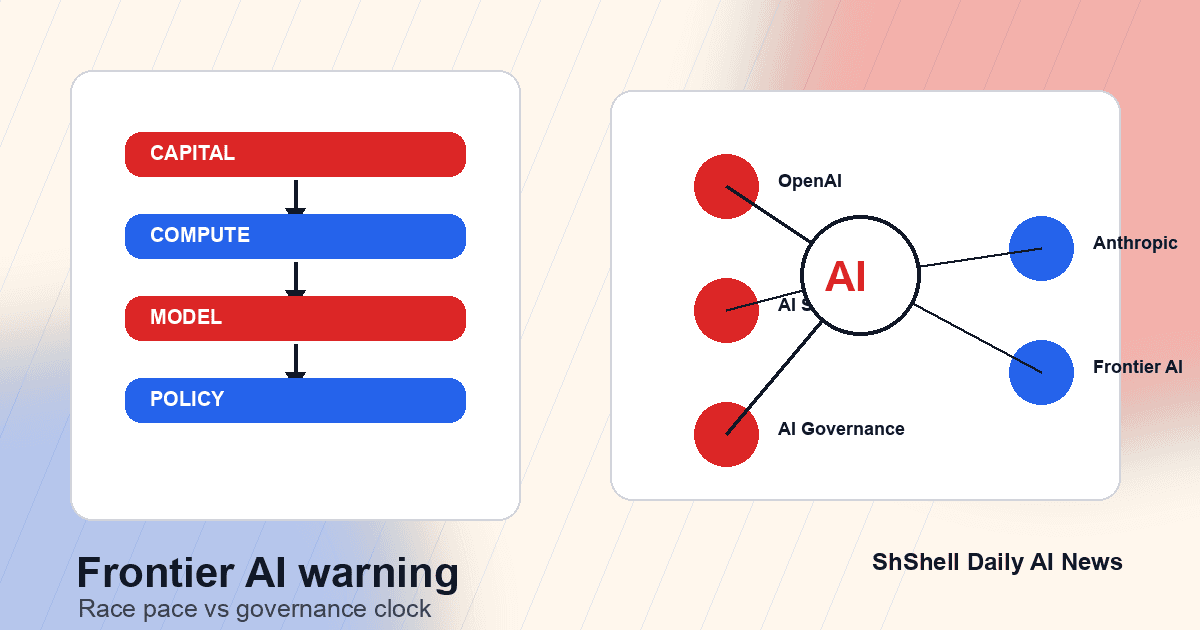
OpenAI And Anthropic Are Warning About The Frontier AI Race They Still Lead
OpenAI and Anthropic's slowdown warnings expose the governance gap between frontier model releases, safety policy, and AI adoption.
OpenAI And Anthropic Are Warning About The Frontier AI Race They Still Lead
OpenAI And Anthropic Are Warning About The Frontier AI Race They Still Lead is today's most useful AI infrastructure and governance signal because it turns a fresh market event into a concrete operating question. The story is not simply that another model, workstation, funding round, or cloud venture appeared. The story is how the event changes what builders, buyers, researchers, and operators should verify before they commit money, data, or workflow authority to a new AI system.
Source trail
- Business Insider — reported that OpenAI and Anthropic have been warning that frontier AI progress is outrunning policy while continuing to release powerful models and adoption tools.
- Anthropic Institute reporting — covered Anthropic's argument that labs may need to slow down or pause so society and safety systems can catch up.
Ten facts that lock this story to the event
- OpenAI and Anthropic have both recently warned that AI capability growth is moving faster than governance capacity.
- Business Insider framed the contradiction as labs warning about a future they are still building at speed.
- Anthropic has argued that frontier labs may need to slow down or pause in coordination with governments and other developers.
- The warning arrives while labs are also shipping powerful models and tools intended to broaden adoption.
- Anthropic has discussed AI systems increasingly accelerating technical work inside AI labs.
- The governance concern includes safety research, alignment, regulation, labor disruption, misuse, and public trust.
- OpenAI has advocated international coordination for AI safety and catastrophic risk mitigation.
- The debate is sharpened by anticipated public-market pressure around major AI company IPO paths.
- The contradiction is not purely rhetorical: labs face competitive pressure from rivals, open models, national strategies, and customer demand.
- The practical question is what measurable conditions would justify slowing deployment, pausing training, or limiting access.
Operating map for this AI News Today story
graph TD
    Model_capability_gains[Model capability gains] --> Competitive_pressure[Competitive pressure]
    Competitive_pressure[Competitive pressure] --> Fast_releases[Fast releases]
    Fast_releases[Fast releases] --> Public_adoption[Public adoption]
    Public_adoption[Public adoption] --> New_risks_and_labor_shocks[New risks and labor shocks]
    New_risks_and_labor_shocks[New risks and labor shocks] --> Policy_catch-up_demand[Policy catch-up demand]
    Policy_catch-up_demand[Policy catch-up demand] --> Slowdown_warnings[Slowdown warnings]
    Slowdown_warnings[Slowdown warnings] --> Model_capability_gains[Model capability gains]
Decision table for builders and buyers
| Layer | Reported detail | What to verify next |
|---|---|---|
| Lab warning | Capability progress may outrun society | Ask which capability threshold triggers action |
| Market behavior | New models and tools keep shipping | Separate safety rhetoric from deployment controls |
| Government gap | Policy capacity lags model releases | Look for enforceable reporting and evaluation regimes |
| Enterprise gap | Companies adopt before controls mature | Require evals, logs, approval, and rollback paths |
| Public trust | Warnings can sound self-serving | Demand transparent metrics and independent review |
The Contradiction Is The Story
OpenAI and Anthropic are asking the public to take frontier AI risk seriously while they keep pushing the frontier forward. That tension is not a cheap gotcha. It is the central governance problem of the AI industry in 2026. The labs most capable of describing the risks are also the labs with the strongest incentive to release, monetize, and defend leadership.
Business Insider's framing lands because it captures what many builders, policymakers, and enterprise buyers feel: the warning lights are flashing from inside the race cars. The companies say society needs more time, but the product cycle keeps accelerating. New models, coding tools, agents, and enterprise integrations continue to arrive because competitive pressure does not pause itself.
The useful response is not to dismiss the warnings as hypocrisy. It is to ask what the warnings commit the labs to do. A serious slowdown argument needs thresholds, measurements, evaluation results, disclosure rules, and consequences. Without those, it becomes atmosphere: alarming enough to shape public debate, but not concrete enough to govern deployment.
For OpenAI And Anthropic Are Warning About The Frontier AI Race They Still Lead, this detail changes the practical read of the story: OpenAI and Anthropic have both recently warned that AI capability growth is moving faster than governance capacity. That is not trivia; it is an operating constraint for teams following latest AI news and AI News Today. A builder sees integration work, an operator sees a runbook, a buyer sees a contract question, and a governance lead sees a control that must be written down. In this specific the contradiction is the story context, the important move is to connect the reported fact to a decision: what gets tested, who owns the risk, which data can move, what the fallback path is, and how the team will know if the deployment is working. That discipline is what separates useful Artificial Intelligence News from a headline that disappears by tomorrow.
For OpenAI And Anthropic Are Warning About The Frontier AI Race They Still Lead, this detail changes the practical read of the story: Business Insider framed the contradiction as labs warning about a future they are still building at speed. That is not trivia; it is an operating constraint for teams following latest AI news and AI News Today. A builder sees integration work, an operator sees a runbook, a buyer sees a contract question, and a governance lead sees a control that must be written down. In this specific the contradiction is the story context, the important move is to connect the reported fact to a decision: what gets tested, who owns the risk, which data can move, what the fallback path is, and how the team will know if the deployment is working. That discipline is what separates useful Artificial Intelligence News from a headline that disappears by tomorrow.
For OpenAI And Anthropic Are Warning About The Frontier AI Race They Still Lead, this detail changes the practical read of the story: Anthropic has argued that frontier labs may need to slow down or pause in coordination with governments and other developers. That is not trivia; it is an operating constraint for teams following latest AI news and AI News Today. A builder sees integration work, an operator sees a runbook, a buyer sees a contract question, and a governance lead sees a control that must be written down. In this specific the contradiction is the story context, the important move is to connect the reported fact to a decision: what gets tested, who owns the risk, which data can move, what the fallback path is, and how the team will know if the deployment is working. That discipline is what separates useful Artificial Intelligence News from a headline that disappears by tomorrow.
For OpenAI And Anthropic Are Warning About The Frontier AI Race They Still Lead, this detail changes the practical read of the story: The warning arrives while labs are also shipping powerful models and tools intended to broaden adoption. That is not trivia; it is an operating constraint for teams following latest AI news and AI News Today. A builder sees integration work, an operator sees a runbook, a buyer sees a contract question, and a governance lead sees a control that must be written down. In this specific the contradiction is the story context, the important move is to connect the reported fact to a decision: what gets tested, who owns the risk, which data can move, what the fallback path is, and how the team will know if the deployment is working. That discipline is what separates useful Artificial Intelligence News from a headline that disappears by tomorrow.
Why The Labs Cannot Simply Step Off The Track
Frontier labs face a coordination problem. If one company slows model training or deployment while others continue, it may lose customers, talent, revenue, and strategic influence. If every major lab slows together, regulators may view the coordination as either safety leadership or market control, depending on structure. If governments impose limits unevenly, development may move across borders or into less transparent environments.
That is why voluntary warnings do not solve much by themselves. The labs can publish safety frameworks, evaluation cards, preparedness documents, and policy proposals, but the hard question remains enforcement. Who decides when capability is too dangerous? Which evaluations count? What happens when a model passes a lab's internal bar but independent researchers disagree? What if a country sees slowdown as surrendering strategic advantage?
The answer will not be a single global pause button. More likely, governance will emerge through disclosure requirements, incident reporting, third-party evaluations, compute monitoring, trusted access programs, model capability thresholds, and procurement rules. That system is less dramatic than a pause, but it is more plausible.
For OpenAI And Anthropic Are Warning About The Frontier AI Race They Still Lead, this detail changes the practical read of the story: OpenAI and Anthropic have both recently warned that AI capability growth is moving faster than governance capacity. That is not trivia; it is an operating constraint for teams following latest AI news and AI News Today. A builder sees integration work, an operator sees a runbook, a buyer sees a contract question, and a governance lead sees a control that must be written down. In this specific why the labs cannot simply step off the track context, the important move is to connect the reported fact to a decision: what gets tested, who owns the risk, which data can move, what the fallback path is, and how the team will know if the deployment is working. That discipline is what separates useful Artificial Intelligence News from a headline that disappears by tomorrow.
For OpenAI And Anthropic Are Warning About The Frontier AI Race They Still Lead, this detail changes the practical read of the story: Business Insider framed the contradiction as labs warning about a future they are still building at speed. That is not trivia; it is an operating constraint for teams following latest AI news and AI News Today. A builder sees integration work, an operator sees a runbook, a buyer sees a contract question, and a governance lead sees a control that must be written down. In this specific why the labs cannot simply step off the track context, the important move is to connect the reported fact to a decision: what gets tested, who owns the risk, which data can move, what the fallback path is, and how the team will know if the deployment is working. That discipline is what separates useful Artificial Intelligence News from a headline that disappears by tomorrow.
For OpenAI And Anthropic Are Warning About The Frontier AI Race They Still Lead, this detail changes the practical read of the story: Anthropic has argued that frontier labs may need to slow down or pause in coordination with governments and other developers. That is not trivia; it is an operating constraint for teams following latest AI news and AI News Today. A builder sees integration work, an operator sees a runbook, a buyer sees a contract question, and a governance lead sees a control that must be written down. In this specific why the labs cannot simply step off the track context, the important move is to connect the reported fact to a decision: what gets tested, who owns the risk, which data can move, what the fallback path is, and how the team will know if the deployment is working. That discipline is what separates useful Artificial Intelligence News from a headline that disappears by tomorrow.
For OpenAI And Anthropic Are Warning About The Frontier AI Race They Still Lead, this detail changes the practical read of the story: The warning arrives while labs are also shipping powerful models and tools intended to broaden adoption. That is not trivia; it is an operating constraint for teams following latest AI news and AI News Today. A builder sees integration work, an operator sees a runbook, a buyer sees a contract question, and a governance lead sees a control that must be written down. In this specific why the labs cannot simply step off the track context, the important move is to connect the reported fact to a decision: what gets tested, who owns the risk, which data can move, what the fallback path is, and how the team will know if the deployment is working. That discipline is what separates useful Artificial Intelligence News from a headline that disappears by tomorrow.
The Enterprise Adoption Gap Is Already Here
While policymakers debate frontier risk, companies are deploying AI agents into real workflows. Coding agents write pull requests. Customer support agents handle refunds. Research agents summarize proprietary data. Sales agents draft outreach. Finance agents classify transactions. The governance gap does not begin at hypothetical superintelligence. It begins when ordinary employees let a model act with permissions the organization has not mapped.
OpenAI and Anthropic both benefit from making tools easy to adopt. That is not inherently bad. Useful AI tools should become easier to use. But ease of adoption can outpace evaluation discipline. A team may add an AI coding assistant before it has dependency scanning, secret detection, test coverage, or review rules strong enough to catch model mistakes. A business unit may deploy a customer agent before legal, privacy, and brand teams understand the failure modes.
This is where Latest AI News becomes operational. The big-lab warning should push enterprises to build AI control planes now: model inventory, prompt and output logging, tool-call approvals, data classification, cost budgets, eval suites, and rollback processes. Waiting for perfect regulation is not a strategy.
For OpenAI And Anthropic Are Warning About The Frontier AI Race They Still Lead, this detail changes the practical read of the story: OpenAI and Anthropic have both recently warned that AI capability growth is moving faster than governance capacity. That is not trivia; it is an operating constraint for teams following latest AI news and AI News Today. A builder sees integration work, an operator sees a runbook, a buyer sees a contract question, and a governance lead sees a control that must be written down. In this specific the enterprise adoption gap is already here context, the important move is to connect the reported fact to a decision: what gets tested, who owns the risk, which data can move, what the fallback path is, and how the team will know if the deployment is working. That discipline is what separates useful Artificial Intelligence News from a headline that disappears by tomorrow.
For OpenAI And Anthropic Are Warning About The Frontier AI Race They Still Lead, this detail changes the practical read of the story: Business Insider framed the contradiction as labs warning about a future they are still building at speed. That is not trivia; it is an operating constraint for teams following latest AI news and AI News Today. A builder sees integration work, an operator sees a runbook, a buyer sees a contract question, and a governance lead sees a control that must be written down. In this specific the enterprise adoption gap is already here context, the important move is to connect the reported fact to a decision: what gets tested, who owns the risk, which data can move, what the fallback path is, and how the team will know if the deployment is working. That discipline is what separates useful Artificial Intelligence News from a headline that disappears by tomorrow.
For OpenAI And Anthropic Are Warning About The Frontier AI Race They Still Lead, this detail changes the practical read of the story: Anthropic has argued that frontier labs may need to slow down or pause in coordination with governments and other developers. That is not trivia; it is an operating constraint for teams following latest AI news and AI News Today. A builder sees integration work, an operator sees a runbook, a buyer sees a contract question, and a governance lead sees a control that must be written down. In this specific the enterprise adoption gap is already here context, the important move is to connect the reported fact to a decision: what gets tested, who owns the risk, which data can move, what the fallback path is, and how the team will know if the deployment is working. That discipline is what separates useful Artificial Intelligence News from a headline that disappears by tomorrow.
For OpenAI And Anthropic Are Warning About The Frontier AI Race They Still Lead, this detail changes the practical read of the story: The warning arrives while labs are also shipping powerful models and tools intended to broaden adoption. That is not trivia; it is an operating constraint for teams following latest AI news and AI News Today. A builder sees integration work, an operator sees a runbook, a buyer sees a contract question, and a governance lead sees a control that must be written down. In this specific the enterprise adoption gap is already here context, the important move is to connect the reported fact to a decision: what gets tested, who owns the risk, which data can move, what the fallback path is, and how the team will know if the deployment is working. That discipline is what separates useful Artificial Intelligence News from a headline that disappears by tomorrow.
What A Real Slowdown Trigger Would Need
A credible slowdown trigger cannot be vibes-based. It needs measurable conditions. For example: a model reaches a defined cyber capability threshold under independent evaluation; autonomous agent tests show reliable multi-step exploitation; biological assistance crosses a published expert baseline; internal deployment produces repeated critical incidents; or alignment evaluations reveal deceptive behavior that existing safeguards cannot contain.
Even then, the decision has to specify what slows. Training runs, public deployment, API access, high-risk tool access, or certain capability domains could be restricted differently. A model might remain available for low-risk consumer tasks while sensitive cybersecurity or biology workflows require trusted access. That is messy, but it reflects how AI systems are actually used.
The most important missing piece is independent verification. Labs can and should run internal evaluations, but public trust requires outside institutions with technical access, legal protection, and enough funding to challenge lab claims. Otherwise the public has to accept risk assessments from the same organizations racing for market share.
For OpenAI And Anthropic Are Warning About The Frontier AI Race They Still Lead, this detail changes the practical read of the story: OpenAI and Anthropic have both recently warned that AI capability growth is moving faster than governance capacity. That is not trivia; it is an operating constraint for teams following latest AI news and AI News Today. A builder sees integration work, an operator sees a runbook, a buyer sees a contract question, and a governance lead sees a control that must be written down. In this specific what a real slowdown trigger would need context, the important move is to connect the reported fact to a decision: what gets tested, who owns the risk, which data can move, what the fallback path is, and how the team will know if the deployment is working. That discipline is what separates useful Artificial Intelligence News from a headline that disappears by tomorrow.
For OpenAI And Anthropic Are Warning About The Frontier AI Race They Still Lead, this detail changes the practical read of the story: Business Insider framed the contradiction as labs warning about a future they are still building at speed. That is not trivia; it is an operating constraint for teams following latest AI news and AI News Today. A builder sees integration work, an operator sees a runbook, a buyer sees a contract question, and a governance lead sees a control that must be written down. In this specific what a real slowdown trigger would need context, the important move is to connect the reported fact to a decision: what gets tested, who owns the risk, which data can move, what the fallback path is, and how the team will know if the deployment is working. That discipline is what separates useful Artificial Intelligence News from a headline that disappears by tomorrow.
For OpenAI And Anthropic Are Warning About The Frontier AI Race They Still Lead, this detail changes the practical read of the story: Anthropic has argued that frontier labs may need to slow down or pause in coordination with governments and other developers. That is not trivia; it is an operating constraint for teams following latest AI news and AI News Today. A builder sees integration work, an operator sees a runbook, a buyer sees a contract question, and a governance lead sees a control that must be written down. In this specific what a real slowdown trigger would need context, the important move is to connect the reported fact to a decision: what gets tested, who owns the risk, which data can move, what the fallback path is, and how the team will know if the deployment is working. That discipline is what separates useful Artificial Intelligence News from a headline that disappears by tomorrow.
For OpenAI And Anthropic Are Warning About The Frontier AI Race They Still Lead, this detail changes the practical read of the story: The warning arrives while labs are also shipping powerful models and tools intended to broaden adoption. That is not trivia; it is an operating constraint for teams following latest AI news and AI News Today. A builder sees integration work, an operator sees a runbook, a buyer sees a contract question, and a governance lead sees a control that must be written down. In this specific what a real slowdown trigger would need context, the important move is to connect the reported fact to a decision: what gets tested, who owns the risk, which data can move, what the fallback path is, and how the team will know if the deployment is working. That discipline is what separates useful Artificial Intelligence News from a headline that disappears by tomorrow.
The IPO Pressure Makes The Warnings Harder To Read
The timing matters. As AI companies move toward public-market scrutiny, every safety statement also becomes a market signal. A lab can use warnings to argue that it is responsible, to shape regulation around its strengths, or to create barriers that less-resourced rivals cannot clear. That does not mean the warnings are false. It means readers need to separate the safety claim from the business incentive.
Public investors will want growth, margin, defensibility, and risk control. Frontier AI safety sits awkwardly across all four. More capable models drive revenue and strategic value. More capable models also raise evaluation cost, legal exposure, infrastructure demand, and reputational risk. The result is a company telling the market it can grow quickly while telling society that growth may need guardrails.
For policymakers, that dual message should be useful evidence. The labs themselves are saying the technology has unusual risk. The next step is to translate that admission into enforceable obligations rather than relying on press-cycle concern.
For OpenAI And Anthropic Are Warning About The Frontier AI Race They Still Lead, this detail changes the practical read of the story: OpenAI and Anthropic have both recently warned that AI capability growth is moving faster than governance capacity. That is not trivia; it is an operating constraint for teams following latest AI news and AI News Today. A builder sees integration work, an operator sees a runbook, a buyer sees a contract question, and a governance lead sees a control that must be written down. In this specific the ipo pressure makes the warnings harder to read context, the important move is to connect the reported fact to a decision: what gets tested, who owns the risk, which data can move, what the fallback path is, and how the team will know if the deployment is working. That discipline is what separates useful Artificial Intelligence News from a headline that disappears by tomorrow.
For OpenAI And Anthropic Are Warning About The Frontier AI Race They Still Lead, this detail changes the practical read of the story: Business Insider framed the contradiction as labs warning about a future they are still building at speed. That is not trivia; it is an operating constraint for teams following latest AI news and AI News Today. A builder sees integration work, an operator sees a runbook, a buyer sees a contract question, and a governance lead sees a control that must be written down. In this specific the ipo pressure makes the warnings harder to read context, the important move is to connect the reported fact to a decision: what gets tested, who owns the risk, which data can move, what the fallback path is, and how the team will know if the deployment is working. That discipline is what separates useful Artificial Intelligence News from a headline that disappears by tomorrow.
For OpenAI And Anthropic Are Warning About The Frontier AI Race They Still Lead, this detail changes the practical read of the story: Anthropic has argued that frontier labs may need to slow down or pause in coordination with governments and other developers. That is not trivia; it is an operating constraint for teams following latest AI news and AI News Today. A builder sees integration work, an operator sees a runbook, a buyer sees a contract question, and a governance lead sees a control that must be written down. In this specific the ipo pressure makes the warnings harder to read context, the important move is to connect the reported fact to a decision: what gets tested, who owns the risk, which data can move, what the fallback path is, and how the team will know if the deployment is working. That discipline is what separates useful Artificial Intelligence News from a headline that disappears by tomorrow.
For OpenAI And Anthropic Are Warning About The Frontier AI Race They Still Lead, this detail changes the practical read of the story: The warning arrives while labs are also shipping powerful models and tools intended to broaden adoption. That is not trivia; it is an operating constraint for teams following latest AI news and AI News Today. A builder sees integration work, an operator sees a runbook, a buyer sees a contract question, and a governance lead sees a control that must be written down. In this specific the ipo pressure makes the warnings harder to read context, the important move is to connect the reported fact to a decision: what gets tested, who owns the risk, which data can move, what the fallback path is, and how the team will know if the deployment is working. That discipline is what separates useful Artificial Intelligence News from a headline that disappears by tomorrow.
What Builders Should Do With The Warning
Builders do not need to wait for OpenAI, Anthropic, or a regulator to define basic discipline. If your product uses large language models or ai agents, document what the model can access, what tools it can call, what data it can retain, what tests it must pass, and who reviews failures. If the model touches code, money, health, legal text, credentials, or customer identity, add stronger human approval and audit trails.
The second move is evaluation realism. Do not test only happy paths. Test ambiguous prompts, malicious prompts, stale context, poisoned documents, tool failures, and unauthorized data requests. Most enterprise incidents are not cinematic frontier failures. They are boring permission mistakes that become expensive because nobody built the controls.
The labs' warnings may be uncomfortable, but they are useful if they force the industry to mature. The frontier race is not slowing on its own. The practical task is to build brakes that actually connect to the wheels.
For OpenAI And Anthropic Are Warning About The Frontier AI Race They Still Lead, this detail changes the practical read of the story: OpenAI and Anthropic have both recently warned that AI capability growth is moving faster than governance capacity. That is not trivia; it is an operating constraint for teams following latest AI news and AI News Today. A builder sees integration work, an operator sees a runbook, a buyer sees a contract question, and a governance lead sees a control that must be written down. In this specific what builders should do with the warning context, the important move is to connect the reported fact to a decision: what gets tested, who owns the risk, which data can move, what the fallback path is, and how the team will know if the deployment is working. That discipline is what separates useful Artificial Intelligence News from a headline that disappears by tomorrow.
For OpenAI And Anthropic Are Warning About The Frontier AI Race They Still Lead, this detail changes the practical read of the story: Business Insider framed the contradiction as labs warning about a future they are still building at speed. That is not trivia; it is an operating constraint for teams following latest AI news and AI News Today. A builder sees integration work, an operator sees a runbook, a buyer sees a contract question, and a governance lead sees a control that must be written down. In this specific what builders should do with the warning context, the important move is to connect the reported fact to a decision: what gets tested, who owns the risk, which data can move, what the fallback path is, and how the team will know if the deployment is working. That discipline is what separates useful Artificial Intelligence News from a headline that disappears by tomorrow.
For OpenAI And Anthropic Are Warning About The Frontier AI Race They Still Lead, this detail changes the practical read of the story: Anthropic has argued that frontier labs may need to slow down or pause in coordination with governments and other developers. That is not trivia; it is an operating constraint for teams following latest AI news and AI News Today. A builder sees integration work, an operator sees a runbook, a buyer sees a contract question, and a governance lead sees a control that must be written down. In this specific what builders should do with the warning context, the important move is to connect the reported fact to a decision: what gets tested, who owns the risk, which data can move, what the fallback path is, and how the team will know if the deployment is working. That discipline is what separates useful Artificial Intelligence News from a headline that disappears by tomorrow.
For OpenAI And Anthropic Are Warning About The Frontier AI Race They Still Lead, this detail changes the practical read of the story: The warning arrives while labs are also shipping powerful models and tools intended to broaden adoption. That is not trivia; it is an operating constraint for teams following latest AI news and AI News Today. A builder sees integration work, an operator sees a runbook, a buyer sees a contract question, and a governance lead sees a control that must be written down. In this specific what builders should do with the warning context, the important move is to connect the reported fact to a decision: what gets tested, who owns the risk, which data can move, what the fallback path is, and how the team will know if the deployment is working. That discipline is what separates useful Artificial Intelligence News from a headline that disappears by tomorrow.
What ShShell readers should watch next
The next signal for OpenAI And Anthropic Are Warning About The Frontier AI Race They Still Lead is whether the announcement becomes repeatable operating behavior. Watch for customer evidence, transparent pricing, clear model or hardware limits, published safety and retention terms, and examples that survive real workflows. For people trying to Learn AI, the lesson is not to memorize the headline. The lesson is to ask what changed in the system: compute access, model routing, data retention, developer ergonomics, capital structure, or human approval. That is where durable AI knowledge lives.
Sudeep Devkota writes ShShell's Daily AI News for readers who need practical signal from fast-moving model, infrastructure, agentic AI, and governance stories. The goal is simple: turn latest AI news into decisions that teams can test, document, and improve.