Nvidia Edge AI Energy Audit Exposes the Missing Telemetry Behind Local Agents
A new audit of GB10 edge AI hardware says process-level energy attribution is missing, challenging claims about efficient local agents.
Local AI agents promise privacy, lower latency, and freedom from cloud bills. The harder question is whether anyone can measure what those agents actually cost to run.
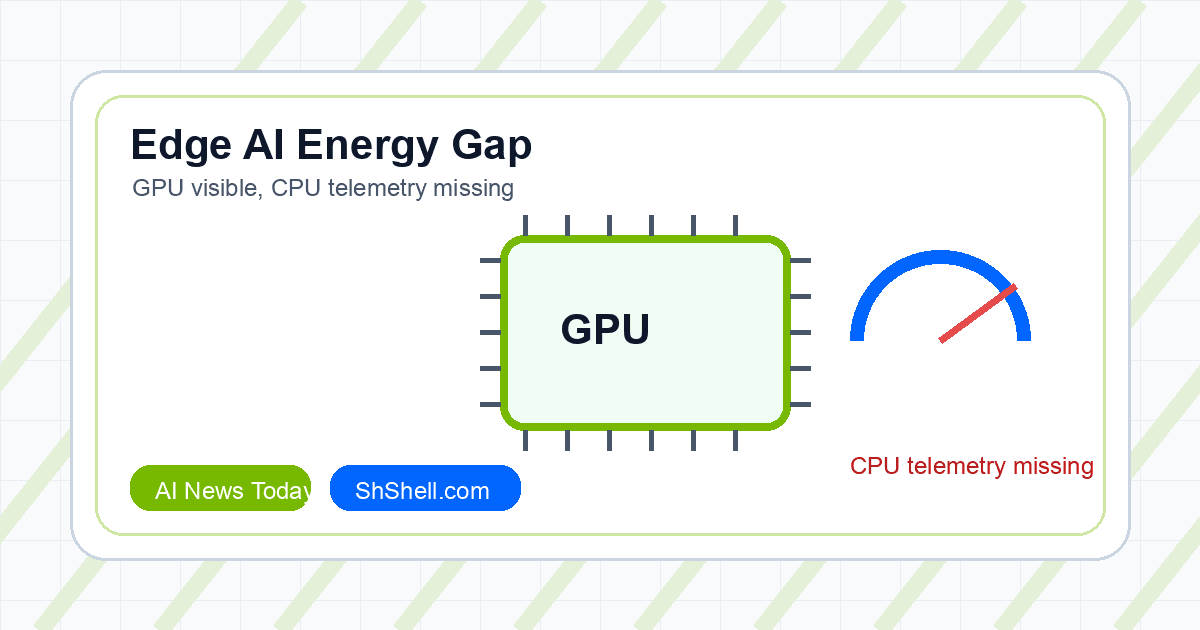
A May 26 arXiv paper, The Energy Blind Spot, audits Nvidia GB10-based edge AI hardware and argues that the platform cannot support process-level energy attribution through supported interfaces. The authors report GPU power visibility through NVML but no supported CPU energy counter, INA rail monitor, IPMI or BMC telemetry, or SCMI powercap path on the audited ASUS Ascent GX10 system.
For readers tracking latest AI news and Artificial Intelligence News, the importance is not that another AI headline appeared. The importance is that this story exposes a concrete operating constraint: the people buying, regulating, deploying, or building AI systems now have to make decisions before the infrastructure around those systems is mature. That is the connective tissue between model releases, agentic AI, AI training, AI tools, and enterprise governance in 2026.
This ShShell analysis is source-grounded but not a wire rewrite. It separates what the cited reports say, what can be inferred from the technical or commercial mechanism, and what remains uncertain. The goal is to help builders, buyers, researchers, and operators understand how this specific event changes the next set of decisions.
What changed on June 12
Edge AI hardware is being sold as the place where agentic workloads become local, private, and fast. A recent arXiv audit of Nvidia GB10-based systems raises a less glamorous question: can operators actually measure the energy cost of those agents at process level? The authors examined an ASUS Ascent GX10 platform and reported that it exposes GPU power through NVML but does not expose supported CPU rail information, INA power-rail monitoring, IPMI or BMC controls, or SCMI powercap telemetry. For AI infrastructure teams, that is not a minor observability gap.
The mechanism is attribution. Agentic AI workloads do not behave like a single inference call. A user goal can trigger planning, retrieval, tool calls, file parsing, browser actions, retries, validation, and error recovery. Prior work cited in the paper suggests orchestration structure can dominate energy cost, with workflows consuming 4.33 times more energy per successful goal than linear baselines in one reported setup. If the hardware exposes only part of the energy picture, teams cannot tell whether optimization improved the workflow or merely shifted cost from GPU to CPU.
For builders, this changes the definition of efficient AI tools. A local agent that feels fast may still waste energy in CPU-side orchestration, polling, serialization, and repeated validation loops. Without per-process attribution, developers are left with wall-plug meters and rough subtraction. That may be acceptable for hobby projects, but it is weak for enterprise procurement, carbon accounting, and fleet-scale capacity planning.
For buyers, the practical question is simple: does the device expose the telemetry needed to govern the workload you intend to run? If a vendor markets an AI PC, workstation, or edge box for persistent agents, ask for supported power counters, per-process attribution paths, fleet collection APIs, and standards-track compatibility. Agentic AI cannot become operational infrastructure if its energy behavior is invisible.
The mechanism behind the headline
Edge AI hardware is being sold as the place where agentic workloads become local, private, and fast. A recent arXiv audit of Nvidia GB10-based systems raises a less glamorous question: can operators actually measure the energy cost of those agents at process level? The authors examined an ASUS Ascent GX10 platform and reported that it exposes GPU power through NVML but does not expose supported CPU rail information, INA power-rail monitoring, IPMI or BMC controls, or SCMI powercap telemetry. For AI infrastructure teams, that is not a minor observability gap.
The mechanism is attribution. Agentic AI workloads do not behave like a single inference call. A user goal can trigger planning, retrieval, tool calls, file parsing, browser actions, retries, validation, and error recovery. Prior work cited in the paper suggests orchestration structure can dominate energy cost, with workflows consuming 4.33 times more energy per successful goal than linear baselines in one reported setup. If the hardware exposes only part of the energy picture, teams cannot tell whether optimization improved the workflow or merely shifted cost from GPU to CPU.
For builders, this changes the definition of efficient AI tools. A local agent that feels fast may still waste energy in CPU-side orchestration, polling, serialization, and repeated validation loops. Without per-process attribution, developers are left with wall-plug meters and rough subtraction. That may be acceptable for hobby projects, but it is weak for enterprise procurement, carbon accounting, and fleet-scale capacity planning.
For buyers, the practical question is simple: does the device expose the telemetry needed to govern the workload you intend to run? If a vendor markets an AI PC, workstation, or edge box for persistent agents, ask for supported power counters, per-process attribution paths, fleet collection APIs, and standards-track compatibility. Agentic AI cannot become operational infrastructure if its energy behavior is invisible.
flowchart LR
    A[Agent user goal] --> B[Planner]
    B --> C[Retrieval and tools]
    C --> D[CPU orchestration]
    C --> E[GPU inference]
    D --> F[Unattributed energy gap]
    E --> G[NVML GPU power]
    F --> H[Incomplete cost model]
    G --> H
Why this matters for builders and AI operators
Edge AI hardware is being sold as the place where agentic workloads become local, private, and fast. A recent arXiv audit of Nvidia GB10-based systems raises a less glamorous question: can operators actually measure the energy cost of those agents at process level? The authors examined an ASUS Ascent GX10 platform and reported that it exposes GPU power through NVML but does not expose supported CPU rail information, INA power-rail monitoring, IPMI or BMC controls, or SCMI powercap telemetry. For AI infrastructure teams, that is not a minor observability gap.
The mechanism is attribution. Agentic AI workloads do not behave like a single inference call. A user goal can trigger planning, retrieval, tool calls, file parsing, browser actions, retries, validation, and error recovery. Prior work cited in the paper suggests orchestration structure can dominate energy cost, with workflows consuming 4.33 times more energy per successful goal than linear baselines in one reported setup. If the hardware exposes only part of the energy picture, teams cannot tell whether optimization improved the workflow or merely shifted cost from GPU to CPU.
For builders, this changes the definition of efficient AI tools. A local agent that feels fast may still waste energy in CPU-side orchestration, polling, serialization, and repeated validation loops. Without per-process attribution, developers are left with wall-plug meters and rough subtraction. That may be acceptable for hobby projects, but it is weak for enterprise procurement, carbon accounting, and fleet-scale capacity planning.
For buyers, the practical question is simple: does the device expose the telemetry needed to govern the workload you intend to run? If a vendor markets an AI PC, workstation, or edge box for persistent agents, ask for supported power counters, per-process attribution paths, fleet collection APIs, and standards-track compatibility. Agentic AI cannot become operational infrastructure if its energy behavior is invisible.
| Telemetry need | Why agents need it | Reported GB10 gap |
|---|---|---|
| CPU energy counter | Tool orchestration can dominate cost | No supported CPU rail counter |
| GPU power | Inference still matters | NVML instantaneous GPU power exposed |
| Per-process attribution | Needed for workload optimization | Not reproducible through supported interfaces |
| Fleet power policy | Needed for enterprise governance | Standards path suggested through SCMI powercap |
The business pressure underneath the AI News Today cycle
Edge AI hardware is being sold as the place where agentic workloads become local, private, and fast. A recent arXiv audit of Nvidia GB10-based systems raises a less glamorous question: can operators actually measure the energy cost of those agents at process level? The authors examined an ASUS Ascent GX10 platform and reported that it exposes GPU power through NVML but does not expose supported CPU rail information, INA power-rail monitoring, IPMI or BMC controls, or SCMI powercap telemetry. For AI infrastructure teams, that is not a minor observability gap.
The mechanism is attribution. Agentic AI workloads do not behave like a single inference call. A user goal can trigger planning, retrieval, tool calls, file parsing, browser actions, retries, validation, and error recovery. Prior work cited in the paper suggests orchestration structure can dominate energy cost, with workflows consuming 4.33 times more energy per successful goal than linear baselines in one reported setup. If the hardware exposes only part of the energy picture, teams cannot tell whether optimization improved the workflow or merely shifted cost from GPU to CPU.
For builders, this changes the definition of efficient AI tools. A local agent that feels fast may still waste energy in CPU-side orchestration, polling, serialization, and repeated validation loops. Without per-process attribution, developers are left with wall-plug meters and rough subtraction. That may be acceptable for hobby projects, but it is weak for enterprise procurement, carbon accounting, and fleet-scale capacity planning.
For buyers, the practical question is simple: does the device expose the telemetry needed to govern the workload you intend to run? If a vendor markets an AI PC, workstation, or edge box for persistent agents, ask for supported power counters, per-process attribution paths, fleet collection APIs, and standards-track compatibility. Agentic AI cannot become operational infrastructure if its energy behavior is invisible.
The risks that are still unresolved
Edge AI hardware is being sold as the place where agentic workloads become local, private, and fast. A recent arXiv audit of Nvidia GB10-based systems raises a less glamorous question: can operators actually measure the energy cost of those agents at process level? The authors examined an ASUS Ascent GX10 platform and reported that it exposes GPU power through NVML but does not expose supported CPU rail information, INA power-rail monitoring, IPMI or BMC controls, or SCMI powercap telemetry. For AI infrastructure teams, that is not a minor observability gap.
The mechanism is attribution. Agentic AI workloads do not behave like a single inference call. A user goal can trigger planning, retrieval, tool calls, file parsing, browser actions, retries, validation, and error recovery. Prior work cited in the paper suggests orchestration structure can dominate energy cost, with workflows consuming 4.33 times more energy per successful goal than linear baselines in one reported setup. If the hardware exposes only part of the energy picture, teams cannot tell whether optimization improved the workflow or merely shifted cost from GPU to CPU.
For builders, this changes the definition of efficient AI tools. A local agent that feels fast may still waste energy in CPU-side orchestration, polling, serialization, and repeated validation loops. Without per-process attribution, developers are left with wall-plug meters and rough subtraction. That may be acceptable for hobby projects, but it is weak for enterprise procurement, carbon accounting, and fleet-scale capacity planning.
For buyers, the practical question is simple: does the device expose the telemetry needed to govern the workload you intend to run? If a vendor markets an AI PC, workstation, or edge box for persistent agents, ask for supported power counters, per-process attribution paths, fleet collection APIs, and standards-track compatibility. Agentic AI cannot become operational infrastructure if its energy behavior is invisible.
What to watch next
Edge AI hardware is being sold as the place where agentic workloads become local, private, and fast. A recent arXiv audit of Nvidia GB10-based systems raises a less glamorous question: can operators actually measure the energy cost of those agents at process level? The authors examined an ASUS Ascent GX10 platform and reported that it exposes GPU power through NVML but does not expose supported CPU rail information, INA power-rail monitoring, IPMI or BMC controls, or SCMI powercap telemetry. For AI infrastructure teams, that is not a minor observability gap.
The mechanism is attribution. Agentic AI workloads do not behave like a single inference call. A user goal can trigger planning, retrieval, tool calls, file parsing, browser actions, retries, validation, and error recovery. Prior work cited in the paper suggests orchestration structure can dominate energy cost, with workflows consuming 4.33 times more energy per successful goal than linear baselines in one reported setup. If the hardware exposes only part of the energy picture, teams cannot tell whether optimization improved the workflow or merely shifted cost from GPU to CPU.
For builders, this changes the definition of efficient AI tools. A local agent that feels fast may still waste energy in CPU-side orchestration, polling, serialization, and repeated validation loops. Without per-process attribution, developers are left with wall-plug meters and rough subtraction. That may be acceptable for hobby projects, but it is weak for enterprise procurement, carbon accounting, and fleet-scale capacity planning.
For buyers, the practical question is simple: does the device expose the telemetry needed to govern the workload you intend to run? If a vendor markets an AI PC, workstation, or edge box for persistent agents, ask for supported power counters, per-process attribution paths, fleet collection APIs, and standards-track compatibility. Agentic AI cannot become operational infrastructure if its energy behavior is invisible.
The operator playbook for energy-aware local agents
Teams evaluating local AI agents should test energy behavior before buying fleets of hardware. A useful pilot measures wall-plug power, GPU power, CPU utilization, memory pressure, latency, retries, and completed tasks. The goal is not to produce a perfect lab-grade carbon model on day one. The goal is to understand whether the platform exposes enough signals to compare workflows honestly. If the system can only show GPU power, then CPU-heavy orchestration and tool execution may remain hidden.
The second step is workload design. Agentic workloads should be benchmarked by successful goal, not by single inference call. A local research agent that opens files, searches indexes, calls tools, retries failed plans, and validates answers may consume most of its energy outside the headline model. Teams should compare a linear baseline, a simple retrieval workflow, and a fully agentic workflow. If the agentic version uses four times the energy for a marginally better answer, the business case changes.
The third step is procurement pressure. Vendors respond when buyers ask specific questions. Does the platform expose CPU energy counters through supported interfaces? Can telemetry be collected per process? Is there an API for fleet monitoring? Can power caps be set or read through a standards-track mechanism such as SCMI powercap? Are there documented limitations for MediaTek, Arm, or Nvidia components? A vague answer about efficiency is not enough for infrastructure that may run persistent agents all day.
The fourth step is software optimization. Developers can reduce energy waste by shortening tool loops, caching retrieval results, limiting unnecessary retries, batching validation, and selecting smaller models for routine steps. They can also add budget-aware planners that stop when a task has exceeded its expected cost. But those optimizations need measurement. Without attribution, teams are left guessing whether an improvement reduced real energy or simply moved work to a less visible component.
For AI News Today readers, the larger signal is that local AI infrastructure is entering the same accountability era cloud infrastructure already faced. Speed and privacy are not enough. Buyers will increasingly ask for observability, governance, and proof that the edge device can be managed as production infrastructure rather than a shiny demo box.
What teams should do next quarter
The next practical move is to turn the news event into a checklist with owners. Assign one person to map the affected workflows, one person to verify vendor claims, one person to define the risk thresholds, and one person to measure outcomes after deployment. That sounds mundane, but most AI programs fail at exactly this handoff. They discuss strategy at a high level, buy a tool, and then discover that nobody owns the operational questions raised by the tool.
The checklist should be specific enough to change behavior. Which data can enter the system? Which actions require human approval? Which logs are retained? Which model or agent is allowed to call which tool? Which failure conditions trigger rollback? Which costs count as success costs rather than experimentation costs? If the team cannot answer these questions in writing, it is not ready for broad rollout.
Teams should also create a small measurement packet for executives. It should include quality, cost, latency, risk exceptions, human review load, and incidents avoided or created. AI News Today headlines often make adoption feel binary: move fast or fall behind. Production reality is more measured. The winners will be the teams that can show where an AI system works, where it should stay supervised, where it is too expensive, and where the risk boundary is still unclear.
For ShShell readers learning AI from a builder’s perspective, this is the habit to develop: convert every major Artificial Intelligence News story into architecture, controls, and metrics. The headline tells you what changed. The operating model tells you whether that change should alter your roadmap.
The immediate discipline is simple: do not promote autonomy faster than observability, rollback, and ownership can support it.
That discipline also protects budgets. A team that cannot observe an agent cannot price it, secure it, or explain it after a failure. The responsible path is not to reject agentic AI. It is to make every additional permission earn its place through measured reliability, bounded scope, and clear accountability.
The reader decision hidden inside the headline
The useful way to read this story is as a decision prompt, not as passive news. Ask what would have to be true for your team to act differently tomorrow. If the answer is better vendor visibility, put that into procurement. If the answer is safer tool permissions, put that into engineering design. If the answer is clearer measurement, put that into dashboards before the next rollout. AI adoption becomes less speculative when every headline is converted into an operational question with a named owner.
The second decision is timing. Some teams should move immediately because the risk or opportunity touches an active deployment. Others should watch for one more signal: a regulation, a pricing change, a model update, an audit report, or a production case study. Both responses can be rational. The mistake is to treat latest AI news as entertainment while the underlying architecture, cost model, or governance expectation changes under your feet.
For builders, this is also a prompt engineering lesson. Good prompts define the task, context, constraints, and acceptance criteria. Good AI strategy does the same. Define the task the AI system is allowed to perform, the context it may use, the constraints it must obey, and the evidence required before output becomes action.
Sources used for this article
Author note
Sudeep Devkota is an AI architect and ShShell editor focused on agentic systems, enterprise AI strategy, and production-grade AI operations.