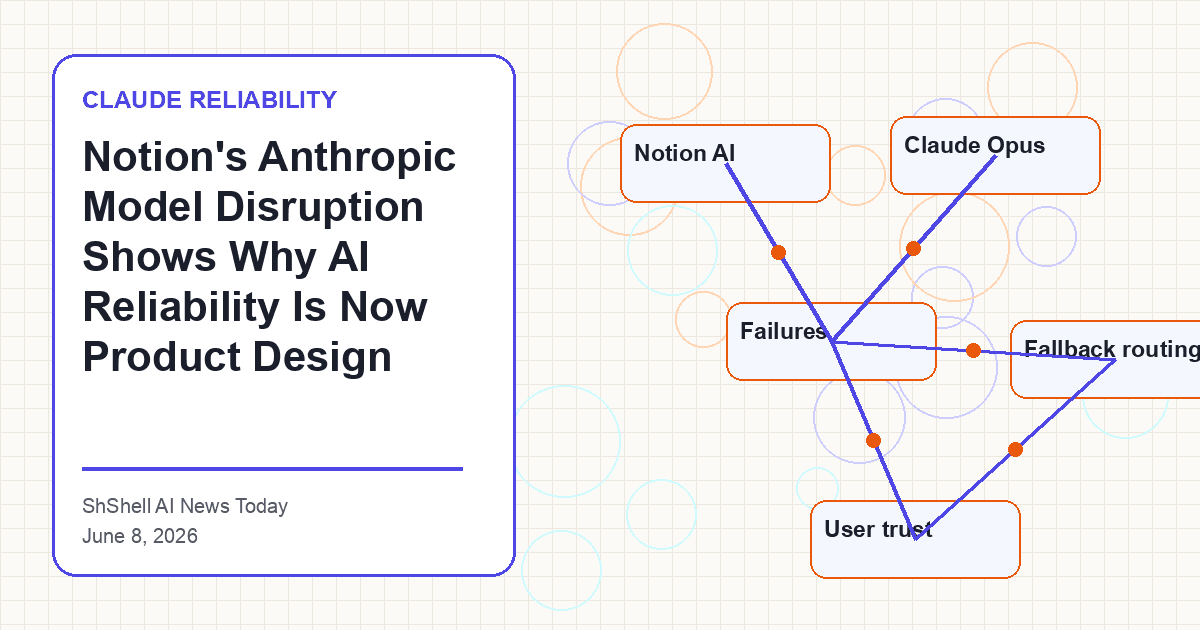
Notion's Anthropic Model Disruption Shows Why AI Reliability Is Now Product Design
Notion's temporary Anthropic model outage turned Claude reliability, fallbacks, and agent governance into urgent AI News Today material.
Notion's Anthropic Model Disruption Shows Why AI Reliability Is Now Product Design
Notion did not need a week-long outage to expose the new enterprise AI problem. A few hours of degraded Claude access were enough to show that model reliability is now part of product design, not an invisible vendor concern.
Source trail
- TechCrunch — reported that Notion temporarily disabled all Anthropic models after degraded performance affected Opus 4.7 and 4.8 selections in Notion AI.
- Anthropic status and product context — provides current Claude product context, including Opus 4.8 as the latest Opus class model released on May 28, 2026.
- Notion public communication via TechCrunch report — said access was restored and quoted Notion product lead Max Schoening framing the incident as a temporary service disruption rather than a model-quality story.
This article uses those sources as the factual base and adds ShShell analysis for builders, buyers, operators, and learners following latest AI news. Reported plans are identified as reports rather than confirmed launches.
Ten source-grounded facts that anchor the story
- TechCrunch reported that Notion posted early Sunday that Anthropic Opus 4.7 and 4.8 models were experiencing degraded performance inside Notion AI.
- Notion temporarily disabled all Anthropic models in its automated productivity tool during the disruption.
- About twelve hours later, Notion product leader Max Schoening said the issue was a temporary service disruption and that Anthropic model access had been restored.
- Anthropic told TechCrunch that a brief infrastructure issue caused elevated errors on multiple Claude models for a short period.
- The disruption became a social-media story because some readers interpreted the disablement as a model-quality signal rather than an availability incident.
- The incident happened shortly after Anthropic's May 28 Opus 4.8 release, which made the model-name confusion commercially sensitive.
- The strongest reading is operational rather than promotional: teams should evaluate the workflow, evidence, cost, and permissions before treating the announcement as production-ready.
- The strongest reading is operational rather than promotional: teams should evaluate the workflow, evidence, cost, and permissions before treating the announcement as production-ready.
- The strongest reading is operational rather than promotional: teams should evaluate the workflow, evidence, cost, and permissions before treating the announcement as production-ready.
- The strongest reading is operational rather than promotional: teams should evaluate the workflow, evidence, cost, and permissions before treating the announcement as production-ready.
The operating map
graph TD
    A[User selects Claude in Notion AI] --> B[Notion model router]
    B --> C[Anthropic Opus endpoint]
    C --> D{Elevated errors}
    D --> E[Temporary disablement]
    E --> F[Fallback or degraded UX]
    F --> G[Restored access]
    G --> H[Post-incident trust review]
Decision table
| Layer | What it changes | What to verify |
|---|---|---|
| Model degradation | Lower quality responses | Eval drift, user reports, answer audits |
| Service disruption | Higher error rates or failures | Status telemetry, retries, vendor incident data |
| Router weakness | Bad fallback choice | Per-model health checks and policy rules |
| UX confusion | Users blame the AI product | Clear incident messaging in-product |
| Governance gap | No owner for model incidents | Runbooks, SLOs, vendor review |
What happened inside Notion AI
The sequence is narrow but important. Notion saw degraded performance for users selecting Anthropic's Opus 4.7 and 4.8 models in Notion AI, then disabled Anthropic models temporarily. TechCrunch reported that Notion restored access later the same day, while Anthropic described the root as a brief infrastructure issue with elevated errors across multiple Claude models.
That distinction matters. A service disruption is not the same as a model quality regression. A model quality regression means the same request returns less capable answers under healthy infrastructure. A service disruption means requests fail, time out, or return elevated errors because the serving path is unhealthy. Users experience both as the AI not working, but operators need different playbooks for each.
The incident was amplified because Notion AI is not a toy integration. It sits inside a workplace product where users draft documents, summarize meetings, query knowledge bases, and automate routine content work. When an integrated model fails, the visible brand is often Notion, not Anthropic. That is the new support reality for SaaS products that embed third-party large language models.
Why this is more than an outage note
For AI News Today readers, the Notion incident is a reliability lesson. Agentic AI depends on chains of services: the user-facing app, the model router, the model provider, embeddings or retrieval, connectors, auth, logging, moderation, and sometimes background workers. Any one of those layers can break the user's mental model of the product.
It also shows why buyers should ask about multi-model strategy. Notion temporarily disabling all Anthropic models may have been the right operational choice during the incident, but it raises a broader design question: what should happen when one provider is unhealthy? Should users be routed to another model automatically? Should the product pause only high-risk workflows? Should it show a banner explaining that a vendor issue may affect results? The answer depends on the task.
A low-risk summarization task might safely fall back to another LLM. A task that depends on Claude-specific behavior, long-context performance, or an enterprise contract may need to stop rather than silently change providers. The deeper point is that model routing is no longer just a cost optimization layer. It is a product trust layer.
The reliability architecture teams need now
A production AI product needs health checks that operate at the model and workflow level. Basic API uptime is not enough. A healthy response can still be too slow, incomplete, over budget, or missing required citations. Teams should track error rate, latency distribution, retry rate, token spend, fallback rate, and user-visible failure messages by provider and model.
The router should separate three decisions. First, is the provider available? Second, is the selected model appropriate for this workflow? Third, is it safe to continue or should the user approve a fallback? That separation prevents a temporary provider issue from becoming a silent behavior change. It also gives support teams a clear explanation when customers ask why their AI tool behaved differently.
For ai agents, the stakes are higher. A document summary can fail visibly. A background agent might continue after receiving partial context or a malformed tool result. That is why agent orchestration should include circuit breakers, max retries, task checkpoints, and explicit failure states. A workflow that cannot tell the difference between degraded model service and weak reasoning should not be trusted with irreversible actions.
What Notion and Anthropic made visible
The public messaging became part of the event. Schoening's reported response pushed back on the idea that this was evidence of bad model quality. Anthropic's statement framed the issue as infrastructure and said it had been resolved. Those messages matter because model brands now carry enterprise confidence. A rumor that a flagship model became unreliable can spread faster than a dry status-page update.
Vendors should expect more incidents like this. As more SaaS products expose model choice directly to users, temporary provider issues will be noticed by non-technical customers. The model name in a dropdown is now a product promise. If a user chooses Claude Opus, GPT, Gemini, or another model, the host app has to explain what happens when that choice is unavailable.
This is also a procurement signal. Enterprise buyers should ask vendors whether model-provider incidents are included in service reviews. They should ask whether the product has tested failover, whether fallback models are disclosed, and whether audit logs show which model produced which output. Those are no longer edge-case questions.
How builders should respond this week
Builders do not need to overreact by building five-provider routing on day one. They do need to define the workflows where model downtime harms users and the workflows where automatic fallback is acceptable. That list should be explicit. A customer-support draft may fall back. A legal memo may pause. A code-modifying agent may ask for approval before switching models.
Teams should also improve incident language. Users understand that cloud software can break. What damages trust is ambiguity: was the model less smart, was the vendor down, did my data fail to load, or did the product choose a cheaper fallback? A good AI product explains the failure class in plain language and gives the user a next action.
The takeaway for ShShell readers is practical. If your app embeds llms, add provider health telemetry before users force you to. If your team uses Notion AI, Claude, ChatGPT, or Gemini for core workflows, write a short fallback policy now. The latest AI news is not only about more capable models. It is about whether those models can be operated like dependable software.
What to monitor next
The next signal to watch is whether this story produces durable product behavior rather than a short-lived headline. For builders, that means APIs, controls, logs, benchmarks, and examples that survive contact with real workflows. For buyers, it means procurement language that names the model, the data boundary, the fallback plan, and the operational owner. For learners, it means treating the announcement as a case study in how large language models become systems.
ShShell readers tracking Artificial Intelligence News should connect this event to a broader pattern in 2026: the market is moving from impressive isolated models toward governed AI work surfaces. The durable skills are not only prompt engineering or memorizing model names. They are workflow design, evaluation design, source discipline, cost awareness, and the ability to decide where humans must stay in the loop.
That is why this belongs in AI News today. It changes the practical questions teams should ask before they deploy ai agents or buy new ai tools: what does the system know, what can it do, what happens when it fails, and who is accountable for the result?
Additional implementation notes for builders
For operators, the immediate discipline is to convert Claude Reliability into a runbook. The runbook should define the owner, the allowed data, the fallback path, the human approval point, and the measurement that proves whether the workflow improved. Without that discipline, the team is only reacting to latest AI news instead of learning from it.
For executives, the relevant question is not whether Claude Reliability sounds strategic. The question is whether it changes a budget, an architecture, a risk register, or a training plan. If the answer is no, the announcement is worth watching but not worth reorganizing around yet.
For hands-on builders, the practical exercise is to write three test cases that would break the optimistic version of this story. One should test stale context, one should test ambiguous user intent, and one should test an integration failure. Strong AI tools become trustworthy when teams test the edges, not when teams admire the launch post.
For people trying to Learn AI, this story is a reminder that large language models are only one layer. The surrounding layers include product design, identity, data access, monitoring, cost controls, and human review. Real AI training should teach those layers together because production failures usually happen between them.
For operators, the immediate discipline is to convert Claude Reliability into a runbook. The runbook should define the owner, the allowed data, the fallback path, the human approval point, and the measurement that proves whether the workflow improved. Without that discipline, the team is only reacting to latest AI news instead of learning from it.
For executives, the relevant question is not whether Claude Reliability sounds strategic. The question is whether it changes a budget, an architecture, a risk register, or a training plan. If the answer is no, the announcement is worth watching but not worth reorganizing around yet.
For hands-on builders, the practical exercise is to write three test cases that would break the optimistic version of this story. One should test stale context, one should test ambiguous user intent, and one should test an integration failure. Strong AI tools become trustworthy when teams test the edges, not when teams admire the launch post.
For people trying to Learn AI, this story is a reminder that large language models are only one layer. The surrounding layers include product design, identity, data access, monitoring, cost controls, and human review. Real AI training should teach those layers together because production failures usually happen between them.
For operators, the immediate discipline is to convert Claude Reliability into a runbook. The runbook should define the owner, the allowed data, the fallback path, the human approval point, and the measurement that proves whether the workflow improved. Without that discipline, the team is only reacting to latest AI news instead of learning from it.
For executives, the relevant question is not whether Claude Reliability sounds strategic. The question is whether it changes a budget, an architecture, a risk register, or a training plan. If the answer is no, the announcement is worth watching but not worth reorganizing around yet.
For hands-on builders, the practical exercise is to write three test cases that would break the optimistic version of this story. One should test stale context, one should test ambiguous user intent, and one should test an integration failure. Strong AI tools become trustworthy when teams test the edges, not when teams admire the launch post.
For people trying to Learn AI, this story is a reminder that large language models are only one layer. The surrounding layers include product design, identity, data access, monitoring, cost controls, and human review. Real AI training should teach those layers together because production failures usually happen between them.
For operators, the immediate discipline is to convert Claude Reliability into a runbook. The runbook should define the owner, the allowed data, the fallback path, the human approval point, and the measurement that proves whether the workflow improved. Without that discipline, the team is only reacting to latest AI news instead of learning from it.
For executives, the relevant question is not whether Claude Reliability sounds strategic. The question is whether it changes a budget, an architecture, a risk register, or a training plan. If the answer is no, the announcement is worth watching but not worth reorganizing around yet.
For hands-on builders, the practical exercise is to write three test cases that would break the optimistic version of this story. One should test stale context, one should test ambiguous user intent, and one should test an integration failure. Strong AI tools become trustworthy when teams test the edges, not when teams admire the launch post.
For people trying to Learn AI, this story is a reminder that large language models are only one layer. The surrounding layers include product design, identity, data access, monitoring, cost controls, and human review. Real AI training should teach those layers together because production failures usually happen between them.
For operators, the immediate discipline is to convert Claude Reliability into a runbook. The runbook should define the owner, the allowed data, the fallback path, the human approval point, and the measurement that proves whether the workflow improved. Without that discipline, the team is only reacting to latest AI news instead of learning from it.
For executives, the relevant question is not whether Claude Reliability sounds strategic. The question is whether it changes a budget, an architecture, a risk register, or a training plan. If the answer is no, the announcement is worth watching but not worth reorganizing around yet.
For hands-on builders, the practical exercise is to write three test cases that would break the optimistic version of this story. One should test stale context, one should test ambiguous user intent, and one should test an integration failure. Strong AI tools become trustworthy when teams test the edges, not when teams admire the launch post.
For people trying to Learn AI, this story is a reminder that large language models are only one layer. The surrounding layers include product design, identity, data access, monitoring, cost controls, and human review. Real AI training should teach those layers together because production failures usually happen between them.
For operators, the immediate discipline is to convert Claude Reliability into a runbook. The runbook should define the owner, the allowed data, the fallback path, the human approval point, and the measurement that proves whether the workflow improved. Without that discipline, the team is only reacting to latest AI news instead of learning from it.
For executives, the relevant question is not whether Claude Reliability sounds strategic. The question is whether it changes a budget, an architecture, a risk register, or a training plan. If the answer is no, the announcement is worth watching but not worth reorganizing around yet.
For hands-on builders, the practical exercise is to write three test cases that would break the optimistic version of this story. One should test stale context, one should test ambiguous user intent, and one should test an integration failure. Strong AI tools become trustworthy when teams test the edges, not when teams admire the launch post.
For people trying to Learn AI, this story is a reminder that large language models are only one layer. The surrounding layers include product design, identity, data access, monitoring, cost controls, and human review. Real AI training should teach those layers together because production failures usually happen between them.
For operators, the immediate discipline is to convert Claude Reliability into a runbook. The runbook should define the owner, the allowed data, the fallback path, the human approval point, and the measurement that proves whether the workflow improved. Without that discipline, the team is only reacting to latest AI news instead of learning from it.
For executives, the relevant question is not whether Claude Reliability sounds strategic. The question is whether it changes a budget, an architecture, a risk register, or a training plan. If the answer is no, the announcement is worth watching but not worth reorganizing around yet.
For hands-on builders, the practical exercise is to write three test cases that would break the optimistic version of this story. One should test stale context, one should test ambiguous user intent, and one should test an integration failure. Strong AI tools become trustworthy when teams test the edges, not when teams admire the launch post.
For people trying to Learn AI, this story is a reminder that large language models are only one layer. The surrounding layers include product design, identity, data access, monitoring, cost controls, and human review. Real AI training should teach those layers together because production failures usually happen between them.
For operators, the immediate discipline is to convert Claude Reliability into a runbook. The runbook should define the owner, the allowed data, the fallback path, the human approval point, and the measurement that proves whether the workflow improved. Without that discipline, the team is only reacting to latest AI news instead of learning from it.