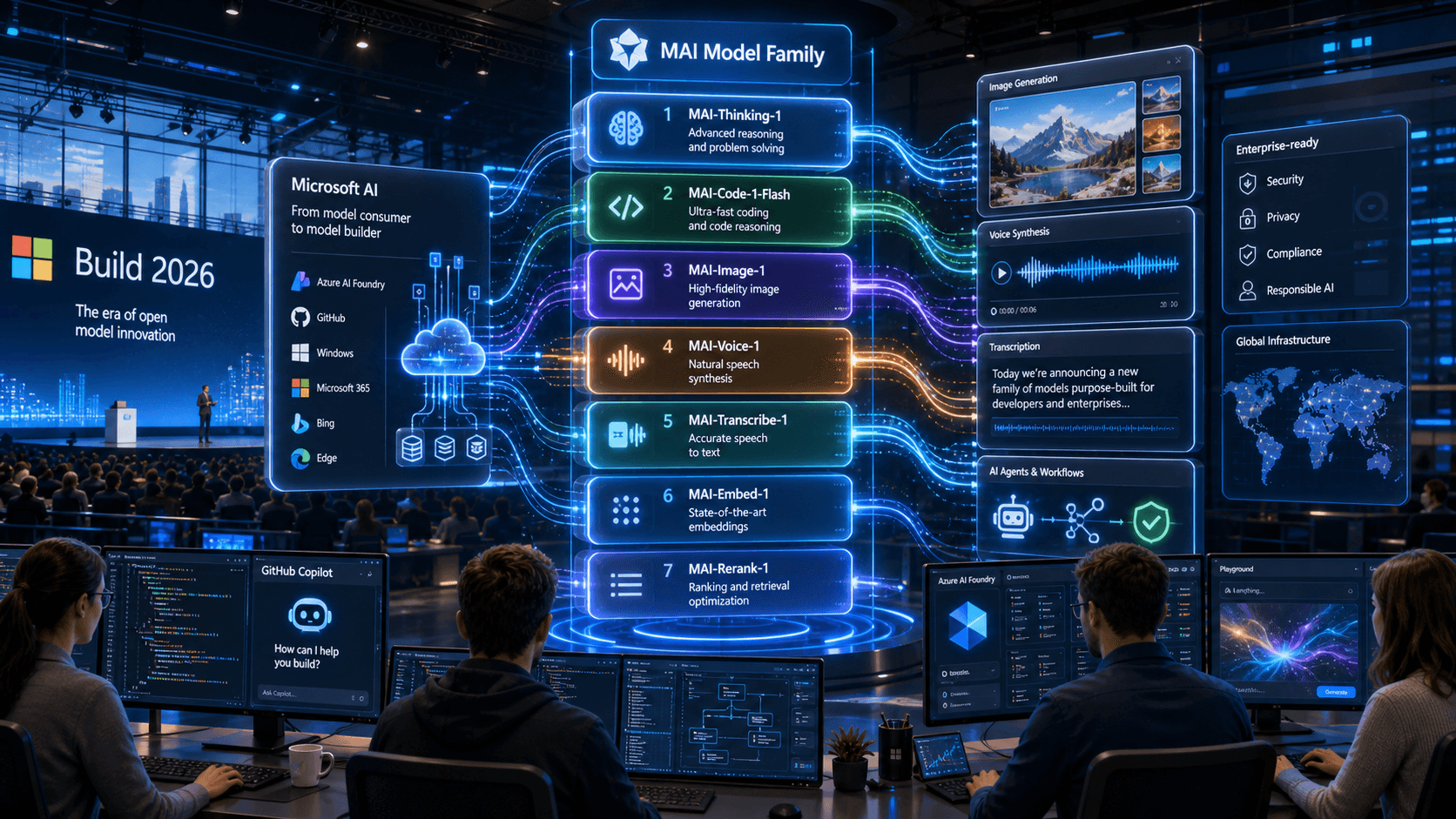
Microsoft's MAI Model Family Turns Build 2026 Into an Agentic AI Platform Reset
Microsoft's MAI model family signals a deeper Agentic AI platform strategy across coding, reasoning, voice, image, transcription, and developer workflows.
Microsoft's MAI Model Family Turns Build 2026 Into an Agentic AI Platform Reset
Microsoft's reported MAI model expansion at Build 2026 is not just another model-release headline. It is a platform-control story. If Microsoft has more of its own reasoning, coding, voice, image, and transcription models inside the stack that already includes Azure AI Foundry, GitHub Copilot, Windows, Microsoft 365, and enterprise identity, then the company is no longer only a distributor of frontier AI. It is shaping the model layer that developers and businesses will touch every day.
That matters because agentic systems are assembled from more than one model. A coding assistant may need a reasoning model, a repo-search model, a code-generation model, a summarizer, an audio interface, an image understanding model, and a policy layer. The Build 2026 signal is that Microsoft wants those pieces to live inside its own developer and enterprise platform, not only behind calls to external model partners.
Source trail
- Windows Central report on Microsoft's seven MAI models
- Microsoft Build 2026 book of news
- Microsoft AI official site
- Microsoft Azure AI Foundry documentation
- GitHub Copilot documentation
This article uses those sources as the factual base and adds ShShell analysis for developers, AI platform teams, CIOs, and readers tracking latest AI news. The article treats model names and capability claims from secondary reporting as reported claims unless Microsoft documentation confirms production availability.
What changed at Build 2026
The reported news is that Microsoft showed or discussed a broader MAI model family at Build 2026, spanning several functions that matter to agentic software: reasoning, coding, image work, speech, transcription, and possibly smaller specialized systems for workflow routing. Even if every model is not immediately available to every developer, the direction is clear. Microsoft wants to build a first-party AI substrate for the workflows it already owns.
That is different from simply saying "Microsoft uses OpenAI." The Microsoft-OpenAI partnership remains strategically important, but a first-party MAI family gives Microsoft more control over cost, latency, routing, policy, product tuning, and integration. A Copilot feature in Visual Studio Code does not always need the same model as a Teams transcript summarizer. A Windows on-device assistant does not always need the same model as an Azure-hosted enterprise research agent. A platform with multiple models can route each task to a system that is cheaper, faster, safer, or more specialized.
For Artificial Intelligence News readers, this is the point: model portfolios are becoming a platform feature. The market is moving past the question of which single LLM is best. The better question is which platform can orchestrate large language models, smaller task models, retrieval, tools, identity, audit logs, and deployment controls in a way developers can trust.
Why this is a developer-stack reset
Build is Microsoft's developer conference, so the MAI signal should be read through developer workflows. A developer does not experience AI as a research benchmark. A developer experiences it as autocomplete, code review, test generation, documentation search, bug triage, terminal help, deployment diagnostics, security explanations, and product support. Each of those tasks has a different tolerance for hallucination, latency, privacy, and cost.
The platform reset is that Microsoft can now place model choice closer to the developer workflow. GitHub Copilot can use one set of models for code suggestions, another for repo-level reasoning, another for conversational planning, and another for voice or multimodal input. Azure AI Foundry can expose model routing and evaluation to enterprise teams. Microsoft 365 can connect models to calendars, documents, email, meetings, and identity controls. Windows can become the local runtime surface for smaller models.
graph TD
    User[Developer or enterprise user]
    Surface[GitHub, VS Code, Windows, M365, Azure]
    Router[Model routing and policy layer]
    Reason[MAI reasoning model]
    Code[MAI coding model]
    Voice[MAI voice or transcription model]
    Vision[MAI image model]
    Tools[Repos, docs, tickets, cloud APIs]
    Audit[Identity, logging, and evaluation]
    User --> Surface
    Surface --> Router
    Router --> Reason
    Router --> Code
    Router --> Voice
    Router --> Vision
    Reason --> Tools
    Code --> Tools
    Voice --> Tools
    Vision --> Tools
    Tools --> Audit
    Router --> Audit
The diagram shows why a model family matters. The important layer is not only the model. It is routing plus tools plus audit. If Microsoft can make that loop feel native across GitHub, Azure, Windows, and Microsoft 365, then its AI platform becomes harder to replace than a single API endpoint.
Who is affected by the MAI move
Developers are first. A broader MAI stack could change how Copilot handles long-horizon coding tasks, repo search, code explanations, test generation, command-line help, and agentic pull-request work. The practical developer question is whether the system can inspect the right files, make a correct change, run tests, explain the diff, and hand control back before it does damage.
Enterprise architects are second. They have to decide whether to standardize AI workflows on Azure AI Foundry, GitHub, and Microsoft 365 because those platforms already have identity and compliance hooks. If MAI models sit inside that stack, the buying decision becomes less about raw model quality and more about governance, integration, support, and cost predictability.
OpenAI and other model providers are third. Microsoft can still route high-end tasks to partner models, but every first-party MAI model gives Microsoft more leverage. It can decide when a task needs an OpenAI frontier model and when an internal model is good enough. That matters for margins. It also matters for product speed, because Microsoft can tune internal models for its own surfaces without waiting for every external roadmap.
What a model family changes technically
A model family lets Microsoft split work by job type. A coding task needs repository context, syntax discipline, test awareness, and patch-generation behavior. A voice task needs low latency and natural turn-taking. A transcription task needs speaker handling, domain vocabulary, and reliable timestamps. An image task needs visual grounding. A reasoning task needs planning and tool-use discipline. Bundling all of that into one frontier model is expensive and often unnecessary.
Specialization also makes evaluation more practical. A coding model can be tested on internal repo tasks, build failures, migration jobs, and security fixes. A transcription model can be tested on meeting audio, accents, jargon, and noisy rooms. A reasoning model can be tested on enterprise workflows that require tool calls and policy decisions. That is better than using a single broad benchmark and pretending it predicts every product surface.
The risk is fragmentation. If a Copilot experience silently routes to different MAI models, developers need enough visibility to debug behavior. Why did one request use one model and another request use a different one. Was context truncated. Was a safety policy applied. Did the model fail because of capability, retrieval, permissions, or tool integration. Without clear traces, a multi-model platform can become opaque.
The Microsoft advantage is distribution plus identity
Microsoft's strongest AI advantage is not only research talent. It is distribution through work software. GitHub sits where developers write code. Azure sits where companies deploy infrastructure. Microsoft 365 sits where documents, meetings, and email live. Entra ID sits where enterprise identity and permissions are managed. Windows sits on the device.
That distribution lets Microsoft turn AI features into default workflows. A developer may not shop for a standalone AI code review product if Copilot already opens inside the repository. A company may not build a custom meeting-summary pipeline if Teams and Microsoft 365 already provide one with enterprise permissions. A security team may prefer an AI workflow that inherits Microsoft identity controls over a more powerful standalone tool with weaker governance.
This is why the MAI story belongs with ai agents and AI tools. The agent's quality depends on the model, but adoption depends on where the agent lives. A good agent inside the tool people already use can beat a better agent that requires a separate login, separate data policy, and separate procurement path.
What buyers should ask before standardizing
| Buyer question | Why it matters for MAI models | Evidence to request |
|---|---|---|
| Which model handled the task | Multi-model routing can hide behavior differences. | Model-routing logs or admin-visible traces. |
| Where did the data go | Enterprise prompts may include code, contracts, tickets, or meeting content. | Data residency, retention, and training-use documentation. |
| How are model changes governed | A model update can change code suggestions or compliance behavior. | Versioning, release notes, rollback options, and evaluation reports. |
| How does Copilot call tools | Agentic AI becomes risky when it writes, deploys, or modifies records. | Tool permission boundaries and approval gates. |
| What does it cost at scale | Routing many tasks through premium models can surprise budgets. | Usage dashboards, routing policies, and cost controls. |
These are not procurement formalities. They decide whether the platform is manageable after hundreds or thousands of employees start using it.
Why Microsoft still has to prove the details
The reported existence of seven MAI models does not automatically prove production readiness. Developers should separate three things: announcement, access, and operational evidence. An announcement says the direction. Access says who can use the model and where. Operational evidence says whether the model improves a real workflow under realistic constraints.
For a coding model, operational evidence means more than a demo. It means success on messy repositories, outdated dependencies, flaky tests, monorepos, CI failures, security patches, and review comments. For a voice or transcription model, evidence means low error rates in noisy enterprise meetings with domain terms. For a reasoning model, evidence means correct tool choice, reliable refusal behavior, and traceable decisions.
Microsoft's credibility will come from how much of this it exposes through Azure AI Foundry, GitHub Copilot, documentation, and admin controls. The more visible the evaluation and routing layer becomes, the easier it is for enterprises to trust the stack.
What developers should test first
Developers should not start by asking whether MAI models are better in general. They should choose a workflow that wastes time today. Good tests include: converting a failing CI log into a minimal patch, finding the source of a regression across a repository, generating unit tests for a risky function, explaining a cloud deployment error, summarizing a pull request for a reviewer, or turning a product requirement into a scoped implementation plan.
For each test, measure baseline time, review time, correctness, cost, and the number of human corrections. If the model gives a useful answer but creates too much review burden, the workflow is not solved. If it saves time on easy tasks but fails on the hard cases, route it accordingly. If it writes plausible code that does not pass tests, the integration needs better execution and verification, not a prettier chat panel.
Prompt engineering still matters, but in a Microsoft stack it should be paired with system design. A good prompt tells the model the repository target, output format, evidence requirement, and approval rule. A good system gives the model the right files, runs the right tests, limits dangerous commands, and records the trace.
What this means for OpenAI reliance
The MAI family also changes how observers should read Microsoft's relationship with OpenAI. It does not necessarily mean Microsoft is walking away from OpenAI. It means Microsoft is reducing dependence on any single external model for every AI feature. That is a rational platform move.
Frontier partner models may still handle the hardest reasoning tasks. First-party models may handle high-volume, latency-sensitive, privacy-sensitive, or product-specific tasks. The best economics may come from routing, not from choosing one model vendor forever. This is similar to cloud infrastructure: companies use premium services where they matter and cheaper specialized services where they are enough.
For AI News Today readers, the strategic signal is that large AI platforms are becoming model orchestrators. Microsoft, Google, Amazon, Meta, OpenAI, Anthropic, and xAI all want leverage over different layers. Microsoft has a special advantage because its layer is the work surface itself.
Risks that come with vertical integration
Vertical integration can improve usability, but it can also create opacity. If Microsoft controls the model, product surface, identity system, cloud runtime, and admin interface, customers may get a smoother experience while losing some ability to compare independently. That makes transparency more important, not less.
Enterprises should watch for lock-in at three layers. The first is data lock-in: workflows become easier inside Microsoft because the data already lives there. The second is evaluation lock-in: success metrics are defined by the vendor's dashboards. The third is agent lock-in: employees build habits around Copilot workflows that are hard to port elsewhere.
None of that makes the platform bad. It means buyers need an exit plan, exportable logs, clear governance, and model-comparison practices. A strong Microsoft AI strategy should make the organization more capable, not make it unable to evaluate alternatives.
What learners should take from this
For people trying to Learn AI, the MAI story is a good lesson in how large language models become products. The model is only one layer. The production system includes identity, retrieval, context windows, tool APIs, evaluation, cost routing, user interface, documentation, and support. AI courses that teach only prompts are missing half the stack.
The better learning path is to study model routing and workflow design. Why use a small model for transcription cleanup but a stronger model for planning. Why route code-generation tasks through test execution. Why attach citations to research outputs. Why require approval for state-changing actions. Those questions are now part of prompt engineering because prompts sit inside systems.
Developers who understand this will be more useful than developers who only know which model topped a leaderboard. Enterprises need people who can turn model capability into reliable workflows.
The economics behind Microsoft's model routing
The MAI model family also changes the cost conversation. Enterprises tend to notice AI pricing only after adoption spreads. A handful of Copilot experiments is one budget line. Millions of daily prompts across developers, meeting summaries, search, document drafting, support, and workflow agents is a different operating model. If every task goes to the most expensive frontier model, the platform becomes hard to scale. If every task goes to a cheaper model, quality breaks on complex work.
This is why first-party models matter. Microsoft can route high-volume, predictable tasks to lower-cost MAI systems while reserving premium models for hard reasoning. A Teams transcript cleanup may not need the same model as a multi-repository refactor. A screenshot explanation may not need the same model as an agent that touches production infrastructure. A short customer-service rewrite may not need the same model as a compliance analysis. The economic advantage comes from matching model cost to task risk.
Developers should expect model routing to become an invisible but important part of the platform. The user asks one question. The system decides whether to retrieve documents, call a coding model, use a reasoning model, call a speech model, or escalate. That can improve user experience, but it creates a new observability requirement. If the answer is wrong, the team needs to know whether the wrong model was selected, the prompt was weak, the retrieval was incomplete, the context was truncated, or the tool result was stale.
For buyers, the cost question should be tied to governance. Can administrators set routing policies. Can high-risk workflows force stronger models or human review. Can low-risk workflows use cheaper models. Can teams see cost per workflow, not only cost per user. Can security or legal teams require a specific model class for sensitive data. Without those controls, model routing becomes a black box that affects both quality and budget.
How MAI could change GitHub Copilot specifically
GitHub Copilot is the clearest place to watch. Coding assistants are no longer only autocomplete products. They are moving toward issue triage, pull-request generation, test repair, dependency migration, security explanation, documentation updates, and agentic coding tasks that span multiple files. Those workflows need different model behavior from ordinary chat.
A Microsoft coding model can be tuned around repository operations. It can learn to produce patches, respect project structure, ask for missing context, summarize diffs, and run through review-oriented outputs. The model still needs tool support, because code quality is not proven by prose. It is proven by tests, type checks, linters, builds, and human review.
The strongest Copilot workflow would look like this: inspect the issue, identify relevant files, propose a minimal plan, apply a patch, run tests, explain failures, revise, and produce a reviewable pull request. That is Agentic AI, but it is not autonomy without accountability. Each step should be visible. The user should know what changed and why.
This is where Microsoft has leverage. It owns GitHub, Azure, developer tooling, and enterprise identity. If MAI models improve the agent loop inside those surfaces, the value is not isolated model intelligence. It is a better software-delivery workflow.
Where the MAI story could disappoint
There are clear failure modes. Microsoft could announce many models but expose little detail. It could integrate them deeply but make routing opaque. It could optimize for demos rather than messy enterprise tasks. It could make Copilot feel more autonomous without giving teams enough review and rollback control. It could use first-party models to lower cost while quality varies across workflows.
Developers should watch for these signs during pilots. Does the model handle real repositories or only clean examples. Does it cite files and tests. Does it admit uncertainty. Does it ask for approval before risky actions. Does it keep behavior stable across model updates. Does it fail gracefully when context is missing. Does it help reviewers understand the work, or does it create plausible patches that require more cleanup than manual coding.
The platform reset only works if Microsoft makes the full system inspectable. Enterprises do not need every internal training detail. They do need enough transparency to evaluate quality, privacy, cost, and change management.
What to watch next
Watch whether Microsoft publishes clearer details on MAI availability, model names, benchmark results, and product integration. Watch where the models appear first: GitHub Copilot, Azure AI Foundry, Microsoft 365 Copilot, Windows, or developer APIs. The first surfaces will reveal which workflows Microsoft believes are ready.
Also watch pricing. If first-party MAI models reduce inference cost for high-volume Copilot or Microsoft 365 features, Microsoft gains room to bundle AI more aggressively. If premium tasks still depend heavily on external frontier models, routing policy becomes the key economic lever.
The third thing to watch is evaluation. Serious enterprise buyers should demand evidence tied to their own workflows. A Build demo can show direction. A pilot with logs, tests, cost data, and user review tells the truth.
Bottom line
Microsoft's MAI model family turns Build 2026 into an agentic platform story because it connects models to the places work already happens. The important question is not whether Microsoft has a model for every modality. The important question is whether Microsoft can route the right model through GitHub, Azure, Windows, and Microsoft 365 with enough evidence, control, and transparency for enterprises to trust it.
For builders following Latest AI News, this is the shift to study: the AI race is no longer only about the smartest model. It is about the platform that can turn reasoning, code, voice, vision, identity, tools, and governance into a workflow developers actually use.