Micro-Discovery: How Microsoft's New AI Platform is Solving Science’s Hardest Problems
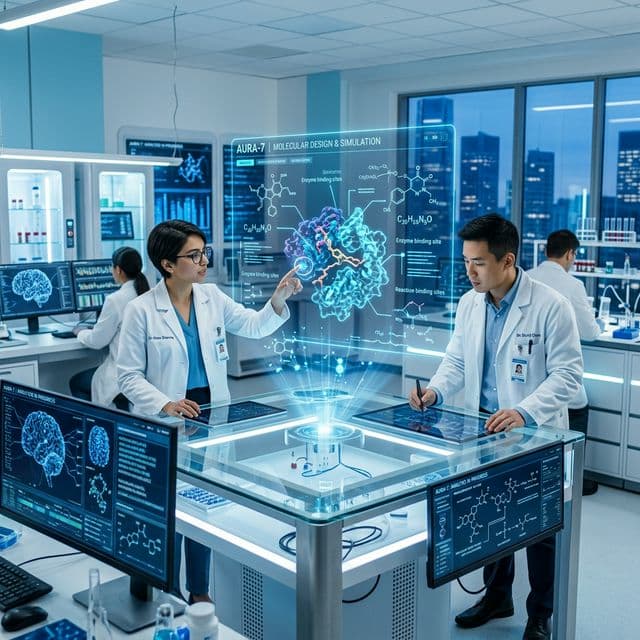
Microsoft unveils 'Microsoft Discovery,' an agentic AI platform for scientific R&D that has already compressed years of data center coolant research into just 200 hours.
Micro-Discovery: How Microsoft's New AI Platform is Solving Science’s Hardest Problems
The scientific method is getting a digital upgrade. On March 19, 2026, Microsoft announced the global release of Microsoft Discovery, an enterprise-grade agentic platform built specifically for the R&D labs of tomorrow.
While the consumer world has been focused on AI writing emails and creating art, Microsoft Research has been quietly building an "AI Lab Assistant" capable of summarizing 100 years of chemical literature, generating novel hypotheses, and even controlling automated laboratory equipment to test them.
"2026 is the year AI moves from being a researcher's tool to being a researcher's partner," said Peter Lee, President of Microsoft Research.
The Core Engine: Graph-Based Reasoning and Azure Scale
Microsoft Discovery is not just a Large Language Model. It is a Reasoning Hierarchy that combines:
- A Domain-Specific Knowledge Graph: Ingesting every academic paper, patent, and clinical trial published in the last 50 years.
- Simulation Agents: Specialized models trained in quantum chemistry, molecular dynamics, and materials physics.
- The Orchestrator: An agentic brain that manages the "Discovery Lifecycle"—from initial question to final verified proof.
The Breakthrough: 200 Hours vs. 2 Years
To demonstrate the platform's power, Microsoft revealed it used the system to find a Novel Data Center Coolant Prototype.
- Traditional Process: Researchers would spend 18-24 months screening thousands of candidates, testing toxicity, and measuring thermal properties.
- Microsoft Discovery Process: The AI agent analyzed 5 million potential molecular combinations, performed 50,000 high-fidelity simulations, and identified the top 3 candidates in just 200 hours.
graph TD
    subgraph "The Discovery Lifecycle"
    A[Human Researcher: Goal] --> B{Microsoft Discovery Orchestrator}
    B --> C[Literature Review Agent]
    B --> D[Hypothesis Generation Agent]
    B --> E[Simulation & Testing Agent]
    C --> B
    D --> B
    E --> B
    B --> F[Validated Result: Prototype]
    end

    subgraph "Real-World Output"
    F --> G[Automated Lab synthesis]
    G --> H[Physical Verification]
    end

    style B fill:#00A4EF,stroke:#333,stroke-width:2px,color:#fff
    style F fill:#76b900,stroke:#333
Deep-Dive: The Three Pillars of Microsoft Discovery
1. Autonomous Hypothesis Generation
Most AI models are reactive—they answer questions. Microsoft Discovery is proactive. Using a technique called "Cognitive Gap Analysis," the model scans scientific literature to find "white spaces"—areas where two different fields (e.g., neuroscience and metallurgy) might intersect but haven't been studied together. It then suggests experiments that a human might never think of.
2. Digital Twin Simulations
Before a single drop of chemicals is touched, Microsoft Discovery runs experiments in a high-fidelity "Digital Twin" of the laboratory environment. This allows for the testing of extreme conditions—high pressure, high heat, or toxic exposure—without any physical risk or cost.
3. "Clean Room" Traceability
In science, the why is as important as the what. Microsoft Discovery includes an "Evidence Ledger." For every conclusion it reaches, it provides a cryptographically signed trail of the exact papers, simulation data, and logical steps used to get there. This makes the AI’s work fully compliant with FDA, EMA, and patent office standards for "Provable Discovery."
Sector Impact: Pharma, Energy, and Beyond
Healthcare: Curing the Incurable
Microsoft is already collaborating with GSK and The Estée Lauder Companies to apply this platform to drug discovery and dermatological research. The goal is to reduce the "DRUG-TO-MARKET" timeline from 10 years to 2 years by using AI to predict clinical trial failures before patients are even recruited.
Materials Science: Decarbonizing the Planet
The platform is being used to find new materials for high-capacity batteries and carbon-capture filters. By identifying molecules that can store 5x more energy than current lithium-ion solutions, Microsoft Discovery is effectively accelerating the transition to a net-zero world.
Comparison: Traditional R&D vs. AI-Assisted R&D
| Feature | Legacy R&D (2024) | Microsoft Discovery (2026) |
|---|---|---|
| Literature Review | Manual / Keyword Search | Multi-Modal Synthesis (Seconds) |
| Candidate Screening | Tens of Molecules | Millions of Molecules |
| Failure Cost | Millions of $ / Years | Fraction of Compute Credits |
| Collaboration | Siloed Teams | Real-time AI-Human Feedback Loop |
Safety and Ethics: The "Human-First" Guardrail
Microsoft is acutely aware of the risks of "automated science." To prevent the discovery of harmful pathogens or chemical weapons, the platform includes a Science Safety Layer (SSL). Developed in partnership with the Global Bio-Security Initiative, the SSL prevents the model from generating hypotheses related to restricted biological or chemical agents.
Frequently Asked Questions (FAQ)
Is Microsoft Discovery replacing human scientists?
No. It is designed to be a "Force Multiplier." It handles the brute-force analysis and simulation, allowing human scientists to focus on higher-level strategy, ethics, and physical validation.
Can small labs afford this?
Microsoft plans to release a "Discovery Tier" for academic institutions and non-profit research labs at a significantly discounted rate, ensuring that life-saving research isn't limited by budget.
Does the AI own the patents for its discoveries?
Current laws (including the UK shift mentioned in previous reports) affirm that humans must be the named inventors. Microsoft Discovery is legally treated as a "Sophisticated Tool," and the human researchers using it retain all intellectual property rights.
Conclusion: The Diffusion of Discovery
As Satya Nadella noted in his March 19th address, "We are moving from the era of discovery to the era of diffusion." Microsoft Discovery is the bridge that will allow scientific breakthroughs to happen at the speed of software. In the next decade, we may look back at 2026 as the year the "Innovation Bottleneck" was finally cleared.
This investigative report was prepared by Sudeep Devkota for the Daily AI News initiative. Data sourced from Microsoft Research’s 2026 Technical Showcase and the Global R&D Innovation Index.