Meta Muse Spark 1.1 Turns Agentic AI Into a Price War
Meta Muse Spark 1.1 brings aggressive API pricing, agentic coding, and a new developer channel into the latest AI news cycle.
Meta Muse Spark 1.1 Turns Agentic AI Into a Price War
Meta introduced Muse Spark 1.1 and opened the Meta Model API in public preview for United States developers on July 9, 2026. For people tracking latest AI news, that is not a small product note. It is a signal about where the AI market is moving now: away from isolated chat demos and toward systems that touch prices, privacy, infrastructure, safety commitments, and real engineering output.
The headline is easy to compress, but the consequences are not. The release matters because Meta is no longer treating frontier models only as feed-ranking infrastructure or free consumer assistants. It is pricing a paid developer API directly against OpenAI, Anthropic, Google, xAI, and the open-model ecosystem. The result is a story that matters to platform teams deciding whether to add another model provider to their routing layer, not because every team must react immediately, but because the announcement changes what a serious evaluation should include.
What happened this week
Meta introduced Muse Spark 1.1 and opened the Meta Model API in public preview for United States developers on July 9, 2026. That sentence is the anchor for the story, because it separates this item from the broader background hum around large language models, ai tools, and generative ai. This is not simply another company saying it is serious about Artificial Intelligence News. It is a specific product, report, study, or governance move that landed in the July 2026 cycle and forces a concrete decision for platform teams deciding whether to add another model provider to their routing layer.
The release matters because Meta is no longer treating frontier models only as feed-ranking infrastructure or free consumer assistants. It is pricing a paid developer API directly against OpenAI, Anthropic, Google, xAI, and the open-model ecosystem. In Latest AI News terms, the timing is the story. The industry has moved from asking whether AI can answer a question to asking whether an AI system can take an action, hold context, touch a workflow, and remain accountable after the first prompt disappears. That shift puts pressure on pricing, data rights, model safety, infrastructure, and developer behavior at the same time.
The important move is easy to miss if the article is read as generic AI News Today. The event changes the operating assumptions around one named piece of the market. It gives teams a new vendor to test, a new risk to model, a new benchmark to question, or a new governance signal to include in procurement. That is why this belongs in the daily AI news file rather than an evergreen explainer about agentic AI.
The facts that make this latest AI news material
-
Meta says Muse Spark 1.1 is available through the Meta Model API public preview.
-
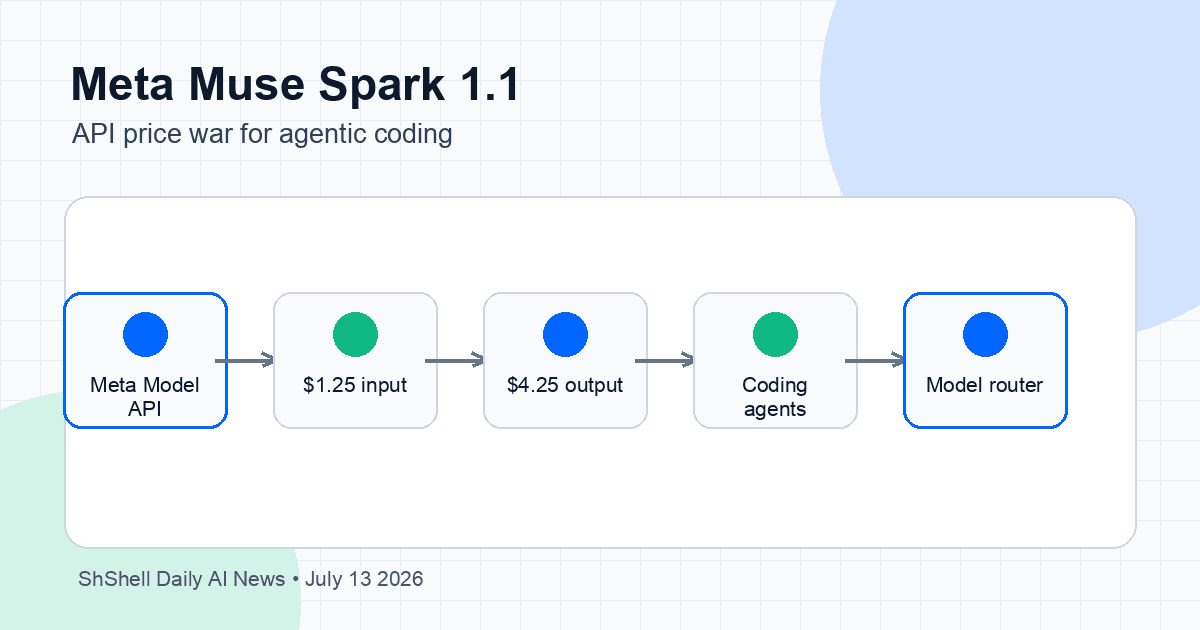
Reporting around the launch cites prices of 1.25 dollars per million input tokens and 4.25 dollars per million output tokens.
-
Coverage also describes 20 dollars in free credits for new API accounts.
-
The preview is limited at launch, which makes adoption breadth an open question.
-
Meta has framed the release as part of the Superintelligence Labs push led by Alexandr Wang.
Those facts do not prove the whole story by themselves. They define the boundary of what can be responsibly said right now. Product launches can overstate practical adoption. Reports can frame survey data through a vendor lens. Academic papers can measure available proxies rather than final economic value. Advocacy indexes can sharpen real governance gaps while still reflecting a particular institutional view of safety. The job for readers is to separate confirmed facts from implications.
For platform teams deciding whether to add another model provider to their routing layer, the immediate question is not whether the announcement sounds impressive. The question is what changes in a decision memo on Monday morning. If the answer is nothing, the story is noise. If the answer changes evaluation criteria, vendor routing, privacy controls, infrastructure budgets, rollout strategy, or risk review, then the story deserves attention.
How the system actually works
Muse Spark 1.1 is positioned around reasoning, coding, tool use, multimodal inputs, and agent workflows. Meta says the model is available in Thinking mode in the Meta AI app and on meta.ai, while the new API gives developers a direct integration path. The mechanism matters because most AI stories collapse into brand language. A model launch is not just a model launch if it changes the API surface and the economics of inference. A consumer image tool is not just a creative feature if it draws from social identity and public images. An infrastructure report is not just a survey if it describes why agents break old networks and data layers. A safety index is not just a ranking if it turns voluntary pledges into a comparative scorecard. A coding-agent study is not just another productivity claim if it observes thousands of real engineers over a rollout window.
undefined
flowchart LR
A["Developer
Calls Meta Model API"]
B["Meta Model API
Routes prompt to Muse Spark 1.1"]
A --> B
C["Muse Spark 1.1
Plans coding or agent task"]
B --> C
D["Tools and context
Provide files docs images and web grounding"]
C --> D
E["Application
Receives structured response or agent result"]
D --> E
    The flow above is the working model for this specific story. It shows the chain that builders should test instead of the headline they should admire. Every link can fail. A cheap model can become expensive if it needs too many retries. A creative model can become a trust problem if consent is vague. An agent platform can stall if the data layer is fragmented. A safety pledge can weaken if redlines are competitor-contingent. A coding-agent rollout can create more pull requests while increasing review load, duplicated work, or security debt.

    ## The strategic read for builders and buyers

    | Decision area | What changed in this story | Practical question for teams |
| --- | --- | --- |
| Product surface | Meta introduced Muse Spark 1.1 and opened the Meta Model API in public preview for United States developers on July 9, 2026. | Does this create a new workflow, or only a new option inside an existing workflow? |
| Operating model | Muse Spark 1.1 is positioned around reasoning, coding, tool use, multimodal inputs, and agent workflows. Meta says the model is available in Thinking mode in the Meta AI app and on meta.ai, while the new API gives developers a direct integration path. | Who owns reliability, audit trails, and user consent when this enters production? |
| Market pressure | The release matters because Meta is no longer treating frontier models only as feed-ranking infrastructure or free consumer assistants. It is pricing a paid developer API directly against OpenAI, Anthropic, Google, xAI, and the open-model ecosystem. | Does the news change vendor selection, architecture, budget, or policy timing? |
| Risk boundary | The facts are fresh, but some performance, pricing, adoption, and governance claims still need longer-term evidence. | What should be tested before the story becomes a production dependency? |

    The practical read is that AI adoption is becoming less about buying one impressive assistant and more about designing a controlled operating system around model choice. That operating system includes routing, observability, permissions, user education, consent, audit logs, rollback paths, and a way to compare claims against outcomes. This is where many teams are still weak. They have prompt engineering guides and enthusiasm, but they do not have a measurement model that can survive procurement, security review, legal review, and production incidents.

    The sharper version: platform teams deciding whether to add another model provider to their routing layer should avoid treating this news as a simple yes-or-no decision. The correct response is a test plan. What workload fits the announcement? What is the failure mode? What is the human review point? What metric would prove value? What metric would prove harm? What source of truth will settle the argument after the first demo?

    ## Two concrete scenarios this story changes

    A startup running repository repair agents can route low-risk codebase cleanup through Muse Spark 1.1 when cost matters, while reserving a pricier frontier model for security-sensitive architecture changes. That is the kind of workflow where the announcement becomes operational, not rhetorical. The team can measure total cost, latency, human review time, error rate, and whether the result survives real use. If it cannot be measured at that level, it should not be counted as business value.

    An internal tools team can test Meta Model API as a backup model in a gateway, then compare task completion, review burden, and total token spend against the same tasks on Claude, Gemini, Codex, and Grok. This second scenario is deliberately different because single-example thinking is dangerous in AI rollouts. Some systems are cost-sensitive. Some are trust-sensitive. Some are latency-sensitive. Some are reputation-sensitive. The same model, policy, report, or study can point to opposite decisions depending on the risk profile.

    ## What remains uncertain

    The first uncertainty is durability. Fresh AI news often arrives before the slow facts appear: renewal rates, real production usage, enterprise procurement friction, failure frequency, regulatory response, and whether early pricing survives when compute demand grows. That is especially true when the topic touches agentic AI, because agent workloads are longer, less predictable, and harder to evaluate than one-shot chat.

    The second uncertainty is comparability. Companies and institutions rarely measure the same thing in the same way. A benchmark score, a survey finding, a safety grade, a model price, and a pull-request metric can all be useful while still being incomplete. Buyers should ask what was measured, what was excluded, who had access, what incentives shaped the framing, and whether the source can be independently checked.

    The third uncertainty is governance. The moment AI systems take actions, use personal data, inspect code, or influence operational decisions, the organization needs more than a prompt policy. It needs identity boundaries, approval gates, incident response, logging, and a habit of saying no to impressive demos that cannot be supervised.

    ## The operating questions teams should ask before copying the headline

    The first operating question is ownership. Platform teams deciding whether to add another model provider to their routing layer should decide who is accountable when this news becomes a deployed workflow. A product manager may own the user promise, an engineering lead may own integration quality, a security lead may own policy, and finance may own cost exposure, but the system itself will cut across all four. If ownership is vague, the headline creates motion without responsibility.

    The second operating question is reversibility. The safest AI rollouts are designed so a team can turn the feature down, route around a provider, disable a risky data source, pause an agent action, or roll back a policy without breaking the rest of the product. This matters for this story because the fresh facts are still moving. Pricing can change. Model access can narrow. Regulatory pressure can rise. Benchmark claims can be challenged. A study can inspire imitation before the limits are understood.

    The third operating question is evidence. A useful evaluation plan should include a before state, an after state, and a human review of failure cases. For platform teams deciding whether to add another model provider to their routing layer, that means measuring the exact workflow affected by this announcement rather than asking users whether they liked the new tool. Sentiment is useful, but it is not enough. The stronger measures are task completion, rework, latency, cost per successful outcome, escalation rate, defect rate, consent complaints, policy exceptions, and the time reviewers spend cleaning up AI output.

    The fourth operating question is data boundary. If the system touches source code, customer records, social images, infrastructure telemetry, safety evaluations, or internal workflows, the input boundary matters as much as the output. A model can be impressive and still be inappropriate for a given dataset. A workflow can be efficient and still be hard to audit. A policy can sound responsible and still leave the most important threshold undefined.

    The fifth operating question is substitution. Does this development replace an old workflow, complement it, or create a parallel process that adds complexity? Many AI deployments fail quietly because they do not remove any existing work. They add an assistant, a dashboard, a second review queue, a new vendor account, and a new incident path. The team feels more modern, but the operating load increases. The best response to this story is to find one workflow where substitution is real enough to test.

    ## How this fits the 2026 AI market

    The 2026 market is being pulled in two directions at once. On one side, frontier labs are trying to prove that large language models can plan longer, use tools better, reason across more context, and serve as ai agents rather than answer engines. On the other side, buyers are demanding lower prices, clearer controls, better safety evidence, and infrastructure that does not collapse under production workloads. This story sits directly inside that tension.

    That tension explains why the same announcement can look exciting to one team and risky to another. A developer platform group may see a new routing option. A privacy team may see ambiguous consent. A cloud architect may see hidden inference taxes. A policy lead may see a voluntary framework that needs enforcement. A CTO may see a productivity claim that still needs quality data. None of those readings are contradictions. They are different views of the same operational object.

    The competitive layer also matters. AI providers are no longer competing only on benchmark charts. They are competing on token economics, tool integration, distribution, developer experience, enterprise controls, safety posture, and the credibility of their own internal usage data. That is why a story about one product or report can affect architecture decisions beyond the named company. Teams are learning how to build model-agnostic systems because the market changes too quickly for one provider to be treated as permanent.

    The adoption layer is just as important. Many organizations now have AI access but weak AI habits. They have accounts, pilots, and internal champions, yet they do not have a repeatable path from promising demo to governed workflow. This article's topic matters because it gives teams another live case study in that transition. The right lesson is not to copy the newest release. The right lesson is to improve the machinery for evaluating releases.

    ## A practical evaluation plan for this specific story

    Start with a narrow workload tied to the event: A startup running repository repair agents can route low-risk codebase cleanup through Muse Spark 1.1 when cost matters, while reserving a pricier frontier model for security-sensitive architecture changes. Do not begin with a vague transformation goal. Begin with ten to fifty real tasks, a baseline, and a review rubric. The task set should include easy cases, edge cases, and cases where the system should refuse or escalate.

    Next, run a controlled comparison. If the story is about model pricing, compare total cost per accepted output, not just listed token price. If it is about privacy, compare user expectations against actual data flows. If it is about infrastructure, compare the demo path against the production path with logging and permissions enabled. If it is about safety governance, compare public commitments against enforceable obligations. If it is about coding agents, compare merged work against review burden and defect rate.

    Then assign a human review owner. Agentic AI workflows fail in ways that are difficult to see from aggregate metrics alone. A review owner should inspect failed tasks, surprising successes, retries, user complaints, security exceptions, and cases where the system appeared correct but depended on a brittle assumption. This is where many teams discover that the main bottleneck is not the model. It is the missing review process around the model.

    Finally, decide the stop condition before expanding. A stop condition might be cost above a threshold, low acceptance rate, unclear consent, missing audit logs, unacceptable latency, weak safety documentation, or higher review burden than the workflow can absorb. This prevents the team from treating sunk effort as proof of value. Fresh AI news should earn expansion through evidence, not momentum.

    ## What to do next

    Watch whether Meta expands the API beyond public preview, whether it keeps pricing aggressive after free-credit experimentation, and whether developers trust a closed Meta model for production agent workflows. That is the near-term watchlist. It is more useful than asking whether the news is good or bad. The better question is whether the announcement changes the test you should run this week.

    For Learn AI readers, the lesson is specific: follow the mechanism, not the marketing. Identify the actor, the product, the workflow, the dependency, the metric, and the failure mode. Then decide whether the news should change your architecture, your buying plan, your governance checklist, or your training material.

    ## Sources checked

    - [Meta AI](https://ai.meta.com/blog/introducing-muse-spark-meta-model-api/) - launch blog for Muse Spark 1.1 and Meta Model API.
- [The Verge](https://www.theverge.com/ai-artificial-intelligence/963193/meta-muse-spark-model-api) - coverage of the API preview and model positioning.
- [Business Insider](https://www.businessinsider.com/meta-launches-muse-spark-1-1-cost-effective-ai-2026-7) - pricing and Zuckerberg comments on aggressive pricing.
- [The Decoder](https://the-decoder.com/metas-muse-spark-1-1-api-pricing-squeezes-openai-and-anthropic-as-the-ai-price-war-heats-up/) - token pricing comparison and developer economics.

    The sources above were used as the evidence base for this article. Where the article goes beyond direct source claims, it does so as analysis and labels the uncertainty. That boundary matters in daily Artificial Intelligence News because speed without source discipline turns a useful update into a rumor pipeline.

    ## The bigger signal

    The deeper lesson from this story is that AI News Today is becoming less about model spectacle and more about operating discipline. The winning teams will not be the ones that chase every release. They will be the ones that can absorb fresh information, run a narrow test, update their architecture, and keep evidence separate from excitement.

    That discipline is especially important when a story involves ai agents, llms, ai search, generative ai, AI training, or prompt engineering workflows. These systems are no longer isolated experiments. They increasingly sit near software repositories, customer data, public images, enterprise workflow engines, infrastructure budgets, and safety policies. The cost of vague thinking is rising.

    The practical move is simple: write down the claim, write down the test, write down the owner, and write down the failure condition. If the claim survives, expand carefully. If it fails, you have learned something before the system became expensive or reputationally risky. That is how builders should use daily AI news: not as hype, but as a live signal for better decisions.

    For ShShell readers, the story belongs on the watchlist because it captures the real shape of the 2026 AI market. The frontier is not only smarter models. It is cheaper APIs, social-media-scale creation tools, infrastructure refits, safety-accountability scorecards, and evidence from engineering organizations that are already living with coding agents. Each one pushes the field from possibility into operations.

    The next few weeks will show whether this particular news item becomes a durable shift or a short-lived cycle. Either way, the correct response is not passive consumption. Builders, buyers, researchers, and operators should turn the story into one concrete question they can answer with their own data.