The Linux Foundation's Tokenomics Push Makes AI Cost Control a Board-Level Problem
The Tokenomics Foundation plan shows AI token spend is moving from developer excitement to governed enterprise cost discipline.
The Linux Foundation's Tokenomics Push Makes AI Cost Control a Board-Level Problem
The Linux Foundation announced on June 3, 2026 its intent to launch the Tokenomics Foundation. This is the kind of latest AI news that matters because it changes the operating layer around large language models, llms, ai agents, and generative ai systems rather than merely adding another feature announcement.
The proposed foundation is focused on open industry standards, benchmarks, and best practices for the economics of AI infrastructure. The specific question for builders and buyers is what this changes in practice: capacity, cost, governance, distribution, safety, or workflow reliability. ShShell readers should treat the story as a prompt to update deployment assumptions, not as a loose market signal.
Source trail
- TechCrunch report on runaway AI token costs
- Linux Foundation announcement via PRNewswire
- FinOps Foundation homepage and FinOps X context
- FinOps Foundation article on token economics
- Research on agentic token consumption
This article uses those sources as the factual base and adds ShShell analysis for engineering, product, security, finance, and operations teams. Claims from reporting are framed as reporting; claims from company pages or filings are treated as primary-source claims.
Source-grounded operating read
- The Linux Foundation announced on June 3, 2026 its intent to launch the Tokenomics Foundation.
- The proposed foundation is focused on open industry standards, benchmarks, and best practices for the economics of AI infrastructure.
- The Linux Foundation said more details, including roadmap and working groups, would be discussed at FinOps X from June 8 to June 10, 2026 in San Diego.
- TechCrunch reported companies are pulling back after early 2025 all-you-can-eat AI usage patterns collided with 2026 budgets.
- The report cited Uber exhausting its 2026 AI coding budget by April and Microsoft revoking developer Claude Code licenses after enabling them.
- A Priceline employee told TechCrunch a routine Cursor renewal came back four to five times more expensive.
- J.R. Storment of the FinOps Foundation told TechCrunch some companies reported being three times over their 2026 token budgets by April or May.
- TechCrunch quoted OpenAI enterprise leader Alexander Embiricos saying enterprise conversations had shifted toward visibility, auditability, token controls, and model efficiency.
- Jellyfish found heavy AI users were about twice as productive as lower-use peers but used ten times the tokens.
- Nicholas Arcolano said per-developer consumption rose about 18.6 times in nine months, according to TechCrunch.
- The Tokenomics Foundation aims to define metrics such as cost-per-intelligence and tokens-per-watt.
- Recent research on agentic coding tasks found token usage can vary by up to 30 times across runs on the same task.
Decision table
| Decision point | Why it matters for this story | Practical check |
|---|---|---|
| What changed | The Linux Foundation announced on June 3, 2026 its intent to launch the Tokenomics Foundation. | Confirm dates, named entities, and scope from primary sources |
| Who is exposed | Builders, buyers, operators, and finance teams affected by Linux Foundation, Tokenomics Foundation, AI Costs | Identify the workflow, budget owner, and risk owner |
| What to measure | Cost, latency, quality, safety, adoption, and operational reliability | Compare against the current baseline before scaling |
| What can go wrong | Overcommitment, weak governance, vendor lock-in, poor observability, or misleading launch metrics | Require logs, versioning, review paths, and rollback |
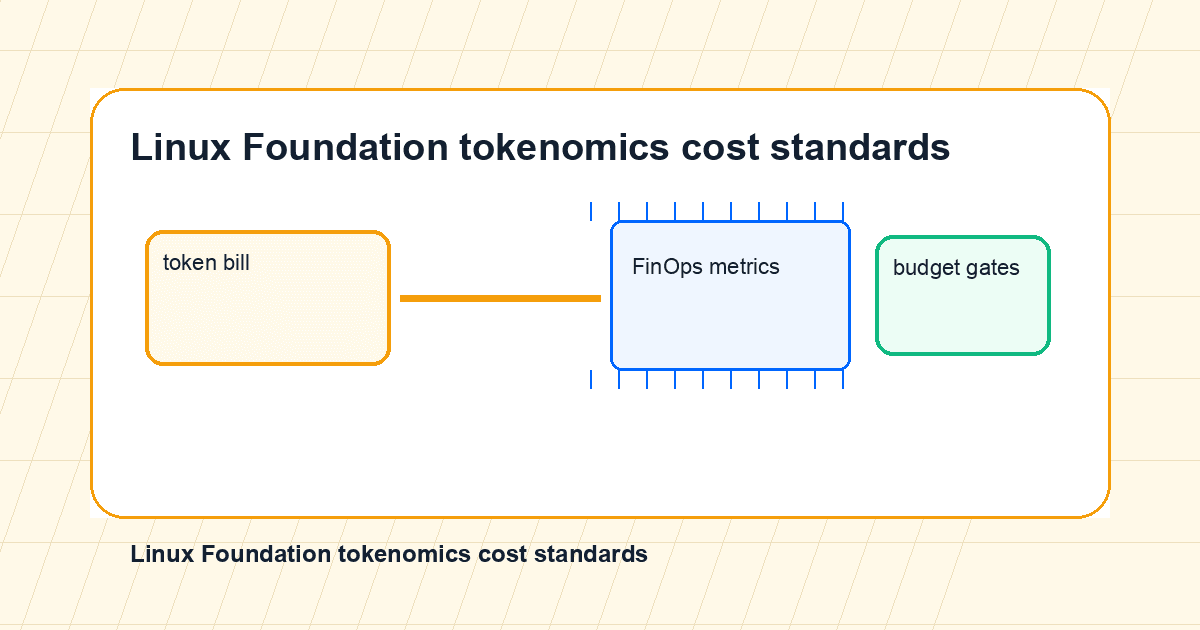
The Linux Foundation's Tokenomics: the architecture map
graph TD
    AgentUse[Agentic AI usage]
    TokenSpend[Token spend explosion]
    Finance[Finance and procurement shock]
    Observability[Token observability tools]
    Standards[Tokenomics Foundation standards]
    Metrics[Cost per intelligence and tokens per watt]
    Governance[Enterprise AI cost governance]
    AgentUse --> TokenSpend
    TokenSpend --> Finance
    Finance --> Observability
    Observability --> Standards
    Standards --> Metrics
    Metrics --> Governance
Why Tokenomics Became An Enterprise Emergency
The AI industry spent 2025 telling every team to use agents more aggressively. In 2026, the invoice arrived. The Tokenomics Foundation matters because it marks a shift from experimentation to cost governance. A token is no longer just a technical unit in a model API. It is a budget line, a procurement category, an observability signal, and a business metric. When companies cannot explain which agent consumed which tokens for which outcome, they cannot decide whether AI is improving the business or simply burning compute.
The Linux Foundation Is Borrowing The FinOps Playbook
Cloud computing created the first version of this problem. Teams adopted elastic infrastructure faster than finance teams could understand it, then FinOps emerged as a shared discipline for measurement, allocation, and optimization. AI token spend is harder because the unit is more abstract. A cloud instance is a machine. A token is a fragment of language, code, image metadata, retrieval context, or tool output. The Tokenomics Foundation is trying to create common definitions before every vendor invents a different accounting language.
Agentic AI Makes Token Budgets Unstable
The cost problem is not just chat volume. Agents multiply consumption because they plan, call tools, read documents, inspect source code, recover from errors, and repeat steps until a task appears complete. Research on agentic coding tasks found that repeated runs can vary dramatically, and higher token use does not always produce higher accuracy. That makes budgeting difficult. A human may see two tickets as equally complex, while an agent burns radically different token volumes because one requires long-context retrieval, more retries, or a model switch.
Why Visibility Is The First Control
Enterprise leaders cannot optimize what they cannot see. The first useful tokenomics layer is attribution: which team, user, product, model, task, repository, or customer account caused the spend. The second layer is outcome: whether the spend shipped code, resolved a support case, produced a correct analysis, or created more review work. The third layer is policy: model routing, context limits, tool permissions, spending ceilings, and escalation when a workflow burns through a budget. Without all three layers, companies will confuse AI enthusiasm with AI return on investment.
The Emerging Vendor Market Around Token Control
TechCrunch described a market forming around this gap: pure-play cost products, engineering management platforms, observability vendors, spend-management tools, and model routers. That market will grow because every AI platform now has an incentive to claim it is efficient. Buyers need independent measurement. A vendor invoice is not enough. Token counts, context size, model routing decisions, cache hits, tool retries, and final outcomes all need a shared audit trail.
What Builders Should Do Before Standards Arrive
The Tokenomics Foundation will not solve a company budget this week. Teams need immediate controls. Start by logging tokens per workflow, not only per model call. Add task identifiers and user/team ownership. Separate exploratory usage from production usage. Set policy for expensive models. Track cost per successful outcome, not cost per prompt. Require agent workflows to explain when they escalate to a larger model or repeat a failed step. These controls are unglamorous, but they turn latest AI news into a practical operating discipline.
Builder checklist
- Track tokens by workflow and business outcome, not only by provider invoice.
- Separate agentic AI experimentation from production spend controls.
- Prepare for Tokenomics Foundation standards, but do not wait for them to govern budgets.
- Treat model routing and context limits as product design decisions.
The practical read for ShShell readers
The Linux Foundation's Tokenomics Push Makes AI Cost Control a Board-Level Problem belongs in AI News Today because it shows how quickly artificial intelligence news has moved from model announcements into operating systems for money, infrastructure, governance, and distribution. The useful response is not to copy the headline into a roadmap. The useful response is to turn the headline into a local test. Identify the workflow affected by Linux Foundation, define the baseline, then measure whether the new capability changes cost, speed, quality, risk, or reach.
For teams trying to Learn AI in a serious way, the story also explains why AI tools and ai agents cannot be judged only by demo quality. A model or assistant sits inside a stack: data, identity, context, compute, cost controls, user interface, policy, and evaluation. If the stack is weak, the model can look impressive and still fail in production. If the stack is strong, even a narrower model can create durable value because the workflow is measurable and reversible.
The next operational question is ownership. Someone has to own model selection, someone has to own spend, someone has to own security, and someone has to own user outcomes. In small teams, that may be the same person. In large enterprises, those responsibilities often live in different departments. The Linux Foundation's Tokenomics Push Makes AI Cost Control a Board-Level Problem matters because it makes those boundaries visible. It forces teams to ask whether procurement, engineering, security, product, and finance are aligned before the capability becomes business-critical.
The final lesson is pacing. Early adoption is valuable when it produces evidence. It is dangerous when it produces hidden dependency. Before expanding a workflow touched by Tokenomics Foundation, teams should ask what happens if the provider changes pricing, if the model changes behavior, if the data boundary moves, or if the system fails during a high-pressure moment. The answer should be in architecture, not hope.
What to watch next
Watch item 1: Jellyfish found heavy AI users were about twice as productive as lower-use peers but used ten times the tokens. Track whether this becomes operating evidence rather than another market headline.
Watch item 2: Nicholas Arcolano said per-developer consumption rose about 18.6 times in nine months, according to TechCrunch. Track whether this becomes operating evidence rather than another market headline.
Watch item 3: The Tokenomics Foundation aims to define metrics such as cost-per-intelligence and tokens-per-watt. Track whether this becomes operating evidence rather than another market headline.
Watch item 4: Recent research on agentic coding tasks found token usage can vary by up to 30 times across runs on the same task. Track whether this becomes operating evidence rather than another market headline.
The bottom line: The Linux Foundation's Tokenomics Push Makes AI Cost Control a Board-Level Problem is useful because it connects an external event to a concrete AI adoption decision. Readers should ask what workflow changes, what budget or infrastructure assumption changes, what governance control becomes mandatory, and what evidence would prove the story mattered after the news cycle moves on.
Why Tokens Are Harder To Govern Than Cloud Instances
Cloud FinOps matured around resources that finance teams could understand: instances, storage, bandwidth, reserved capacity, and idle infrastructure. Tokens are stranger. They are both usage units and behavior signals. A token bill can rise because more people used a tool, because a prompt grew too long, because an agent retried a failed step, because retrieval returned too much context, because a model changed pricing, or because a developer forgot to cap a loop. The invoice says tokens. The root cause may live in product design, model selection, data architecture, or user behavior.
That is why the Tokenomics Foundation matters. A useful standard cannot simply define a token. It has to define how to attribute token consumption to work. Did the agent answer a customer. Did it fix a bug. Did it run an unnecessary research loop. Did it choose an expensive model when a cheaper one would work. Without that level of attribution, companies will cut AI budgets bluntly and damage the workflows that actually produce value.
The Governance Pattern For Agentic Spending
Agentic systems need budget controls at runtime, not only after-the-fact dashboards. A practical control plane should set per-user, per-team, per-agent, and per-workflow budgets. It should define maximum context size, maximum tool calls, retry limits, model tiers, and approval thresholds for expensive tasks. It should also separate experimentation from production so a prototype does not quietly inherit enterprise-scale permissions.
The best teams will connect token spend to outcome metrics. A coding agent should be measured against accepted pull requests, review defects, cycle time, and developer satisfaction. A support agent should be measured against resolution quality, escalation rate, customer sentiment, and cost per resolved case. A research agent should be measured against citation quality, freshness, and analyst time saved. Token efficiency without outcome quality is just cheaper failure.
What A Useful Token Standard Should Include
A serious tokenomics standard should define common fields for model calls, agent runs, retrieval events, tool calls, cache hits, retries, and human approvals. It should include units for tokens per successful task, cost per accepted output, tokens per watt where infrastructure data is available, and budget variance by workflow. It should also define what not to count as success. A model that produces more text is not necessarily more valuable. An agent that calls more tools is not necessarily more capable.
The Linux Foundation is well positioned to convene this work because AI cost management cannot be solved by one vendor's dashboard. Enterprises are using OpenAI, Anthropic, Google, Microsoft, AWS, open models, vector databases, observability tools, and internal orchestration layers at the same time. The standard has to travel across that stack.
Why This Is A Board Problem Now
Token budgets were easy to ignore when AI pilots were small. They become board-level when developers, analysts, support teams, legal teams, and sales teams all adopt agents at once. A company that is three times over token budget by April or May is not facing a simple optimization problem. It is facing an operating model problem. Who approves high-cost workflows. Who owns model routing. Who validates that productivity gains justify spend. Who stops a runaway agent. Who explains the bill to finance.
The tokenomics story is therefore not anti-AI. It is pro-serious-AI. Teams that can measure and govern token economics will keep the useful systems. Teams that cannot will swing between hype and austerity.
The Metrics Finance Actually Needs
Finance teams do not need a dashboard that says tokens went up. They need to know whether tokens bought useful work. A serious tokenomics standard should connect consumption to business units, applications, agents, users, tasks, models, and outcomes. The minimum useful record for an agent run should include the model used, input tokens, output tokens, cached tokens, retrieval volume, tool-call count, retry count, latency, user or service owner, workflow name, and completion status.
The next layer is outcome attribution. A coding assistant might consume many tokens but reduce cycle time for complex changes. A support agent might consume fewer tokens but escalate too often. A research agent might produce long reports that no one reads. Finance cannot judge those systems by token volume alone. It needs cost per accepted pull request, cost per resolved ticket, cost per validated research brief, cost per approved contract review, or cost per prevented incident.
This is why the Linux Foundation's standardization push could matter. If every vendor invents its own unit, buyers cannot compare. If every observability tool uses different fields, procurement cannot reconcile spend. If every model provider defines efficiency differently, budget owners will optimize around marketing claims. Open standards are boring until the invoice arrives.
Why Developers Need Guardrails That Do Not Break Flow
Developers adopted coding agents quickly because the tools removed friction. Heavy-handed cost controls can bring that friction back. If every model call requires approval, people will route around the system. If budgets are invisible until the end of the month, teams will overspend accidentally. If cheap models are forced onto tasks where they fail, developers will lose trust.
The better approach is contextual control. Let routine completions use cheap, fast paths. Let complex architecture changes use stronger reasoning with clear budget visibility. Warn when a task is about to exceed a normal range. Require approval for unusually long agent loops, large repository scans, or repeated failed attempts. Show developers the cost of a run without shaming them for using the tool.
Good token governance should feel like performance profiling. It helps teams understand where the expensive work is and whether it is justified. The goal is not to make developers think about tokens all day. The goal is to make waste visible before it becomes policy backlash.
The Tokenomics Foundation Could Define The Shared Language
The word tokenomics can sound abstract, but the practical agenda is concrete. Define common telemetry. Define benchmarks that measure task value rather than raw output length. Define energy-related metrics where infrastructure data is available. Define cost attribution across agents, models, tools, and teams. Define guidance for caching, context pruning, retrieval limits, and model routing. Define how to report uncertainty when token counts do not map cleanly to value.
If the foundation succeeds, enterprises could ask vendors for comparable reports. A CIO could compare two coding-agent deployments by accepted change, defect rate, and token cost. A CFO could see which workflows are over budget because adoption is working and which are over budget because agents are looping. A platform team could set internal standards before every department buys its own AI subscription.
The broader point is simple: AI cost discipline is becoming part of AI literacy. Teams that Learn AI only at the prompt level will miss the operating model. Teams that understand token economics, evaluation, security, and workflow design will be able to keep scaling after the novelty budget disappears.
The Hidden Cost Is Failed Autonomy
The most expensive token spend is often not the obvious usage. It is failed autonomy. An agent loops because a tool returns an ambiguous error. A coding assistant scans the same repository files repeatedly because context management is weak. A research agent keeps searching because it has no stopping rule. A support agent drafts long answers that still require human rewrites. A compliance agent produces impressive summaries but cannot cite the controlling policy. Each run may look defensible in isolation. Together, they turn into a budget problem.
That is why tokenomics has to include failure modes. A useful standard should distinguish successful task tokens from retry tokens, exploratory tokens, dead-end tool calls, human-rejected outputs, and cached reuse. It should show when spend is rising because adoption is creating value and when spend is rising because the system lacks boundaries. Without that distinction, leaders will cut the wrong workflows.
The Model-Routing Layer Becomes Strategic
Token governance also changes model strategy. Companies will not use one model for everything. They will route small extraction tasks to cheaper models, complex reasoning to stronger models, private data tasks to controlled environments, and high-volume interactions to cached or distilled paths. The routing layer becomes a business-control layer, not just an engineering convenience.
The Tokenomics Foundation could help by defining how routing decisions are reported. If a workflow used a premium model, the report should say why. If a cheaper model failed and triggered escalation, the report should capture that too. If caching avoided repeated spend, that should count as an efficiency gain. The point is to make cost control compatible with quality, not to force every task through the lowest-cost model.
For builders, the immediate action is simple: log agent runs with enough detail to explain the bill later. Capture model, prompt version, retrieval volume, tool calls, retries, cache hits, user outcome, and approval state. That telemetry will become the foundation for every serious AI budget conversation.
The metrics that should survive vendor marketing
The Tokenomics Foundation will be useful only if its metrics survive contact with vendor incentives. Model providers can always highlight falling per-token prices, but enterprise buyers need to know the total cost of a completed workflow. That means a standard should track prompt construction, retrieval context, cached context, reasoning steps where visible, model routing, tool calls, retries, human review time, and final acceptance. A cheaper token is not cheaper if the agent uses thirty times more of them to reach the same result.
A useful metric set should also separate exploration from production. A research team may intentionally spend heavily to find a better workflow. A production support agent should run inside tighter budgets because its value is measured across thousands or millions of cases. Coding agents need another lens: tokens per accepted pull request, tokens per fixed test, tokens per reverted change, and tokens per reviewer hour saved. Finance teams can understand those metrics because they connect spend to output.
The real goal is not to punish AI usage. It is to prevent blind usage. Teams should be able to identify a high-spend engineer who is producing high-value work, a runaway agent that is looping through bad plans, and a vendor invoice that does not match internal telemetry. That is why token economics belongs beside observability, not inside procurement alone.