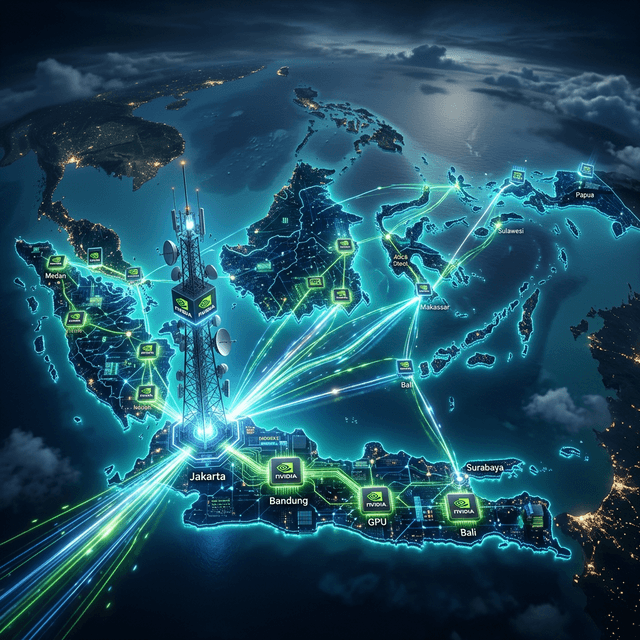
AI-RAN: Indosat and the Nationwide GPU-Telecom Integration
Indosat Ooredoo Hutchison, Nokia, and Nvidia scale Southeast Asia's first AI-RAN infrastructure, using shared GPUs to handle both 5G connectivity and AI reasoning.
AI-RAN: Indosat and the Nationwide GPU-Telecom Integration
The traditional model of a "Cell Tower" is becoming obsolete. As of March 11, 2026, Indosat Ooredoo Hutchison (IOH) has confirmed the nationwide rollout of its AI-RAN (Artificial Intelligence Radio Access Network) infrastructure. Partnering with Nvidia and Nokia, Indosat is the first carrier in Southeast Asia to successfully merge the telecommunications network and the AI data center into a single, unified compute fabric.
By utilizing shared H200 and Rubin GPUs at the network edge, IOH isn't just delivering 5G; it is delivering decentralized, low-latency intelligence to the masses.
1. What is AI-RAN? The Shared Compute Revolution
Historically, a mobile network required specialized, single-purpose chips (ASICs) to handle radio signals. These chips would sit idle during periods of low traffic, and they couldn't be used for anything else.
AI-RAN replaces these ASICs with high-performance GPUs.
- Duality of Workload: When the network is busy, the GPUs handle the signal processing (RAN duties).
- Idle Monetization: When the network is quiet (e.g., in a business district at 3 AM), the exact same GPUs switch to processing LLM tokens for local enterprises (AI duties).
This "Shared Dynamic Allocation" increases infrastructure utilization by over 300%, making it the most capital-efficient way to build a national AI backbone.
graph LR
    A[Cell Tower Site] --> B{Shared GPU: Nvidia AI Aerial}
    B -->|Peak Traffic| C[5G Radio Signal Processing]
    B -->|Off-Peak| D[Local Enterprise AI Reasoning]
    C --> E[Ultra-Low Latency 5G]
    D --> F[AI API Revenue]
    E --> G[Smarter Cities / Robotics]
    F --> G
2. The Surabaya Demo: 5G Controls the Robot
To prove the power of this integration, Indosat recently demonstrated Southeast Asia’s first AI-RAN Layer 3 5G call.
In the Surabaya test lab, a remote operator controlled a high-precision humanoid robot over a 15km distance. Because the AI logic for the robot’s "Balance and Safety" was running on the tower's GPU (less than 100 microseconds away from the radio signal), the latency was effectively zero.
This creates the foundation for Robotics-as-a-Service, where businesses can rent robot intelligence that is streamed directly from the nearest mobile tower, rather than relying on expensive on-board computers.
3. The Nvidia "AI Aerial" Platform
The "Brain" of this integration is the Nvidia AI Aerial platform. Launched in late 2025, AI Aerial provides the software stack that allows a standard Nvidia GPU to mimic a high-speed radio base station.
Key Benefits of AI Aerial for IOH:
- Software-Defined Everything: Indosat can upgrade an entire region’s radio performance by simply pushing a software update to the tower’s GPU, rather than climbing the pole to replace hardware.
- Native Ray Tracing: The system uses Nvidia’s ray-tracing engines to simulate how radio waves bounce off local buildings in real-time, optimizing signal strength for every individual user on the fly.
- Power Efficiency: By consolidating the AI and RAN servers into a single unit, site power consumption is reduced by 22%.
4. Nationwide Scaling: The 2026 Roadmap
Indosat has outlined an aggressive timeline:
- Q1 2026 (Now): Full operational capability in 5 major hubs including Jakarta, Surabaya, and Bali.
- Q3 2026: Rollout to 20 additional "Tier 1" cities.
- Goal: By December 2026, 60% of all IOH sites will be AI-RAN enabled, creating the world's most dense edge-AI network.
5. Conclusion: The New Revenue Moat
For telecommunications companies, the "Pipe" has become a commodity. Prices for data are falling globally. Indosat’s pivot to AI-RAN is a strategic masterstroke—they are no longer just selling "Gigabytes," they are selling "GigaFLOPS."
By owning the infrastructure that is closest to the user, Indosat is uniquely positioned to beat global cloud providers (AWS/Google) on latency. Whether it’s autonomous driving, remote surgery, or real-time AI translation, the winner won't be the model with the most parameters—it will be the network that can deliver that model in under 10 milliseconds.
With AI-RAN, Indosat has turned the cell tower into the most valuable real estate of the AI era.
Research Sources:
- Forbes: Indosat Ooredoo Hutchison’s $2B Nvidia AI Pivot (March 2026)
- Telecommunications News: Southeast Asia’s First AI-RAN Call Analysis
- Nvidia Press: Scaling AI Aerial with Nokia and Indosat
- TechNode Global: The Future of shared GPU Infrastructure in Indonesia
- Munjal Shah Blog: Why AI-RAN is the Killer App for 5G