Google's $920M-a-Month SpaceX Compute Deal Turns Gemini Enterprise Into an Infrastructure Race
Google's SpaceX compute deal shows how Gemini Enterprise demand is turning AI product launches into capacity planning.
Google's $920M-a-Month SpaceX Compute Deal Turns Gemini Enterprise Into an Infrastructure Race
On June 5, 2026, SpaceX disclosed a Cloud Service Agreement with Google in an SEC filing tied to its registration materials. This is the kind of latest AI news that matters because it changes the operating layer around large language models, llms, ai agents, and generative ai systems rather than merely adding another feature announcement.
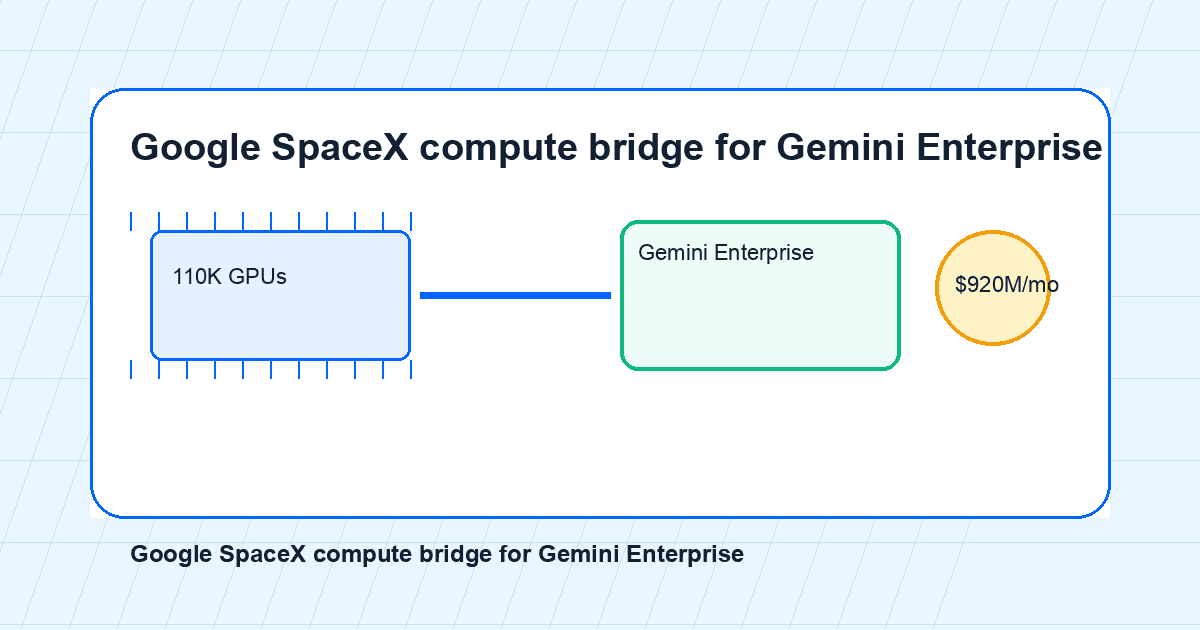
The agreement covers access to approximately 110,000 NVIDIA GPUs, CPUs, memory, and related components. The specific question for builders and buyers is what this changes in practice: capacity, cost, governance, distribution, safety, or workflow reliability. ShShell readers should treat the story as a prompt to update deployment assumptions, not as a loose market signal.
Source trail
- TechCrunch report on Google paying SpaceX for compute
- SEC filing for the SpaceX Google cloud service agreement
- Alphabet investor presentation, June 2026
- Epoch AI compute estimates referenced in coverage
- Google Cloud Gemini Enterprise context
This article uses those sources as the factual base and adds ShShell analysis for engineering, product, security, finance, and operations teams. Claims from reporting are framed as reporting; claims from company pages or filings are treated as primary-source claims.
Source-grounded operating read
- On June 5, 2026, SpaceX disclosed a Cloud Service Agreement with Google in an SEC filing tied to its registration materials.
- The agreement covers access to approximately 110,000 NVIDIA GPUs, CPUs, memory, and related components.
- Google is set to pay SpaceX $920 million per month from October 2026 through June 2029.
- Capacity ramps through September 2026 at a reduced fee, and Google can terminate if committed GPU access is not delivered after the one-month grace period described in the filing.
- The agreement allows either party to terminate after December 31, 2026 with 90 days notice.
- Google retains ownership and intellectual property rights in its content, AI models, and related data under the filing.
- TechCrunch reported Google framed the deal as bridge capacity for unexpectedly high Gemini Enterprise demand.
- Alphabet told investors it expects 2026 capital expenditure of $180 billion to $190 billion, with most spending in technical infrastructure.
- Alphabet said next year capital expenditure should significantly increase compared with 2026.
- Alphabet reported more than 8.5 million developers building with its models each month and about 19 billion model API tokens per minute.
- Google said Antigravity developer tooling had reached more than three trillion tokens a day internally.
- SpaceX had previously announced a separate large compute arrangement with Anthropic around Colossus 1 capacity.
Decision table
| Decision point | Why it matters for this story | Practical check |
|---|---|---|
| What changed | On June 5, 2026, SpaceX disclosed a Cloud Service Agreement with Google in an SEC filing tied to its registration materials. | Confirm dates, named entities, and scope from primary sources |
| Who is exposed | Builders, buyers, operators, and finance teams affected by Google, SpaceX, Gemini Enterprise | Identify the workflow, budget owner, and risk owner |
| What to measure | Cost, latency, quality, safety, adoption, and operational reliability | Compare against the current baseline before scaling |
| What can go wrong | Overcommitment, weak governance, vendor lock-in, poor observability, or misleading launch metrics | Require logs, versioning, review paths, and rollback |
Google's $920M-a-Month SpaceX Compute: the architecture map
graph TD
    GeminiEnterprise[Gemini Enterprise demand]
    GoogleCloud[Google Cloud capacity planning]
    SpaceXAgreement[SpaceX cloud service agreement]
    GPUs[110000 GPUs plus CPUs and memory]
    Bridge[Bridge capacity through 2029]
    BuyerControls[90 day termination and delivery clauses]
    EnterpriseCustomers[Enterprise agent workloads]
    GeminiEnterprise --> GoogleCloud
    GoogleCloud --> SpaceXAgreement
    SpaceXAgreement --> GPUs
    GPUs --> Bridge
    Bridge --> EnterpriseCustomers
    BuyerControls --> SpaceXAgreement
What Google Actually Bought From SpaceX
This story is not just another big number in the AI infrastructure cycle. The SEC filing describes compute capacity, not a vague strategic partnership. Google is buying access to a defined pool of GPUs, CPUs, memory, and related components, and the payment schedule runs long enough to matter for enterprise product roadmaps. The useful reading is that Gemini Enterprise demand created a near-term gap between product ambition and available serving capacity. Google has its own TPUs, its own global data-center network, and a huge technical infrastructure budget, yet it still signed a bridge agreement with SpaceX. That says more about the speed of AI demand than about a permanent shortage at Google. It shows how fast agentic AI workloads can turn model launches into facilities planning.
Why Gemini Enterprise Demand Changes The Capacity Equation
Enterprise AI is not priced or provisioned like a consumer chatbot. Once a company routes support, coding, sales operations, analytics, or finance workflows through Gemini Enterprise, demand becomes less bursty and more contractual. The workload also gets heavier as agents plan, search, call tools, inspect files, and retry failed steps. A single user request can fan out into thousands or millions of tokens and multiple model calls. That is why Google described the SpaceX agreement as bridge capacity for demand that exceeded expectations. The important word is bridge. It implies Google believes demand is real enough to rent external capacity, but temporary enough that its own infrastructure buildout can eventually absorb the load.
The Contract Clauses Matter More Than The Headline Number
The filing includes delivery and termination language that buyers should notice. If SpaceX does not deliver committed GPU access by September 30, 2026, Google can terminate after a grace period or accept reduced capacity with a proportional fee reduction. Either side can terminate after December 31, 2026 with 90 days notice. That makes the deal large but not blindly irreversible. It gives Google a way to cover demand without surrendering all flexibility if its own data centers, TPUs, or demand forecasts shift. For enterprise AI buyers, this is the template: big capacity commitments should still include delivery tests, ramp schedules, data ownership terms, and exit rights.
Why SpaceX Is Becoming A Compute Counterparty
SpaceX is no longer just a launch provider in this story. Through the xAI and Colossus infrastructure path, it is becoming a compute seller at a scale usually associated with hyperscalers and specialized neoclouds. That makes the SpaceX IPO story partly an AI infrastructure story. If the company can monetize large AI clusters with Google and Anthropic contracts, investors can value it as more than rockets, Starlink, and satellites. But the same move exposes SpaceX to data-center execution risk: power, cooling, networking, GPU availability, customer commitments, and uptime guarantees. The buyer wants capacity. The seller has to turn physical hardware into reliable service.
What Builders Should Learn From The Google SpaceX Deal
The builder lesson is capacity abstraction has limits. Developers can call an API and pretend compute is infinite, but platform teams cannot. Agentic systems need model routing, token budgets, graceful degradation, and workload tiers. A high-value workflow may deserve the most expensive model and fastest GPU pool. A low-risk summarization task may need a cheaper path. The companies that survive the agentic AI cost curve will build systems that understand capacity as a product constraint, not an accounting afterthought.
What To Watch Next
Watch whether Gemini Enterprise quotas expand, whether Google describes the SpaceX contract as temporary or strategic on future earnings calls, and whether other hyperscalers sign similar bridge deals. Also watch whether SpaceX publishes reliability metrics around AI compute customers as it approaches public-market scrutiny. The headline is $920 million per month. The deeper story is that AI infrastructure has become a market where even Google buys time.
Builder checklist
- Treat external compute as bridge capacity unless contracts prove otherwise.
- Require delivery clauses and data ownership language in major AI capacity deals.
- Design Gemini Enterprise-style agent workflows with routing and budget controls.
- Watch SpaceX as an AI infrastructure counterparty, not only a space company.
The practical read for ShShell readers
Google's $920M-a-Month SpaceX Compute Deal Turns Gemini Enterprise Into an Infrastructure Race belongs in AI News Today because it shows how quickly artificial intelligence news has moved from model announcements into operating systems for money, infrastructure, governance, and distribution. The useful response is not to copy the headline into a roadmap. The useful response is to turn the headline into a local test. Identify the workflow affected by Google, define the baseline, then measure whether the new capability changes cost, speed, quality, risk, or reach.
For teams trying to Learn AI in a serious way, the story also explains why AI tools and ai agents cannot be judged only by demo quality. A model or assistant sits inside a stack: data, identity, context, compute, cost controls, user interface, policy, and evaluation. If the stack is weak, the model can look impressive and still fail in production. If the stack is strong, even a narrower model can create durable value because the workflow is measurable and reversible.
The next operational question is ownership. Someone has to own model selection, someone has to own spend, someone has to own security, and someone has to own user outcomes. In small teams, that may be the same person. In large enterprises, those responsibilities often live in different departments. Google's $920M-a-Month SpaceX Compute Deal Turns Gemini Enterprise Into an Infrastructure Race matters because it makes those boundaries visible. It forces teams to ask whether procurement, engineering, security, product, and finance are aligned before the capability becomes business-critical.
The final lesson is pacing. Early adoption is valuable when it produces evidence. It is dangerous when it produces hidden dependency. Before expanding a workflow touched by SpaceX, teams should ask what happens if the provider changes pricing, if the model changes behavior, if the data boundary moves, or if the system fails during a high-pressure moment. The answer should be in architecture, not hope.
What to watch next
Watch item 1: Alphabet said next year capital expenditure should significantly increase compared with 2026. Track whether this becomes operating evidence rather than another market headline.
Watch item 2: Alphabet reported more than 8.5 million developers building with its models each month and about 19 billion model API tokens per minute. Track whether this becomes operating evidence rather than another market headline.
Watch item 3: Google said Antigravity developer tooling had reached more than three trillion tokens a day internally. Track whether this becomes operating evidence rather than another market headline.
Watch item 4: SpaceX had previously announced a separate large compute arrangement with Anthropic around Colossus 1 capacity. Track whether this becomes operating evidence rather than another market headline.
The bottom line: Google's $920M-a-Month SpaceX Compute Deal Turns Gemini Enterprise Into an Infrastructure Race is useful because it connects an external event to a concrete AI adoption decision. Readers should ask what workflow changes, what budget or infrastructure assumption changes, what governance control becomes mandatory, and what evidence would prove the story mattered after the news cycle moves on.
Why The Google Deal Reprices Enterprise AI Reliability
The SpaceX agreement gives enterprise buyers a more concrete way to think about reliability in AI platforms. If Gemini Enterprise demand was high enough for Google to buy bridge capacity from SpaceX, then customers should assume capacity is now an explicit product variable. A support automation, coding agent, document analysis system, or sales assistant may work perfectly in a pilot and still strain under full deployment if every user begins running long-context, tool-heavy workflows at once. The problem is not only model quality. It is the number of concurrent jobs, the context size of each job, the retry rate when tools fail, the amount of retrieval needed, and whether the platform can keep latency predictable while meeting enterprise privacy and residency promises.
That makes the contract's data ownership language important. The SEC filing says Google retains ownership and intellectual property rights in its content, AI models, and related data. That is the kind of clause enterprise buyers should normalize in their own AI infrastructure contracts. Compute capacity is useful only if the data boundary is clear. A company that rents GPUs, uses a model API, or deploys agents across third-party infrastructure needs to know where prompts, embeddings, files, logs, model outputs, and operational telemetry live. The more distributed the compute stack becomes, the more important those ownership and retention terms become.
How This Affects Model Routing And Product Design
Google has a differentiated infrastructure stack that includes TPUs, NVIDIA GPUs, Axion CPUs, a global fiber network, and dozens of cloud regions. The SpaceX deal does not erase that advantage. It shows why even a strong stack needs flexible routing. A Gemini Enterprise workload may route some requests to a high-end reasoning model, some to a faster lower-cost model, some to cached retrieval, and some to specialized infrastructure. A customer may never see that routing, but the platform economics depend on it.
Product teams building on Gemini Enterprise or any agent platform should design for heterogeneous compute from the start. The system should record which model handled a task, how much context it consumed, how many tool calls it made, and how many retries happened. If a workflow suddenly moves from a standard pool to a premium pool because demand spikes or a model changes, the customer should be able to see the cost and latency effect. The Google-SpaceX deal makes this visible at hyperscaler scale, but the same design rule applies inside ordinary companies.
The Competitive Signal For OpenAI, Anthropic, Microsoft, And AWS
This deal also affects competitive positioning. OpenAI, Anthropic, Microsoft, AWS, Google, and xAI are not only competing on model capability. They are competing on capacity, contract flexibility, distribution, and the ability to keep enterprise workloads online as agents become heavier. If Google needs bridge capacity for Gemini Enterprise, competitors should expect similar pressure. Anthropic already moved to secure SpaceX capacity through a larger Colossus 1 arrangement. Microsoft is balancing OpenAI workloads, its own MAI models, Azure infrastructure, and customer demand. AWS is trying to turn Bedrock into a multi-model control plane while absorbing demand from enterprise customers that want model choice.
The next phase of AI competition will reward providers that can explain their infrastructure strategy without hiding behind marketing. Buyers will ask whether capacity is dedicated or shared, whether priority tiers exist, which regions support the newest models, how quotas are enforced, and what happens during shortages. These are not procurement details at the edge of the decision. They shape whether an AI product can become dependable infrastructure.
What Enterprise Buyers Should Add To Their RFPs
AI platform evaluations should now include capacity disclosures. Ask vendors for quota behavior under peak load, model availability by region, fallback behavior when premium capacity is constrained, logging for tool calls, data-retention terms for third-party infrastructure, and contract remedies if committed capacity is not delivered. Ask whether the vendor can maintain latency under agent workloads rather than single-turn chat tests.
The Google-SpaceX agreement is a large example of a simple rule: intelligence needs supply-chain management. The enterprises that learn that rule early will build AI systems that degrade gracefully instead of failing mysteriously when usage finally becomes real.
The Unit Economics Behind The Headline
The $920 million monthly figure is striking because it makes the hidden economics of enterprise AI visible. Most customers experience AI infrastructure as a model price, a seat price, or an API bill. Google experiences it as a capacity plan that must cover tokens, memory bandwidth, GPU availability, storage, networking, support commitments, and product growth. If demand for Gemini Enterprise forces bridge capacity from SpaceX, the cost of serving AI is not a background detail. It is part of product strategy.
That does not mean Gemini Enterprise is uneconomic. It means the product has to be managed like infrastructure. A successful enterprise agent platform will need usage tiers, model routing, caching, workload classification, and clear customer expectations. A high-value legal review workflow may justify expensive reasoning. A routine meeting summary probably does not. A coding agent that touches repositories all day should not have the same budget path as a one-off document question.
The lesson for buyers is to ask how the vendor prevents the most expensive compute from becoming the default. The lesson for builders is to measure every agent run as a costed workflow. Which prompt produced the tokens. Which retrieval step expanded the context. Which tool failure caused retries. Which model choice changed the bill. Without that telemetry, AI cost management becomes guesswork.
Why Bridge Capacity Is Strategically Useful
Bridge capacity gives Google time. It can satisfy near-term Gemini Enterprise demand while its own infrastructure plan catches up. It can learn which workloads are durable and which are launch-period spikes. It can avoid starving customer growth while capital projects move through construction and deployment. In a fast-growing AI market, time is a strategic asset.
The risk is dependency. If a bridge becomes permanent without clear economics, the platform inherits another supplier, another operational surface, and another set of reliability assumptions. That is why the termination language matters. Google appears to have preserved options. It can use SpaceX capacity while monitoring delivery and demand, then adjust if internal capacity, TPUs, or customer usage patterns change.
Enterprise buyers should copy that posture. When adopting AI platforms, they should avoid irreversible commitments before usage data is mature. Start with workloads that can show measurable value. Negotiate capacity and data terms before volume explodes. Keep fallback models and providers viable where risk warrants it. The goal is not to distrust the platform. The goal is to avoid confusing a successful pilot with a stable operating model.
The Infrastructure Race Is Also A Data Race
Compute alone is not enough for enterprise AI. Gemini Enterprise workloads involve customer files, permissions, logs, retrieval indexes, code repositories, tool integrations, and user histories. The SpaceX deal's data ownership language is therefore as important as the GPU count. If compute is distributed across external facilities, data governance has to remain coherent across that distribution.
Companies building on enterprise AI platforms should map data movement at the same level of detail they map API calls. Which prompts leave the tenant. Which logs are retained. Which embeddings are stored. Which tools can read documents. Which model outputs become training data, if any. Which jurisdictions apply. The more complex the serving stack becomes, the more important this map becomes.
The infrastructure race will likely produce more unusual partnerships. Hyperscalers will rent from specialized operators. Model labs will secure dedicated clusters. Hardware companies will become service providers. Space, telecom, and energy companies may find themselves in AI supply chains. The winning AI platforms will not merely own the most chips. They will make the complexity invisible without making it ungoverned.