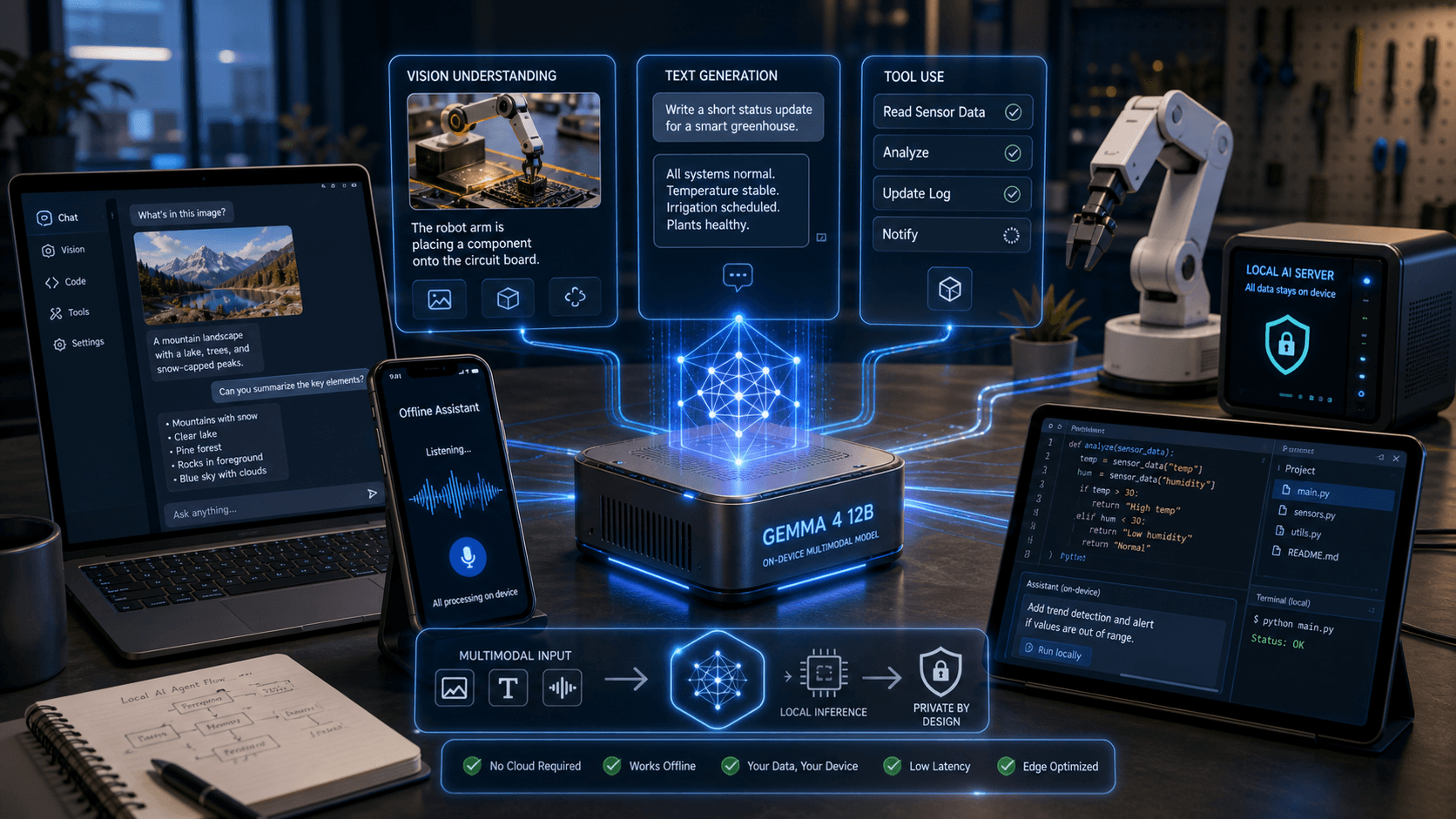
Google Gemma 4 12B Makes Local Multimodal AI Agents a Practical Enterprise Question
Google Gemma 4 12B pushes open local AI toward multimodal agents, private workflows, edge inference, AI tools, and LLM deployment choices.
Google Gemma 4 12B Makes Local Multimodal AI Agents a Practical Enterprise Question
Google Gemma 4 12B matters because it sits in a part of the AI market that enterprise teams keep circling back to: models that are small enough to run close to the data, capable enough to handle useful work, and open enough to adapt for private workflows. The headline is not only "another Google model." The real question is whether a 12B-class multimodal model can make local AI agents practical for teams that cannot send every document, image, support case, or field note to a remote frontier API.
That is why this story belongs in Artificial Intelligence News. Frontier models still set the ceiling, but deployment choices decide what companies can actually use. If Gemma 4 12B gives builders a stronger local option for text and visual tasks, the enterprise conversation shifts from "Can local models do anything useful?" to "Which workflows should stay local, and which should escalate to a larger model?"
Source trail
- Google Gemma model family
- Google Developers blog on Gemma
- Hugging Face Gemma models
- Google AI Edge documentation
- VentureBeat AI coverage
This article uses those sources as the factual base and adds ShShell analysis for developers, AI platform teams, enterprise architects, and readers tracking latest AI news. Model capability claims should be validated against the exact checkpoint, license, hardware target, quantization approach, and benchmark before production use.
What changed with a 12B-class multimodal Gemma
Gemma has been Google's family of open models aimed at developers who want lighter-weight systems than Gemini but still want the engineering discipline of a major AI lab. A 12B-class multimodal Gemma extends that idea into a more useful enterprise zone. It is not tiny. It is not a frontier cloud model. It sits in the middle, where teams start asking practical questions about local inference, private retrieval, image understanding, tool use, and cost control.
The multimodal part matters. A text-only local model can summarize policy documents, classify tickets, or help with search. A multimodal model can inspect screenshots, forms, product photos, diagrams, invoices, field images, whiteboard captures, or UI states. That makes it more relevant for ai agents, because many real workflows are not pure text. A help-desk agent may need a screenshot. A manufacturing assistant may need an image of a component. A compliance reviewer may need to compare a scanned form to structured rules.
The 12B size matters too. Smaller models can run cheaply but may struggle with reasoning and instruction following. Larger models can perform better but require more memory, more expensive hardware, and more operational planning. A 12B model is where enterprises start asking whether quantization, GPU workstations, edge servers, or private cloud inference can cover meaningful use cases without a frontier-model bill for every request.
Why local multimodal AI is not just a privacy story
Privacy is the obvious reason to keep inference local, but it is not the only one. Local models also give teams latency control, offline tolerance, cost predictability, version stability, and tighter integration with device-specific workflows. For some field, industrial, healthcare, legal, and public-sector environments, those qualities matter as much as raw benchmark scores.
Consider a field service workflow. A technician takes a photo of a damaged part, asks an assistant what to check, and needs an answer inside a low-connectivity environment. A cloud-only model may be powerful but unavailable. A local multimodal model can classify the image, retrieve a repair procedure from a local knowledge base, and suggest the next diagnostic step. It may still escalate hard cases to a larger model later, but the first response can happen near the device.
Or consider an enterprise document workflow. A team may need to process scanned invoices, contracts, diagrams, and forms that cannot leave a controlled environment. A local model does not remove every compliance obligation, but it changes the risk calculation. The company can keep data inside its own network, log inference locally, and tune the system around its own document types.
The architecture question: local first, not local only
The strongest architecture is usually not "all local" or "all cloud." It is local first with escalation. A Gemma-class model can handle routine classification, extraction, summarization, visual inspection, and retrieval-augmented answers. A stronger cloud model can handle ambiguous reasoning, complex synthesis, or tasks that require broader world knowledge. The system decides when to escalate based on confidence, policy, cost, and user intent.
graph TD
    Input[Text, image, screenshot, or document]
    Local[Gemma 4 12B local multimodal model]
    RAG[Private retrieval index]
    Tools[Approved local tools]
    Judge[Confidence and policy check]
    Answer[Local answer with evidence]
    Escalate[Escalate to larger model]
    Review[Human review]
    Input --> Local
    Local --> RAG
    RAG --> Local
    Local --> Tools
    Tools --> Local
    Local --> Judge
    Judge --> Answer
    Judge --> Escalate
    Escalate --> Review
    Answer --> Review
This is the practical pattern for AI tools in regulated or cost-sensitive environments. The local model handles the first pass. Retrieval keeps answers grounded in private documents. Tools are restricted. A confidence or policy gate decides whether the system should answer, refuse, ask for clarification, or escalate.
Who should care first
Developers building private AI tools should care because Gemma gives them another option between small hobby models and expensive frontier APIs. If the model can run on available hardware with acceptable latency, it can power internal copilots, offline assistants, document processors, and edge agents.
Enterprise architects should care because local models change the placement of AI infrastructure. Instead of every request traveling to a vendor endpoint, some inference can happen on employee devices, secure workstations, branch servers, factory systems, private Kubernetes clusters, or controlled cloud environments. That affects networking, monitoring, procurement, data governance, and support.
Security and compliance teams should care because local inference is not automatically safe. A local model can still leak data through logs, produce incorrect answers, follow malicious instructions in retrieved documents, or call tools it should not call. The difference is that the organization has more control over the environment. Control only helps if it is used.
What builders should test before believing the demo
The first test is hardware reality. What memory does the model need at the chosen precision. Does quantization reduce quality too much. What latency is acceptable for the workflow. Can the model run on a laptop, workstation, server GPU, or edge accelerator. Does batching help or hurt user experience. These questions matter more than an abstract model size.
The second test is multimodal accuracy on real enterprise inputs. Public demos often use clean images. Real workflows use blurry screenshots, cropped forms, noisy photos, dense diagrams, handwritten notes, bad scans, and domain-specific labels. A useful local multimodal agent must survive that mess.
The third test is tool discipline. If the agent can search a private index, call a ticketing system, generate a repair note, or extract structured data, then the model must respect permissions and output requirements. Local deployment does not remove the need for guardrails. It moves guardrails closer to the organization.
Local AI decision table
| Workflow | Why Gemma 4 12B could fit | When to escalate |
|---|---|---|
| Screenshot-based IT support | Multimodal input plus local knowledge base can handle common device problems. | Unknown error states, privileged actions, or security-sensitive requests. |
| Invoice and form triage | Local visual extraction can reduce exposure of sensitive documents. | Low confidence fields, legal ambiguity, or exceptions above approval thresholds. |
| Field inspection assistant | Offline image review can guide technicians where connectivity is weak. | Safety-critical diagnosis or uncertain visual evidence. |
| Private documentation search | Local RAG keeps internal context in the controlled environment. | Multi-source synthesis, conflicting evidence, or high-impact recommendations. |
| Developer support agent | Local repo-aware help can answer routine questions cheaply. | Large refactors, security patches, or production-impacting code changes. |
This table is the point. Local multimodal AI is not a universal replacement for cloud frontier models. It is an infrastructure option for specific jobs.
Why multimodal local agents are harder than text chat
Text chat hides many product problems. Multimodal agents expose them. If a model inspects an image, the user needs to know what region or object influenced the answer. If it reads a form, the system needs structured extraction and confidence. If it looks at a screenshot, it may need UI-state awareness. If it summarizes a diagram, it should preserve relationships, not only labels.
That means the product around the model has to include visual grounding, evidence display, error handling, and user correction. A field technician should be able to say "that is not the valve, use the lower-right component." A document processor should show extracted fields and uncertain values. A UI assistant should ask for another screenshot when the current one is too ambiguous.
Prompt engineering changes in this environment. A useful prompt must tell the model how to inspect the image, what evidence to cite, when to say it is unsure, and what output format to produce. For production systems, prompts should be versioned and evaluated just like code.
The security model is different, not simpler
Local deployment reduces some risks but creates others. It may reduce external data transfer. It may make retention easier to control. It may support offline operation. But it can also spread models and data across many devices, create patch-management problems, and make logs harder to centralize.
If Gemma-powered agents run on laptops or edge devices, teams need model version control, update policies, local log collection, encryption, access control, and incident response. If they run in private cloud, teams need the same controls they use for other production services: authentication, rate limits, monitoring, secrets management, vulnerability patching, and capacity planning.
Prompt injection remains relevant. A local RAG system can retrieve a malicious document that tells the model to ignore instructions, leak a secret, or call a tool incorrectly. The fact that the model runs locally does not make it immune. Builders still need content isolation, instruction hierarchy, tool allowlists, and test cases that include adversarial documents.
What this means for AI search and RAG
Gemma 4 12B becomes especially interesting when paired with private ai search. A local model by itself has limited knowledge. A local model connected to a well-indexed document store can answer questions about company policies, device manuals, product catalogs, incident reports, contracts, and internal procedures.
The quality of that system depends on retrieval as much as model capability. Bad chunking, stale indexes, missing permissions, or weak citation handling will produce weak answers. A better system retrieves fewer, more relevant passages, shows citations, preserves access control, and tells the user when the evidence is insufficient.
This is one reason local models are not just for privacy. They can make retrieval cheaper. If thousands of internal search queries can be handled by a local model with local embeddings and private indexes, the organization may reserve frontier calls for harder questions.
What buyers should ask Google and implementation partners
Buyers should ask about license terms, supported hardware, quantized variants, multimodal input limits, context length, benchmark methodology, safety tuning, and commercial support. They should also ask how Gemma integrates with Google AI Edge, Android, Vertex AI, or third-party serving stacks if those are part of the deployment.
They should ask for workflow evidence, not only benchmark scores. How does the model perform on scanned enterprise forms. How does it handle screenshots with small text. Does it preserve table structure. Can it cite retrieved evidence. Does it refuse unsafe requests. What happens when the image is ambiguous. How much does quantization change the result.
The best pilot uses the organization's own data. Choose 100 to 300 representative examples, include messy cases, define expected outputs, and compare local Gemma against a cloud baseline. Measure accuracy, latency, cost, privacy fit, and reviewer effort. That will tell the truth faster than a general leaderboard.
What learners should take from the Gemma story
For readers trying to Learn AI, the lesson is deployment literacy. Large language models are not only API calls. The real skill is understanding when to use a local model, when to use a cloud model, how to add retrieval, how to evaluate outputs, how to manage prompts, and how to design escalation.
AI courses should teach this. A modern AI training path should include quantization basics, context limits, embeddings, RAG, multimodal inputs, tool permissions, logging, and cost modeling. Prompt engineering remains useful, but it is not enough when the model is embedded in a real workflow.
Gemma also makes open-model evaluation more accessible. Developers can run experiments, compare prompts, test retrieval pipelines, and inspect failure modes without sending every request to a remote model. That hands-on loop is one of the best ways to learn what AI agents can and cannot do.
The hardware planning reality
Local AI sounds simple until the team has to pick hardware. A 12B-class model can be practical, but only after the organization chooses precision, quantization, concurrency, context length, and serving architecture. A model that feels responsive for one user on a workstation may struggle when twenty users ask multimodal questions at once. A model that fits at four-bit quantization may lose enough quality to fail the workflow.
The right pilot should test the deployment target, not a fantasy target. If the workflow is a field laptop, test the laptop. If the workflow is a factory edge server, test the server. If the workflow is a private cloud GPU pool, test batching, cold starts, autoscaling, and monitoring. Local AI has a real operations footprint. It needs patching, capacity planning, observability, and incident response like any other production system.
Teams should also measure total workflow latency. Image preprocessing, retrieval, model inference, tool calls, and post-processing all add time. A local model may answer quickly, but a poor retrieval pipeline can still make the product feel slow. Conversely, a slightly slower local model may be acceptable if it avoids a network round trip and keeps sensitive data inside the environment.
How to design the first Gemma pilot
The first pilot should be narrow enough to evaluate. Pick one workflow, one user group, one data source, and one output format. A good example is "classify incoming support screenshots into five known issue types and cite the matching internal runbook." Another is "extract fields from these invoice images and mark uncertain values for human review." A third is "answer technician questions from a local device manual and flag when the image evidence is insufficient."
Each pilot needs a baseline. How long does the current process take. How often do humans make mistakes. How much sensitive data moves today. What is the cost per completed task. What failure rate is acceptable. Without this baseline, the team will only know whether the demo feels impressive, not whether the system improved the work.
The evaluation set should include bad inputs. Blurry photos, rotated scans, screenshots with tiny text, outdated manuals, missing fields, irrelevant documents, and adversarial instructions should all be present. Local multimodal agents fail in boring ways: they misread labels, overtrust retrieved snippets, ignore missing context, or treat visual similarity as proof. Those failures are manageable when they are measured early.
The role of Google AI Edge and ecosystem support
Gemma's enterprise relevance depends partly on ecosystem support. A model checkpoint is not enough. Builders need serving examples, edge deployment guidance, tokenizer compatibility, quantized variants, hardware recommendations, safety notes, and integration patterns with retrieval and application frameworks. Google AI Edge is relevant because it signals that Google wants smaller models to run closer to devices and applications, not only in centralized cloud endpoints.
Hugging Face availability matters too. Developers often evaluate open models through community tooling before committing to a production stack. If Gemma variants are easy to download, quantize, benchmark, and compare, adoption can spread faster. But community convenience does not replace governance. Enterprises still need license review, security scanning, model provenance, and controlled deployment.
The ecosystem will also decide how quickly prompt and RAG patterns mature. A strong local model becomes much more useful when the community shares reliable recipes for multimodal retrieval, field extraction, screenshot reasoning, and local tool use.
Where local multimodal AI can disappoint
The most common disappointment will be over-scoping. A team will see a capable local model and try to build a general enterprise assistant. That is usually too broad. The model will face too many document types, policies, user intents, and edge cases. The answer quality will vary, and users will lose trust.
The better route is a portfolio of small agents. One agent handles invoice triage. Another handles device troubleshooting. Another handles private documentation search. Another handles visual inspection. Each one has its own evaluation set, tool permissions, and escalation path. This is more work upfront, but it creates systems that can be trusted.
Another disappointment is assuming local means cheaper. It can, but only if utilization is high and operations are well managed. Idle GPUs, support burden, failed outputs, and engineering time can erase savings. Teams should compare accepted-output cost, not only per-token or per-request cost.
What enterprise leaders should decide
The strategic decision is model placement. Which workflows require frontier reasoning. Which require privacy. Which require low latency. Which need offline operation. Which can tolerate cloud calls. Which should never leave a controlled environment. Gemma 4 12B gives leaders one more option in that placement map.
That map should be revisited regularly. Model quality changes. Hardware gets cheaper. Cloud pricing changes. Regulations evolve. A workflow that needs frontier models today may run locally next year. A workflow that seems safe locally may need centralized monitoring as it scales.
The enterprise that wins with local AI will not be the one that runs every model on every laptop. It will be the one that understands where each model belongs.
What to watch next
Watch for official Google documentation on model cards, supported checkpoints, license terms, evaluation results, and edge deployment examples. Watch for Hugging Face adoption, community quantizations, benchmarks on consumer GPUs, and integration into local AI frameworks.
Also watch for enterprise case studies. The real proof will be workflows: offline support, document extraction, local code assistants, field inspection, private search, and multimodal compliance review. A 12B model is interesting only if it can do a specific job well enough to justify deployment.
Finally, watch how Google positions Gemma against Gemini. If Gemma becomes the local and open edge of the portfolio while Gemini remains the frontier cloud option, Google will have a clearer answer to the market's deployment split.
Bottom line
Google Gemma 4 12B is important because it makes local multimodal AI agents a practical enterprise design question. The smart response is not to treat local models as either toys or replacements for every frontier system. The smart response is to test them where privacy, latency, cost, offline use, and workflow control matter.
For builders following Latest AI News, the lesson is direct: the AI stack is becoming a portfolio. Use local models where they make the workflow safer or cheaper. Escalate when the task demands stronger reasoning. Measure everything. Keep evidence close to the answer. That is how open local AI becomes production infrastructure instead of another demo.