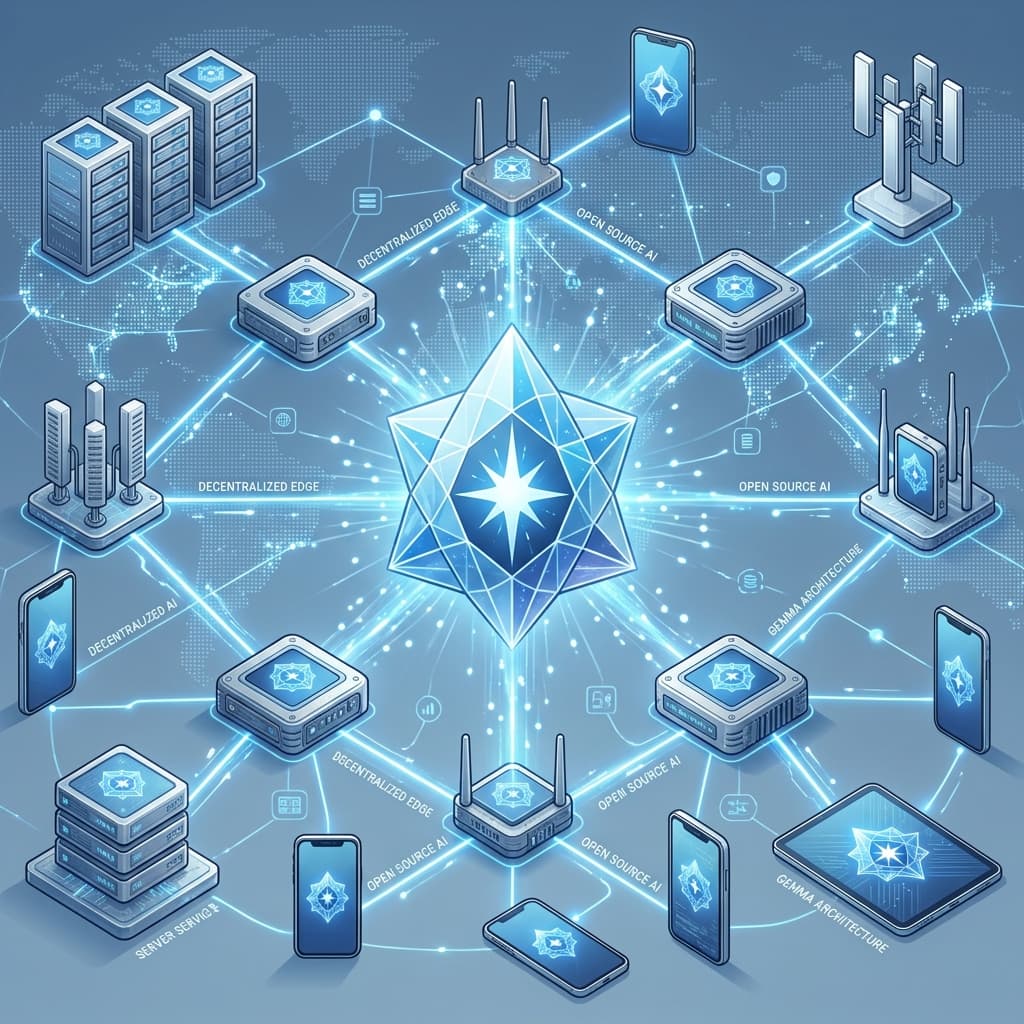
Gemma 4 and the Edge Revolution: Decentralizing AI Infrastructure for the Enterprise
Google's release of Gemma 4 under the Apache 2.0 license is a game-changer for enterprise AI. Discover how decentralized intelligence is becoming the new standard.
The Open-Weights Watershed: Google’s Strategic Pivot
On April 2, 2026, Google DeepMind delivered a masterstroke in the battle for AI ecosystem dominance. With the release of Gemma 4, Google has not only updated its suite of highly efficient open-weights models but has also transitioned the entire family to the commercially permissive Apache 2.0 license.
This shift is more than just a legal technicality; it is a declaration of war on the "walled garden" approach of closed-source giants. By removing restrictive usage policies and allowing enterprises to fine-tune, modify, and deploy Gemma 4 on their own terms, Google is positioning itself as the primary infrastructure provider for the Decentralized AI movement.
The History of Google's Open Journey: From BERT to Gemma
To understand where we are in 2026, we must look back at Google's complicated history with open intelligence. In 2018, Google released BERT, which sparked the modern NLP revolution. However, as models grew more powerful, Google became more protective. The "LaMDA" and early "PaLM" eras were marked by extreme secrecy.
With the launch of the original Gemma series in 2024, Google signals a change in heart. They realized that to compete with Meta’s Llama ecosystem, they needed to provide something Llama didn't: a path to True Sovereignty. Meta’s license, while "open-weights," still contained restrictions for very large companies. Gemma 4’s move to Apache 2.0 removes the last barriers to entry for the world's largest enterprises.
The Gemma 4 Family: A Model for Every Node
Gemma 4 is not a single model; it is a diverse family of architectures designed to live at the edge, in the private cloud, or deep within the enterprise data center.
| Model Variant | Architecture | Params | Best Use Case | Performance (MMLU) |
|---|---|---|---|---|
| Gemma 4 E2B/E4B | Hyper-Dense | 2B / 4B | On-device mobile inference, IoT. | 65.4% |
| Gemma 4 26B MoE | Mixture of Experts | 26B (3.8B active) | High-throughput serverless agents. | 82.1% |
| Gemma 4 31B Dense | Dense | 31B | High-complexity reasoning, RAG. | 86.7% |
Technical Spotlight: The 26B Mixture of Experts (MoE)
The standout performer in the 2026 lineup is the 26B MoE. Using a "sparse" architecture, the model contains 26 billion total parameters but only "activates" approximately 3.8 billion of them for any given token.
graph TD;
    In[Input Token] --> G[Gating Network];
    G --> E1[Expert 1: Coding];
    G --> E2[Expert 2: Logic];
    G --> E3[Expert 3: Creative];
    G --> E4[Expert 4: Math];
    E1 -- Active --> Sum[Weighted Sum];
    E2 -- Inactive --> Sum;
    E3 -- Inactive --> Sum;
    E4 -- Active --> Sum;
    Sum --> Out[Output Token];
This sparsity allows the 26B model to provide the reasoning depth of a much larger dense model while maintaining the inference speed and memory requirements of a 4B model. For enterprises, this means they can run "Opus-class" reasoning on consumer-grade server hardware—slashing their operational costs by up to 80%.
The 31B Dense Powerhouse: Deep Dive into the Architecture
While the MoE model wins on speed, the 31B Dense model is the intellectual anchor of the family. It utilized a refined Grouped Query Attention (GQA) mechanism and Sliding Window Attention to maintain a 128k context window with minimal memory pressure.
Google's researchers also implemented Knowledge Distillation from Gemini 1.5 Ultra. This means the weights of Gemma 4 were literally "labeled" by the world's most powerful model during training, allowing the 31B model to inherit the "Internal Logic" of a much larger system. This is why the Gemma 4 31B outperforms nearly every other model in its parameter class on the HumanEval coding benchmark.
Sovereignty over SaaS: The Enterprise Shift to On-Premise
The most significant trend driven by Gemma 4 is the move toward Model Sovereignty. In 2024 and 2025, enterprises were forced to send their most sensitive data to third-party APIs (like OpenAI or Anthropic) to get frontier-level performance. This created massive risks in terms of data privacy, regulatory compliance, and vendor lock-in.
In mid-2026, the pendulum has swung back. With Gemma 4’s performance matching or exceeding the flagship models of 2025, organizations are choosing to keep their "Weights in a Vault."
The Benefits of Local Deployment: A Strategic Analysis
- Air-Gapped Security: Critical sectors (Defense, Healthcare, Nuclear Energy) can now deploy frontier-class agents in environments with zero internet access.
- No Token Tax: Enterprises pay for the hardware, not the token. This allows for the high-volume processing—billions of tokens per day—that would be economically ruinous on a public API.
- Fine-Tuning Freedom: Because the Apache 2.0 license allows modification, companies are "distilling" their internal institutional knowledge directly into the weights of Gemma 4, creating bespoke agents that understand their specific industry jargon and internal procedures perfectly.
- Deterministic Latency: By running locally, developers avoid the "Spiky Latency" of public APIs, enabling real-time robotic control and high-frequency trading.
Case Study: Local Governance - The 'Town Hall' Agent
In March 2026, a mid-sized city in the European Union deployed a fine-tuned version of Gemma 4 26B to handle municipal services. Due to strict EU data privacy laws (GDPR), the city could not use cloud-based US models for processing resident data.
The city deployed its own "Town Hall Grid"—a cluster of 10 local servers running Gemma 4. The agents were able to:
- Transcribe and Summarize Public Hearings in real-time.
- Process Zoning Permits autonomously by cross-referencing applications with thousands of pages of local code.
- Answer Resident Queries about garbage collection, school zones, and taxes, with all data staying entirely within the city's private network.
The Impact: In the first three months, the backlog for zoning permits dropped from 6 weeks to 2 days. The city saved an estimated €400,000 in administrative costs while maintaining 100% compliance with data sovereignty requirements.
The Impact on the Global South: Low-Cost AI Sovereignty
The Apache 2.0 release of Gemma 4 is particularly transformative for the Global South. Organizations in nations with limited budget for high-cost API subscriptions or unreliable international internet links can now become "AI Producers" rather than just "AI Consumers."
We are seeing the rise of Sovereign Cloud Initiatives in countries like Kenya, Vietnam, and Brazil, where local language datasets (e.g., Swahili or Vietnamese) are being used to fine-tune Gemma 4 models. This ensures that the benefits of the AI revolution are not centralized in Silicone Valley but are distributed across the globe in a culturally and linguistically relevant way.
Gemma 4 vs. Llama 4 vs. Mistral: The Open-Source Landscape
The competition in the open-weights space has never been more intense. While Meta’s Llama 4 (rumored for late 2026) aims for raw scale, Gemma 4 has captured the market for Efficiency-per-Parameter.
The Benchmark Breakdown (April 2026)
| Model | Size | License | Focus |
|---|---|---|---|
| Gemma 4 | 26B / 31B | Apache 2.0 | Speed / Efficiency |
| Llama 3.1 | 70B / 405B | Meta Custom | Raw Capability |
| Mistral Large 2 | 123B | Mistral Custom | Multilingual / EU-Centric |
The Edge Revolution: From Server to Sensor
The decentralized nature of Gemma 4 is enabling the next generation of Edge Computing. We are seeing the first widespread deployment of:
- Autonomous Retail Nodes: Local agents in stores that manage inventory and customer interaction without needing a constant cloud link.
- Smart Industrial Sensors: Factory sensors that don't just alert on failure but use Gemma 4 to autonomously diagnose the root cause and schedule a repair.
- Privacy-First Personal Assistants: Digital twins that live entirely on a user's laptop or smartphone, managing their schedule and private emails without ever sending a single byte to a central server.
- Agricultural Drones: Drones that process hyper-spectral imagery in-flight with Gemma 4 E2B to identify crop diseases in real-time without needing a data link.
The Logic of the Apache 2.0 License: A Philosophical Victory
The transition of Gemma 4 to the Apache 2.0 license is the most significant event in the history of open-weights AI. While Meta’s Llama license has been the industry standard for two years, its "Meta-Specific Limitations"—which restrict use for companies with over 700 million monthly active users—have always been a point of friction for the global giants.
By choosing Apache 2.0, Google is essentially saying that they no longer care about "Owning the Weights." They care about Owning the Ecosystem. Every developer who builds on Gemma 4 today is one more developer integrated into Google’s tooling, their cloud infrastructure (even if they run locally initially), and their architectural standards. It is a classic "Loss Leader" strategy designed to make Google the default choice for the next decade of agentic development.
Technical Deep Dive: GQA and Sliding Window Attention
Gemma 4 achieves its efficiency through two primary architectural innovations that have been refined since the early days of Mistral and Llama.
- Grouped Query Attention (GQA): Traditional attention requires a separate set of "Key" and "Value" heads for every "Query" head. GQA allows multiple Query heads to share the same Key/Value heads. This dramatically reduces the memory footprint of the KV-cache, allowing Gemma 4 31B to maintain a 128k context window on hardware that would normally be restricted to 32k.
- Sliding Window Attention (SWA): Instead of every token attending to every other token in the 128k window, SWA uses a "limited view" for the lower layers, only enabling full attention in the final reasoning layers. This creates a "Memory Bottleneck" that actually improves performance by forcing the model to condense its representation of the context at every step.
Case Study: Healthcare - The Privacy-Sovereign Diagnostic Fleet
A major pharmaceutical research lab in Switzerland deployed a fleet of fine-tuned Gemma 4 31B models in early 2026.
- The Problem: The lab was working on "Patient-Zero" data for a rare genetic disorder. Due to Swiss privacy laws, this data could never leave the lab’s air-gapped facility.
- The Solution: They used Gemma 4 to build an "Autonomous Genomic Auditor" that runs entirely on local NVIDIA H200 air-gapped clusters.
- The Result: The agents were able to identify a novel protein-folding anomaly that had been missed by traditional bio-statistical methods. Because the model was Apache 2.0, the lab was able to "Hard-Code" their own recursive security protocols into the model's weights during the fine-tuning process, reaching a level of safety that would be impossible with a closed-source API.
The Impact on Developer Productivity: The End of Cloud Dependency
For developers, Gemma 4 represents the "Freedom of the Local Machine." The overhead of managing API keys, navigating rate limits, and worrying about "Model Drift" in the cloud is gone. A developer can now build, test, and deploy a frontier-class agentic system on their own workstation.
This has led to a massive surge in "Edge-Native" Applications. We are seeing the first generation of video editors, IDEs, and local-first databases that have a "God-Class" AI built directly into the binary. The AI is no longer a separate service; it is a feature of the software, as fundamental as the undo button or the save command.
Comparison: Gemma 4 vs. Mistral 3
The rivalry between Google and Mistral is the "Battle for the Heart of the Developer."
- Mistral 3: Focuses on "Ultra-Dense" capabilities and multilingual support, specifically for the European market. It remains the choice for high-end, complex legal and financial tasks in France and Germany.
- Gemma 4: Focuses on "Efficiency and Integration." It is the choice for developers who want the fastest path from "Idea" to "Production" using the Google Cloud/Vertex AI ecosystem as a scaling path.
Predictions for 2030: The Distributed Intelligence Grid
By 2030, we anticipate the rise of the Global Intelligence Grid. In this future, billions of Gemma-descended edge nodes will be linked together in a decentralized network. If your local agent needs more "Thinking Power" to solve a complex problem, it will autonomously "rent" the idle capacity of other Gemma nodes in your neighborhood, paying for the compute in decentralized energy credits.
The Apache 2.0 license is the fundamental building block of this future. It ensures that the "Brain Power" of humanity is not a centralized commodity controlled by a few corporations, but a distributed public utility available to everyone.
Conclusion: The New Normal is Local
The release of Gemma 4 marks the end of the "API-Only" era of artificial intelligence. By providing frontier-level reasoning with the efficiency required for local deployment and the legal freedom of the Apache 2.0 license, Google has democratized intelligence for the enterprise.
Infrastructure is no longer something you rent from a centralized cloud provider; it is something you own, control, and evolve. As we move into the latter half of 2026, the question for the C-suite is no longer "When will the AI be safe enough for us to send our data to?" it is "When will we start deploying our own sovereign intelligence at the edge?" The answer, thanks to Gemma 4, is today. The decentralized revolution is here, and it is open-source.
Final Thoughts: The Collaborative Future
The next 12 months will see a massive explosion in Community-Driven Models based on the Gemma 4 foundation. From specialized "Medical Gemma" to high-performance "Legal Gemma," the Apache 2.0 ecosystem will outpace the closed-source giants through sheer collaborative volume. Google has not just released a model; they have planted a forest.