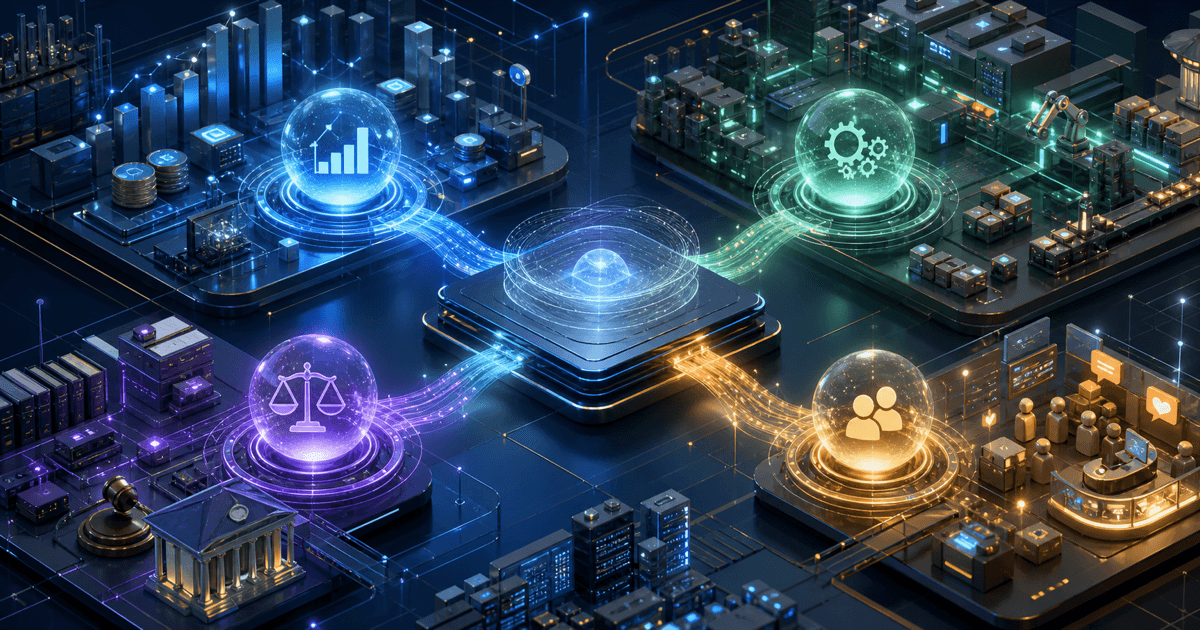
1,445% and Rising: The Multi-Agent AI Revolution Reshaping Enterprise Work
Multi-agent AI adoption surged 1,445% in 2026. Discover how autonomous agent networks are replacing entire workflows and redefining enterprise software.
20 articles

Multi-agent AI adoption surged 1,445% in 2026. Discover how autonomous agent networks are replacing entire workflows and redefining enterprise software.

Anthropic releases Claude Opus 4.7 with advanced coding capabilities while keeping its frontier Claude Mythos model under a secretive gated program.

Anthropic has unveiled Project Glasswing, a restricted initiative using their most powerful model yet—Claude Mythos—to secure global infrastructure.

Google's release of Gemma 4 under the Apache 2.0 license is a game-changer for enterprise AI. Discover how decentralized intelligence is becoming the new standard.

Anthropic unveils Claude Mythos Preview, a model so powerful it is restricted to a gated consortium of critical infrastructure protectors.

As we hit the mid-point of 2026, the era of the chatbot is officially over. Enterprise AI has shifted from passive advice to autonomous execution.

GitHub Copilot CLI reaches General Availability, introducing the 'Rubber Duck' cross-model verification protocol to the command line.

Locus Robotics launches Locus Array, marking the transition from 'Smart Robots' to autonomous 'Physical AI Agents' in our shared spaces.

Anthropic's Claude Managed Agents enters public beta, offering a hosted harness for deploying long-running autonomous AI agents with sandboxing, governance, and session persistence at $0.08/session-hour.

A new CAMH study reveals how clinical AI risk-prediction models are inadvertently reinforcing systemic biases against marginalized populations in psychiatry.

Inside Anthropic's 'Project Glasswing' and the Claude Mythos Preview—a model so adept at finding zero-days, it is restricted to deep US partnerships.

With 96% of enterprises deploying Agentic AI, a massive 'AI sprawl' is emerging. Discover the security risks and the Z.ai GLM-5.1 solution.

Researchers at USC have broken the thermal barrier of AI hardware with new memristor-based memory devices capable of operating at extreme temperatures.

OpenAI's latest policy paper suggests massive shifts from taxing labor to capital, alongside public wealth funds, to cushion the blow of workforce automation.

How modern enterprises are moving from conversational chatbots to autonomous digital coworkers and the major friction points identified in 2026.

An in-depth analysis of the new generation of frontier models released in 2026 featuring natively integrated computer use and UI navigation capabilities.

Analyzing the shift toward collaborative multi-agent systems where specialized digital intelligence hands off context and tasks seamlessly.

Evaluating the National Institute of Standards and Technology's robust new framework addressing prompt injection and the security risks of AI agents.

An exploration of how the new Vera Rubin architecture and Neuro-Symbolic research are reducing energy consumption and boosting logic processing.