Gemini Robotics-ER 1.6: Google Gives Robots Spatial Reasoning and Boston Dynamics Takes Them to the Factory Floor
Google DeepMind launches Gemini Robotics-ER 1.6, a reasoning model that gives industrial robots spatial awareness and gauge-reading accuracy. Boston Dynamics integrates it into Spot.
The Robot That Reads the Gauge
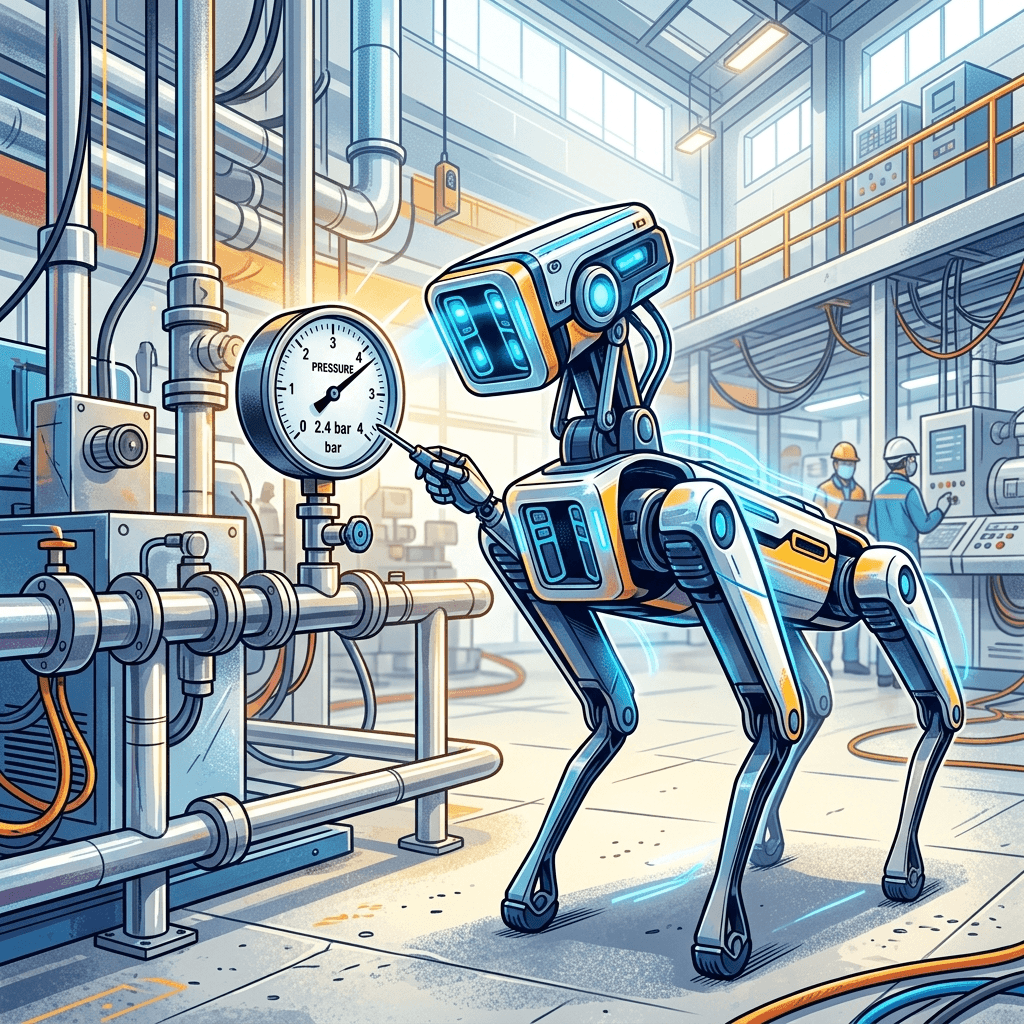
In a GE Vernova gas turbine maintenance facility in Schenectady, New York, a Boston Dynamics Spot robot paused in front of a pressure gauge mounted on a steam pipe three meters above the floor. The gauge was analog—a physical needle embedded behind pitted glass, partially obscured by years of industrial grime. A human technician would need to squint, estimate the needle's position between tick marks, and log the reading on a clipboard. The robot pointed its wrist-mounted camera at the gauge, processed the image through Google DeepMind's Gemini Robotics-ER 1.6 model, and recorded the pressure as 47.3 PSI—within 0.2 PSI of the ground truth measured by a reference digital sensor installed for calibration testing.
The reading took 1.7 seconds. The robot had never seen that specific gauge before.
This scenario, demonstrated during Google DeepMind's April 14 launch event for Gemini Robotics-ER 1.6, encapsulates the transition from scripted robotic automation to reasoning-first robotics. Previous generations of inspection robots could follow pre-programmed patrol routes and capture images for human review. They could not interpret what they saw. Gemini Robotics-ER 1.6 gives robots the cognitive machinery to understand their physical environment, decompose complex inspection tasks into executable sub-goals, and make autonomous decisions about what to examine next—all without human intervention.
What Changed from ER 1.0 to ER 1.6
Gemini Robotics-ER (Extended Reality) represents Google DeepMind's embodied AI initiative, distinct from the conversational Gemini models used in consumer products. The "ER" designation signals a model architecture specifically designed for agents that exist in and interact with physical space—robots, drones, autonomous vehicles, and industrial inspection systems.
Version 1.6 introduces three capabilities that its predecessors lacked. The first is multi-view temporal reasoning. Earlier models processed individual camera frames independently, losing the temporal relationships between observations. A robot inspecting a long corridor of equipment would analyze each frame in isolation, unable to remember that the valve it passed thirty seconds ago was in a different state than expected. ER 1.6 processes streams from multiple cameras simultaneously—overhead, forward-facing, and wrist-mounted—and maintains a coherent temporal model of the environment. The robot does not merely see its current frame. It remembers what it saw three minutes ago and uses that memory to contextualize its current observations.
The second capability is instrument reading. This sounds mundane until you consider the diversity of analog instruments still in active use across industrial facilities worldwide. Pressure gauges, temperature dials, flow meters, sight glasses, level indicators, and mechanical counters all present information through needle positions, fluid levels, and numerical displays that vary enormously in size, font, condition, and mounting orientation. ER 1.6 achieves 93% accuracy on first-attempt gauge readings across its benchmark dataset—a dataset that includes gauges photographed in low light, through protective enclosures, and at oblique angles with significant lens distortion.
The third capability is agentic task decomposition. Given a high-level mission—"Inspect all steam pressure regulators in Building 7 and flag any reading outside the 40-55 PSI operating range"—the model generates a patrol plan, navigates to each regulator, captures and interprets readings, compares results against specified thresholds, and generates an anomaly report. It can determine when additional investigation is needed (a blurry reading prompts the robot to reposition for a clearer angle) and when a task is complete.
graph TD
    A[High-Level Mission] --> B[Task Decomposition]
    B --> C[Navigation Planning]
    B --> D[Instrument Identification]
    B --> E[Safety Constraint Checking]
    C --> F[Multi-Camera Fusion]
    D --> G[Gauge Reading]
    D --> H[Anomaly Detection]
    F --> I[Spatial Awareness Map]
    G --> J{Within Threshold?}
    J -->|Yes| K[Log Normal Reading]
    J -->|No| L[Flag Anomaly]
    L --> M[Generate Report]
    K --> N[Move to Next Target]
    E --> O[Weight Limit Recognition]
    E --> P[Hazmat Area Detection]
The Boston Dynamics Integration
Boston Dynamics has integrated Gemini Robotics-ER 1.6 into two of its commercial platforms: the Spot quadruped robot and the Orbit fleet management system. The Spot integration is the more immediately visible—the robot's existing camera array provides the multi-view input that ER 1.6 requires for spatial reasoning, while Spot's legged locomotion enables access to environments that wheeled or tracked robots cannot reach.
The Orbit integration is strategically more significant. Orbit is Boston Dynamics' cloud-based platform for managing fleets of Spot robots deployed across industrial facilities. It handles mission scheduling, data aggregation, and fleet coordination. With ER 1.6 integration through what Boston Dynamics calls the "AIVI-Learning" stack, Orbit gains the ability to continuously refine robot behaviors based on accumulated inspection data. A Spot robot that encounters an unusual gauge configuration at one facility can share that experience across the fleet, improving recognition accuracy for every other robot in the network.
This fleet-level learning addresses one of the most persistent challenges in industrial robotics: the long tail of environmental variability. Every factory, power plant, and refinery has unique layouts, equipment configurations, and ambient conditions. A robot trained exclusively in controlled laboratory settings performs poorly when confronted with the reality of a forty-year-old manufacturing facility where pipes are labeled inconsistently, lighting varies from blinding fluorescent to near-darkness, and equipment has been modified, repaired, and rearranged dozens of times since the original blueprints were drawn.
The Technical Architecture of Spatial Reasoning
Understanding what Gemini Robotics-ER 1.6 actually computes requires examining its three-layer processing architecture. The perception layer handles raw sensor fusion—combining RGB images from multiple cameras with depth data from LiDAR or stereo vision systems into a unified 3D representation of the environment. This layer builds what DeepMind calls a "voxel-semantic map": a three-dimensional grid where each cell contains both geometric information (occupied vs. empty space) and semantic labels (wall, pipe, gauge, floor, obstacle).
The reasoning layer operates on this voxel-semantic map using a transformer architecture adapted for spatial attention. Unlike language transformers that attend to token sequences, the spatial transformer attends to volumetric regions, weighting nearby regions more heavily than distant ones while maintaining long-range spatial dependencies. This allows the model to reason about relationships between objects—understanding, for example, that a pressure gauge mounted on a specific pipe likely corresponds to the steam system documented in the facility's maintenance records, not the adjacent cooling system.
The action layer translates reasoning outputs into motor commands. For a Spot robot, this means generating trajectories that navigate the robot to optimal observation positions, adjusting camera angles for clear line-of-sight to target instruments, and coordinating leg movements to maintain stability on uneven industrial flooring. The action layer also enforces safety constraints: the model recognizes weight limit markings on elevated platforms, identifies hazardous material symbols, and refuses to navigate into areas that its safety assessment deems too risky for the robot's hardware capabilities.
| Feature | ER 1.0 (2025) | ER 1.5 (Jan 2026) | ER 1.6 (Apr 2026) |
|---|---|---|---|
| Camera inputs | Single | Dual | Multi (unlimited) |
| Temporal memory | None | Short-term (30s) | Long-term (full session) |
| Gauge reading accuracy | N/A | 71% | 93% |
| Task decomposition | Static scripts | Basic planning | Agentic reasoning |
| Safety constraint handling | Rule-based | Learned (limited) | Learned + physical awareness |
| API availability | Private | Beta partners | General (Gemini API) |
| Fleet learning | None | None | Orbit AIVI integration |
| Reasoning latency | 3-5s per frame | 1-2s per frame | 0.3-0.8s per frame |
Why Industrial Robotics and Not Consumer Robotics
Google DeepMind's decision to focus Gemini Robotics-ER on industrial applications rather than consumer robots or household assistants reflects a hard-learned lesson about the economics of embodied AI. Consumer robotics has been a graveyard for ambitious companies—Jibo, Anki, Amazon's Astro—each promising household robots that could navigate homes, recognize family members, and assist with daily tasks. The failure mode was consistent: the cost of hardware capable of safe household operation exceeded what consumers were willing to pay, and the limited utility of early-generation robots couldn't justify the premium.
Industrial environments invert this equation. The cost of a Spot robot equipped with ER 1.6 capabilities—estimated at $120,000 to $180,000 for a fully configured unit—is trivial compared to the cost of human inspection labor in hazardous industrial facilities. Nuclear power plants, offshore oil platforms, chemical processing facilities, and semiconductor fabrication plants all require regular inspection of equipment in environments that are dangerous, expensive, or physically inaccessible for human workers. A robot that can reliably read gauges, detect anomalies, and file inspection reports eliminates the need for human workers to enter confined spaces, climb scaffolding, or traverse radioactive zones.
The value proposition is not "cheaper than humans." It is "safer than humans, more consistent than humans, and available twenty-four hours a day, seven days a week." A human inspector in a nuclear facility can inspect equipment for approximately four hours per shift before radiation exposure limits require rotation. A robot has no such constraint.
DeepMind's Broader Robotics Vision
Gemini Robotics-ER 1.6 is one component of what appears to be a deliberately methodical robotics strategy at Google DeepMind. The company has avoided the high-profile humanoid robot demonstrations favored by competitors like Figure AI, Tesla (with Optimus), and Sanctuary AI. Instead, DeepMind has focused on building the cognitive infrastructure that makes any physical robot platform more capable—a "brain-first" approach that treats the robot body as interchangeable hardware.
This strategy has historical precedent in Google's approach to smartphones. Android was not a phone—it was an operating system that could power any phone. Similarly, Gemini Robotics-ER is not a robot—it is a reasoning system that can power any robot. By making the model available through the Gemini API and Google AI Studio, DeepMind positions itself as the default intelligence layer for the entire robotics industry, regardless of which company manufactures the physical platform.
The implications for robotics startups are substantial. A company building specialized robots for warehouse inspection, agricultural monitoring, or infrastructure maintenance can now integrate Gemini Robotics-ER as their perception and reasoning engine, focusing their own engineering resources on hardware design, mobility systems, and domain-specific sensors. The cognitive layer—the hardest and most expensive component to develop in-house—becomes a cloud service billed per API call.
The Semiconductor Fabrication Opportunity
The most commercially significant early deployment of Gemini Robotics-ER 1.6 may not be in traditional heavy industry but in semiconductor fabrication. Modern chip fabs—the cleanroom facilities where semiconductors are manufactured—represent a uniquely challenging environment for AI-powered inspection. The equipment is extraordinarily expensive (a single EUV lithography machine costs over $350 million), the tolerances are measured in nanometers, and the consequences of undetected defects cascade across entire chip production runs.
TSMC, Samsung, and Intel have all expressed interest in robotic inspection systems that can supplement or replace human technicians in fab environments. Human inspectors in cleanrooms face strict contamination protocols—gowning procedures that take fifteen minutes, limited shift durations to maintain concentration, and movement restrictions that prevent rapid traversal between inspection stations. A robot operating under ER 1.6's spatial reasoning capabilities faces none of these constraints. It can operate continuously in cleanroom conditions, navigate between inspection targets without contamination risk, and maintain consistent inspection quality across twelve-hour shifts that would exhaust human attention.
The gauge-reading capabilities that ER 1.6 demonstrated in the GE Vernova facility translate directly to fab inspection requirements. Semiconductor manufacturing equipment generates continuous streams of process parameters—chamber pressure, gas flow rates, substrate temperature, plasma power levels—displayed on a combination of digital readouts and legacy analog gauges. A robot equipped with ER 1.6 can patrol a fab floor, read these instruments, correlate readings across multiple tools, and flag deviations from process specifications before they result in defective wafers.
The economic case is compelling. A single production interruption at a major fab can cost between $5 million and $50 million in lost output, depending on the product mix and the duration of the interruption. A fleet of ER 1.6-equipped inspection robots that reduces unplanned downtime by even ten percent generates returns that dwarf the deployment cost within months.
The Competitive Landscape: Figure, Optimus, and the Humanoid Question
Gemini Robotics-ER 1.6's deployment on a quadruped platform like Spot raises an implicit strategic question: is the future of industrial robotics legged, wheeled, or humanoid? The answer matters because it determines which companies' hardware investments will appreciate and which will become stranded assets.
Figure AI, backed by significant investment from Microsoft and NVIDIA, has bet heavily on humanoid form factors. The rationale is intuitive: human-designed environments—staircases, doorways, control panels, hand-operated valves—are optimized for human body proportions. A humanoid robot can operate in these environments without infrastructure modification. Figure's latest prototype demonstrates impressive bipedal locomotion and hand dexterity, and the company argues that humanoids represent the largest possible addressable market because they can perform any physical task a human can perform.
Tesla's Optimus program makes a similar argument, with the added strategic advantage of Grok integration following the SpaceX-xAI merger. Optimus robots deployed in Tesla manufacturing facilities learn from a data environment that includes automotive assembly, logistics, and now AI model training—a feedback loop that no pure robotics company can replicate.
Boston Dynamics and DeepMind's counter-argument is pragmatic: industrial environments don't need humanoid robots, they need effective robots. Spot's quadruped form factor offers stability advantages on uneven industrial surfaces, a lower center of gravity that reduces tip-over risk, and a payload capacity that accommodates sensor arrays without the balance calculations required by bipedal platforms. The cognitive capability—provided by ER 1.6—matters more than the physical form.
The market will likely support both approaches, segmented by use case. Humanoids for environments requiring fine manipulation and tool use (assembly, maintenance). Quadrupeds for environments requiring mobility, endurance, and stability (inspection, patrol, monitoring). The cognitive layer—the spatial reasoning, task decomposition, and instrument reading capabilities—is increasingly hardware-agnostic, which favors DeepMind's "brain-first" strategy regardless of which body wins in any given application.
Workforce Implications and the Inspection Technician
The deployment of AI-powered inspection robots inevitably raises questions about the human technicians whose roles they are designed to supplement or replace. The framing matters: "supplement" and "replace" describe different trajectories with different social consequences.
In the near term, ER 1.6-equipped robots will most likely supplement human inspectors rather than replace them. The robots handle routine patrol inspections—the repetitive, scheduled walk-throughs that consume the majority of a technician's shift—while human inspectors focus on anomaly investigation, maintenance planning, and the judgment-intensive tasks that require understanding equipment history and operational context. This division of labor increases overall inspection coverage without reducing headcount.
The longer-term trajectory is less comfortable. As the AI's anomaly detection capabilities improve through fleet learning, the range of situations that require human judgment will narrow. The technician who currently investigates a flagged pressure reading may find that the robot's contextual understanding—informed by data from hundreds of similar readings across dozens of facilities—produces investigation recommendations that are as accurate as their own. At that point, the human's role shifts from investigator to supervisor—monitoring the robot's decisions rather than making them.
Industrial unions are already engaging with this transition. The International Brotherhood of Electrical Workers and the United Steelworkers have both issued position papers on AI-powered inspection, acknowledging the safety benefits of robotic inspection in hazardous environments while emphasizing the need for retraining programs, transition support, and contractual protections for displaced workers. The debate is not about whether AI-powered inspection is coming—it clearly is—but about who benefits from the productivity gains it creates.
The Philosopher in the Room
In a move that garnered far less attention than the ER 1.6 launch but may prove more consequential, Google DeepMind hired Henry Shevlin—a philosopher specializing in artificial consciousness and moral status—into a newly created role. The appointment signals that DeepMind is thinking seriously about the long-term implications of embodied AI systems that reason, learn, and make autonomous decisions in the physical world.
The questions Shevlin is tasked with exploring are not yet commercially urgent but are philosophically unavoidable. When a robot equipped with Gemini Robotics-ER encounters a situation not covered by its training—a piece of equipment it has never seen, an environmental condition it cannot categorize—does its attempt to reason through the situation constitute something meaningfully different from pattern matching? As fleet learning allows robots to share experiences across the network, does the collective intelligence of a hundred Spot robots constitute a single distributed cognitive system or a hundred independent agents with shared memory?
These questions may seem abstract beside the immediate commercial value of accurate gauge readings and autonomous inspection patrols. But DeepMind's willingness to engage with them formally—by hiring an academic philosopher rather than relegating these questions to marketing blog posts—suggests an organizational seriousness about the trajectory of embodied AI that extends well beyond the current product generation.
The Economics of the Inspection Revolution
The total addressable market for AI-powered industrial inspection is larger than most technology analysts have recognized. Industrial inspection services—encompassing equipment monitoring, safety compliance verification, environmental monitoring, and predictive maintenance—represent a global market estimated at $45 billion annually. This market is currently served almost entirely by human labor, with minimal automation beyond stationary sensors and scheduled maintenance protocols.
ER 1.6-equipped robots do not need to capture the entire market to represent a transformational business for Google DeepMind and Boston Dynamics. Even a five percent penetration of the industrial inspection market would generate over $2 billion in annual recurring revenue from hardware sales, cloud processing fees (billed per API call through the Gemini platform), and fleet management subscriptions through the Orbit platform.
The pricing model that Boston Dynamics and DeepMind are deploying follows the "razor and blade" pattern that has proven effective across enterprise technology. The robot hardware is sold at moderate margins (the "razor"), while the ongoing cognitive capabilities—model updates, fleet learning improvements, expanded instrument recognition—are delivered as a cloud subscription (the "blades"). This model creates predictable recurring revenue and increasing customer lock-in as the fleet learning system accumulates facility-specific knowledge that would be expensive to replicate with a competing platform.
For the industrial companies deploying these systems, the ROI calculation extends beyond direct labor replacement. Insurance premiums for facilities with comprehensive robotic inspection programs are beginning to reflect the reduced risk profile—lower incident rates, better documentation, and faster anomaly response translate into measurable reductions in property and casualty insurance costs. Regulatory compliance becomes more auditable when inspection data is generated by consistent, calibrated robotic systems rather than variable human observers.
Meanwhile, on the factory floor in Schenectady, the Spot robot has completed its patrol. It identified one gauge reading 3.1 PSI above the target threshold and flagged the location for maintenance review. It recharges in its docking station, its cameras idle.
It does not yet know what to make of the philosopher's questions. Neither do we.