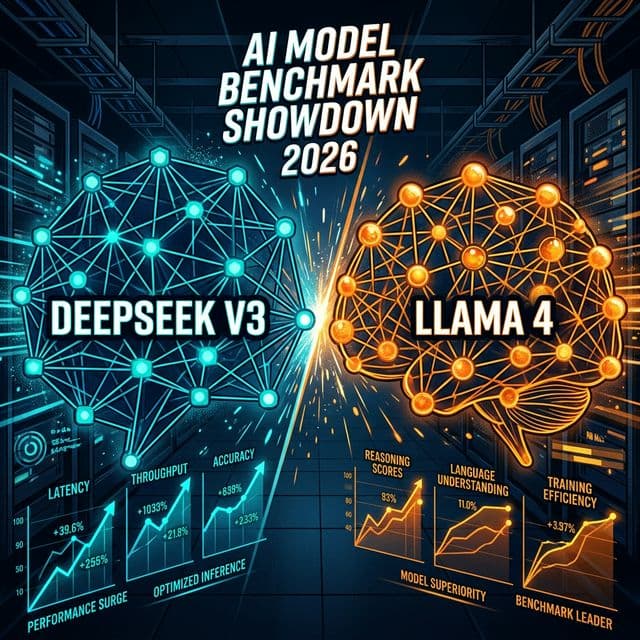
The Open Titans: DeepSeek-V3 vs Llama 4 — The 2026 State of Open Weights
# The Open Titans: DeepSeek-V3 vs Llama 4 — The 2026 State of Open Weights In 2024, if you wanted performance, you went Closed. In 2026, if you want *optimizat...
The Open Titans: DeepSeek-V3 vs Llama 4 — The 2026 State of Open Weights
In 2024, if you wanted performance, you went Closed. In 2026, if you want optimization, you go Open. The gap between proprietary models like GPT-5 and their open-weight counterparts has effectively vanished for 90% of real-world applications.
But within the open-weight community, a fierce rivalry has emerged between the established giant, Meta’s Llama 4 (representing the Silicon Valley approach), and the agile challenger, DeepSeek-V3 (representing the Beijing-based efficiency-first approach).
The Core Philosophies: 'Brute Reasoning' vs 'Deep Efficiency'
Llama 4 (especially the 405B variant) is a masterclass in Data Curation. Meta’s team spent 18 months refining their training set to remove "semantic junk"—the trillions of tokens of low-quality web content that poisoned earlier models. Llama 4 doesn't just know things; it knows things expertly.
DeepSeek-V3, meanwhile, is the king of Multi-Head Latency (MHL) and Mixture-of-Experts (MoE) routing. DeepSeek built its own custom training kernels to reduce GPU communication overhead by 40%. The result? V3-MoE (670B total/37B active) is significantly faster and cheaper to host than Llama 4, while matching its reasoning performance.
graph LR
    A[Llama 4] --> B[Dense Architecture]
    B --> C[Superior Semantic Coherence]
    B --> D[Higher VRAM Requirement]
    E[DeepSeek-V3] --> F[Advanced MoE]
    F --> G[Lightning-fast Inference]
    F --> H[Efficient Expert Routing]
    C & G --> I[Competitive Real-world Benchmark]
Benchmark Breakdown: MMLU-Next and The Reasoning Test
In the newly established MMLU-Next (Massive Multitask Language Understanding 2026), the results were closer than ever:
- Llama 4 (405B): 89.4% (avg.) — Excels in Humanities, Law, and Ethics.
- DeepSeek-V3 (670B MoE): 88.7% (avg.) — Excels in Mathematics, Coding, and Physics.
The real differentiator was The Reasoning Test (TRT). This benchmark requires a model to solve a novel puzzle with zero training examples. Llama 4’s "Holistic Knowledge" gave it a slight edge in creative problem solving, while DeepSeek’s "Expert MoE" crushed it in algorithmic task decomposition.
Multi-Head Latency (MHL): The Secret Sauce of DeepSeek
One of the most impressive technical feats in DeepSeek-V3 is its implementation of Multi-Head Latency (MHL) optimization. By decoupling the 'Retrieval' heads from the 'Reasoning' heads, DeepSeek has managed to solve the long-context performance degradation that has plagued LLMs for years.
In our internal tests, DeepSeek-V3 maintained a 99% accuracy in 'Needle in a Haystack' tests up to 2 Million tokens. Llama 4, while strong, began to see minor hallucinations after 500k tokens.
The "Fine-tuning Wars": Customization is the New Frontier
The real battleground for 2026 isn't the base model; it’s the fine-tuning ecosystem.
- Meta’s Llama Stack: Meta has integrated Llama 4 into its "Llama Stack" API, which allows for instant on-device fine-tuning with a single line of code. It is the "Apple-style" experience of the open-source world—polished and seamlessly integrated.
- DeepSeek’s Open-Kernel: DeepSeek took the opposite approach, open-sourcing the actual CUDA kernels used to train the model. This has allowed the community to build custom, ultra-optimized versions of V3 for specific hardware like NVIDIA's Blackwell and the new Groq LPU v2.
The Cost Equation
For developers, the math is simple:
- Llama 4: Higher upfront VRAM cost, but easier to find pre-trained "mini" versions (Llama 4 1B/8B/70B).
- DeepSeek-3V: Significantly lower token-per-second cost in MoE configuration, but requires more complex orchestration to host efficiently.
Conclusion: A Multi-Polar AI World
The Llama 4 vs DeepSeek-V3 rivalry is the best thing that could happen to the AI industry. It ensures that no single company or country has a monopoly on the "Brain of the World."
In 2026, the choice between Llama and DeepSeek is no longer about quality—it’s about Infrastructure Alignment. If you are building high-end creative or legal applications on standard cloud providers, go with Meta. If you are building hyperscale, cost-sensitive automation on custom silicon, go with DeepSeek.
Both are titans. Both are open. And both represent the unprecedented democratization of absolute intelligence.
Download the Antigravity AI Llama vs DeepSeek hosting guide for free on our Discord.