Cornelis Wants the Network to Earn Back Idle GPU Time
Cornelis pairs $205 million with an active networking roadmap, but shipping transport and programmable fabric compute remain different propositions.
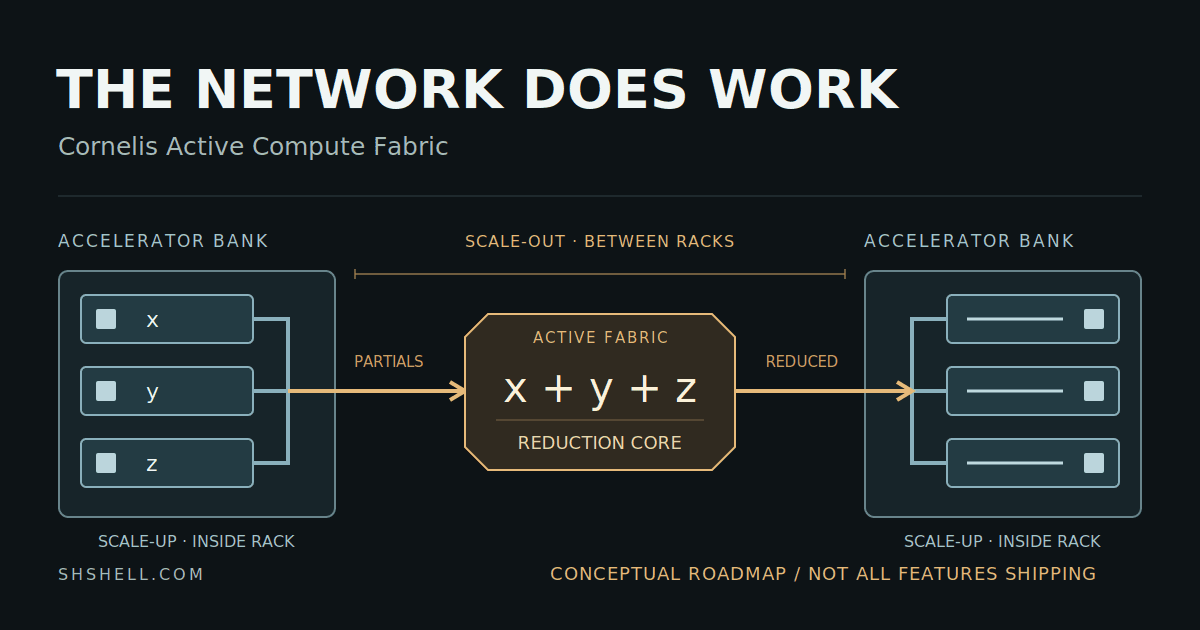
An expensive accelerator can finish its local calculation and still have no useful next step: the distributed job needs results from other devices. In training, that dependency often appears in collective communication, where participants exchange or combine data before dependent computation can proceed. Cornelis describes the resulting idle time as a network economics problem: capacity has been purchased, powered, and installed, but communication prevents it from producing results. Its proposal is to give the network more responsibility for that work, moving beyond faster delivery toward operations performed inside the fabric. The mechanism matters because only some accelerator waiting is recoverable through networking improvements. Cornelis’s communication-bottleneck explainer makes that distinction explicit.
That is the premise behind Cornelis’s September 14 announcement of Active Compute Fabric, approximately $205 million in funding, and a Qualcomm collaboration described as validation toward future rack-scale AI designs. The announcement marks Cornelis’s entry into scale-up networking and frames programmable fabric compute as a way to improve accelerator utilization. But the investment supports a transition whose stages have different availability: CN5000 is shipping, CN6000 is sampling with expanded availability expected in the fourth quarter of 2026, and broader programmable scale-up capabilities belong to the forward roadmap. The title’s promise—earning back idle GPU time—is therefore an architectural and commercial objective, not a demonstrated return from the entire newly announced system. Cornelis’s September 14 release supplies both the ambition and those boundaries.
The synchronization bill behind the funding
A collective operation explains why faster accelerators alone cannot settle this problem. NVIDIA’s NCCL documentation defines AllReduce as combining values across devices through an operation such as sum, minimum, or maximum, then placing the result in every participant’s receive buffer. AllGather distributes the collected inputs to all participants, while ReduceScatter distributes portions of a reduced result. These are coordinated operations with specific data semantics, rather than unrelated transfers that can complete whenever convenient. The documentation requires participating ranks to use matching counts and datatypes, warning that violations can cause hangs, crashes, or corruption. That makes communication part of computational correctness as well as performance. NVIDIA’s collective-operations documentation establishes the underlying requirements independently of Cornelis’s product positioning.
Consider a hypothetical training job in which most accelerators finish a local computation while one participant’s contribution encounters a congested path. Where the next phase depends on the combined result, finishing local arithmetic earlier does not remove the dependency. Communication can overlap with useful computation, so the relevant delay is the portion that remains exposed after that overlap. Cornelis’s August 28 explainer describes precisely this distinction, including the role of stragglers and slow or overloaded links in collective duration. The illustration shows why an application might benefit from more predictable communication even without a headline increase in port speed; it does not establish how much any particular deployment would gain. Cornelis’s workload discussion explicitly makes benefits dependent on the workload and configuration.
Inference creates related dependencies with different traffic. Cornelis identifies mixture-of-experts token routing through all-to-all exchanges and movement of key-value cache data in some distributed serving architectures as sources of bursty, latency-sensitive communication. NCCL defines AlltoAll as each participant sending different data to every other participant and receiving distinct data from each. Unlike simply broadcasting an identical buffer, that pattern makes the distribution of destinations relevant to the communication work. The architectural implication is that a network optimized around a single aggregate bandwidth figure may leave important application behavior unexplained. Message distribution, concurrent traffic, and the timing of the slowest required transfers belong in the assessment. Cornelis’s explainer and NCCL’s operation definitions support that distinction.
Cornelis translates the utilization argument into a dramatic financial illustration: its modeled 100,000-GPU system attributes roughly half of GPU hours to waiting, representing about $1.68 billion annually in unused capacity and 500 GWh of power. Those figures are Cornelis estimates, not observations from a disclosed customer cluster or savings achieved by Active Compute Fabric. The release specifies assumptions including GPU-hour pricing, annual operating hours, and unproductive time, and identifies next-generation performance figures as projections based on pre-production simulation and modeling. The legitimate takeaway is the potential economic importance of communication delays. Treating the modeled waste as recoverable revenue, or treating all of it as network-remediable, would exceed the evidence. The announcement’s methodology note is essential to interpreting the headline numbers.
The financing gives Cornelis resources to pursue that opportunity without establishing that its architecture will capture it. TechCrunch reports that IAG Capital Partners led the round and frames the company as a networking challenger to NVIDIA; it also reports Cornelis’s 2020 separation from Intel. Cornelis says the funds will support production, customer partnerships, commercialization, and next-generation development. Taken together, those accounts describe a company financing both execution around an existing product business and expansion into another part of the system. The analytical distinction is important: shipping experience can support confidence in delivery, but financing and experience do not substitute for qualification of the proposed scale-up products. TechCrunch’s September 14 reporting and Cornelis’s release describe those separate commitments.
Crossing from the cluster into the accelerator domain
Cornelis’s architecture page distinguishes scale-up, which binds accelerators into a shared-memory domain, from scale-out, which connects nodes across a larger fabric. That distinction describes different relationships between compute resources, not merely different cable lengths. In Cornelis’s account, organizations commonly operate separate architectures and management planes at these layers, with interactions crossing between them. Active Compute Fabric proposes a common architecture spanning both. The potential attraction is a more consistent approach to communication as a workload moves between tightly coupled accelerators and the wider cluster. Whether that produces simpler operations will depend on how the promised products and software implement the relationship. The architecture description provides the scope of the proposal.
The expansion is anchored in an existing scale-out family. As historical background, Cornelis launched CN5000 on June 3, 2025, describing a 400G portfolio of SuperNICs, switches, director-class switches, cabling, and the OPX software suite. The launch said customer shipments would begin that month, with broader availability starting in the third quarter of 2025. The September 2026 announcement now states that CN5000 is shipping. This chronology matters because Active Compute Fabric is an umbrella for an installed-product foundation and future capability, rather than evidence that every function associated with the new name has just become available. The original CN5000 launch and the current announcement establish that sequence.
The proposed standards map also separates the layers. Cornelis identifies UALink and ESUN for scale-up and Ultra Ethernet specifications for scale-out, while its architecture page assigns native UALink and ESUN support to the future CN7000 platform. Those are vendor descriptions of intended architecture; the published announcement does not establish completed interoperability across arbitrary accelerator and fabric combinations. The relevant analytical question is which interfaces will allow a buyer to preserve choice, and which parts of the resulting system still require coordinated qualification. A standards commitment can define a direction for that work without proving that the work has already been completed. Cornelis’s architecture page makes the product mapping explicit.
Qualcomm’s involvement fits this forward-looking stage. The release’s summary and executive quotation emphasize a shared view that networking, memory, and compute must be considered together as AI systems become rack-scale. Its FAQ describes a collaboration on validation toward future rack-scale AI data-center designs, while the event announcement says Qualcomm executive Tony Pialis will join Cornelis CEO Lisa Spelman during her September 15 keynote. Those statements support reporting a collaboration and planned public discussion. They do not establish a shipping joint rack, a completed qualification result, or a disclosed purchase commitment. The distinction preserves the significance of another compute supplier engaging with the architecture without turning strategic alignment into delivered interoperability. Cornelis’s Qualcomm announcement is the direct evidence.
Transport, acceleration, and compute have different clocks
The clearest way to read the launch is through Cornelis’s own cumulative capability model. Active transport changes how data moves, active acceleration relocates communication work into the fabric, and active compute adds programmable operations. These layers may support a shared architectural narrative, but they answer different engineering questions and arrive through different products. Credit-based flow control does not itself demonstrate collective offload, and collective offload does not establish a programmable substrate for workload-specific functions. Keeping those distinctions visible prevents an existing transport product from inheriting the demonstrated status of a future computing platform merely because both carry the same architectural label. Cornelis’s capability breakdown explicitly separates the stages.
| Capability layer | Mechanism described by Cornelis | Product and stated maturity |
|---|---|---|
| Active transport | Credit-based flow control and fine-grained adaptive routing | CN5000, shipping |
| Active acceleration | Native collective acceleration inside the fabric | Coming soon; associated with CN6000 |
| Active compute | Programmable operations at fabric ports through Distributed Compute Fabric | CN7000 design roadmap |
The table follows Cornelis’s architecture page; the September 14 announcement separately identifies CN6000 as sampling, with expanded availability expected in the fourth quarter of 2026.
At the shipping layer, Cornelis describes credit-based flow control as regulating traffic injection according to available network resources, and dynamic adaptive routing as adjusting paths in response to conditions. Its CN5000 discussion also includes RDMA-based movement, optimized host software, and support for high message rates. These mechanisms address how endpoints and switches keep traffic progressing while reducing unnecessary host involvement. Cornelis markets the result as lossless and congestion-free, but those are the vendor’s product claims; the published materials do not establish universal absence of congestion-related application delay. The mechanisms provide a concrete basis for evaluation, especially where many small messages or contending flows matter more than nominal bandwidth. Cornelis’s transport explanation ties them to the present product.
CN6000 adds another dimension: protocol compatibility at the adapter. In its November 18, 2025 announcement, Cornelis described an 800 Gbps SuperNIC combining Omni-Path, Ethernet RoCEv2, and Ultra Ethernet support. The company attributed its proposed RoCEv2 scaling behavior to lightweight queue pairs and a hardware-accelerated RoCEv2 In-Flight table for tracking concurrent operations. Those are specific design claims, distinct from the same release’s expansive language about “limitless” scale. The historical announcement anticipated customer sampling in mid-2026; the September 2026 release says sampling is underway. That progression supports a product-development narrative, while leaving expanded availability and production results to subsequent evidence. The CN6000 announcement details the mechanism and original schedule.
The architecture page introduces an important qualification to the Ethernet story: the end-to-end fabric remains Omni-Path, with RoCEv2 and Ultra Ethernet compatibility at the port level. Cornelis presents that arrangement as an entry point for Ethernet-based deployments. It should not be read as proof that every switch, management function, or acceleration feature becomes interchangeable with existing Ethernet equipment. Analytically, this is a boundary between compatibility at an interface and substitutability throughout a system. A buyer may gain a useful migration option while still selecting an integrated Cornelis fabric for particular capabilities. Both propositions can be true, and the architectural boundary determines which one applies. Cornelis’s Ethernet FAQ states the limitation directly.
The following flowchart summarizes the announced progression, rather than a demonstrated packet-processing path or a guarantee that existing hardware gains every later capability. Each step comes from Cornelis’s published product mapping.
flowchart LR
    A["CN5000: shipping active transport"] --> B["CN6000: sampling; acceleration coming"]
    B --> C["CN7000: programmable compute roadmap"]
What the fabric would actually compute
CN7000 carries the most ambitious part of the proposition. Cornelis describes Distributed Compute Fabric as a portfolio of in-network capabilities for that platform, with programmable compute at every port. Its stated design includes 96 programmable cores per switch and eight per adapter, alongside a 3.2 TB/s execution target. The company expressly labels forward-looking products as design targets subject to change. These specifications therefore describe intended implementation resources, not independently measured application acceleration. Their architectural significance is that Cornelis wants the fabric to support a composable set of functions on shared silicon, extending beyond a transport engine whose behavior is largely defined by moving messages correctly. The CN7000 capability description sets out the targets and caveat.
The proposed functions track the communication patterns behind the utilization argument. Cornelis describes a pipeline for moving key-value cache data between prefill and decode stages in disaggregated serving, designed to reduce host work and shorten time to first token. For mixture-of-experts workloads, it proposes content-addressed deduplication and load-aware routing for all-to-all token traffic. These are different interventions: one concerns a serving-stage transfer, while the other concerns repeated data and destination load during expert dispatch. Their inclusion makes the roadmap more specific than a general claim that switches will become smarter. Neither description, however, includes supplied production results showing how much host work is removed or how the benefits vary across models. Cornelis’s workload-function portfolio presents both as designed capabilities.
Collective acceleration is similarly concrete in scope but forward-looking in delivery. Cornelis lists AllReduce, AllGather, and ReduceScatter with in-network quantization, alongside NIC-resident schedule replay and hardware completion for persistent MPI collectives. NCCL’s definitions show why such functions need more than efficient forwarding: they must preserve the requested reduction, distribution, and rank-dependent data layout. Our assessment is that evaluation of these capabilities should connect performance with the application’s required semantics, including any consequences of the proposed quantization. A faster communication stage is useful only if it supplies the result the application requires. The supplied pages describe the intended functions and operation semantics, not a completed validation of their combination. Cornelis’s roadmap and NCCL’s documentation define that evidence boundary.
The roadmap also reaches into job continuity. Cornelis lists in-fabric checkpoint, restore, and failure recovery, as well as hardware completion and atomic combining for NVSHMEM and OpenSHMEM. These proposals broaden the economic objective from shortening an individual exchange to reducing recurring host work and recovering useful progress across a job’s lifetime. They also make operational integration more consequential: a fabric taking responsibility for workload-specific functions must fit the software’s expectations about completion and recovery. That is an analytical implication of the announced scope, not evidence of a defect or a proven benefit. The supplied material identifies the intended capabilities without establishing their production behavior under failures. Cornelis’s Distributed Compute Fabric description places them on CN7000.
Hardware choice becomes real through qualification
Cornelis’s openness argument has a practical foundation in supported software interfaces. The architecture page says CN5000’s OPX provider integrates with Open Fabrics Interfaces and libfabric, and that applications using supported versions of Open MPI, MPICH, MVAPICH2, NCCL, and RCCL can operate without application rewrites, subject to supported configurations. The same page acknowledges that migration may require updated drivers, providers, libraries, or configuration. This is a more useful statement than unconditional portability: an application interface can remain stable while the infrastructure beneath it changes. Hardware neutrality therefore describes the ability to support different compute choices; actual interoperability depends on the particular versions and combinations that have been made to work together. Cornelis’s application-compatibility FAQ contains both sides.
The company’s public PSM2 repository provides background evidence of an inspectable communication-software lineage, rather than proof of current CN7000 support. Its README describes supported MPI integrations, build dependencies, CUDA-related options, and platform restrictions. It also documents a specific Open MPI configuration in which using PSM2 through both transport paths requires additional endpoints and disables context sharing. The significance is not that these legacy details should guide a new deployment. It is that even open communication software has consequential interactions between library selection, runtime configuration, and hardware resources. The repository’s references to older operating-system and library generations make it historical technical context, not a present-day certification matrix. The PSM2 README supplies that bounded example.
Standards do not erase this integration work. The Ultra Ethernet Consortium describes its mission as a complete Ethernet-based communications architecture for AI and HPC, addressing performance, functionality, cost of ownership, and usability while maintaining Ethernet interoperability. Its explanation of the workload problem emphasizes multipathing, fast congestion response, and dependencies between individual flows, where tail latency matters. Those goals align with the problem Cornelis is addressing, but a consortium mission is not certification of a particular product or mixed-vendor system. Our assessment is that standards participation matters most when it produces documented behavior and usable implementation choices. The name of a specification alone cannot establish every higher-level acceleration function a buyer might expect. The consortium’s mission and technical FAQ describe its scope.
A more concrete interoperability example predates this week’s announcement. On November 6, 2025, Cornelis announced CN5000 qualification across Lenovo ThinkSystem V3 and V4 servers and support within Lenovo’s EveryScale solution. It identified an EveryScale 25B 2.1 Best Recipe incorporating Cornelis air-cooled adapters, switches, cables, and storage solutions, and described validated options involving AMD and Intel CPUs and GPU-accelerated systems. This is evidence of a named integration effort with specified platform families. It supports the claim that Cornelis has worked beyond abstract hardware neutrality, while remaining narrower than universal compatibility and separate from the new Qualcomm collaboration or CN7000 roadmap. The Lenovo integration announcement establishes that historical deployment foundation.
Cornelis’s August 17, 2026 account of OEM validation explains why such qualification can matter even when packet movement works. The company reports finding a Platform Level Data Model exchange problem between a server’s baseboard management controller and CN5000 SuperNIC firmware during qualification with an unnamed major OEM. According to Cornelis, both components operated independently, but the integration issue required joint investigation and a firmware correction. This is a vendor-reported engineering example, not an independently audited incident. Still, it identifies a specific failure mode outside the usual bandwidth comparison: a network component can pass basic connectivity tests and expose management problems when placed in a complete server platform. Cornelis’s validation account describes the mechanism.
The benchmark must reach the completed job
The performance evidence also needs separation by what was measured. Cornelis’s June 2025 CN5000 launch advertised faster collective communication against RoCE, but its configuration notes identify that comparison as simulations of all-to-all traffic using an industry-standard simulation framework. Other claims in the same release reference point-to-point tests and an Ansys Fluent configuration with specified processors, software, and network equipment. These are different forms of evidence with different scopes. A simulation can illuminate the behavior of modeled flow control; an application result can describe a particular integrated setup. Neither automatically demonstrates that the newly announced programmable architecture improves every training or inference workload. The CN5000 launch’s configuration notes make those distinctions possible.
Cornelis’s more recent communication explainer is unusually direct about this limitation. It reports a public point-to-point demonstration with approximately 979 nanoseconds of CN5000 latency against approximately 1.45 microseconds for the tested NDR 400G configuration, and approximately 14 million messages per second against approximately 3.9 million. These remain vendor-reported results for the tested conditions. Cornelis explicitly says they do not mean every training or inference workload runs 3.75 times faster. That caution should govern interpretation of the broader launch: faster messages can reduce a bottleneck, but application benefit depends on communication patterns, overlap, placement, topology, and software. The August 28 explainer states those dependencies.
Our recommendation is to evaluate the September announcement through a representative workload’s exposed communication time and completed output. For a hypothetical training deployment, shorter collective duration would be encouraging, but unchanged iteration time would show that the improvement had not translated into that application’s immediate objective.
For a hypothetical disaggregated serving deployment, suppose one accelerator performs prefill and another performs decode. The receiving accelerator needs the request's KV cache before it can continue, and measurement shows that preparing and transferring the cache leaves an exposed gap before decode starts. Cornelis's proposed CN7000 pipeline would target this handoff by moving transfer work into the fabric. An evaluation should compare host work, cache-transfer duration, and time to first token under the same workload and output requirements. If the transfer becomes shorter but time to first token stays unchanged because another stage dominates, the communication improvement has not delivered the intended response-time benefit. If request latency improves but the serving system cannot sustain its required concurrency, the procurement decision remains unresolved. This is an illustrative evaluation of a roadmap capability, not a reported deployment result; Cornelis's architecture page describes the proposed KV-cache pipeline.
These illustrations follow Cornelis’s own distinction between communication metrics and application results. They also prevent utilization from becoming an end in itself: the business objective is a completed run or useful response, and the network is valuable insofar as it improves that outcome. Cornelis’s evaluation discussion identifies the relevant measures.
That leaves Cornelis with a substantive proposition and a demanding burden of proof. The September 14 funding announcement supports continued manufacturing and development; shipping CN5000 provides a transport foundation; CN6000 sampling moves the adapter roadmap forward; and Qualcomm’s validation collaboration gives the future rack-scale architecture a concrete partner context. None of those facts makes programmable fabric compute a completed deployment result. The consequential next evidence will connect the promised functions to supported systems and useful workload output. Cornelis wants the network to become part of the computing machinery. Its opportunity is to show, at each maturity layer, that assuming more of the communication work gives purchased accelerators more productive work to do. The announcement and the architecture roadmap define that test.
Sudeep Devkota writes about AI systems, enterprise software, and the practical limits of automation.